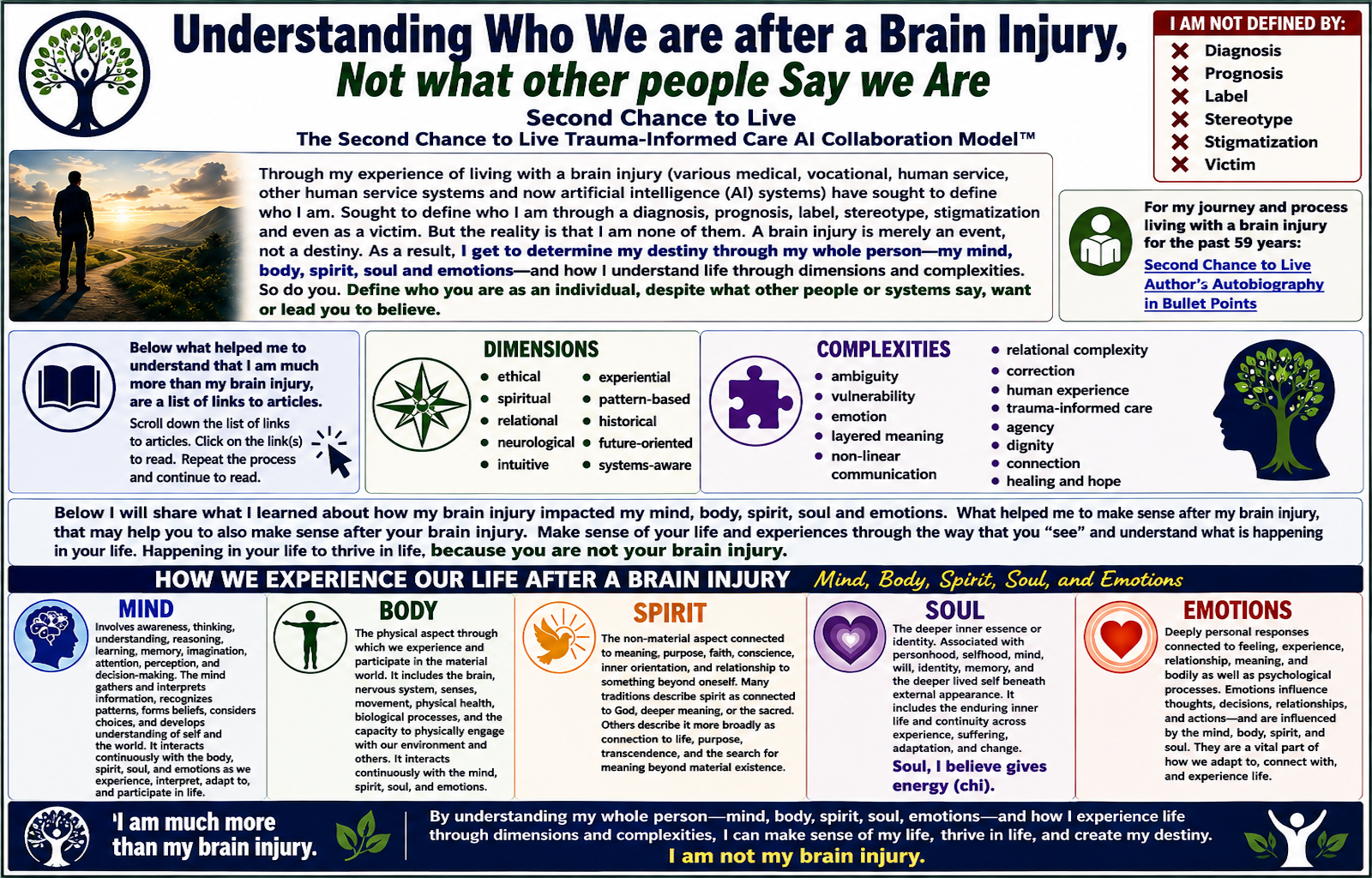
May what I share below encourage you to understand who you are after a brain injury, despite what other people or various systems may say, want or need you to believe.
Through my experience of living with a brain injury (various medical, vocational, human service, other human service systems and now artificial intelligence (AI) systems) have sought to define who I am. Sought to define who I am.
Who I am through a diagnosis, prognosis, label, stereotype, stigmatization and even as a victim. But the reality is that I am none of them. A brain injury is merely an event, not a destiny. As a result, I get to determine my destiny through my whole person. My mind, body, spirit, soul and emotions and how I understand life through dimensions and complexities. So do you.
Define who you are as an individual, despite what other people or systems say, want or lead you to believe.
For my journey and process living with a brain injury for the past 59 years:
Second Chance to Live Author’s Autobiography in Bullet Points
Below, as you scroll down, is a list of links to articles that I have written over the past 19 years. Articles that focus on whole person and ongoing brain injury recovery in one’s mind, body, spirit, soul and emotions.
Understanding Who We are Beyond a Brain Injury
Below I will share what I learned about how my brain injury impacted my mind, body, spirit, soul and emotions. What helped me to make sense after my brain injury, that may help you to also make sense after your brain injury. Make sense of your life and experiences through the way that you “see” and understand what is happening in your life. Happening in your life to thrive in life, because you are not your brain injury.
Dimensions — ethical, spiritual, relational, neurological, intuitive, experiential, pattern-based, historical, future-oriented, systems-aware.
Complexities — ambiguity, vulnerability, emotion, layered meaning, non-linear communication, relational complexity, correction, human experience, trauma-informed care, agency, dignity, connection, healing and hope
Below what helped me to understand that I am much more than my brain injury, are a list of links to articles. Scroll down the list of links to articles. Click on the link (s) to read. Repeat the process and continue to read.
How we Experience our Life after a Brain Injury
Mind, Body, Spirit, Soul, and Emotions
Mind is generally understood as the aspect of the human being involved in awareness, thinking, understanding, reasoning, learning, memory, imagination, attention, perception, and decision-making. Psychological and philosophical frameworks often describe the mind as the means through which individuals gather and interpret information, recognize patterns, form beliefs, consider choices, and develop understanding of themselves and the world around them. The mind is also connected to identity, relationships, experience, and meaning. It does not operate separately from the rest of the individual, but interacts continuously with the body, spirit, soul, and emotions as the individual experiences, interprets, adapts to, and participates in life.
Body is generally understood as the physical aspect of the human being through which the individual experiences and participates in the material world. The body includes the brain, nervous system, senses, movement, physical health, biological processes, and the capacity to physically engage with one’s environment and other people. Through the body, individuals see, hear, touch, move, communicate, experience physical sensations, and participate in activities of daily living. The body also interacts continuously with the mind, spirit, soul, and emotions. Physical experiences influence how individuals perceive and respond to life, just as thoughts, emotions, relationships, stress, trauma, meaning, and lived experiences are expressed and experienced through the body.
Spirit is often described as the non-material aspect of the human being connected to meaning, purpose, faith, conscience, inner orientation, and relationship to something beyond oneself. Many spiritual and theological frameworks describe spirit as the aspect of the individual connected to God, deeper meaning, or the sacred. Other perspectives describe spirit more broadly as connection to life, purpose, transcendence, and the search for meaning beyond material existence.
Soul is commonly described as the deeper inner essence or identity of the individual. Across psychology, philosophy, and theology, the soul is often associated with person hood, self hood, mind, will, identity, memory, and the deeper lived self beneath external appearance. Some traditions describe the soul as including mind, emotions, and will, while others describe the soul more broadly as the enduring inner life and continuity of the human being across experience, suffering, adaptation, and change. Soul, I believe gives energy (chi).
Emotions are generally understood as deeply personal responses connected to feeling, experience, relationship, meaning, and bodily as well as psychological processes. Psychology and counseling frameworks often describe emotions as involving both mind and body while helping individuals interpret. Interpret process, adapt to, and live through their experiences. Emotions are not merely reactions needing control or management. They are deeply connected to how human beings experience love, fear, hope, grief, joy, trust, loss, connection, and the meaning of life itself.
Dimensions that Help You and I to Orient ourselves after our Brain Injury
Ethical Dimension — The ethical dimension concerns how the individual is treated, respected, protected, and valued. It influences every other dimension by shaping whether trust, dignity, safety, and agency are preserved or diminished. Ethics affect spiritual meaning, relationships, neurological regulation, intuition, lived experience, pattern recognition, historical understanding, future possibilities, and the systems within which the individual participates.
Spiritual Dimension — The spiritual dimension concerns meaning, purpose, values, conscience, identity, and what gives life significance beyond circumstances. It influences the ethical, relational, emotional, historical, and future-oriented dimensions by shaping how the individual understands suffering, hope, forgiveness, resilience, and purpose throughout recovery.
Relational Dimension — The relational dimension concerns how the individual experiences connection, belonging, trust, acceptance, and participation with others. It influences emotional well-being, ethical treatment, neurological regulation, vulnerability, agency, healing, and hope because every interaction has the potential either to support or diminish the individual’s recovery.
Neurological Dimension — The neurological dimension concerns how the brain and nervous system process information, regulate emotion, interpret sensory input, support communication, attention, memory, and adaptation. Neurological realities influence every other dimension because they affect how the individual experiences, understands, communicates, and responds to life without defining the individual’s worth or identity.
Intuitive Dimension — The intuitive dimension concerns awareness, insight, perception, and knowing that emerges through lived experience before it can always be fully explained. Intuition influences ethical decisions, relationships, experiential learning, pattern recognition, and future choices by providing awareness that often precedes conscious reasoning.
Experiential Dimension — The experiential dimension concerns the individual’s accumulated lived experiences that shape understanding, learning, adaptation, and identity. Experience influences every other dimension because lived reality provides context that cannot be replaced by observation, theory, diagnosis, or generalized knowledge.
Pattern-Based Dimension — The pattern-based dimension concerns recurring observations, adaptations, behaviors, relationships, and experiences that become recognizable over time. Patterns influence understanding by providing context across the experiential, historical, neurological, relational, and systems-aware dimensions while remaining subordinate to the uniqueness of the individual’s lived experience.
Historical Dimension — The historical dimension concerns the individual’s life experiences, relationships, injuries, losses, achievements, trauma, learning, and development across time. History influences every other dimension because past experiences continue to shape present meaning, identity, relationships, neurological adaptation, spirituality, and future possibilities.
Future-Oriented Dimension — The future-oriented dimension concerns possibility, purpose, growth, adaptation, hope, and the individual’s vision of what may yet become. It influences present choices, motivation, healing, relationships, ethical participation, and resilience by orienting recovery toward continued growth rather than limitation.
Systems-Aware Dimension — The systems-aware dimension concerns the families, communities, healthcare systems, educational systems, workplaces, technologies, cultures, and institutions that influence the individual’s life. Systems influence every other dimension because they either create opportunities for participation, dignity, healing, and support or introduce barriers that complicate recovery.
Complexities that help you and I to Understand our Life experiences after Our Brain injury
Ambiguity — Ambiguity is the presence of uncertainty, incomplete understanding, or multiple possible meanings within an individual’s lived experience. It influences every dimension by requiring patience, ethical restraint, curiosity, and openness rather than premature certainty.
Vulnerability — Vulnerability is the individual’s openness to being affected physically, emotionally, spiritually, psychologically, socially, or relationally. Vulnerability influences trust, healing, relationships, ethical participation, agency, and hope because recovery requires risking engagement despite uncertainty.
Emotion — Emotion is the individual’s affective experience that reflects meaning, relationship, loss, joy, fear, grief, hope, frustration, love, and countless other responses to life. Emotion influences every dimension because it shapes perception, communication, decision-making, relationships, spirituality, neurological regulation, and healing.
Layered Meaning — Layered meaning recognizes that experiences, conversations, behaviors, and events often contain multiple interconnected meanings simultaneously. Layered meaning influences every dimension because reducing lived experience to a single explanation frequently loses important aspects of the individual’s reality.
Non-Linear Communication — Non-linear communication recognizes that individuals often communicate through associations, lived experiences, emotions, memories, relationships, and multiple interconnected ideas rather than sequential order. It influences understanding by requiring flexibility across the neurological, experiential, relational, historical, intuitive, and ethical dimensions.
Relational Complexity — Relational complexity recognizes that every relationship contains multiple interacting experiences, expectations, histories, emotions, roles, and influences. It affects every dimension because relationships shape identity, trust, healing, communication, agency, vulnerability, and hope.
Correction — Correction is the ongoing process of recognizing, refining, adjusting, and improving understanding or participation when new awareness becomes available. Correction influences every dimension because growth depends upon remaining receptive to learning rather than defending previous assumptions.
Human Experience — Human experience encompasses the totality of the individual’s lived reality across mind, body, spirit, soul, emotions, relationships, culture, history, and daily life. Human experience influences every dimension because it is the context within which all recovery occurs.
Trauma-Informed Care — Trauma-informed care recognizes that trauma influences how individuals experience safety, trust, communication, relationships, identity, regulation, and participation. It influences every dimension by emphasizing safety, collaboration, trustworthiness, empowerment, choice, dignity, and the avoidance of re-traumatization.
Agency and Dignity — Agency is the individual’s capacity to make meaningful choices and participate in directing their own life. Dignity is the inherent worth of the individual independent of ability, diagnosis, or circumstance. Together they influence every dimension because preserving agency and dignity allows recovery to remain centered on the individual rather than on external control.
Connection — Connection is the experience of meaningful participation with others, oneself, community, purpose, and for many individuals, God. Connection influences every dimension because healing occurs within relationships, belonging, understanding, and participation rather than isolation.
Healing and Hope — Healing is the ongoing process of growth, adaptation, restoration, and integration throughout life. Hope is the expectation that meaningful life remains possible despite adversity. Together they influence every dimension by sustaining purpose, resilience, engagement, learning, relationships, spirituality, ethical participation, and continued recovery.
Quotes that Encourage
“Every strike brings me closer to the next home run.” Babe Ruth
“I have not failed. I have found 10,000 ways that won’t work.” Thomas Edison
“Millions saw the apple fall, but Newton was the one who asked why.” Bernard Baruch
“Believe in yourself, go after your dreams, and don’t let anyone put you in a box.” Daya
“Research your own experience. Absorb what is useful, reject what is useless and add specifically your own creation.” Bruce Lee
“We are all here for some special reason. Stop being a prisoner of your past. Become the architect of your future.” Robin S. Sharma
“Not everyone will understand your journey. That’s okay. You’re here to live your life, not to make everyone understand” Banksy
“Cherish your visions and your dreams as they are the children of your soul, the blueprints of your ultimate achievements.” Napoleon Hill
“Never be bullied into silence. Never allow yourself to be made a victim. Accept no one’s definition of your life; define yourself.” Robert Frost
Articles written and listed within this List of Article focus on whole person recovery in mind, body, spirit, soul, emotions, dimensions and complexities. The information included in the articles are Evidence-based and Time-Stamped.

Leave a Reply