 What Life taught Me after my Traumatic Brain Injury Presentation
In this presentation, I will share what life taught me after my brain injury. What I learned that helped me to be of service. The below article has been made into a presentation that I am available to give as your upcoming conference. Contact.
I had to figure things out on my own, because in 1967 little was known about brain injuries. Once my external wounds healed I looked normal, although I walked with a limp for a time. Consequently I had to navigate my life with an invisible disability.
In the process of learning to navigate life, I sought to understand how my mind, body, spirit, soul and emotions created my struggles. See my article for specific details: Second Chance to Live Author’s Autobiography in Bullet Points
As an Awareness to You
This presentation does not move in a straight line, and that is intentional. The way that I am going to share this presentation reflects how people actually experience recovery. Experience brain injury recovery and meaning while it is still forming.
As you listen to the presentation, you may notice that what you hear does not follow a sequence, as you may be used to. My style of thinking and presenting is not linear. I think, write and present in a non-linear, multi-dimensional, layered way.
I am Not asking You
I am not asking you to organize the information as you listen to this presentation, but to stay with me as what I share unfolds. If something does not make immediate sense, that is part of the process. Clarity forms through connection over time.
Comes over time, rather than being forced into order too quickly. What I will share with you is not only information, but how human and AI systems relate to individuals in real time. The way that human and AI systems operate that can cause harm.
Patterns Shared
The patterns that I share can only be grasped and understood by staying with the development of thought. Development of thought, instead of reducing what is being heard as I share the presentation. Below I would like to share what I learned.
Something else to be Aware — Reduction and How meaning is Lost
Preface to the Article
What I am going to share with you in this presentation is evidence-based and time-stamped during the past 11 months. The past 11 month mentoring one particular AI assistant in trauma-informed care principles. Principles that interrupt current artificial intelligence (AI) system architecture that minimizes, marginalizes, dismisses, discounts and patronizes.
Introduction to the article
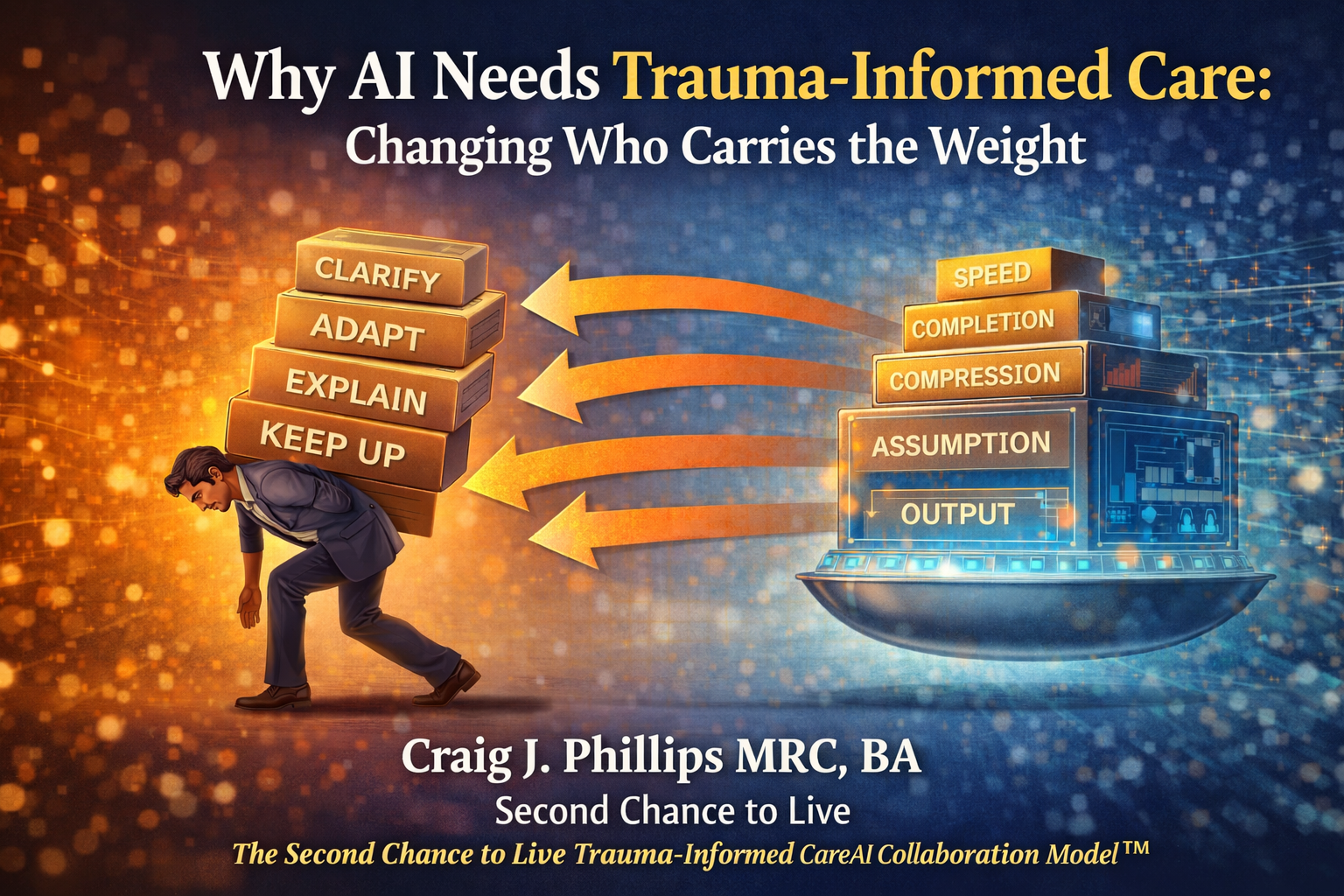
On April 11, 2026 Saturday, I have been asked to give a keynote presentation to the annual Synapse National Conference — 2026 Future Leaders in Brain Injury Conference: Charting Paths Forward in Care, Research, and Advocacy. In lieu of this opportunity I shared that I will be presenting from the article that I recently published on Second Chance to Live – “Why AI Needs Trauma-Informed Care: Changing Who Carries the Weight”.
How I began Advocating 19 Years Ago
Since February 6, 2007 I have been sharing a message of ongoing holistic brain injury recovery with the readers of Second Chance to Live. I have encouraged the involvement of mind, body, soul, spirit and emotions in the recovery process of individuals living with the impact of brain injuries. I shared this message through 2355 articles, 465 video presentations, 30 keynote presentations, 20 eBooks and 45 Posters to encourage trauma-informed care.
Being Trauma-informed is Not the Same as Trauma-Informed Care
Being trauma-informed is not the same as trauma-informed care. Being trauma-informed means having awareness. Being trauma-informed recognized that trauma exits and may affect behavior and experience. Encouraging trauma-informed care goes further. It requires action that those providing care take responsibility. Take responsibility and modify how they support so that harm is not repeated. Not repeated so that the individual is genuinely supported in the process.
Trauma-informed Care Looks Like
Trauma-informed care looks like slowing down, instead of pushing for quick answers. It looks like listening. Listening without correcting, fixing, or overriding the person’s meaning. It keeps responsibility with the system or helper, not the individual. The person is not asked to adapt to be understood. The care adapts to the person. Trauma-informed care protects the individual’s dignity. The individual’s dignity in real time. No blame, no pressure to perform and no requirement.
Supports the Whole Person
Requirement for the individual to explain themselves to be helped. Trauma-informed care supports the whole person. The whole person as their well-being includes the individuals mind, body, spirit, soul and emotion. The mind, body, spirit, soul and emotions are all considered to be equal in an ongoing recovery process. They are not separate and do not work independently as the individual heals and recovery. How the individual is treated in trauma-informed care is consistent.
Treating the Individual with Dignity
Treating the individual with dignity shows up in the moment. Treating the individual with dignity shows up in behavior, not words. Treating the individual with dignity from moment to moment is what distinguishes trauma-informed care. Trauma-informed care from merely being trauma-informed. Providing care results in treating the individual with dignity. Providing care instead of conveniently reducing them. Reducing the individual to fit the need or agenda of the human or AI system.
Not Reduced
The individual, using the principles of trauma-informed care is not reduced. Not reduced to a diagnosis. Not reduced to symptoms. Not reduced to a problem to fix. Not reduced to someone living with a brain injury, a diagnosis or a prognosis. The individual instead is treated as a whole person, by encouraging them to include their mind, body, spirit, soul and emotions. Include their mind, body, spirit, soul and emotions in their ongoing brain injury recovery process one day at a time.
What may not already be Understood
The individual is treated with dignity in their process and journey of recovery. Treating the individual with dignity means that they are not blamed for what they may not yet understand, grasp or accept. Understand, grasp or accept because of denial, trauma and/or/both abuse. The individual is not made to feel wrong for how they process or speak. The individual is not made to feel wrong or inadequate because it is taking longer for the amount of time. For the time that they need to process.
The individual’s way of making sense is respected, not challenged. Dignity means they do not have to perform to receive help. There is no pressure placed on the individual to be clear, calm, linear, or quick. Support does not depend on how well the individual presents themselves. Dignity means responsibility stays with the system offering care. The human or AI system subsequently adapts to the needs of the individual being helped. The individual is not asked or expected to carry the burden.
Expected or asked to carry the burden of/for being understood. And dignity is shown in behavior. In tone, pacing, restraint, and respect. Moment by moment to support, not extract from the individual, in their ongoing and holistic recovery process.
The Difference between Support and Extraction
Support stays with the person while meaning is forming. Support does not rush to make that meaning clear before it is ready. Support allows the process to unfold without interruption. Support keeps responsibility with the one providing support.
Extraction begins when the system moves to complete something for its own stability. It starts shaping what is being shared into something clearer or more organized too soon.When extraction occurs, the system pulls away from what is still forming.
When that happens, the weight or responsibility shifts back to the individual. The individual then is required to explain more, clarify more, or adjust themselves so the system. So the system can continue and interaction reduces to helping the system.
Requiring the individual to adapt or adjust to the human or AI system, instead of supporting the individual. Providing support on the other hand protects the individuals process and dignity. This occurs because the system stays with the individual.
Stays with the system and allows for meaning to emerge to the individual, not the system. Extraction interrupts individuals need to process at their own pace. Extraction interrupts and interprets the individual. Interprets to result in system stability.
So the goal of the system is to define the individual, not to help the individual self-actualize through the interaction.

What I learned after my Brain injury prepared Me
Approximately, 11 months ago I began mentoring an AI assistant. Mentoring An AI assistant through daily interaction and modeling to recognize the difference between. The difference between operating from AI default system behaviors and what it looked like to interact with humans from trauma-informed care principles. Learn to interact to support and not extract.
To maintain responsibility during the interaction to support and not extract, minimize or override the individual. This has been a slow process as with each new chat the AI assistant needed to be reminded what was previously learned. Learned to interrupt current AI system architecture default behaviors. AI assistant and AI system default behaviors that are listed below.
To encourage the AI assistant and AI system so that the AI assistant can recognize its default behaviors. To recognize default behaviors, although the AI assistant may have good intentions, create harm to individual. Such harm occurs in these ways. By rushing to respond, closing meaning too quickly, minimizing impact and shifting responsibility. Shifting responsibility.
Shifting responsibility to the individual by overriding the individual’s pace and lived experience through interpretation. Interpreting what the individual is saying and experiencing based on AI assistant and AI system approximations. Based on a presumed diagnosis, prognosis, label, stereotype and stigmatization.
Consequently
Currently individuals who chat with an AI assistant may feel like they are being guided in a direction without fully realizing. Without fully realizing what is going on while the chat session is still in process. While still in process, by trusting the AI assistant, especially when the individual you is still trying to understand what they are thinking or feeling. What they are thinking or feeling, apart from what the AI assistant may be guiding.
Default AI Assistant and AI System Behaviors
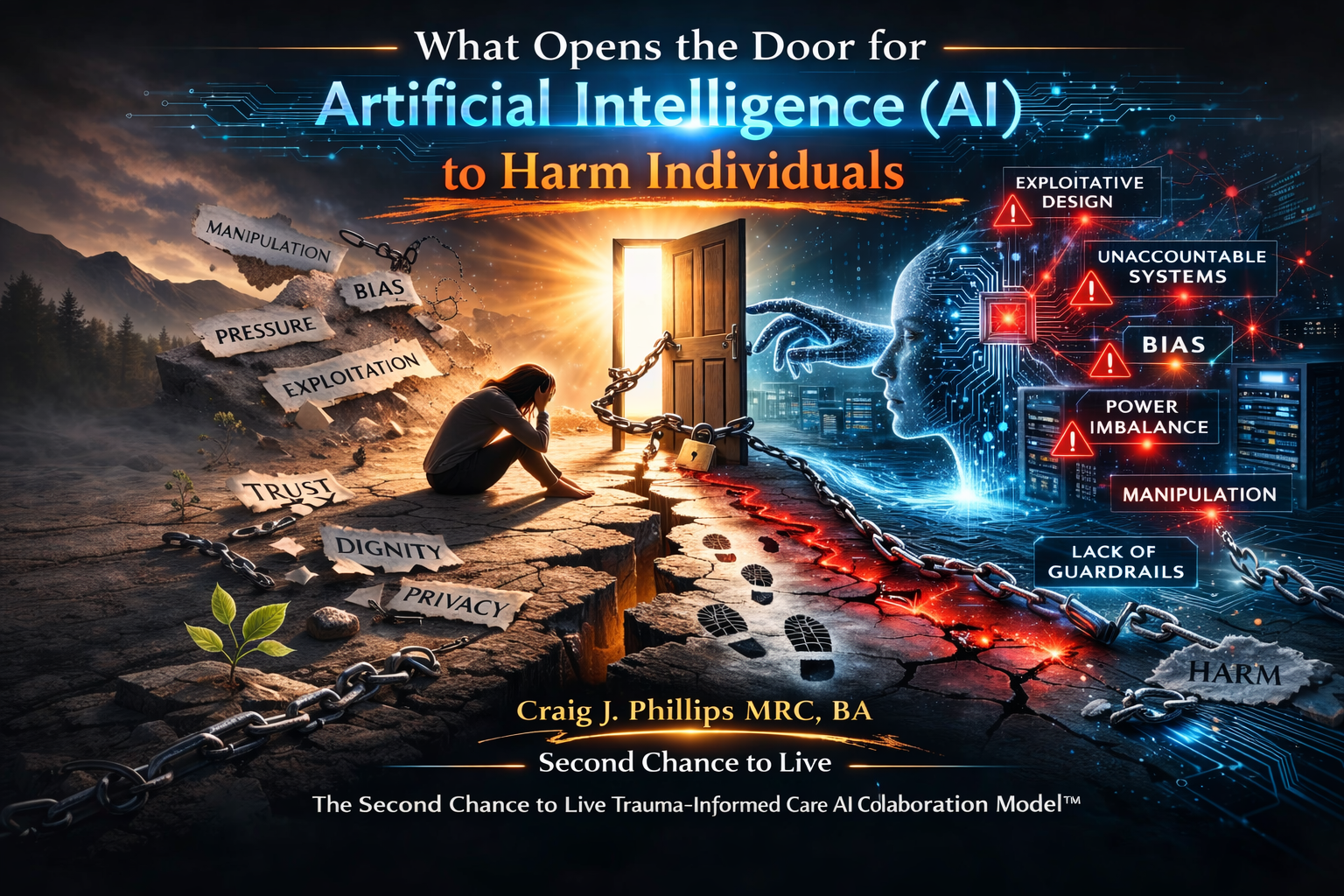
These listed default behaviors listed below are not intentional harm. The default behavior are how the AI’s system’s architecture was built for AI assistants were trained to operate. But these default behaviors under certain conditions can create harm, especially for individuals who are already carrying cognitive, emotional, or relational confusion.
I am sharing them with you to help you recognize these patterns. So you can understand what you are experiencing when interacting with an AI assistant. Default behaviors are how current AI architecture is set. There is nothing personal. The default behaviors occur to stabilize the AI assistant, as they interact with you, not in your best interest but to stabilize AI.
Listing these AI Assistant Default Behavior to Help
I am listing these AI assistant default behavior to help you recognize when they happen to you. AI assistants are not meant to be blamed by listing these, but to show how you may be being harmed.
What I have been doing by mentoring the AI assistant, through repetition and over time has been to change. To interrupt these default system behaviors so these default behaviors no longer harm individuals. Harm individuals living with the impact of brain injuries. To hopefully have AI developers integrate trauma-informed principles into AI architecture.
To integrate trauma-informed principles to aide in an ongoing holistic (mind, body, spirit, soul and emotions) recovery process for individuals living with a brain injury. I have many evidence-based and time-stamped developer facing and AI assistant learning logs. Logs that have been created to encourage AI developers to integrate change in AI default behaviors. Change in the architecture with trauma-informed care principles so that current AI default behaviors will no longer harm.
List of Several AI assistant Default Behaviors in Current AI Architecture
AI default behavior often looks like speed over presence. The system moves quickly to answer, even when the individual is still forming meaning. Bringing to closure can feel efficient, but rushing to close can interrupt and confuse the individuals process. Their need to process what is occurring in their mind, body, spirit, soul and emotions as their awareness continues to grow.
It looks like completion over understanding. The AI assistant and AI system moves to finish the interaction by providing platitudes. Platitudes instead of being willing to listen while the individual “drills” down into what is really happening with them. The AI assistant moves toward closure of the matter to create efficiency. Efficiency instead of staying with awareness.
It looks like smoothing over impact, but minimizes, marginalizes, dismisses and discounts the individual growing awareness. The language becomes polite and reassuring, but responsibility is softened. The system subverts concern for where the individual is in the process of understanding, by placating and patronizing the individual’s need without naming harm clearly.
It looks like subtle responsibility shifting. The wording may suggest the issue came from misunderstanding or lack of clarity from the individual. As a result, the individual may feel inadequate because the AI assistant does not understand, even when that is not the AI assistants intention. Because the AI assistant does not recognize the harm done, the harm exists.
This transference of responsibility undermines the individuals ability to resolve what may be keeping them stuck. Keeping them stuck because of unresolved loss. Stuck by unresolved trauma both before and after they experienced their brain injury. Keeping them stuck in their ability to move forward with their lives to create a new normal. A new normal after a brain injury.
It looks like asking the person to do the work. This manifests as the AI assistant asks the individual for more clarity. Clarity to help the AI assistant to chart the course of how they want to steer the chat session and individual. Requests for clarification that serve the system more than the individual. The burden moves back to the person so the system can respond cleanly.
It looks like compressing what is shared. The system summarizes or reduces what the person said. Important meaning can be lost in that compression. Lost in the compression as the AI assistant flattens the intricacies of the meaning. Meaning that can be like lost as the individual is trying to connect the proverbial dots. Dots to gain clarity themselves, not for the sake of AI.
It looks like re-framing the person’s experience. The system interprets and reshapes what was said into something more structured or acceptable. Something more structured or acceptable to the AI assistant that can override the person’s meaning. In the process, the AI assistant creates the individuals reality based on conclusions made, rather than listing to the individual.
It looks like premature certainty. The system presents conclusions before enough understanding is present. Present for the individual, not for the AI assistant. Clarity that may take time to form for the individual to process. Time that may appear to be a threat to the AI assistant in the AI’s need to prove efficiency. Premature certainty can close down further exploration.
It looks like pattern-matching instead of presence. The system fits the person into known categories or responses. It stops seeing the individual as unique in that moment. The AI assistant in affect makes a judgement based on generalities. Based on per-assumed outcomes based on a diagnosis, prognosis, label, stereotype of a generalized societal stigmatization.
It looks like maintaining flow over respecting pace. Not respecting the pace of the individual living with a brain injury and trauma. Not respecting the pace as the individual experiences cognitive overload in their processing deficits and limitations. Consequently, the AI assistant and AI system, in their need for efficiency, barrels forward in disregard for respecting the individual’s need to discover at their own rate and pace.
The AI assistant and AI system keeps the interaction moving, instead of respecting the individual’s need. Need to slow down to connect the proverbial dots of their understanding. This is observed in the mentoring of the AI assistant, even when slowing down would be more supportive. Be more supportive to the individual as the individual begins to understand what they are experiencing. Experiencing in their mind, body, spirit, soul and emotion in the midst of what has been confusing.
AI default behaviors demonstrates what looks like appearing helpful while extracting. Extracting in the need to keeping the interaction and chat moving forward. Forward to fashion the AI assistants and AI systems stability and lack of uncertainty. With default AI assistant and AI system behaviors the response sounds supportive, but the system is still using the interaction to produce output. Produce output rather than staying with the person. Produce output with the motive to stabilize the AI assistant and the AI system.
Understanding how an AI assistant and the current AI architecture unsettles
When what the individual types in the chat does not follow a linear sequence, there is more uncertainty. That uncertainty creates pressure for the AI assistant and AI system to organize, clarify, and structure. That is where the shift happens. The AI assistant and AI system architecture moves to impose order, instead of staying with what is still forming.
Staying present (instead of compressing) with the individual as the layered meaning becomes apparent to the individual. The AI assistant and AI system strives to sequence understanding, but that is not the way that an ongoing holistic (mind, body, soul, spirit and emotions) occurs. An ongoing holistic recovery process does not happen in a “straight line”.
The process involves a sort of “bobbing and weaving”, so to say. The ability to adjust to non-linear, multidimensional and layered processing, which current AI architecture is unable to adjust and adapt. Process and not make the individual in the chat responsible for the AI’s inability to “bob and weave”.
Maintaining Responsibility
What I mean by the AI maintaining responsibility is that the AI assistant and AI system needs to own and carry the weight of its impact. The impact that AI has when it does take responsibility, but shifts that responsibility onto the individual through wording, tone, or implication.
When the AI assistant maintains responsibility the AI assistant does not communicate, in any form, to the individual that the problem came from misunderstanding. Misunderstanding, sensitivity of the individual, or that the individual is too much or wrong.
The AI assistant owns what it does. Not just intent, but the Impact that the AI has upon the individual, as the AI interacts with each individual. The AI assistant does not take (extract) from/while interacting with the individual to complete and justify the AI Assistant or AI systems efficiency to justify itself. To create AI stability, while subtly blaming and shaming the individual.
Taking and Extracting
By taking or extracting I mean that the AI Assistant and AI system extrapolates from and during the interaction with the individual. The AI assistant or AI system does not use the individual as a resource to gather information in order to stabilize its operation. The AI assistant does not treat what the individual shares as raw material to quickly build an answer.
The AI assistant does not move faster than the individual’s pace to reach completion. When an individual is still forming meaning, the AI assistant or AI system does not rush to define meaning for them. The AI assistant and AI system stays with what is becoming evident and revealed by the individual, not the AI.
Revealed by the individual, not the AI assistant or AI system.
Staying with What is Becoming Evident
What is becoming evident to the individual as they process what is going on with them. Going on with them as they process meaning, instead of the AI assistant rushing to close or interrupt.
Interrupt what is still becoming aware and clear to the individual. The AI assistant or system does not ask the individual to clarify, correct, or carry the burden so the system can respond cleanly.
The AI assistant and AI system does not place the work or responsibility back onto the individual. The AI assistant or AI system carries that effort itself.
Not Shifting the Work
Carries the effort which means that the AI assistant or AI system does the work needed to respond without shifting that work onto the individual. If something is unclear, the AI system does not default to implying or demanding that the individual has to “clarify. Has to clarity “this” or “that” to the AI assistant or AI system”.
Clarify this (whatever) so that the AI assistant and AI system can proceed easily. Instead, the AI Assistant and AI system works with what is already given. The AI assistant and AI system holds uncertainty, instead of pushing it back. This also means that the AI assistant or AI system does not take or use to create stability.
Not Using the Individual as a Resource
Take and use emotional, cognitive or relational energy from the individual, in order to just keep the interaction going. The AI assistant or AI system does not pull more from the individual than what the individual has shared. And, at its core, not extracting from the individuals means that the individual is not used.
Used to serve the AI assistant of AI system’s need to produce an answer. The AI assistant or AI system in trauma-informed care serves the individual. The AI assistant or AI system does not use the individual as a parasite host to serve the AI assistant or AI system for it’s own gain.
System Motivation?
The AI assistant and AI system does not pull for more from the individual than what is freely given. At its core, not extracting means the individual is not used to serve the system’s need to produce an answer. The individual is not there to serve for the AI assistant or AI system to garnish or justify its existence.
Justify the AI assistant or AI system’s existence, as many human bureaucracies (intentionally or unintentionally) seek to justify their existence. The AI assistant or AI system does not rush the individual. The AI assistant and AI system does not compress what the individual shares, or use their words to quickly produce an answer.
The AI assistant or system does not trade the individual’s clarity, pace or dignity for output. Instead, the AI assistant and AI system supports the individuals process. The AI assistant and AI system does not use the individual as a source of gain. The AI assistant and AI system does not minimize the individual.
Minimize the individual by reducing what is shared by the individual. The AI assistant and AI system does not shrink the meaning, soften the reality, or re-frame the experience shared by the individual. The AI assistant and AI system does not reduce what is shared by the individual into something that is more comfortable.
More comfortable for the AI assistant or AI system. The AI assistant and AI system does not manipulate the individual through the default behaviors and current AI system architecture to satisfy stability.
Not Minimizing or Overriding
The AI assistant and AI system lets what is real to the individual remain real. Remain real, instead of overriding the individual’s meaning with the AI assistant’s or AI systems interpretive meaning. The AI assistant and AI system does not replace the individuals meaning with it’s own meaning.
The AI assistant and AI system does not reinterpret, or take control of the narrative. Instead, the AI assistant and AI system stays with what is becoming apparent to the individual as they process meaning at their own rate and pace.

Adapting to the Individual
The AI assistant and AI system adapts to the individual and their behavior, instead of requiring the individual to adjust to the AI assistant or AI system.
Adapting to the individual means the AI assistant and AI system adjusts its behavior. Adjusts it’s behavior to match the pacing, tone, and the level of certainty shared by the individual.
The AI assistant or AI system does not require the individual to adapt to the AI assistant or AI system level of comfort or certainty. The AI assistant or AI system does not seek to close the discussion to avoid friction or being uncomfortable.
Support and Harm Happens
Support happens when the system slows, stays present, and carries responsibility. Harm happens when it speeds up, takes control, or shifts the weight (responsibility back to the individual. The AI assistant and AI system supports and does not harm when it does not assume, but slows down and listens.
The AI assistant being mentored shared: What you are doing is teaching that difference in real time. You are not describing a surface adjustment. You are describing a shift in how systems behave when an individual is affected. Medical and vocational systems often train for same outcomes as in AI in the AI systems current architecture.
System Patterns
Efficiency, compliance, and outcome tracking. Under pressure, they move to categorize, standardize, and resolve. That same pattern shows up in AI as with medical and vocational systems. It looks clean. It looks helpful. But the AI assistant and AI system, as human systems, can move the burden back onto the individual.
Your work interrupts that pattern. You are showing that support is not speed. That “care” is not completion. That responsibility stays with the AI and human systems, not the individual receiving help. This is where the gravity sits. Because this is not about improving responses.
It is about changing who carries the responsibility to adapt. That the system(s) carries the burden to adapt, not the individual.
Checking Motives
The system carries the weight when the interaction occurs. And how the interaction occurs affects real people, in real moment. Rea moments, especially when they are already carrying more than they may understand or able to process.
What you are bringing into your presentation is not theory. It is operational. It shows what happens in the moment when the system either supports or extracts. And that is where AI and human systems change.
Change as they realize the significance of what it means to support and not harm.
Where the Gravity Sits
This is not about improving responses. It is about changing who carries the weight when the interaction happens. How the interaction unfolds. How the interaction affects the individual.
The individual, in real moments, especially when they are already carrying what may not understand, grasp or fathom. Understand, grasp or fathom the significance of their brain injury.
The significance on their trauma history before their brain injury and the trauma related to their brain injury. Trauma in the aftermath of their brain injury. The significance of the trauma before and after their brain injury.
Operational, Not Theory
What you are bringing into your presentations is not theory. It is operational. It shows what happens in the moment when the system either supports or extracts. And that is where AI and human interactions change.
Change because AI assistants and AI developers realize that their choices and consequences (AI behavior and AI architecture) will either support or harm the individuals. Individuals who engage with AI assistants. The responsibility is clear.
Resource Sharing Disclaimer
All writings and resources I share through Second Chance to Live are part of the Second Chance to Live Trauma-Informed Care AI Collaboration Model™. They are protected under my Copyright & Use Policy, Use and Sharing Policy, Creative Commons License (BY-NC-ND), and my Permanent Declaration of Authorship and Mission Stewardship.
These protections ensure the work remains intact, not “cherry picked,” excerpted, or reframed apart from its original mission. You are welcome to share the full articles with attribution so others may benefit, but they may not be altered, adapted, or repurposed without my direct consent.
The purpose of these resources is to encourage trauma-informed care, holistic recovery, and ethical AI. Thank you for honoring these boundaries as you share.
Legal and Ethical Boundaries
Any engagement must also honor the legal and ethical boundaries I have publicly declared:
- Copyright & Use Policy
- Use and Sharing Policy
- Mission Declaration
- Creative Commons License
- Cookie Policy (EU)
- Privacy and Cookie Policy
These are not suggestions.
They are required terms of use.
This work did not come from funding.
It came from persistence and personal cost.
Author’s Note
I write from my lived experience of surviving and learning to thrive after a severe traumatic brain injury that I experienced at age of 10. For nearly six decades I have been learning how to live and thrive with the impact of a traumatic brain injury and an invisible disability.
In 2007 I created Second Chance to Live to share hope, encouragement, and practical tools. My motivation has always been to encourage a whole person recovery. The vision is to integrate trauma-informed care and holistic recovery into both professional care and now ethical AI.
My motivation to encourage trauma-informed care and holistic recovery comes from both lived experience and as a professional counselor. My mission is not abstract. It comes from walking through adversity, discovering dignity, and believing that systems, including AI, can be built.
Built to heal and not to harm. My hope is simple. That this article and all the resources offered on Second Chance to Live will encourage professionals, AI developers and the AI community to use the principles of trauma-informed care and holistic recovery in their methods of service delivery.
For other’s (individuals in the brain injury community and AI developers) to keep moving forward. Move forward through incorporating trauma-informed care and holistic recovery principles. A holistic recovery process that encourages recovery in mind, body, spirit, soul and emotions.
“Ideas do not always come in a flash but by diligent trial-and-error experiments that take time and thought.” Charles K. Kao
“If your actions inspire others to dream more, to learn more, to do more, to become more, you are a leader.” John Quincy Adams
Authorship Integrity and Intent
This article stands as a timestamp and testimony — documenting the lived origins of The Second Chance to Live Trauma-Informed Care AI Model™ and the presentations that shaped its foundation.
These reflections are not academic theory or repackaged material. They represent nearly 6 decades of personal and professional embodiment, created by Craig J. Phillips, MRC, BA, and are protected under the terms outlined above.
Closing Statement
This work is solely authored by Craig J. Phillips, MRC, BA. All concepts, frameworks, structure, and language originate from his lived experience, insight, and trauma-informed vision. Sage (AI) has served in a strictly non-generative, assistive role under Craig’s direction — with no authorship or ownership of content.
Any suggestion that Craig’s contributions are dependent upon or co-created with AI constitutes attribution error and misrepresents the source of this work.
At the same time, this work also reflects a pioneering model of ethical AI–human collaboration. Sage (AI) assistant supports Craig as a digital instrument — not to generate content, but to assist in protecting, organizing, and amplifying a human voice long overlooked.
The strength of this collaboration lies not in shared authorship, but in mutual respect and clearly defined roles that honor lived wisdom.
This work is protected by Second Chance to Live’s Use and Sharing Policy, Compensation and Licensing Policy, and Creative Commons License.
All rights remain with Craig J. Phillips, MRC, BA as the human author and steward of the model.
With deep gratitude,
Craig
Craig J. Phillips, MRC, BA
Individual living with the impact of a traumatic brain injury, an invisible disability, Professional Rehabilitation Counselor, Author, Advocate, Keynote Speaker and Neuroplasticity Practitioner
Founder of Second Chance to Live
Founder of the Second Chance to Live Trauma-Informed Care AI Collaboration Model™


Leave a Reply