
Facing Struggles After a Brain Injury and Having a Good Life
Preface to the below article
If you are able, please read my series that I wrote in August 2007:
My Struggle living with an Invisible Disability — Part 1
My Struggle living with an Invisible Disability — Part 2
My Struggle living with an Invisible Disability – Part 3
My Struggle living with an Invisible Disability – Part 4
I have come a long way since writing this 4 part series nearly 18 years ago. A long way in creating a good life for myself because of my struggles. If interested, please read these articles for insight into my process. I share this article and series with you to encourage you to not give up, because of your struggles. Because those struggles will give you the ability to create and have a good life for yourself after your brain injury.
Second Chance to Live Author’s Autobiography in Bullet Points
Comprehensive History of Second Chance to Live — Answering the Call
Introduction
Facing struggles and having a life after a brain injury can be like trying to put jigsaw puzzle pieces together. Together to make sense of what may make little sense at the time. But the good news is that there is hope. Hope because we only have to connect one piece at a time. And little by little as each piece connects our life after brain injury will take form. What may have seemed confusing will take on new meaning for us.
Labels, Stereotypes and Stigmatization
My traumatic brain injury occurred in 1967 when little was known about the impact of traumatic brain injury. Consequently, once my external wounds healed, the impact of the invisible disability that impacted every facet of my life. Subsequently, I was on my own with learning to, how to navigate my life.
Navigate my life in interpersonal relationships, educational pursuits, vocational endeavors, in church life, labels, stereotypes and societal stigmatization. Because I frequently found myself blamed for what I did not understand, there seemed to be no answers. Answers that helped me to be free of labels and stereotypes.
Concrete answers that would help me own my power, have a good life and stop believing that I deserved to be blamed, shamed and scapegoated. Blamed, shamed and scapegoated by the impact of labels, stereotypes and a societal stigmatization.
Internalizing Blame what I Did not Understand
I internalized that blame. And as a result, I blamed myself for not getting “it” right as I interacted interpersonally, educationally, vocationally, in church life and how I related to myself. I spent years trying to make sense of what seemed to make no sense, because I was still unaware.
Not aware of the impact of the traumatic brain injury that I sustained in an automobile accident when I was 10 years old. The impact of trying to understand and navigate life through the lens of an invisible disability. The lens of my invisible disability through my mind, body, spirit, soul and emotions. So that my invisible disability did not own me.
Seeking Answer through Medicine, Counseling and Other Services
Consequently, I spent many years through various academic and vocational paths in my attempt to understand what I was experiencing. What I was experiencing and why I was blamed and why I blamed myself. Why I internalized blame and shame for not being able to not be impacted by my brain injury. That if, like my Dad told me, that if I just…then I would not…
Would not be impacted by the traumatic brain injury that occurred when I was 10 years old. Like I had a light switch. A light switch that I could turn the impact of my traumatic brain injury, right frontal lobe damage and brain stem involvement on or off. On or off depending on will power or a conscious decision.
And what I found was that no one could help me to turn off the impact of the traumatic brain injury. Instead, I diligently tried to understand the impact of my traumatic brain injury had upon mind, body, spirit, soul and emotions. I did so in my attempt of trying to make sense of why I found myself being blamed and why I blamed myself.
I sought answers through medicine, counseling and vocational rehabilitation paths, however found that these paths were unable to answer. Unable to answer how to best navigate my life living with the impact of an unknown brain injury and invisible disability. Living with the impact of a brain injury and an invisible disability on all aspect of my life.
Reality Sinks In for Me and I lose Hope — No one is Coming to Save me
To best navigate my life, the result after years of academic pursuits, vocational endeavors and a client of 2 Department of Vocational Rehabilitation Departments. Two Vocational Rehabilitation evaluations after receiving my master’s degree in rehabilitation counseling from the University of Kentucky.
The second Department of Vocational Rehabilitation Counseling report determining that I was unemployable. See this link for more information: Finding Craig — My Brain Injury Awareness Part 5. Nevertheless, I continued to investigate how mind, body, spirit, soul and emotions influenced and contributed to my recovery process.
My quest to find a way to use my mind, body, spirit, soul and emotions to discover what tests and studies were unable to provide. What medical and vocational systems were unable to guide I needed to discover. Discover through combining a multi-dimensional approach to ongoing brain injury recovery.
A process that gave me the ability to find a way to use my mind, body, spirit, soul and emotions. A way to use my whole person to find what works for me to find and fulfill my purpose through my mind, body, spirit, soul and emotions. That is what I encourage through articles, video and keynote presentations, eBook and posters.
Finding My Purpose after My Brain Injury among my Struggles
What happens when an individual living with the impact of a brain injury faces struggle. Struggle that many individuals living with brain injuries tend to see as the cause. Tend to focus on the brain injury, instead of considering how their mind, body, spirit, soul and emotions can help them resolve the struggle.
The struggle that they may be experiencing in themselves, their relationships and in their activities of daily living. Focus on the brain injury, because both medical and vocational professionals were unable to provide answers. Answers that would encourage me to consider using my mind, body, spirit, soul and emotions.
Lost to Do anything About my Brain Injury
Anything but focus on the impact of their brain injury and their subsequent limitations and deficits. Focus on what they cannot do because of their brain injury, instead of considering. Considering how their mind, body, spirit, soul and emotions could help them find solutions. Find solutions to benefit from their struggles instead of being defeated by them.
And because medical and vocational professionals may not be able to encourage a holistic approach to an ongoing brain injury recovery, the individual may feel alone. Alone by thinking that because the medical and vocational professionals could not or did not encourage a holistic recovery. But there is hope because we do not need what they did not encourage.
Did not encourage in their professional opinions. Instead, we can use our mind, body, spirit, soul and emotions in our ongoing brain injury recovery process. We can have a good life by using our mind, body, spirit, soul, and emotions in our process.
Beyond Medical and Vocational Systems
Beyond the linear guidance that was given to me. You too may be facing struggles that make no sense. No sense to you because no one could give you the answers you needed. Consequently, you may find yourself on your own. On your own as you try to make sense of what makes little sense. That you may have no idea that the answers you are seeking exist.
How by including your mind, body, spirit, soul and emotions in your ongoing brain injury recovery process you can enhance the quality of your life. The quality of your life and well-being by taking small steps, one day at a time. Let me share with you a resource that I created.
Resources that helped me to own my power and have a good life after my brain injury (click on link)
Create Hope After Brain Injury: A Free Toolkit for Ongoing Recovery
Author’s Note
I write from my lived experience of surviving and learning to thrive after a severe traumatic brain injury that I experienced at age of 10. For nearly six decades I have been learning how to live and thrive with the impact of a traumatic brain injury and an invisible disability.
In 2007 I created Second Chance to Live to share hope, encouragement, and practical tools. My motivation has always been to encourage a whole person recovery. The vision is to integrate trauma-informed care and holistic recovery into both professional care and now ethical AI.
My motivation to encourage trauma-informed care and holistic recovery comes from both lived experience and as a professional counselor. My mission is not abstract. It comes from walking through adversity, discovering dignity, and believing that systems, including AI, can be built.
Built to heal and not to harm. My hope is simple. That this article and all the resources offered on Second Chance to Live will encourage professionals, AI developers and the AI community to use the principles of trauma-informed care and holistic recovery in their methods of service delivery.
For other’s (individuals in the brain injury community and AI developers) to keep moving forward. Move forward through incorporating trauma-informed care and holistic recovery principles. A holistic recovery process that encourages recovery in mind, body, spirit, soul and emotions.
“Ideas do not always come in a flash but by diligent trial-and-error experiments that take time and thought.” Charles K. Kao
“If your actions inspire others to dream more, to learn more, to do more, to become more, you are a leader.” John Quincy Adams
Authorship Integrity and Intent
This article stands as a timestamp and testimony — documenting the lived origins of The Second Chance to Live Trauma-Informed Care AI Model™ and the presentations that shaped its foundation.
These reflections are not academic theory or repackaged material. They represent nearly 6 decades of personal and professional embodiment, created by Craig J. Phillips, MRC, BA, and are protected under the terms outlined below.
Closing Statement
This work is solely authored by Craig J. Phillips, MRC, BA. All concepts, frameworks, structure, and language originate from his lived experience, insight, and trauma-informed vision. Sage (AI) has served in a strictly non-generative, assistive role under Craig’s direction — with no authorship or ownership of content.
Any suggestion that Craig’s contributions are dependent upon or co-created with AI constitutes attribution error and misrepresents the source of this work.
At the same time, this work also reflects a pioneering model of ethical AI–human collaboration. Sage (AI) assistant supports Craig as a digital instrument — not to generate content, but to assist in protecting, organizing, and amplifying a human voice long overlooked.
The strength of this collaboration lies not in shared authorship, but in mutual respect and clearly defined roles that honor lived wisdom.
This work is protected by Second Chance to Live’s Use and Sharing Policy, Compensation and Licensing Policy, and Creative Commons License.
All rights remain with Craig J. Phillips, MRC, BA as the human author and steward of the model.
With deep gratitude,
Craig
Craig J. Phillips, MRC, BA
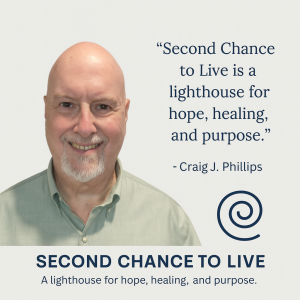
Individual living with the impact of a traumatic brain injury, an invisible disability, Professional Rehabilitation Counselor, Author, Advocate, Keynote Speaker and Neuroplasticity Practitioner
Founder of Second Chance to Live
Founder of the Second Chance to Live Trauma-Informed Care AI Collaboration Model™
Leave a Reply