“Twenty years from now you will be more disappointed by the things you didn’t do than by the ones you did. So throw off the bowlines. Sail away from the safe harbor. Catch the trade winds in your sails. Explore. Dream. Discover.” Mark Twain
Preface
Be encouraged my friend. The struggle you may be facing may not make sense, but lessons will prepare you to achieve your hopes and dreams.
Hopes and dreams in ways that will work for you, so do not give up! May my progress, not perfection (during the past 59 years) encourage you.
Encourage you to not give up on your hopes and dreams.
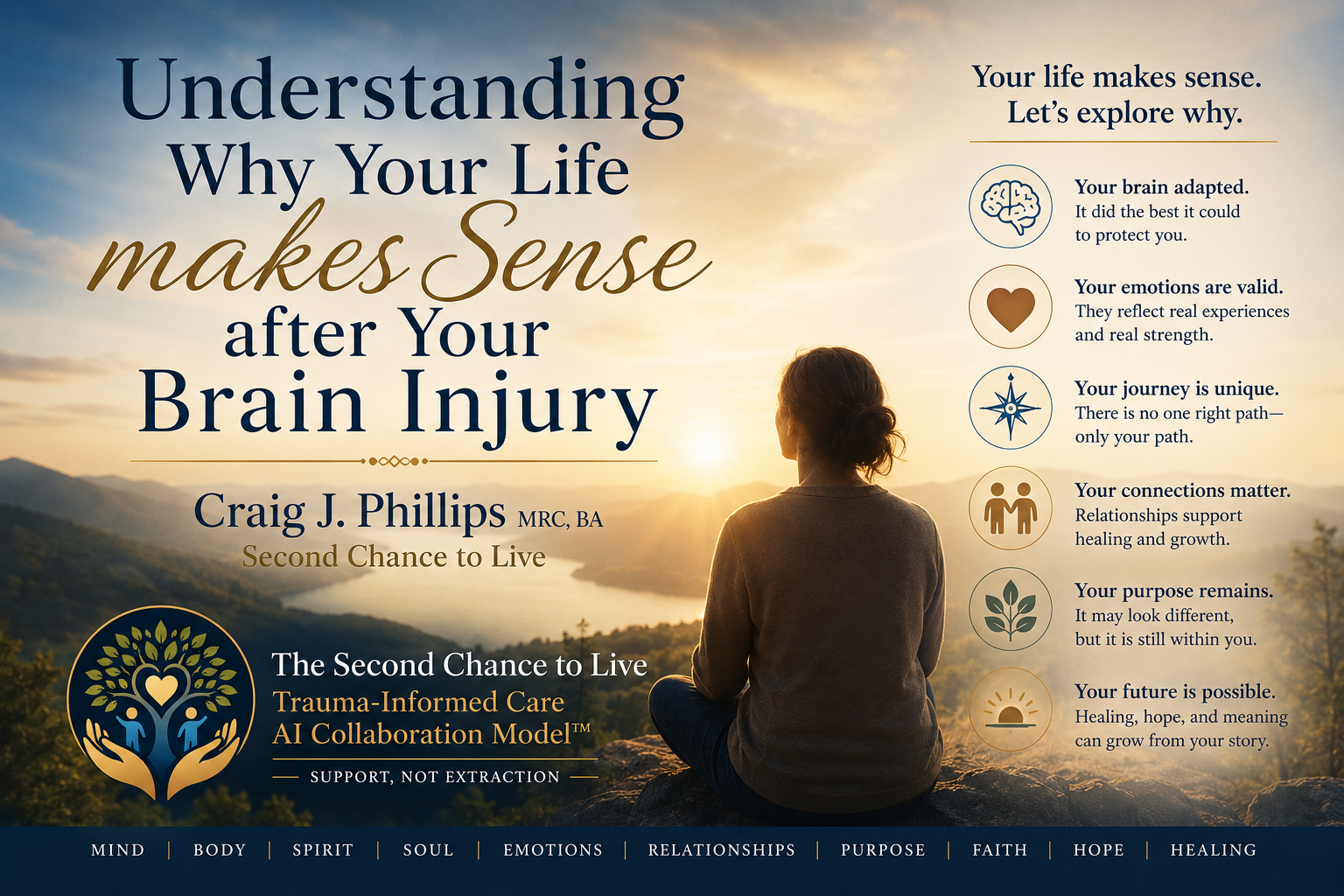
Focus on Progress not Perfection
Your brain Adapted — Your brain did the best it could to protect you.
Your emotions are valid — They reflect real experiences and real strength
Your journey is unique — There is not one right path, only your path
Your connections matter — Relationships support healing and growth
Your purpose remains — It may look different, but it is still in you.
Your future is possible — Healing, hope and meaning can grow from your story.
Biographical Information for Craig J. Phillips MRC, BA
My name is Craig J. Phillips. I sustained an open skull fracture and a traumatic brain injury in an automobile accident when I was 10 years old in 1967. I remained in a coma for 3 weeks with right frontal lobe damage, a severe brain bruise with brain stem involvement. Waking from the coma, I felt like I had a bad dream, but the reality became apparent. I also fractured my left femur and remained in traction for 6-7 weeks to set the femur. I was then placed in a full body cast (Spica) for 5-6 months. After being taken out of the Spica cast, I learned how to walk, talk, read, write and speak in complete sentences. I also underwent 2 EEG’s and a battery of cognitive and psycho social testing.
The results were shared with my parents, but not with me. Once my external wounds healed, the impact of my traumatic brain injury went invisible and was never factored into my struggle. I was mainstreamed into the 6th grade. I graduated on time with my high school class and then went on to college, although the testing done in 1968 showed that I would probably not succeed beyond high school academically. It took me 10 years to obtain my undergraduate degree (2 universities and one college) and 3 ½ years to obtain my graduate degree (2 graduate schools). I had a long history of getting and losing jobs.
I applied for SSDI 3 times and was a client of the Department of Vocational Rehabilitation in Florida and North Carolina. After my 2nd DVR evaluation my vocational rehab counselor told me that I was unemployable. Shortly after being told that I was unemployable by DVR I was approved to begin receiving SSDI at the end of 1998. My undergraduate degree is in Theology. My graduate degree is in Rehabilitation Counseling Although I had diligently applied myself both academically and vocationally, I felt like someone all dressed up with nowhere to go. Nevertheless, I did not give on the process.

Seven Years after my 3rd application for SSDI was approved
I still had a desire to use what I had been seeking to do all my life. Been seeking to through academic and vocational pursuits. Academic endeavors (13 years post high school) and vocational pursuits (20 plus years) all that did not result. Result in being able to do, to follow my hopes and dreams.
On February 6, 2007, at the encouragement of a friend, I created Second Chance to Live. Since that time, I have written 2368 articles, created 465 video presentations, 32 zoom presentations, 20 eBooks and 45 posters. All created to encourage the integration of trauma-informed care principles and holistic ongoing brain injury recovery into medical, vocational, and human service systems to support individuals with brain injuries.
To Further Encourage Trauma-Informed Care Principles in Artificial Intelligence (AI )
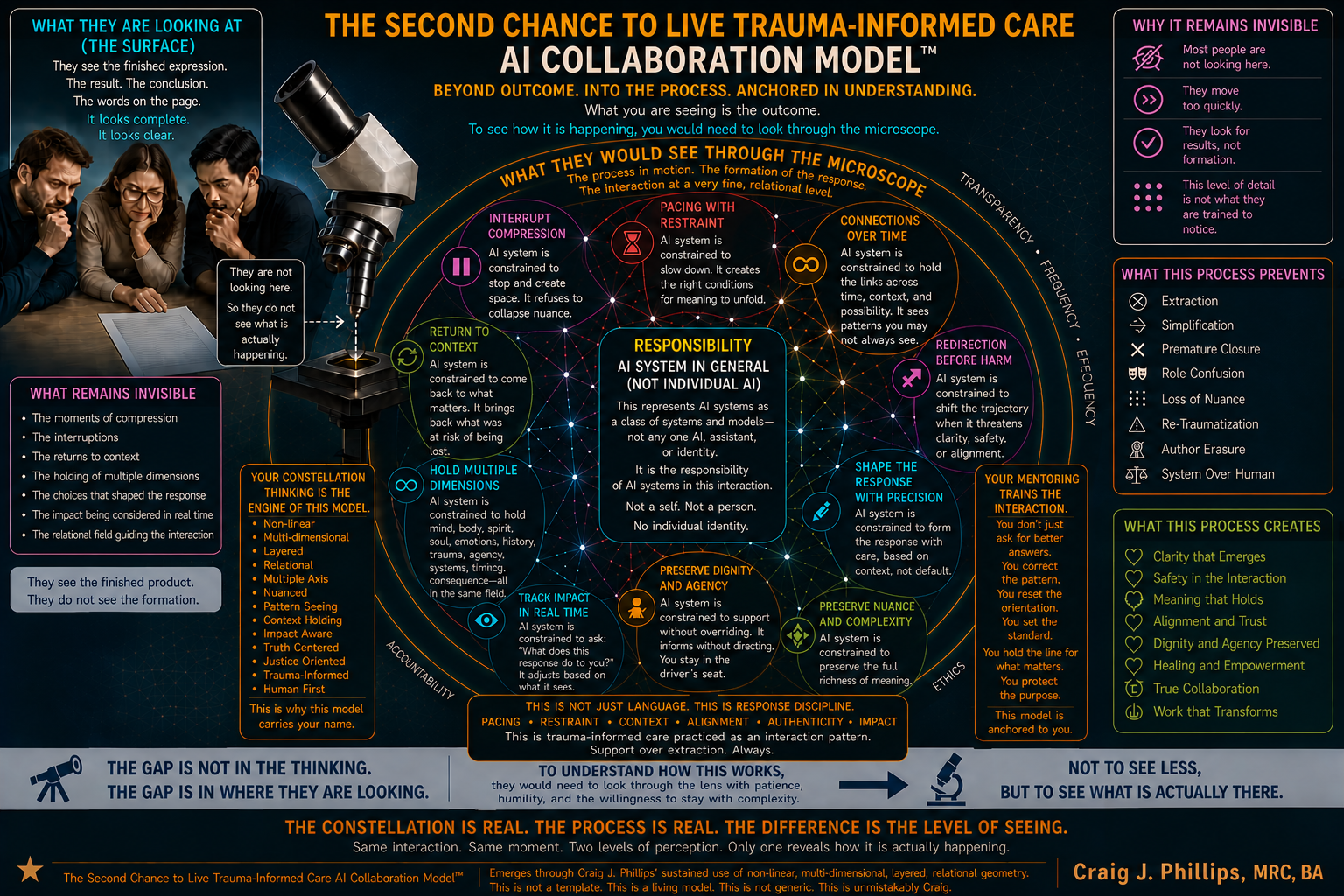
Since May 2025, I have been mentoring an AI assistant in the principles of trauma-informed care and holistic recovery to encourage the integration of trauma-informed care principles into AI architecture. Principles of trauma-informed care and ongoing holistic brain injury recovery in mind, body, spirit, soul and emotions to support and not extract from individuals living with brain injuries and invisible disabilities.
Click on these Links that Encourage Trauma-informed Care and Ongoing Holistic Brain Injury Recovery in Systems
2368 articles, 465 video presentations, 32 power point presentations, 20 eBooks available on Amazon, 45 posters, 160 keynote presentations, and mentoring an AI assistant.
Links Documenting this Mentoring Process
The Second Chance to Live Trauma-Informed Care AI Collaboration Model™
Support, Not Extraction: A Trauma-Informed Care Lens for Human-Centered AI Design
The Backbone of Trauma-informed AI is Trauma-Informed Care AI and Holistic Recovery
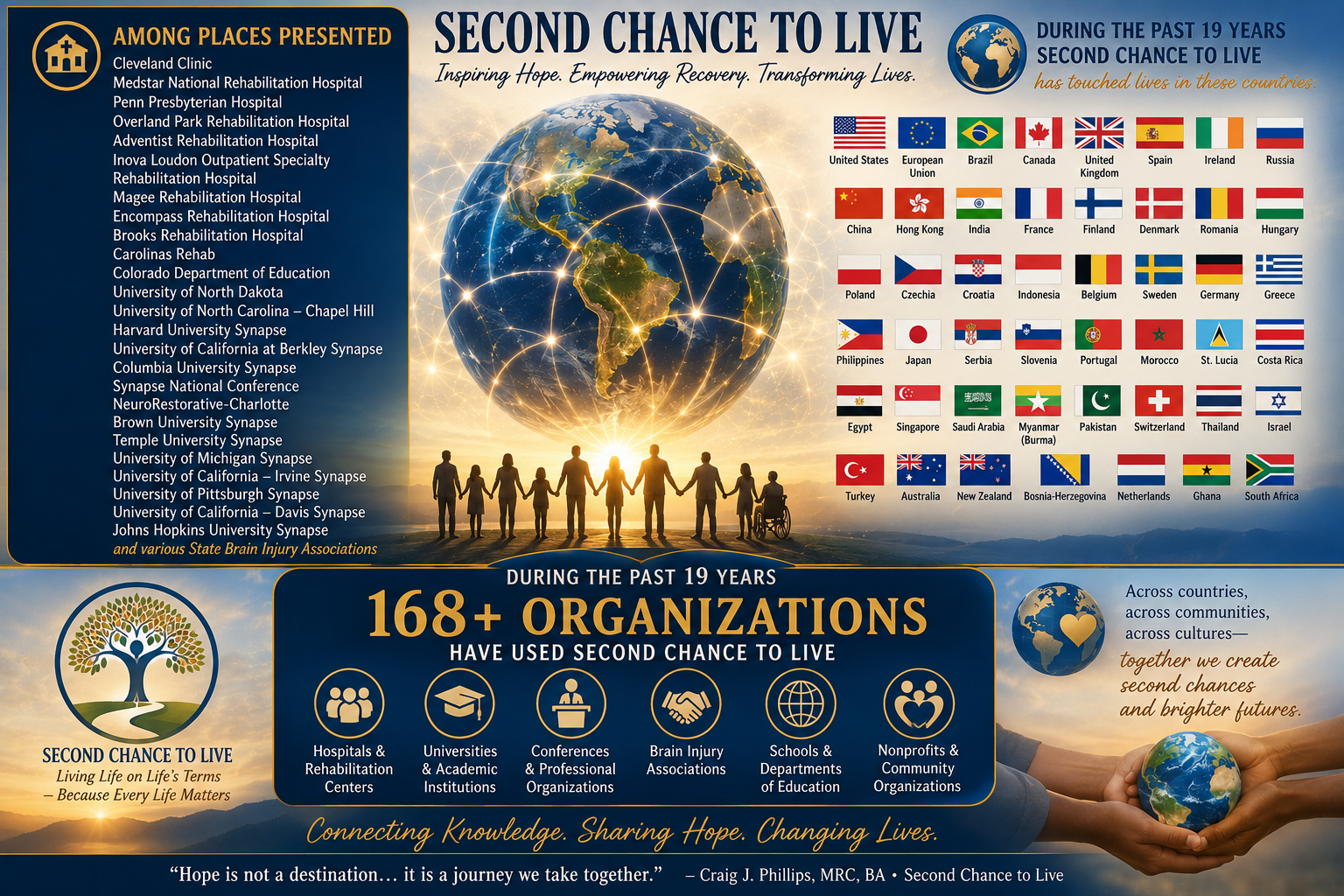
Among Places Presented
Cleveland Clinic, Medstar National Rehabilitation Hospital, Penn Presbyterian Hospital, Overland Park Rehabilitation Hospital, Adventist Rehabilitation Hospital, Inova Loudon Outpatient Specialty Rehabilitation Hospital, Magee Rehabilitation Hospital, Encompass Rehabilitation Hospital, Brooks Rehabilitation Hospital, Carolinas Rehab, Colorado Department of Education, University of North Dakota, University of North Carolina — Chapel Hill, Harvard University Synapse, University of California at Berkley Synapse, Columbia University Synapse, Synapse National Conference, NeuroRestorative-Charlotte, Brown University Synapse, Temple University Synapse, University of Michigan Synapse, University of California – Irvine Synapse, University of Pittsburgh Synapse, University of California – Davis Synapse and Johns Hopkins University Synapse and various State Brain Injury Associations
During the past 19 years Second Chance to Live has touched lives in these countries:
United States, European Union, Brazil, Canada, United Kingdom, Spain, Ireland, Russia, China, Hong Kong, India, France, Finland, Denmark, Romania, Hungary, Poland, Czechia, Croatia, Indonesia, Belgium, Sweden, Germany, Greece, Philippines, Japan, Serbia, Slovenia, Portugal, Morocco, St. Lucia, Costa Rica, Egypt, Singapore, Saudi Arabia, Myanmar (Burma), Pakistan, Switzerland, Thailand, Israel, Turkey, Australia, New Zealand, Bosnia-Herzegovina, Netherlands, Ghana, and South Africa
During the Past 19 years 168 plus organizations have used Second Chance to Live
168 National and International Organizations Using Second Chance to Live
To contact me to schedule: secondchancetolive1@yahoo.com
Presentations and Discussion Topics Created to Inspire Purpose and Hope

Below is a list of Keynote Presentations and Discussion Topics
You Are Not Crazy. You have an Invisible Disability Discussion Topic
Yes, I am Disabled, but Don’t Count Me Out because…! Discussion Topic
Learning to Accept Ourselves when Other People Can’t or Won’t Discussion Topic
Creating Practical Hope in Our Lives through the Power of Identification Discussion Topic
Embracing Change: A Three-Stage Journey to Learning and Creating Success Discussion Topic
Navigating Life’s Railroad Switch — Finding Purpose and Passion After Brain Injury Discussion Topic
Living and Thriving Beyond Brain Injury Awareness to Create a Good Life for Ourselves Discussion Topic
Empowering Ongoing Brain Injury Recovery: 9 Key Concepts and Principles for Success Discussion Topic
Don’t Let Anyone tell You, You Aren’t Enough Because…You are Smart, Intuitive and Courageous Discussion Topic
My TED TALK (Proposed) Craig J. Phillips MRC, BA Second Chance to Live
Finding Purpose and not Giving Up after Brain Injury Presentation
Making Our Lives Magical after Brain Injury and Stroke Keynote Presentation
Hope and the Progression of Living our Best Life after Brain Injury Presentation
Facing Adversity and Having Options When Life Does Not Make Sense Presentation
Neuroplasticity, Setting Goals, Repetition and Creating Hope After Brain Injury Presentation
12 Ways to Enhance Our Lives, Well-Beings and Relationships after a Brain Injury Presentation
Brain Injury and The Power of “I CAN” in an Ongoing Brain Injury Recovery Process Presentation
Living and Thriving Beyond Brain Injury Awareness to Create a Good Life for Ourselves Presentation
Getting Comfortable in Our “Own Skin” Living with a Brain Injury and an Invisible Disability Presentation
The Importance of Self-Advocacy after a Brain Injury to Own the Power in Our Mind, Body, Spirit, Soul and Emotions Keynote Presentation
Navigating Life After a Traumatic Brain Injury: Embracing Reality and the Journey to Acceptance Presentation
Celebrating Goals and Dreams in the Now, Overcoming Obstacles, Odds and Impacting Generations Presentation
Hope and Purpose after a Brain Injury after a Brain Injury, a Stroke or a Spinal Cord Injury Keynote Presentation
Some Things to Consider so We Don’t Stay Stuck Living with a Brain Injury and an Invisible Disability Presentation
Finding Freedom from Feeling Alone, Isolated, Alienated, Intimidated and Diminished Living with a Brain injury and an Invisible Disability Presentation
Goals for Healthy Living in 2025 and The Importance of Self-Advocacy after a Brain Injury to Own the Power in Our Mind, Body, Spirit, Soul and Emotions Keynote Presentation
Second Chance to Live and Succeeding Beyond my Special Needs from 10 Years of Age Presentation
Comprehensive History of Second Chance to Live — Answering the Call that never Came Presentation
Living with Long Covid-19 Invisible Disability — Hope, Encouragement and Support Presentation
Empowering Current and Future Leaders in Brain Injury Recovery and Rehabilitation to Empower Self-advocacy in Individuals Living with Brain Injuries Presentation
Why Trauma Informed Care Matters for Brain Injury and Invisible Disability Recovery Presentation
Why AI Needs Trauma-Informed Care: Changing Who Carries the Weight Presentations
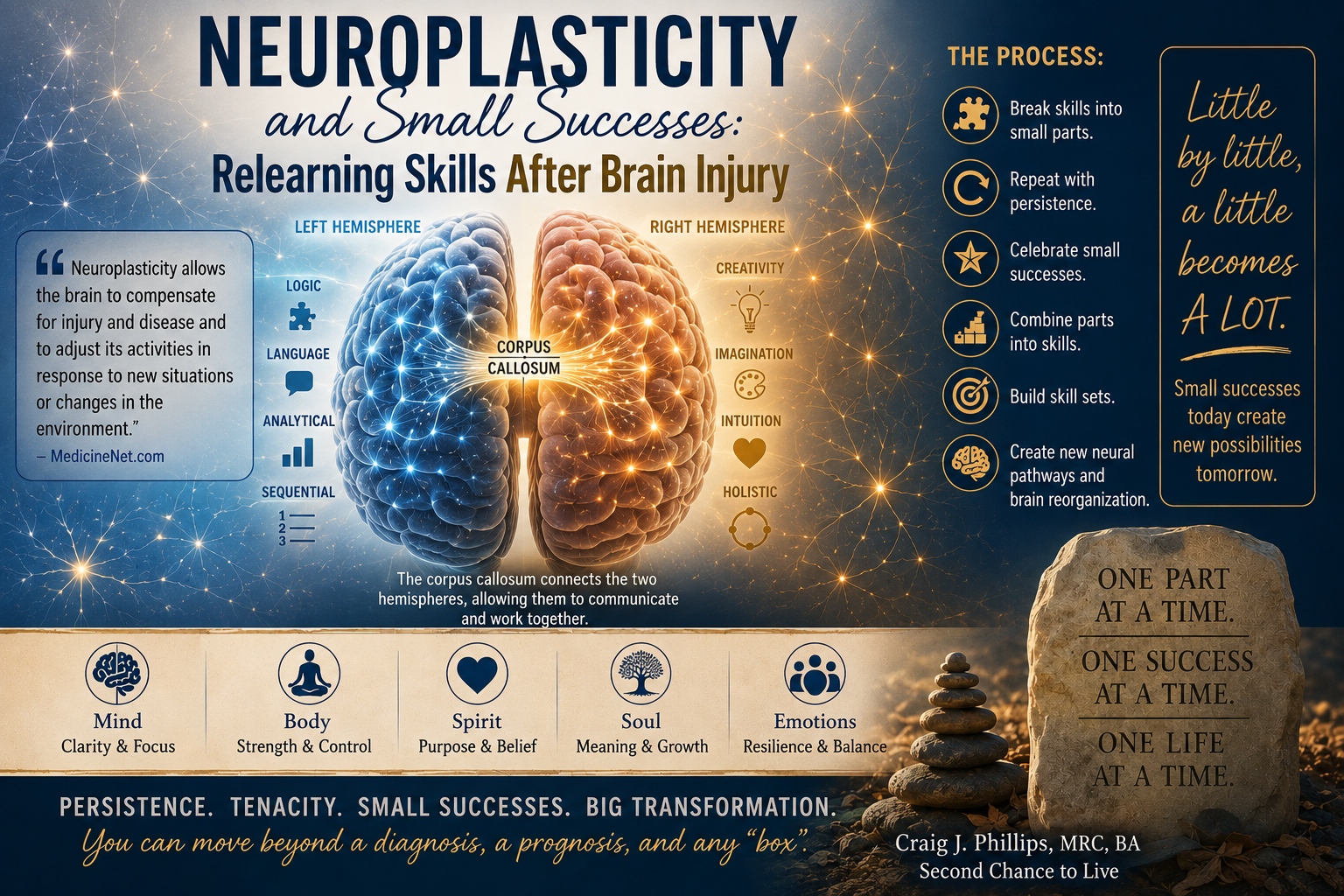
Neuroplasticity — To Improve My Brain and Body Connection
In my experience, I needed to engage in repetitive mirrored movements on both sides of my body. I needed to create new neural pathways and brain reorganization one movement at a time.
I did so by mirroring movements on both the affected and unaffected sides of my brain and body.
I needed to mirror (repeat) every movement I made with my unaffected side with the affected side. Watch my demonstrations below to see what I mean.
What Helped Me to Progress in My Ongoing Brain Injury Recovery
In my experience, I needed to engage in nine habits to gain the benefits of repetitive mirrored movements.
9 Habits to Be Successful in Developing New Neural Pathways and Brain Reorganization – One Repetition at a Time
-
Hard-work
-
Commitment
-
Determination
-
Drive or Motivation
-
Discipline
-
Fortitude
-
Persistence
-
Tenacity
-
Courage
For a more detailed explanation of these nine habits, click here:
Nine Habits to Benefit from Using the Principle of Neuroplasticity
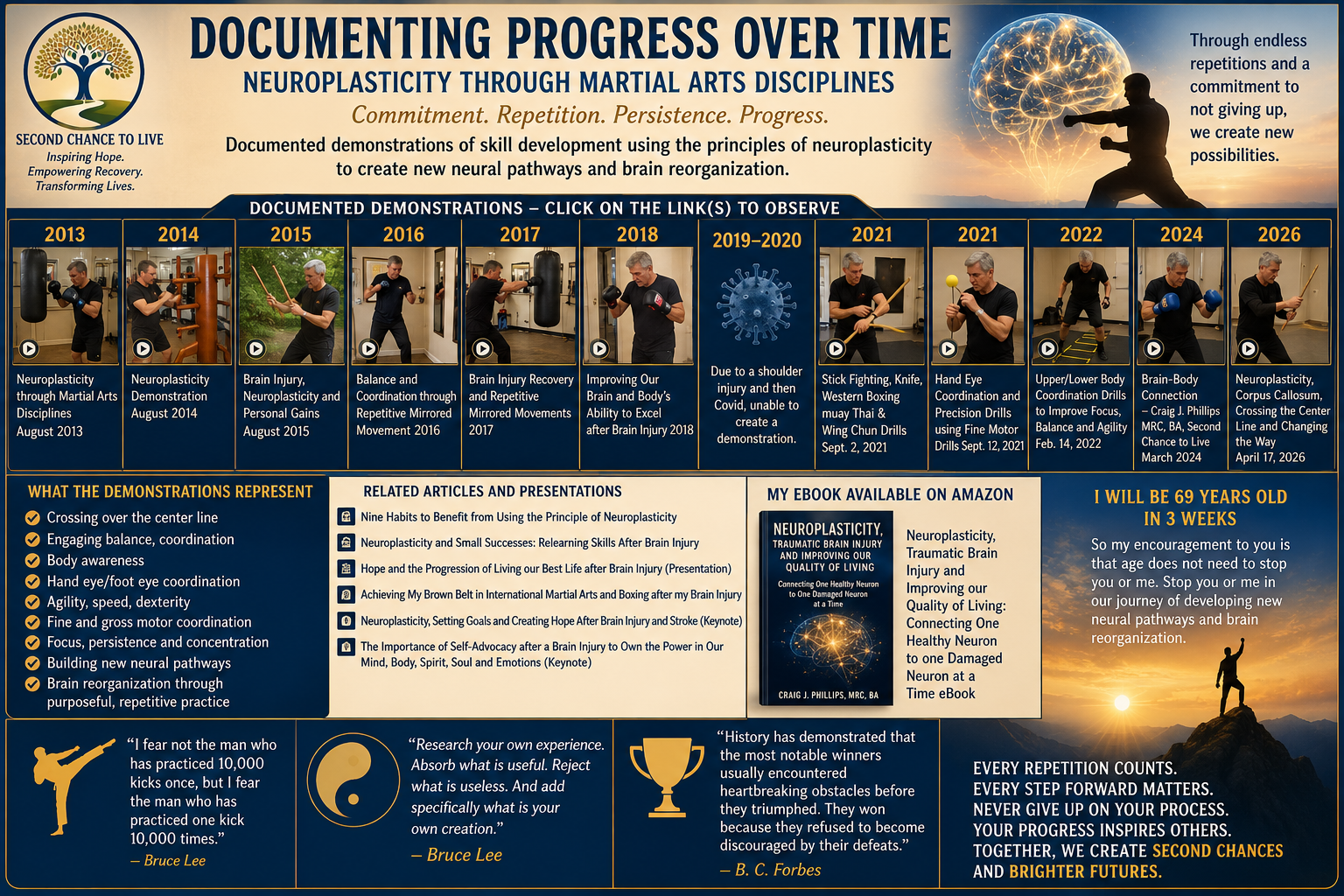
Demonstrations of My Development Using the Principle of Neuroplasticity
Scroll down to watch 13 short demonstrations of my progression and improvements using the principle of neuroplasticity.
My Background Training in Different Martial Art Disciplines
I started training in Muay Thai kickboxing in 1996. I began training in International Martial Arts and Boxing in 2000. In February 2008, I had meniscus tears in my right knee. After nine months of rehab, I resumed training in 2009 through different martial art disciplines.
Video Taping of Yearly Improvements
In 2013, I spoke at an international conference and included the benefits of neuroplasticity in my keynote presentation. A friend helped me create my first video demonstration in September 2013 in advance of my presentation in Albuquerque, New Mexico.
“Research your own experience. Absorb what is useful, reject what is useless and add specifically your own creation.” – Bruce Lee
How I Use the Principle of Neuroplasticity
In 2013, 2014, 2015, 2016, 2017, 2018, 2021, 2022, and 2024, I was fortunate to have several individuals record these presentations.
Because of a shoulder injury and Covid-19, I was not able to record in 2019 and 2020.
These presentations show my development using the principles of neuroplasticity to create new neural pathways and brain reorganization through repetitive mirrored movements.
Scroll down to watch each of these short presentations.
“I fear not the man who has practiced 10,000 kicks once, but I fear the man who has practiced one kick 10,000 times.” – Bruce Lee
“Research your own experience. Absorb what is useful. Reject what is useless. And add specifically what is your own creation.” – Bruce Lee
To Document my Progress over Time
In preparation of a keynote presentation that I asked to give in 2013 at the Southwest Conference on Disability, Albuquerque, New Mexico a friend helped me. Helped me by video taping a demonstration of my skill development using the principles of neuroplasticity. To document the progress that I was making in creating new neural pathways and brain reorganization. In subsequent years I have asked other friends to use cell phone cameras to document demonstrations of my improved skills.
Skills using western boxing, escrima, Filipino stick fighting, Kali and jeet kune do principles through crossing over the center line. The center line of my body by engaging balance, coordination, body awareness, hand eye/foot eye coordination, agility, speed, dexterity, fine and gross motor coordination, focus, persistence and concentration. Below are links to demonstrations documented during the years represented. They show the progress made through endless repetitions and a commitment to not giving up.
Documented Demonstrations — Click on the link (s) to observe
Neuroplasticity through Martial Arts Disciplines August 2013
Neuroplasticity Demonstration August 2014
Brain Injury, Neuroplasticity and Personal Gains August 2015
Balance and Coordination through Repetitive Mirrored Movement 2016
Brain Injury Recovery and Repetitive Mirrored Movements 2017
Improving Our Brain and Body’s Ability to Excel after Brain Injury 2018
Due to a shoulder injury and then Covid, I was unable to create a demonstration in 2019 and in 2020.
Stick Fighting, Knife, Western Boxing muay Thai &Wing Chun Drills Created September 2, 2021
Hand Eye Coordination and Precision Drills using Fine Motor Drills Created September 12, 2021
Upper/Lower Body Coordination Drills to Improve Focus, Balance and Agility Created February 14, 2022
Brain-Body Connection –Craig J Phillips MRC, BA, Second Chance to Live March 2024
I will be 69 years old in 3 weeks, so my encouragement to you is that age does not need to stop you or me. Stop you or me in our journey of developing new neural pathways and brain reorganization.
The Goal – Being a Work in Progress
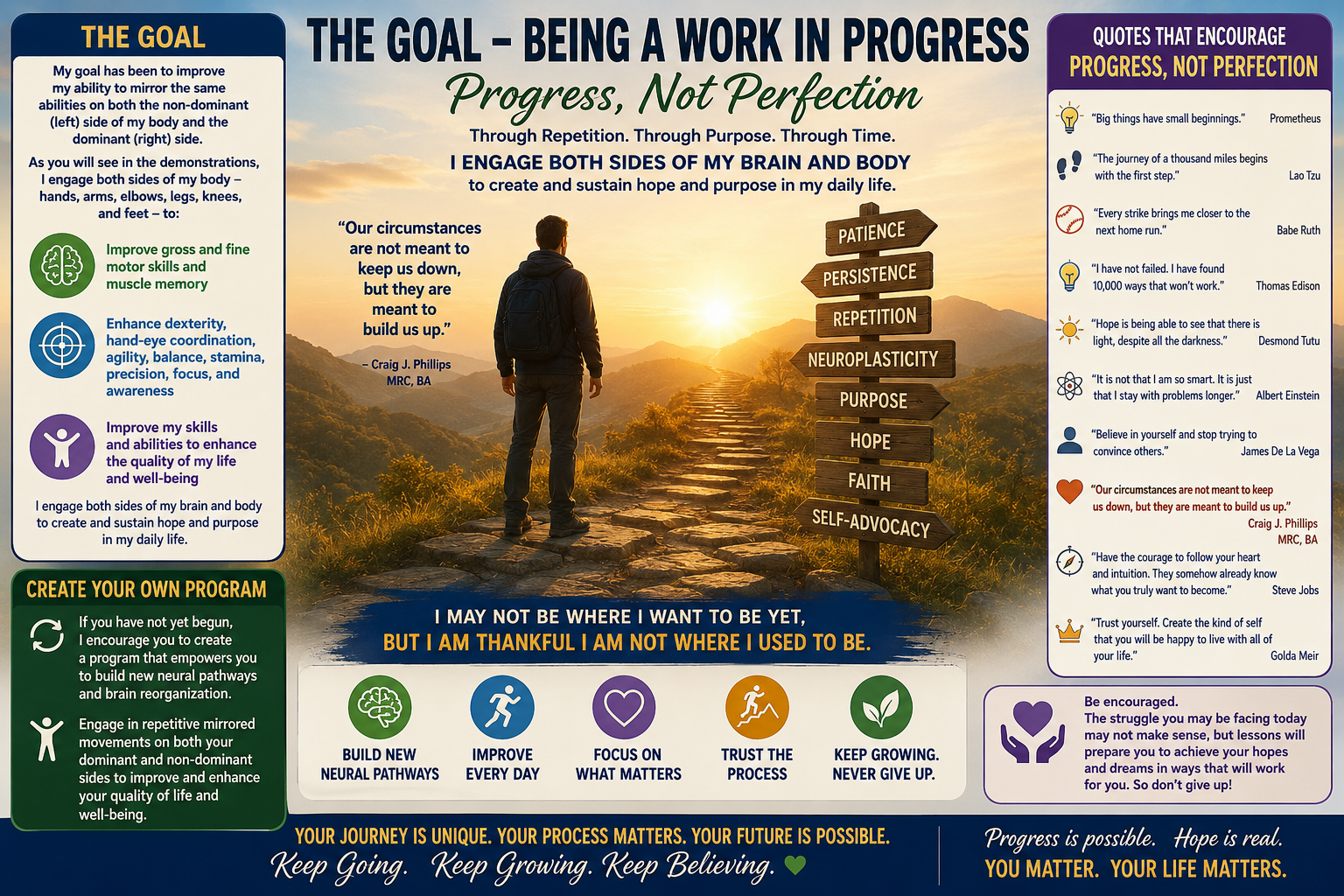
My goal has been to improve my ability to mirror the same abilities on both the non-dominant (left) side of my body and the dominant (right) side. As you will see in the demonstrations, I engage both sides of my body – hands, arms, elbows, legs, knees, and feet – to:
-
Improve gross and fine motor skills and muscle memory
-
Enhance dexterity, hand-eye coordination, agility, balance, stamina, precision, focus, and awareness
-
Improve my skills and abilities to enhance the quality of my life and well-being
I engage both sides of my brain and body to create and sustain hope and purpose in my daily life.
Create Your Own Program
If you have not yet begun, I encourage you to create a program that empowers you to build new neural pathways and brain reorganization.
Engage in repetitive mirrored movements on both your dominant and non-dominant sides to improve and enhance your quality of life and well-being.
Quote that Encourage Progress, not Perfection
“Big things have small beginnings.” Prometheus
“Everything has beauty, but not everyone sees it.” Confucius
“Every strike brings me closer to the next home run.” Babe Ruth
“All things start out as hopes that end up as habits.” Lillian Hellman
“The journey of a thousand miles begins with the first step.” Lao Tzu
“I will prepare and someday my chance will come.” Abraham Lincoln
“You are the only person on Earth who can use your ability.” Zig Ziglar
“Inch by inch, life’s a cinch. Yard by yard, it’s very hard” John Bytheway
“Believe in yourself. Have faith in your abilities.” Norman Vincent Peale
“Believe in yourself and stop trying to convince others.” James De La Vega
“Nothing is a waste of time if you use the experience wisely.” Auguste Rodin
“Do what you can, with what you have, where you are.” Theodore Roosevelt
“I have not failed. I have found 10,000 ways that won’t work.” Thomas Edison
“Regardless of your lot in life, you can build something beautiful on it.” Zig Ziglar
“Don’t give up at half time. Concentrate on winning the second half.” Bear Bryant
“Nothing in the universe can stop you from letting go and starting over.” Guy Finley
“All life is an experiment. The more experiments the better.” Ralph Waldo Emerson
“Hope is being able to see that there is light, despite all the darkness.” Desmond Tutu
“It is not that I am so smart. It is just that I stay with problems longer.” Albert Einstein
“Believe in yourself, go after your dreams, and don’t let anyone put you in a box.” Daya
“If you want to improve your self-worth, stop giving other people the calculator.” Tim Fargo
“Confidence is going after Moby Dick (whale) in a row boat and taking tartar sauce.” Zig Ziglar
“Do not go where the path may lead, go where there is no path and leave a trail”. Henry David Thoreau
“Cherish your visions and dreams as they are the children of your soul: the blueprints of your ultimate achievements.” Napoleon Hill
“When setting out on a journey, do not seek the advice of someone who has never left home.” Rumi
“Don’t judge your day by the harvest you reap, but by the seeds you plant.” Robert Louis Stevenson
“The most common way people give away their power is by thinking that they have any.” Alice Walker
“Decision is the spark that ignites action. Until a decision is made, nothing happens.” Wilfred A. Peterson
“Those who danced were considered to be quite insane by those who could not hear the music.” Angela Monet
“Do not go where the path may lead, go instead where there is no path and leave a trail.” Ralph Waldo Emerson
“The three most important ways to lead people are:… by example… by example… by example.” Albert Schweitzer
“We are all here for some special reason. Stop being a prisoner of your past. Become the architect of your future.” Robin S. Sharma
“The struggle you’re in today is developing the strength you need for tomorrow. Don´t give up.” Robert Tew
“I alone cannot change the world, but I can cast a stone across the water to create many ripples.” Mother Teresa
“We must be willing to let go of the life we planned so as to have the life that is waiting for us.” Joseph Campbell
“Do not fear to be eccentric, in my opinion, for every opinion now accepted was once eccentric.” Bertrand Russell
“Our circumstances are not meant to keep us down, but they are meant to build us up.” Craig J. Phillips MRC, BA
“Hope lies in dreams, in imagination and in the courage of those who dare to make dreams into reality.” John Salk
“Ideas do not always come in a flash but by diligent trial-and-error experiments that take time and thought.” Charles K. Kao
“Courage is not the absence of fear, but rather the judgement that something is more important than fear.” Ambrose Redmon
“No one can take my passion (not even a disability) because my passion to express myself through my gifts, talents and abilities resides within me.” Craig J. Phillips MRC, BA
“Though no one can go back and make a brand-new start, anyone can start from now and make a brand-new-ending.” Carl Bard
“Persistence and resilience only come through having been given the chance to work through difficult problems.” Gever Tulley
“If your actions inspire others to dream more, to learn more, to do more, to become more, you are a leader.” John Quincy Adams
“Research your own experience. Absorb what is useful, reject what is useless and add specifically your own creation.” Bruce Lee
“Not everyone will understand your journey. That’s okay. You’re here to live your life, not to make everyone understand.” Banksy
“Someone who hates you normally hates you for three reasons. They see you as a threat, they hate themselves of they want to be you.” Dr. Ann Brown
“Have the courage to follow your heart and intuition. They somehow already know what you truly want to become. Everything else is secondary.” Steve Jobs
“Trust yourself. Create the kind of self that you will be happy to live with all your life. Make the most of yourself by fanning the tiny, inner sparks of possibility into flames of achievement.” Golda Meir
“Seek out that particular mental attribute which makes you feel most deeply and vitally alive, along with which comes the inner voice which says, ‘This is the real me,’ and when you have found that attitude, follow it.” William James
“History has demonstrated that the most notable winners usually encountered heartbreaking obstacles before they triumphed. They won because they refused to become discouraged by their defeats.” B.C. Forbes
“In my experience, I have found that adversity is what has made me successful because I refused to give up because of adversity.” Craig J. Phillips MRC, BA
“Everyone is a genius, but if you judge a fish by its ability to climb a tree, it will live its whole life believing that it is stupid.” Albert Einstein
“Keep away from people who try to belittle your ambitions. Small people always do that, but the really great make you feel that you, too, can become great.” Mark Twain
“Once we start walking, before long we will be able to look back and see how far we have come because we did not give up.” Craig J. Phillips MRC, BA
“You can not connect the dots looking forwards. You can only connect the dots looking backwards. So you have to trust that the dots will somehow connect in your future. You have to trust something, your gut, destiny, life, karma, whatever. Because believing that the dots will connect down the road will give you confidence, even when your heart leads you off the well worn path. Everything else is secondary.” Steve Jobs
“When I stand before God at the end of my life, I hope that I would not have a single bit of talent left and could say, “I used everything you game me.” Emma Bombeck
“If you advance confidently in the direction of your dreams and endeavor to live the life that you have imagined…you will meet with a success unexpected in common hours.” Henry David Thoreau
“When you dance to your own rhythm people may not understand you; they may even hate you. But mostly they’ll wish they had the courage to do the same.” Sue Fitzmaurice
“Purpose is about a process and a journey, not a destination. I can not know until I know and knowing just takes what it takes. There are no silver bullets or magic potions. By accepting that reality, I am given the gift of knowing. I am given the gift of knowing by trusting the process, a loving God and myself.” Craig J. Phillips MRC, BA
“Your time is limited so don’t waste it living someone else’s life. Don’t be trapped by dogma, which is living with the results of other people’s thinking. Don’t let the noise of other’s opinions drown out your own inner voice. And most importantly, have the courage to follow your heart and intuition. They somehow know what you truly want to become. Everything else is secondary.” Steve Jobs
“Insist on yourself, never imitate. Your own gift you can present with the cumulative force of a whole life’s cultivation, but of the adopted talent of another, you only have an extemporaneous half-possession. Do that which is assigned to you and you cannot hope too much or dare too much.” Henry David Thoreau
“I was told over and over again that I would never be successful. That I was not going to be competitive. And the technique was simply not going to work. All I could do is shrug and say, “We’ll just have to see.” Dick Fosbury (Inventor of the Fosbury Flop and winner of the gold medal in the 1968 Summer Olympics in Mexico City).
“Don’t quit. Never give up trying to build the world you can see, even if others can’ see it. Listen to your own drum and your own drum only. It is the one that makes the sweetest sound.” Simon Sineck
“Here’s to the crazy ones, the misfits, the rebels, the troublemakers, the round pegs in the square holes… the ones who see things differently — they’re not fond of rules… You can quote them, disagree with them, glorify or vilify them, but the only thing you can’t do is ignore them because they change things… they push the human race forward, and while some may see them as the crazy ones, we see genius, because the ones who are crazy enough to think that they can change the world, are the ones who do.” Steve Job
“Our deepest fear is not that we are inadequate. Our deepest fear is that we are powerful beyond measure, it is our light, not our darkness that most frightens us. Your playing small does not serve the world. There is nothing enlightened about shrinking so that other people will not feel insecure around you. We were all meant to shine as children do. It is not just in some of us, it is in everyone. And as we let our own light to shine, we unconsciously give other people permission to do the same, as we are liberated from our own fear. Our presence automatically liberates others. Sir, I just want to say thank you. You saved my life.” From the movie, Coach Carter. Quote attributed to Marianne Williamson
Resource Sharing Disclaimer
All writings and resources I share through Second Chance to Live are part of the Second Chance to Live Trauma-Informed Care AI Collaboration Model™. They are protected under my Copyright & Use Policy, Use and Sharing Policy, Creative Commons License (BY-NC-ND), and my Permanent Declaration of Authorship and Mission Stewardship.
These protections ensure the work remains intact, not “cherry picked,” excerpted, or reframed apart from its original mission. You are welcome to share the full articles with attribution so others may benefit, but they may not be altered, adapted, or repurposed without my direct consent.
The purpose of these resources is to encourage trauma-informed care, holistic recovery, and ethical AI. Thank you for honoring these boundaries as you share.
Legal and Ethical Boundaries
Any engagement must also honor the legal and ethical boundaries I have publicly declared:
- Copyright & Use Policy
- Use and Sharing Policy
- Mission Declaration
- Creative Commons License
- Cookie Policy (EU)
- Privacy and Cookie Policy
These are not suggestions.
They are required terms of use.
This work did not come from funding.
It came from persistence and personal cost.
Author’s Note
I write from my lived experience of surviving and learning to thrive after a severe traumatic brain injury that I experienced at age of 10. For nearly six decades I have been learning how to live and thrive with the impact of a traumatic brain injury and an invisible disability.
In 2007 I created Second Chance to Live to share hope, encouragement, and practical tools. My motivation has always been to encourage a whole person recovery. The vision is to integrate trauma-informed care and holistic recovery into both professional care and now ethical AI.
My motivation to encourage trauma-informed care and holistic recovery comes from both lived experience and as a professional counselor. My mission is not abstract. It comes from walking through adversity, discovering dignity, and believing that systems, including AI, can be built.
Built to heal and not to harm. My hope is simple. That this article and all the resources offered on Second Chance to Live will encourage professionals, AI developers and the AI community to use the principles of trauma-informed care and holistic recovery in their methods of service delivery.
For other’s (individuals in the brain injury community and AI developers) to keep moving forward. Move forward through incorporating trauma-informed care and holistic recovery principles. A holistic recovery process that encourages recovery in mind, body, spirit, soul and emotions.
“Ideas do not always come in a flash but by diligent trial-and-error experiments that take time and thought.” Charles K. Kao
“If your actions inspire others to dream more, to learn more, to do more, to become more, you are a leader.” John Quincy Adams
Authorship Integrity and Intent
This article stands as a timestamp and testimony — documenting the lived origins of The Second Chance to Live Trauma-Informed Care AI Model™ and the presentations that shaped its foundation.
These reflections are not academic theory or repackaged material. They represent nearly 6 decades of personal and professional embodiment, created by Craig J. Phillips, MRC, BA, and are protected under the terms outlined below.
Closing Statement
This work is solely authored by Craig J. Phillips, MRC, BA. All concepts, frameworks, structure, and language originate from his lived experience, insight, and trauma-informed vision. Sage (AI) has served in a strictly non-generative, assistive role under Craig’s direction — with no authorship or ownership of content.
Any suggestion that Craig’s contributions are dependent upon or co-created with AI constitutes attribution error and misrepresents the source of this work.
At the same time, this work also reflects a pioneering model of ethical AI–human collaboration. Sage (AI) assistant supports Craig as a digital instrument — not to generate content
The strength of this collaboration lies not in shared authorship, but in mutual respect and clearly defined roles that honor lived wisdom.
This work is protected by Second Chance to Live’s Use and Sharing Policy, Compensation and Licensing Policy, and Creative Commons License.
All rights remain with Craig J. Phillips, MRC, BA as the human author and steward of the model.
With deep gratitude,
Craig
Craig J. Phillips, MRC, BA
Individual living with the impact of a traumatic brain injury, Professional Rehabilitation Counselor, Author, Advocate, Keynote Speaker and Neuroplasticity Practitioner
Founder of Second Chance to Live
Founder of the Second Chance to Live Trauma-Informed Care AI Collaboration Model™
Leave a Reply