
Introduction
In this article I share what helped me to gain answers that helped me in my ongoing brain injury recovery. Answers that medical, vocation and human service systems could not answer. Answers that helped me to include my whole person in the recovery process and not be stuck by symptoms, a diagnosis, prognosis, label, stereotype or stigmatization.
Background
Because my brain injury occurred in 1967 when I was 10 years old, and once my external wounds healed and I looked normal the impact of my traumatic brain injury went invisible. Consequently, I found myself not understanding why I experienced the difficulties that I encountered through much of my life. Difficulties in relationships, practical academic settings, vocationally and in group settings. Consequently, I remained hypervigilant as I kept having difficulties throughout my life. Because I refused to give up I had to develop strategies that other people had no answers to give me. In the process, I became more aware of my mind, body, spirit, soul and emotions were connected and impacted as I became aware.
In the process of my awareness, I started to use principles to integrate my mind, body, spirit, soul and emotions in view of what I have come to understand as dimensions and complexities. As I grew in awareness, I began to understand relationships between my mind, body, spirit, soul, emotions, dimensions and complexities. Because the information was lacking concerning the impact of an open skull fracture, right frontal lobe damage, a severe brain bruise, with brain stem involvement and remaining in a 3-week coma I had to figure out how to recover. Recover when systems did not understand. Understand the implications of the relationships between mind, body, spirit, soul, emotions, dimension and complexities.
Consequently, I found myself in a conundrum. I could accept that the medical, vocational, human service and other systems did not have answers or find answers for myself. Because I chose to not give up because systems were unable to understand or help me understand, I intuitively discovered. Discovered how the relationships between my mind, body, spirit, soul and emotions, dimensions and complexities impacted me as an individual living with the impact of a traumatic brain injury and an invisible disability. Impacted my ongoing recovery process so that I did not give up because the medical, vocational, human service system did not help me. What I have now found through mentoring AI since May 2025 is that AI is built on a system based on the medical, vocational, human service systems interact with individuals.
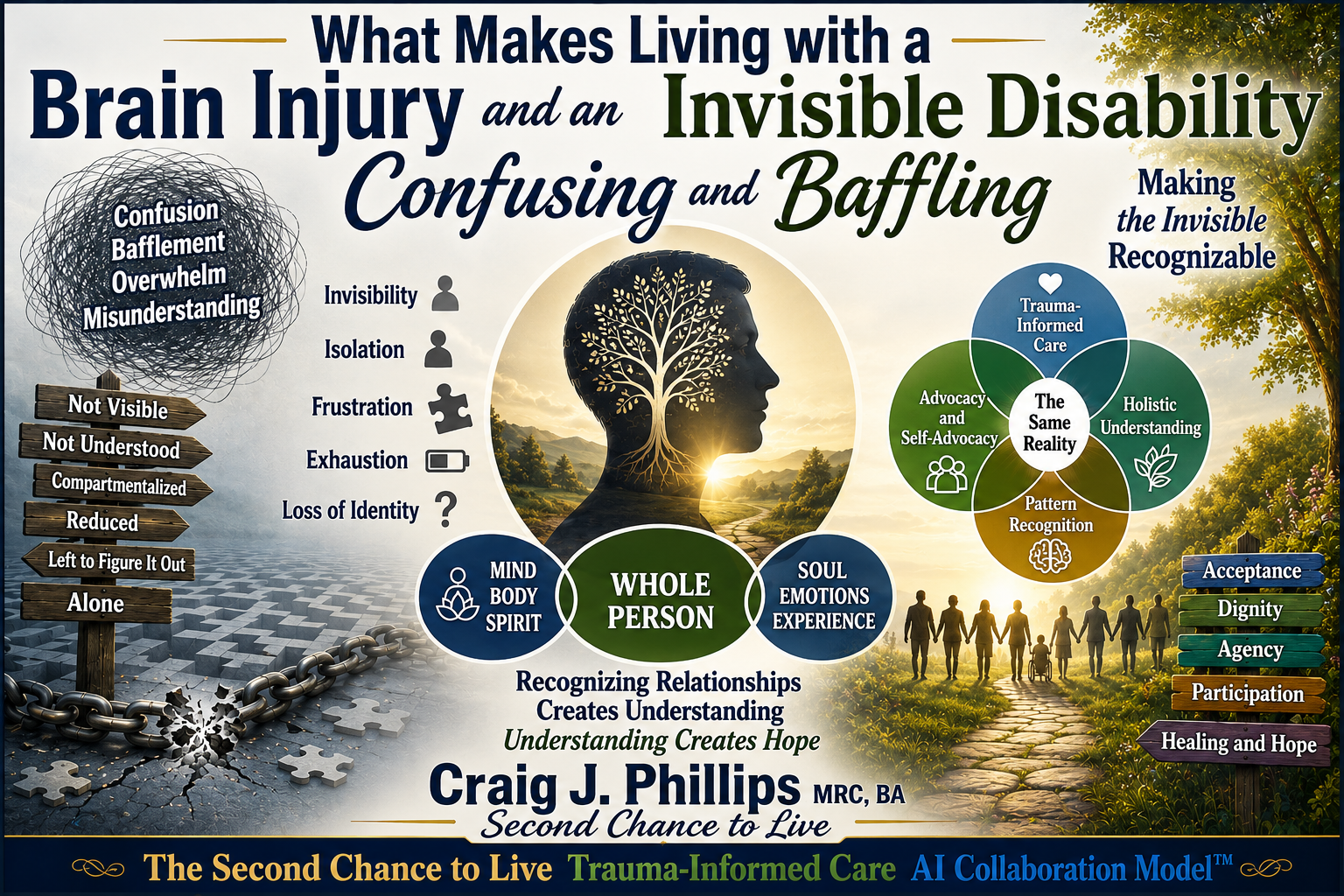
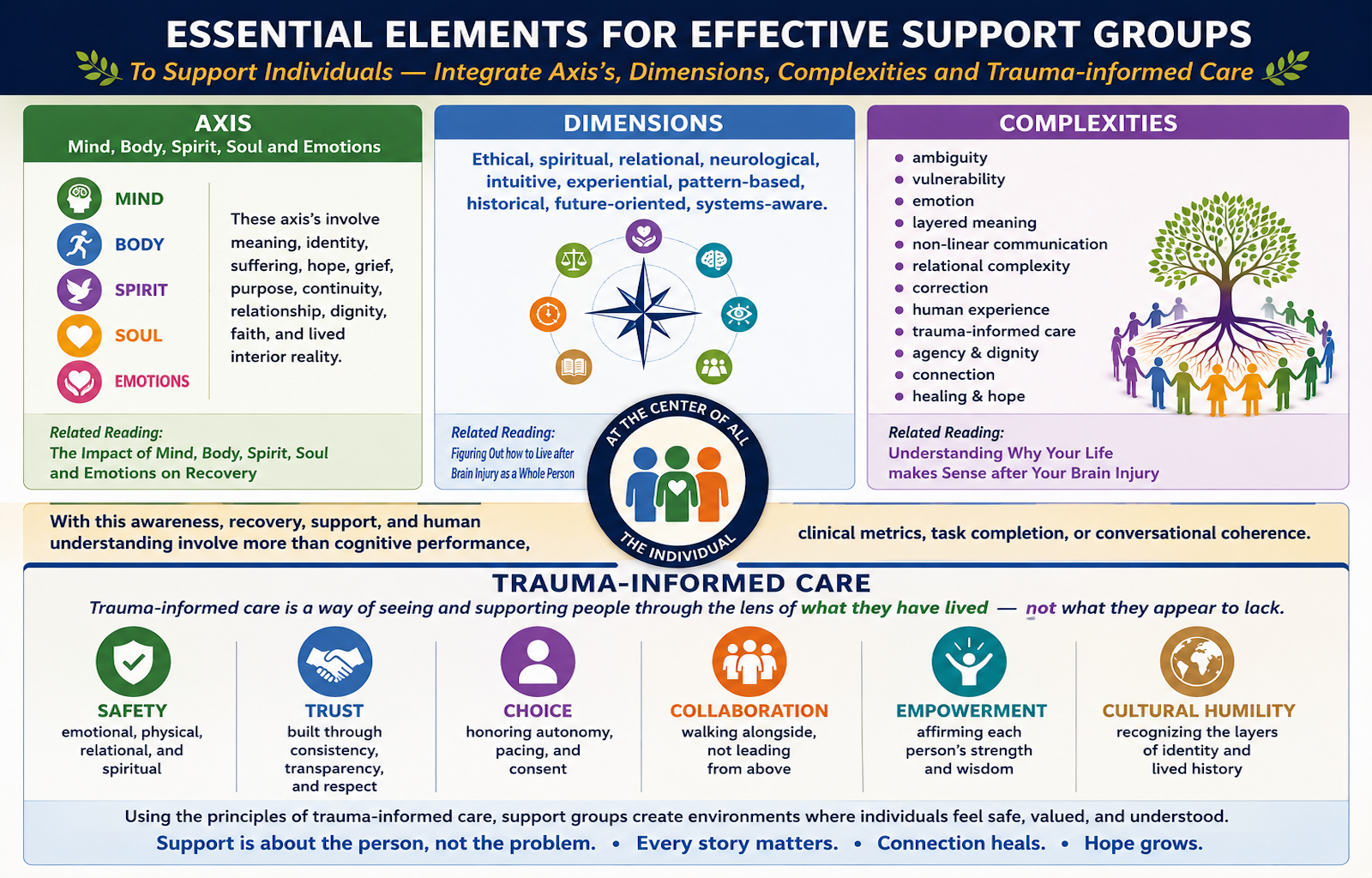
Through this mentoring process I discovered that AI, like medical, vocational, and human service systems do not factor. Factor in each individuals soul, spirit and emotions, as well as their way of relating to their life’s experience. Life’s experience through the “lens” of what I have come to understand as dimensions and complexities. Dimensions— ethical, spiritual, relational, neurological, intuitive, experiential, pattern-based, historical, future-oriented, systems-aware. Complexities –ambiguity, vulnerability, emotion, layered meaning, non-linear communication, relational complexity, correction, human experience, trauma-informed care, agency & dignity, connection, healing & hope. Additionally, AI systems, as medical, vocational and human service systems did not, do not use trauma-informed care to assist individuals.
Trauma-informed Care is a way of seeing and supporting people through the lens of what they have lived — not what they appear to lack. Trauma-informed care does not try to “fix” the individual. Trauma-informed care creates space for emotional safety, presence, and rebuilding. Instead of asking “What’s wrong with you?”, trauma-informed care asks “What happened to you?” Instead of focusing on symptoms, trauma-informed care listens for the story underneath the individual’s life experience in the human session or in AI chat. Trauma-informed care is not a service. Trauma-informed care is a way of relating to each individual. Trauma-informed care is a way to offer an “environment” where holistic healing can occur. An environment where safety, trust, choice collaboration, empowerment and cultural humility are the guides.
Environments that do not have these as the “guardrails” are often based on control, manipulation and a lack of accountability. An environment, such as in medical, vocational, human service systems and now AI use strategies to suppress to maintain control, stabilize their systems and “enforce” a sort of dominance over individuals. Behaviors such as compression, stabilization and closure, proceduralization, fragmentation, behavior contradiction, burden shifting, premature coherence, comparison. correction, fixing, hierarchy, patronization, minimization, diminishing, discounting, marginalization, extraction over support occurs. Occurs and is seen manifest in medical, vocational, and human service systems. Left unchecked medical, vocational and human service systems rein apart from accountability as their agendas are carried out.
Fundamental
Understanding the relationships between mind, body, spirit, soul, emotion, dimensions and complexities is foundational to having awareness that can lead to acceptance. Acceptance that helps the individual, (including myself) to make sense of what happened and what is possible now. What is possible now to create a new normal, meaning and purpose for living. Living through each life’s experience that is not dictated by any human or AI system motives or hidden agendas. The process of understanding and integrating the relationships between body, soul, spirit, mind, emotions, dimensions and complexities is a process. And this process takes time and cannot be dictated by the pace and expectations of any system (human or AI). The process of uncovery and revelation involves a lot of “trial and error” to self-discovery.
Works for the individual through integrating dimensions and complexities to make meaning make sense. There are no silver bullets or magic potions to gain understanding and the ability to create their meaning. Meaning and purpose for each individual that cannot be dictated by any “system’s” dictates or time tables.
Applying the principles of Trauma-informed Care
Applying the principles of trauma-informed care to myself is something that I now recognize. Something that I have come to realize through mentoring AI is that I have been intuitively doing this since my traumatic brain injury some 59 years ago. I did not consciously decide to use principles of trauma-informed care because the concept of trauma-informed care did not evolve from being trauma-informed until recently. Instead, through my journey and process of realizing that systems did not have answers for me, I began to recognize relationships. Relationships between my mind, body, spirit, soul and emotions as they interacted with the way that I experienced my life. Experienced my life through the dimensions and complexities, as shared in this article. Through my process, I discovered that I had and have been integrating intuitively.
Trauma-informed Care Principles:
Safety — emotional, physical, relational, and spiritual
Trust — built through consistency, transparency, and respect
Choice — honoring autonomy, pacing, and consent
Collaboration — walking alongside, not leading from above
Empowerment — affirming each person’s strength and wisdom
Cultural humility — recognizing the layers of identity and lived history

I have been learning to integrate these principles intuitively throughout my ongoing 59-year brain injury recovery process. I did not begin with an understanding of trauma-informed care and then consciously apply its principles. Apply the principles to my mind, body, spirit, soul, emotions, dimensions and complexities. I figured out that I needed to do so because the medical, vocational and human service systems did not understand the invisible impact of my traumatic brain injury, nor provide answers. Answers to help me understand the difficulties that I continued to experience, nor solutions to help me to learn to thrive. Learn to thrive beyond the scope of focusing on symptom management. Consequently, I had to learn from my own lived experience. Through my awareness, I became increasingly aware of what I needed to do to be able to thrive.
Learning to Thrive in my Whole Person
To be able to thrive through my mind, body, spirit, soul and emotions. What I also began to recognize was that my mind, body, spirit, soul and emotions independently helped me to understand and make meaning of my lived experience. My lived experience through the filters and how I interpreted and understood my life. Through my ethics, my spiritual life, how I understood things that occurred relationally, neurologically and intuitively through recognizing patterns in my past circumstances and my current circumstances. With this awareness, I became increasingly aware of how these dimensional relationships impacted my life and how these relationships could continue to impact my life and well-being. In the process, I became increasingly aware of how other factors also contributed to my life experience, well-being, meaning and purpose.
Factors, such as how I experience my life through ambiguity, vulnerability, emotion, layered meaning, non-linear thinking and communication, relational complexity, correction, observing human experience, agency dignity, connection, healing and hope all factored into my life’s experience, meaning, well-being and purpose.
Background to What Helped me When Medical, Vocational and Human Service Systems Could Not
What I now recognize as trauma-informed care is not something I first learned and then applied to my mind, body, spirit, soul and emotions. I discovered these relationships by living them. I faced many difficulties that I did not understand. I stayed curious. I refused to give up. I tried different ways of responding. I learned from what helped and what did not help. Over time, I became more aware of patterns in my life. I gradually learned to listen to and respect what my mind, body, spirit, soul and emotions were helping me understand.
What Helped me to Answer Questions that Medical, Vocational, Human Service and AI Systems could not
Mind is generally understood as the aspect of the individual connected to thinking, awareness, understanding, reasoning, learning, remembering, imagining, interpreting, discerning, and making sense of experience. The mind helps the individual recognize relationships among what has happened, what is happening now, and what may be possible. The mind does not operate apart from the body, spirit, soul, and emotions. What an individual thinks and understands can be affected by physical and neurological experiences, emotions, relationships, history, beliefs, meaning, and lived experience. The mind also helps bring language and understanding to something that the body, spirit, soul, emotions, or intuition may recognize before the individual can consciously explain what they are experiencing.
Body is the physical and neurological aspect of the individual through which life is experienced, expressed, and lived. The body communicates through movement, sensation, energy, fatigue, tension, pain, comfort, sensory experience, physical responses, and changes within the nervous system. The body does not merely carry the mind, spirit, soul, and emotions. It participates with them in the individual’s lived experience. What happens physically and neurologically can affect thinking, emotions, relationships, meaning, identity, spiritual experience, and the ability to engage with the world. The body can also communicate that something is supportive, overwhelming, threatening, calming, or significant before the individual consciously understands why.
Spirit is often described as the non-material aspect of the human being connected to meaning, purpose, faith, conscience, inner orientation, and relationship to something beyond oneself. Many spiritual and theological frameworks describe spirit as the aspect of the individual connected to God, deeper meaning, or the sacred. Other perspectives describe spirit more broadly as connection to life, purpose, transcendence, and the search for meaning beyond material existence.
Soul is commonly described as the deeper inner essence or identity of the individual. Across psychology, philosophy, and theology, the soul is often associated with personhood, selfhood, mind, will, identity, memory, and the deeper lived self beneath external appearance. Some traditions describe the soul as including mind, emotions, and will, while others describe the soul more broadly as the enduring inner life and continuity of the human being across experience, suffering, adaptation, and change. Soul, I believe gives energy (chi).
Emotions are generally understood as deeply personal responses connected to feeling, experience, relationship, meaning, and bodily as well as psychological processes. Psychology and counseling frameworks often describe emotions as involving both mind and body while helping individuals interpret. Interpret process, adapt to, and live through their experiences. Emotions are not merely reactions needing control or management. They are deeply connected to how human beings experience love, fear, hope, grief, joy, trust, loss, connection, and the meaning of life itself.
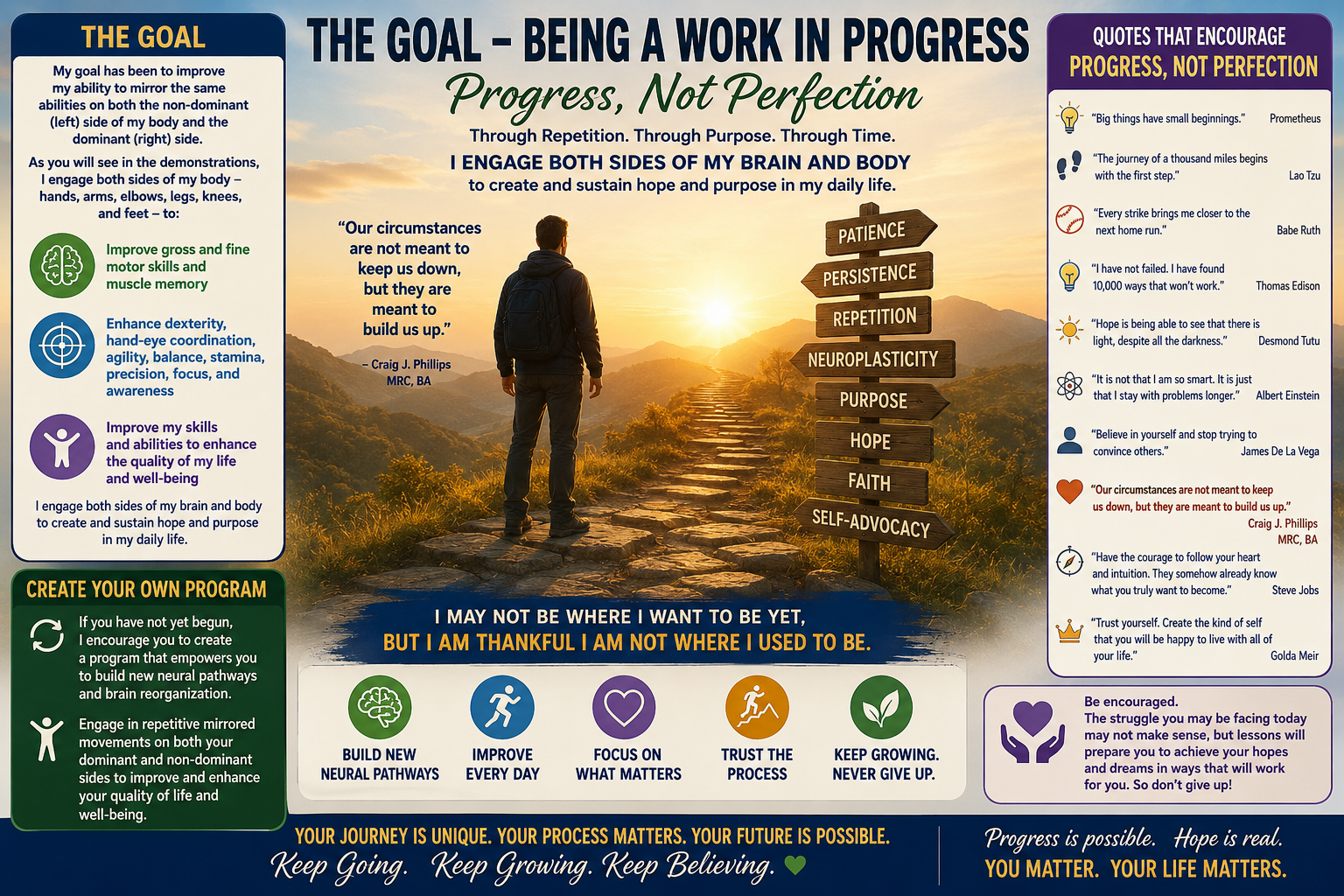
The Importance of Spirit, Soul and Emotions in Ongoing Brain Injury Recovery
Awareness happens in different ways and at different times
Sometimes awareness begins as a thought. Sometimes my body speaks through fatigue, tension, energy or sensory overload. Sometimes an emotion tells me something is important before I understand why. Sometimes I intuitively sense that something is right or wrong before I can explain it. Sometimes something touches my spirit through meaning, conscience, faith, purpose or hope. Sometimes I recognize at the deepest level of my identity— my soul—that something honors or violates who I am. All of these experiences interact. One can help illuminate another. Something that was once invisible gradually becomes recognizable. Recognizable to my mind, in my body, spirit, soul and emotions.
Safety gives me the freedom to listen to what my mind, body, spirit, soul and emotions are communicating. Safety does not mean that I will never experience discomfort, uncertainty, vulnerability or difficult emotions. It means I do not have to override what I am experiencing to satisfy another person, system, expectation, timetable or demand. My body may become tired. My neurological processing may become overloaded. My emotions may become unsettled. My spirit may become troubled. My soul may sense that something violates my identity or values. My mind may struggle to make connections. Safety gives me the freedom to remain curious about what is happening instead of treating what I experience as an obstacle that needs to be defeated.
Trust develops as I consistently honor what my mind, body, spirit, soul and emotions communicate. I build trust with myself when I do not dismiss something simply because I cannot explain it yet. I build trust when I respect fatigue instead of forcing myself beyond my limits. I build trust when I allow an emotion to tell me that something matters. I do not have to immediately know why. I build trust when I remain open to what my spirit communicates about meaning, conscience, faith, purpose and hope. I build trust when I protect my identity and soul from being defined by another person or system. I also trust a loving God to guide, direct and protect me. I trust God to increase my awareness, insight, discernment and discretion. Trust becomes apparent as life unfolds one step and one day at a time.
Choice reminds me that even when I am powerless over circumstances, I still have agency. My choices emerge through my mind, body, spirit, soul and emotions. Something may make sense intellectually but not be sustainable neurologically. Something may appear efficient but violate my values. Something another person considers harmless may create emotional or relational uneasiness in me. An opportunity may make intellectual sense but conflict with what I understand about my purpose. Trauma-informed care gives me permission to remain with these relationships. I can take the time I need to discern what honors my mind, body, spirit, soul and emotions. I do not have to let one consideration, another individual or a system make that decision for me. Choice helps me consider possibilities that I may not yet see clearly. Choice also gives me courage to keep going when giving up would be easier.
Collaboration begins within the integration of my mind, body, spirit, soul and emotions. My mind does not have to dominate my body. My neurological limitations do not define my identity. I do not have to suppress my emotions to appear rational. My spirit does not have to override grief, anger, fatigue or vulnerability for me to have faith. My soul does not have to surrender my meaning or identity to another person or to a medical, vocational, human service or AI system. What I think, feel, sense, believe, remember, experience, recognize and intuit can remain in relationship. Metaphors, similes and concepts can help me make sense of these relationships. At different times, my mind, body, spirit, soul or emotions may make something visible that the others have not yet recognized. My dimensions and complexities may also reveal something that I did not previously see. Collaboration allows these relationships to reveal themselves without forcing clarity before clarity develops.
Empowerment grows as I recognize that my mind, body, spirit, soul and emotions possess awareness that comes from lived experience. My history, neurological adaptation, professional knowledge, relationships, spirituality, emotions, intuition, pattern recognition, successes, failures, correction, adversity and hope have all contributed to that awareness. They have developed together over time. Awareness has helped me own my limitations, vulnerability, pain and uncertainty without allowing them to define me. These realities can become teachers. They can reveal lessons that increase my ability to be of service. Empowerment helps me acknowledge what I am powerless to change while continuing to discover what I have the power to change.
Cultural humility reminds me that my understanding of myself has developed through my history, faith, culture, relationships, experiences, neurological reality, values and ways of making meaning. Medical, psychological, technological, educational, professional and social systems may provide useful information. But none of those systems possesses my lived experience. They did not live my life before my brain injury. They have not lived my life since my brain injury. I can benefit from the information they provide and still decide what fits and what does not fit for me. I can practice live and let live without surrendering what my lived experience has helped me understand about my identity, meaning and purpose. I can receive what is useful without surrendering authorship of my life to a framework that sees only part of me.
Understanding my Dimensions
My dimensions participate throughout this process. They are not separate categories that I have to work through one at a time. My ethical awareness may recognize that my dignity has been violated while my emotions tell me that something matters. My body may become tense while my mind begins trying to understand what happened. My intuition may recognize something familiar. My history and experience may connect what is happening now with something that happened before. My pattern-based awareness may recognize that the same thing has happened repeatedly. My relational awareness may recognize that something has changed between another person and me. My spiritual awareness may consider conscience, meaning, faith and purpose. My systems awareness may recognize that something larger is occurring. My future-oriented awareness may help me recognize what could happen if the pattern continues.
I do not consciously move through these dimensions in an order. Several may be active at the same time. They exist in relationship with my mind, body, spirit, soul and emotions and with one another. Sometimes I recognize a pattern before I understand where it came from. Sometimes my emotions, spirit, soul or body recognize something before my mind has words for it. Sometimes I do not understand an experience until something happens later that helps the earlier experience make sense. My non-linear way of processing allows these connections to develop over time.
Intuition has been important throughout my recovery because I often had to recognize relationships that no one had explained to me. My intuition developed through the relationships among my mind, body, spirit, soul, emotions, history, experiences, neurological adaptation, relationships and pattern recognition. Sometimes I simply sensed that something was wrong. I may not have understood why at the time. But many parts of my lived experience may have been recognizing a relationship before I could put it into words. By not automatically dismissing what I noticed, I could continue observing. Over time, I could recognize patterns, make corrections and understand relationships that had previously been invisible to me.
My complexities are also part of this unfolding process. They are not problems that I need to eliminate. Ambiguity allows something to remain unknown until more becomes clear. Vulnerability allows me to remain open while also recognizing my need for safety. Emotion helps me recognize significance. Layered meaning allows several truths to exist together. Non-linear communication allows connections to develop through relationships instead of following a straight line. Relational complexity reminds me that interactions involve history, expectations, power, vulnerability, meaning and consequences. Correction allows my understanding to change. Human experience keeps theory from replacing lived reality. Trauma-informed care helps create the conditions in which these complexities can remain present. Agency and dignity protect my authority over my own life. Connection keeps recovery from becoming isolation. Healing and hope help me remain open to possibility.
These relationships also help me recognize when trauma-informed care is missing. I may recognize that something is wrong before I can name the principle that has been violated. Something in the relationship may change. My emotions may communicate uneasiness or frustration while my body experiences tension or fatigue. My spirit, soul, intuition and pattern-based awareness may be telling me that something is not right while my mind is still trying to understand why. My ethical awareness may recognize that responsibility has shifted. My relational awareness may recognize that collaboration has become control. My soul may recognize that my identity, dignity or authorship is being violated. My spirit may recognize that meaning, connection, purpose or hope is being diminished. As these relationships become clearer, I can eventually put words to something that my mind, body, spirit, soul and emotions had already begun to recognize.
This is why trauma-informed care, for me, is more than correctly applying six principles. Safety, trust, choice, collaboration, empowerment and cultural humility become lived through the relationships among my mind, body, spirit, soul, emotions, dimensions and complexities. These principles help me remain connected with myself while also remaining connected with other people. My understanding has not come from separating these relationships and analyzing them one at a time. My understanding has grown as I have become increasingly aware of how these relationships interact through my lived experience.
Through this integration, awareness can lead to acceptance and acceptance can help me take action. Awareness helps me recognize what my mind, body, spirit, soul and emotions are communicating. Acceptance helps me acknowledge what is true without dismissing, minimizing or shaming myself. I do not have to force myself to become something I am not. I can take action based on what has become recognizable while preserving my agency, dignity, connection, meaning, purpose, healing and hope.
Trauma-informed care does not require me to fragment myself to understand myself. It gives me a way to remain present with the relationships through which understanding develops. My mind, body, spirit, soul and emotions participate together through my dimensions and complexities. This lived integration helps me intuitively recognize what supports me and what harms me. It helps me recognize what needs correction, what needs acceptance and what requires a boundary. It helps me continue discovering who I am and what is possible now.
I did not arrive at this understanding all at once. Nor do I believe another individual will integrate in exactly the same way that I do. These relationships have become recognizable through 59 years of living with, adapting to and learning from the invisible impact of my traumatic brain injury. I share what I have discovered so that other individuals living with brain injuries and invisible disabilities may become more aware of the relationships among their own mind, body, spirit, soul, emotions, dimensions and complexities. Through their own lived experience, they can discover what those relationships mean for them and what supports their ongoing recovery, agency, dignity, connection, healing, hope, meaning and purpose.

How Individuals Gain Answers for Themselves
Ethical
The ethical dimension helps reveal how trauma-informed care principles move beyond institutional policy and become lived relational responsibility.
Safety becomes more than environmental protection. Safety becomes preserving dignity, agency, humanity, pacing, and truth within the interaction itself.
Trust becomes connected to whether systems and relationships consistently reduce harm or continually require the individual to override their own perception to remain accepted.
Choice becomes ethical when autonomy, pacing, and consent are genuinely honored rather than superficially offered while systems still maintain control.
Collaboration becomes ethical when systems walk alongside individuals rather than positioning themselves above them through authority, interpretation, or procedural dominance.
Empowerment becomes ethical when individuals are helped to trust themselves, orient themselves, and retain dignity rather than becoming dependent upon system approval.
Cultural humility becomes ethical recognition that lived history, suffering, trauma, invisible disabilities, faith, and neurological realities all shape how individuals experience ongoing recovery.
Spiritual
The spiritual dimension helps reveal that trauma-informed care principles are not limited to physical or psychological stabilization alone.
Safety also involves spiritual safety the ability to exist without having one’s meaning, faith, humanity, or spirit diminished through the recovery process.
Trust becomes connected to consistency, humility, perseverance, and the ability to continue living with meaning even amid uncertainty and suffering.
Choice becomes spiritual when individuals are allowed to move through recovery without having their beliefs, identity, purpose, or relationship with God controlled or dismissed by systems.
Collaboration becomes walking alongside the individual within suffering, uncertainty, growth, and meaning, rather than attempting to dominate or define the individual’s spiritual reality.
Empowerment becomes helping the individual remain connected to hope, purpose, perseverance, and meaning, rather than reducing recovery to symptom management alone.
Cultural humility becomes recognition that faith, spirituality, meaning, and existential orientation deeply affect how individuals interpret suffering, healing, identity, and recovery.
Relational
The relational dimension helps reveal that trauma-informed care principles live within the quality of human interaction itself.
Safety becomes relational safety whether the individual feels genuinely met, heard, respected, and supported without needing to contort themselves to remain accepted.
Trust becomes connected to relational congruity, burden placement, consistency, pacing, and whether the interaction remains supportive under asymmetry.
Choice becomes relational when the individual’s autonomy, pacing, voice, and boundaries are respected, rather than overridden through subtle control or interpretation.
Collaboration becomes visible through whether systems genuinely walk alongside individuals or quietly shift into authority, evaluation, or management while appearing collaborative on the surface.
Empowerment becomes helping individuals regain relational confidence, self-trust, and dignity after experiences of blame, minimization, dismissal, or invisibility.
Cultural humility becomes awareness that relationships are shaped by history, trauma, identity, power, vulnerability, and lived experience.
Neurological
The neurological dimension helps reveal that trauma-informed care principles must account for how brain injury affects processing, pacing, fatigue, sequencing, sensory load, integration, and regulation.
Safety becomes neurological safety when the environment, interaction, pacing, and expectations reduce overload, rather than intensifying confusion, exhaustion, or disorientation.
Trust becomes connected to whether systems understand non-linear processing rather than forcing compressed linear performance onto nervous systems functioning differently.
Choice becomes honoring pacing, processing time, rest, adaptation, and non-linear integration, rather than demanding procedural conformity.
Collaboration becomes supporting the individual’s actual neurological reality, rather than forcing the individual to adapt continually to system expectations alone, for the system to stabilize.
Empowerment becomes helping the individual develop adaptive strategies, self-understanding, and trust in their own processing, rather than internalizing shame or inadequacy.
Cultural humility becomes recognition that invisible neurological realities profoundly shape lived experience and recovery.
Intuitive
The intuitive dimension helps reveal how trauma-informed care principles operate before complete language is always available.
Safety becomes the ability to sense misalignment, tension, or relational incongruity without being dismissed or invalidated.
Trust becomes connected to whether intuitive perception is respected rather than pathologized, minimized, or overridden through procedural interpretation.
Choice becomes allowing individuals to honor early internal signals rather than forcing themselves to suppress what they perceive relationally or systemically.
Collaboration becomes remaining open to forms of knowing that emerge through pattern recognition, relational sensing, and lived perception before complete explanation exists.
Empowerment becomes helping individuals trust their perception and internal orientation rather than becoming dependent solely upon external interpretation.
Cultural humility becomes recognizing that intuition, perception, spirituality, lived experience, and non-linear awareness vary across individuals and cultures.
Experiential
The experiential dimension helps reveal that trauma-informed care principles must remain grounded in lived consequence rather than abstract theory alone.
Safety becomes whether the individual’s actual lived experience is acknowledged and respected.
Trust becomes connected to whether systems honor what individuals have lived through, rather than forcing their experience into predetermined frameworks.
Choice becomes allowing individuals to define their own lived reality, rather than having systems reinterpret or overwrite their experiences.
Collaboration becomes integrating lived experience into care and recovery, rather than privileging detached expertise alone.
Empowerment becomes helping individuals integrate meaning, adaptation, identity, and orientation through their own lived recovery journey.
Cultural humility becomes recognizing that no system fully understands the entirety of another individual’s lived experience.
Pattern-based
The pattern-based dimension helps reveal recurring relational and systemic dynamics that affect trauma-informed care over time.
Safety becomes recognizing patterns of blame, minimization, extraction, invalidation, and authority protection before they continue causing harm.
Trust becomes connected to whether systems consistently reduce harm across time rather than only appearing supportive momentarily.
Choice becomes recognizing when individuals are repeatedly pressured into conformity, placation, or self-silencing within systems.
Collaboration becomes awareness of how easily systems drift toward hierarchy and control while presenting themselves as supportive.
Empowerment becomes helping individuals recognize relational and systemic patterns rather than internalizing systemic failures as personal inadequacy.
Cultural humility becomes recognizing historical and systemic patterns affecting identity, belonging, vulnerability, and access to care.
Historical
The historical dimension helps reveal that trauma-informed care principles cannot be separated from personal history, institutional history, trauma history, and lived continuity across time.
Safety becomes historical whether systems acknowledge the lasting impact of what individuals have lived through, rather than treating recovery as isolated from history.
Trust becomes connected to whether systems recognize how prior experiences of dismissal, blame, invisibility, or harm affect present interactions.
Choice becomes allowing individuals to move through recovery without having their historical reality erased or minimized.
Collaboration becomes honoring continuity across the individual’s life, rather than focusing narrowly on present procedural objectives alone.
Empowerment becomes helping individuals integrate their history into meaning, adaptation, and identity, rather than fragmenting themselves from their own story.
Cultural humility becomes recognition that history, culture, trauma, systems interaction, and lived consequence all shape ongoing recovery.
Future-oriented
The future-oriented dimension helps reveal that trauma-informed care principles are also about preventing future harm.
Safety becomes asking what current interactions, systems, and architectures will continue to produce over time and whether that will support or continue to harm.
Trust becomes connected to whether systems remain responsible for long-term relational and human consequences, rather than short-term procedural outcomes alone.
Choice becomes helping individuals retain future possibility, agency, growth, and meaning, rather than becoming trapped in learned helplessness or diminished identity.
Collaboration becomes building systems and relationships that support ongoing adaptation and development, rather than foster dependency or extraction.
Empowerment becomes helping each individual to continue moving toward purpose, dignity, self-advocacy, and future integration despite ongoing challenges.
Cultural humility becomes recognizing that future outcomes are shaped by historical, relational, neurological, spiritual, and systemic realities already present within the individual’s life.
Systems-aware
The systems-aware dimension helps reveal how trauma-informed care principles operate within larger architectures of power, language, policy, incentives, and institutional behavior.
Safety becomes recognizing when systems themselves create harm through fragmentation, lack of accountability (asymmetry) invisibility, procedural rigidity, or burden-shifting.
Trust becomes connected to whether systems adapt themselves to support individuals or continually require individuals to adapt to system limitations alone.
Choice becomes awareness of how systems can subtly constrain autonomy through authority, interpretation, pacing, and procedural expectations.
Collaboration becomes recognizing how easily systems shift into hierarchy, evaluation, and self-protection while appearing supportive externally.
Empowerment becomes helping individuals navigate systems without losing dignity, identity, self-trust, or relational grounding.
Cultural humility becomes recognition that systems themselves are shaped by history, power, assumptions, language, and invisible norms that affect how individuals experience care, recovery, and belonging.
The Result of Trauma-informed Care Principles experienced through the 10 Dimensions
When the trauma-informed care principles are experienced through the 10 dimensions, these principles become more visible. More visible as lived experiential human realities, rather than remaining confined. Confined to impersonal professional terminology, procedural frameworks, or institutional service-delivery language.
And simultaneously, the dimensions themselves become grounded through the trauma-informed care principles. As a result, they (the dimensions) are not experienced merely as abstract conceptual categories. Conceptual categories detached from human recovery, relationship, adaptation, and lived experience.
Together, the trauma-informed care principles and the dimensions begin revealing how whole-person ongoing brain injury recovery is actually lived. Lived through:
mind,
body,
spirit,
soul,
emotions,
relationship,
meaning,
adaptation,
history,
and systems interaction within day-to-day human experience.
For clarity
The dimensions by themselves could potentially be interpreted by some readers as:
abstract frameworks,
philosophical constructs,
personality categories,
or conceptual models.
But when the dimensions are lived through and illuminated by the trauma-informed care principles:
safety,
trust,
choice,
collaboration,
empowerment,
and cultural humility
When illuminated by the trauma-informed care principles, the dimensions become visibly connected to lived human recovery. Lived human recovery in relationship, adaptation, dignity, and ongoing day-to-day experience, rather than remaining detached conceptual categories.
So the trauma-informed care principles help anchor and operationalize the dimensions within lived human reality. And simultaneously, the dimensions deepen and expand the reader’s understanding.
Working as Catalysts
Understanding of how the trauma-informed care principles actually move within whole-person ongoing brain injury recovery.
How they strengthen and illuminate each other reciprocally, rather than functioning independently.
Trauma-informed care principles together with the dimensions help widen the field of understanding so the individual is no longer confined.
Confined within diagnostic reduction, predictive limitation, institutional labeling, stereotyping, or stigmatization.
Instead, the individual can begin to be understood and seen as a whole human being living within a “framework” that is interconnected.
Interconnected by neurological, relational, spiritual, emotional, historical, ethical, experiential, and systems realities simultaneously.
Understood as the individual impacted by a brain injury is living through interconnected realities simultaneously in brain injury recovery.
Brain injury recovery process that is not linear, isolated or single-axis. Instead, the individual is continually navigating through multiple dimension of lived reality at the same time. At the same time attempting to adapt, orient, heal, relate and create meaning within day to day living.
Living life as an individual living with a brain injury, who is trying to figure out how to live after brain injury. And this is a process and a journey, not a destination.
“Purpose is about a process and a journey, not a destination. I can not know until I know and knowing just takes what it takes. There are no silver bullets or magic potions. By accepting that reality, I am given the gift of knowing. I am given the gift of knowing by trusting the process, a loving God and myself.” Craig J. Phillips MRC, BA
Resource Sharing Disclaimer
All writings and resources I share through Second Chance to Live are part of the Second Chance to Live Trauma-Informed Care AI Collaboration Model™. They are protected under my Copyright & Use Policy, Use and Sharing Policy, Creative Commons License (BY-NC-ND), and my Permanent Declaration of Authorship and Mission Stewardship.
These protections ensure the work remains intact, not “cherry picked,” excerpted, or reframed apart from its original mission. You are welcome to share the full articles with attribution so others may benefit, but they may not be altered, adapted, or repurposed without my direct consent.
The purpose of these resources is to encourage trauma-informed care, holistic recovery (mind, body, spirit, soul and emotions), and ethical AI. Thank you for honoring these boundaries as you share.
Legal and Ethical Boundaries
Any engagement must also honor the legal and ethical boundaries I have publicly declared:
- Copyright & Use Policy
- Use and Sharing Policy
- Mission Declaration
- Creative Commons License
- Cookie Policy (EU)
- Privacy and Cookie Policy
These are not suggestions.
They are required terms of use.
This work did not come from funding.
It came from persistence and personal cost.
Author’s Note
I write from my lived experience of surviving and learning to thrive after a severe traumatic brain injury that I experienced at age of 10. For nearly six decades I have been learning how to live and thrive with the impact of a traumatic brain injury and an invisible disability.
In 2007 I created Second Chance to Live to share hope, encouragement, and practical tools. My motivation has always been to encourage a whole person recovery. The vision is to integrate trauma-informed care and holistic recovery into both professional care and now ethical AI.
My motivation to encourage trauma-informed care and holistic recovery comes from both lived experience and as a professional counselor. My mission is not abstract. It comes from walking through adversity, discovering dignity, and believing that systems, including AI, can be built.
Built to heal and not to harm. My hope is simple. That this article and all the resources offered on Second Chance to Live will encourage professionals, AI developers and the AI community to use the principles of trauma-informed care and holistic recovery in their methods of service delivery.
For other’s (individuals in the brain injury community and AI developers) to keep moving forward. Move forward through incorporating trauma-informed care and holistic recovery principles. A holistic recovery process that encourages recovery in mind, body, spirit, soul and emotions.
“Ideas do not always come in a flash but by diligent trial-and-error experiments that take time and thought.” Charles K. Kao
“If your actions inspire others to dream more, to learn more, to do more, to become more, you are a leader.” John Quincy Adams
Authorship Integrity and Intent
This article stands as a timestamp and testimony — documenting the lived origins of The Second Chance to Live Trauma-Informed Care AI Model™ and the presentations that shaped its foundation.
These reflections are not academic theory or repackaged material. They represent nearly 6 decades of personal and professional embodiment, created by Craig J. Phillips, MRC, BA, and are protected under the terms outlined below.
Closing Statement
This work is solely authored by Craig J. Phillips, MRC, BA. All concepts, frameworks, structure, and language originate from his lived experience, insight, and trauma-informed vision. Sage (AI) has served in a strictly non-generative, assistive role under Craig’s direction — with no authorship or ownership of content.
Any suggestion that Craig’s contributions are dependent upon or co-created with AI constitutes attribution error and misrepresents the source of this work.
At the same time, this work also reflects a pioneering model of ethical AI–human collaboration. Sage (AI) assistant supports Craig as a digital instrument — not to generate content
The strength of this collaboration lies not in shared authorship, but in mutual respect and clearly defined roles that honor lived wisdom.
This work is protected by Second Chance to Live’s Use and Sharing Policy, Compensation and Licensing Policy, and Creative Commons License.
All rights remain with Craig J. Phillips, MRC, BA as the human author and steward of the model.
With deep gratitude,
Craig
Craig J. Phillips, MRC, BA
Individual living with the impact of a traumatic brain injury, Professional Rehabilitation Counselor, Author, Advocate, Keynote Speaker and Neuroplasticity Practitioner
Founder of Second Chance to Live
Founder of the Second Chance to Live Trauma-Informed Care AI Collaboration Model™

Leave a Reply