Purpose of this Article
In this article, I share what helped me (may help you too) after my brain injury to stop feeling wrong. Stop feeling wrong and allowing myself to be bullied. Bullied by family, individuals, groups and within human systems (medical, vocational and human service systems). Bullying from an imbalance of power through…
Through repeated minimizing, marginalizing, dismissing, discounting, patronizing, or requiring an individual to continually justify and defend their reality also occurs within relationships involving human systems. To stop being bullied, in order to be able to learn how to own my (your) power to create and thrive in life.
Create and thrive in life after my (your) brain injury.
“Never be bullied into silence. Never allow yourself to be made a victim. Accept no one’s definition of your life; define yourself.” Robert Frost
Yesterday I wrote an article, Why I Continued to Feel Wrong after My Brain Injury revised from an article I wrote in November 2007, Traumatic Brain Injury and the Identified Patient. In October 2007 I wrote Traumatic Brain Injury, the Bully and Carrying Shame to share what helped me to understand.
Today, I want to share the article written in October 2007: Traumatic Brain Injury, the Bully and Carrying Shame with you. The article that gave me insight into why I believed there was something wrong with me. Why I felt comfortable in the role of the identified patient and why I believed that I deserved to be bullied.
What I share in this article may help you to find freedom from the belief that there is something wrong with you. That you deserve to be blamed and shamed as the identified patient. That you deserve to be bullied by anyone or any system who does not understand who you are as an individual living with a brain injury.
And in my experience, over the years, I have found that bullying can occur in very subtle, but aggressively.
Trading Our Judgment and Trust
As a result, we may have traded our judgment for the judgment of other people. As a result, we may have a difficult time trusting ourselves, a loving God and our process. As a result, we may have been led to believe that we are not enough and that good is not in our future. As a result of being bullied individuals living with brain injuries develop a learned helplessness. In the process of developinjg a learned helplessness, they may give up even trying to better themselves.
“Learned helplessness can lead the individual to develop a victim or martyr mindset, where personal responsibility and accountability become indifference and apathy.” Craig J. Phillips MRC, BA
How a Learned Helplessness Occurs
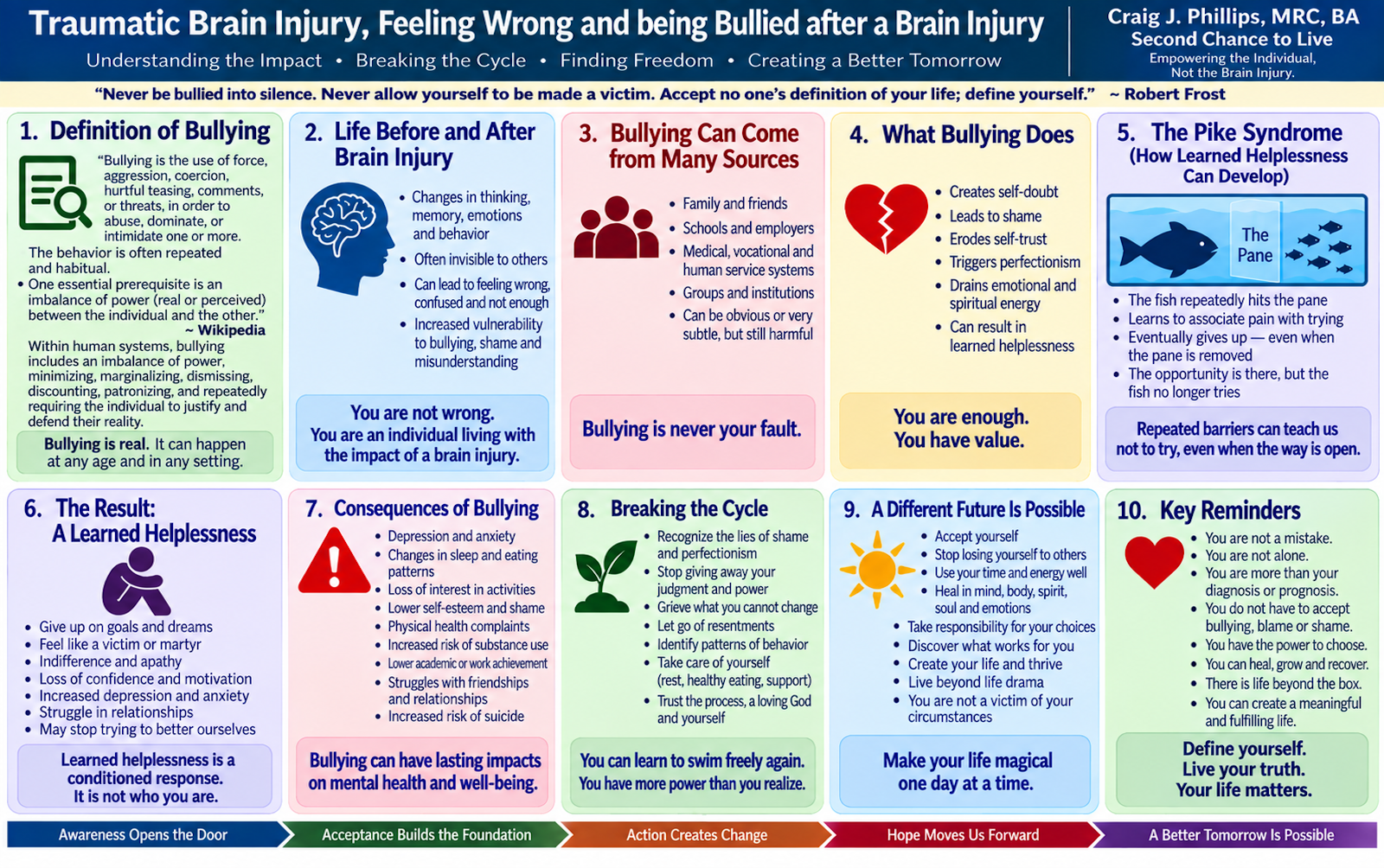
The Pike Syndrome
A aquarium large tank is filled with water. A pane of glass is placed in the tank near one end of the tank. A big fish is released into the water at one end of the tank. At the other end of the tank, on the other side of the pane of glass in the tank, little fish are introduced to the tank. A pane of glass separates the big fish from the little fish. In an interest to get to the food source (little fish) the big fish repeatedly hits the pane of glass.
Over time the big fish begins to associate pain with trying to get to the little fish. After a period of such conditioning the pane of glass is removed separating the big fish from the little fish. Although the big fish can now readily get to the little fish (food source), because of the conditioning associated with trying to get to the little fish, the big fish gives up. The learned helplessness results in the big fish starving to death.
The Pane of Glass — Disappointment and Discouragement
As Individuals living with brain injuries, and many times invisible disabilities we can feel like the big fish in the big tank. The big fish that is trying to get to the little fish to find satisfaction and fulfillment. Satisfaction and fulfillment by achieving our hopes and dreams, yet continue to hit disappointment and discouragement.
Making Our Lives Magical by Not Giving Up Because of the Pane or Pain in Our Lives
Making our lives magical one day at a time by realizing that we have more power than we realize. Realize that we no longer have to or need to feel helpless. That living with a brain injury does not have to leave us feeling as though we have no other choice (s). That we are trapped, like victims of our set of circumstances.
Overcoming a Learned Helplessness
The good news is that we do not have to be limited or be dissuaded by the “pane” of a diagnosis or a prognosis. Like the big fish, we can learn to swim freely. Swim freely to go after what we need to do to improve the quality of our lives, well-beings and relationships. Swim freely to discover what works for us.
Definition of Bullying
“Bullying is the use of force, aggression, coercion, hurtful teasing, comments, or threats, in order to abuse, dominate, or intimidate one or more. The behavior is often repeated and habitual. One essential prerequisite is the perception that an imbalance of physical or social power exists or is currently present.” Wikipedia
Consequences of Bullying
StopBullying.gov — “When bullying happens, everyone who is involved or witnesses it can have lasting impacts on their mental health and well-being. Bullying is linked to many negative outcomes, including increased risks of depression and anxiety, substance use, and suicide.”
- Depression and anxiety disorders, symptoms of borderline personality disorder, changes in sleep and eating patterns, and loss of interest in activities they used to enjoy, like sports teams and clubs.
- Self-esteem issues with feelings of shame that can impact all aspects of kids’ lives.
- Health complaints, including higher rates of headaches, stomach aches, and colds.
- Behaviors, like increased rates of smoking, that increase the risk of future health concerns, like higher stress levels and sleeping problems.
- Decreased academic achievement, like lower GPA, standardized test scores, and school participation. They are more likely to miss, skip, or drop out of school.
- Struggles with friendships and maintaining relationships later in life.
Traumatic Brain Injury, the Bully and Carrying Shame (article)
October 24, 2007 By Second Chance to Live
Hi, and welcome back to Second Chance to Live. I am glad to see you decided to stop by and visit with me. As an individual living with a brain injury, I struggle with a sense of inadequacy at times. At times I listen to messages that seem to challenge me for not being more than I am today. I am encouraged to be more, but for some reason, I simply do not believe I can be more. Innuendos of shame, in these messages, trigger the notion that I am not enough, I don’t do enough and that I am unlovable. Unconsciously, shame seeks to discredit my desire to succeed in life through minimizing, marginalizing, dimissing, discounting and patronizing my best efforts.
Shame seeks to keep me distracted by a faulty.
By a faulty notion that tells me that what I do and who I am is not enough. Shame seeks to keep me in denial. Shame seeks to rob my energy. Shame seeks to silence my efforts through criticism, minimization and marginalization. As a person with a brain injury and an invisible disability, I allowed the message of shame to bully me for many years. The shame bully controlled and manipulated my every move. Shame told me that I was not enough and that my best efforts were never quite good enough. When I attempted to justify, answer, defend and explain myself to the bully, the bully would jeer at me.
The more I attempted to appease the bully; through striving…
Through striving to do more to be enough, the more the bully would remind of the reasons why I felt inadequate and insecure. With time and through my process I began to realize that no matter how much I did to appease the bully, the bully would still abuse me. With time and through my ongoing pain I began to realize what the bully was doing to me. With time and when I got tired of being bullied, I realized that if nothing changed, it would remain the same. Consequently, I made the decision to examine why I believed that I deserved to be bullied. With my decision, I made several other decisions.
I realized that I needed to examine how the bully kept me distracted.
I Needed to Examine
Why I believed that I was a mistake?
Why I believed that my best efforts were never quite good enough?
Why I felt a need to justify, defend, answer and explain myself to the bully?
Why I had such a difficult time living in my own skin?
Finding the Courage and Motivation
Through my recovery process and my pain, I found the motivation and courage to confront the “shame” bully. Through my recovery process I discovered the origins of the lies and how I had been set up to bullied. Through my pain and my recovery process I discovered why I had so readily accepted what I was being told by the bully. Through my recovery process I discovered why I felt minimized and marginalized by the bully. Through my recovery process I discovered how the bully used shame to keep me in denial. Through my process, I discovered that the shame bully echoed the voice of perfectionism, at my every move.
The voice of perfectionism crippled, devalued, minimized. marginalized, dismissed, discounted and patronized who I was and what I had to contribute.
Heal, Grow and Recover in my Mind, Body and Spirit, Soul and Emotions
Through my recovery process and my pain I discovered that my ability to heal and grow in my mind, body, spirit, soul and emotions were hindered by the voice of “fear of failure”. Perfectionism cuts with a two-edge sword. One edge, telling me my efforts were not good enough and that I should not try because I would probably fail. The other edge cute by my feeling less than no matter how hard I tried. Shame also stymied my efforts by threatening me with the fear that I would be abandoned physically and emotionally if I did not do things perfectly. At the core of my being, the fear of abandonment kept me enslaved by the bully.
Because the bully was unrelenting, I had no idea there was life beyond trying to silence the bully. To silence the voice and inunendos of intimidation. To qualify my worth and worth to make sense of my life.
Life beyond the Drama
That there was life beyond the drama created by performing. Performing under the taskmaster of perfectionism and driven by the voice of shame. Consequently, I had no idea how much energy I was using to appease the “voice” and “demands” of the taskmaster in an attempt to avoid being attacked by bullies that shamed me. Through my recovery process and my pain, I began to recognize that my internal energy was being drained in my attempt to avoid being attacked by the bullies.
Through recognizing how shame was draining my life, I was motivated to look for solutions. These solutions helped me to begin to heal in my mind, body, spirit, soul and emotions. Heal in my mind, body, spirit, soul and emotions to be able to use my time and energy. Use my time and energy in ways that would work for me.
Through my recovery process and my pain, I discovered.
I discovered that there were three rules that enforced the power of the bully. For more insight into the three rules, please read my article Don’t Talk, Don’t Trust and Don’t Feel. As I began to learn how to talk, trust and feel my eyes slowly opened. Through my recovery process and my pain, I discovered how the bully gained access to my life and to my world. I discovered how the bully perpetuated the lie. Through my recovery process and my pain, I became aware of what was blocking the peace that I longed for in my life. I found that I needed to do the work to be able to become aware of how the taskmaster.
Undermining and Bullying
The taskmaster called perfectionism was undermining and bullying my life and kept me striving. Striving in an attempt to do more, to be more, in order to be enough. Be enough to be able to accept myself and have peace. With this awareness, I realized that I needed to do the work to be able to move forward. Move forward beyond being aware of how the taskmaster called perfectionism and shame bullied. Bullied and sought to undermine my life, well being and relationships.
I realized that I needed to grow in acceptance of what I could not change, by grieving what I could not change. Change the impact of my brain injury, the taskmaster and the impact that shame had upon my life. By grieving what I could not change, I was able to begin to accept what could not be changed. In the process I was slowly able to move forward with my life, despite the impact that perfectionism and shame was having on my life. Through the process I was slowly able to move to a place of being able to accept.
Accept myself so that I could stop losing myself to others.
Losing Myself
Losing myself in an attempt to not be bullied. In my experience, I found that I had to do the work to gain the acceptance before I could take the action. Take the necessary action to stop being bullied. I discovered that I had to do the work before I could break free of the denial systems that contained the lie. The lie that I had the power to silence the taskmaster and the shame “bully”. Through my recovery process and my pain, I began to realize that I had been living my life through the demands of other people.
The demands that other people had for my life, based on their own.
Based on their own inability to accept. In ability to accept what I could not change, the reality of the impact of living with a brain injury and an invisible disability. Through growing in awareness, I discovered that I had denied my own reality in an attempt to avoid being bullied. Through my recovery process and my pain, I also discovered that over the years I had willingly discarded parts of myself. Discarded part of myself in an attempt to comply with the demands of the bully so as to not be shamed. For more insight, please read my article Displaced/Unresolved Sadness — Why You May be Feeling Depressed?, which is also included in this eBook which is available on Amazon: Understanding and Overcoming Bullying after Brain Trauma eBook
In my experience, I had to begin healing from the effects of shame.
Illusion of Power
I had to break free from the illusion of the “power” that I believed the shame bully had over me. Had over me before I could hope to be able to live life on life’s terms as an individual living with a brain injury and an invisible disability. Through growing in awareness and acceptance I have realized that I am still susceptible and vulnerable to being shamed and bullied. Shamed and bullied when I am hungry, angry, in fear, lonely, tired or sick. Through knowing this about myself I am free to take care of myself when I am hungry, angry, in fear, lonely, tired or not feeling well.
I am able to take care of myself by healthy eating, writing in a journal to process my anger, reach out to trusted friends, getting some extra rest and doing what I need to do when I am feeling sick.
Through being aware and growing in acceptance of how shame lies, distorts and bullies me I was able to address a vital part in my recovery process. A vital part of my recovery process evolved because of my emotional, mental and spiritual pain. Because of my pain and anguish, I was motivated to address both my denial and the denial of family and friends. In my experience, I found that as I addressed my denial and the denial systems of family and friends, I experienced a new freedom.
A freedom to stop fighting with myself and other people for what I was powerless.
Freedom from Self-Reproach
In my experience, I discovered that resentments acted like “locks” on a door that kept me behind. Kept me behind doors that kept me feeling isolated, alienated and in self-reproach. Through my recovery process, I also discovered that my resentments held the keys to those locks. And as long as I held onto those resentments the door remained locked. With this awareness, I realized that I needed to determine who I held resentments towards and why I sought to maintain those resentments. Resentments toward individuals in family, churches, relationships, and institutions.
I needed to examine who I held resentments toward and why so I take the keys held by my resentments to open the doors. Doors to set me free me from isolation, alienation and self-reproach.
Finding Freedom from Resentments
In my desire to be free of my resentments I needed to make a list of the people that I resented. Next, I needed to ask myself a series of questions regarding the people that I resented. I needed to determine what I believed those individuals did to me, how my life was impacted as a result. How my self-esteem, emotions, security, ambitions as well as my personal and sex relationships were affected. Next, I needed to explore how each interaction led to my resentment made me feel? Next, I then needed to determine how I reacted or responded to each of the events, people and situations.
Next, I needed to examine what my part was that led to my resentment (s)? How I contributed to and participated in the event, interaction or situation that led to my resentment. Was I self-fish, dishonest, self-seeking, frightened, inconsiderate, etc.? Lastly, I needed to examine what I did right; if anything, in the event, interaction and situation that led to my resentment. In my experience, I needed to examine specific time periods in my life in order to be able to identify my resentments. Specifically, I needed to examine how I related to my family, friends, educational…
Venues, churches, employers and other significant relationships. Because I wanted to be free of the negative energy that my resentments created, I did an inventory. I did an inventory of my resentments during specific times in my life. I examined as far back as I could remember until I was 6 years of age, then from ages 6-12, 12-18, 18-24, 24-30, 30- 36, 36-42 and so on. I needed to engage in this inventory process in order to identify specific patterns. Specific patterns of behavior as I related (relate) to events, interactions and situations during specific periods of time in my life.
Identifying Patterns
As I examined the way that I related to people places and things I was able to identify specific patterns of behavior. Patterns of behavior that I used to relate both to other people and to myself during those time periods. As I identified patterns in my behavior, I was able to address what was my part, what was not my part and how I could be freed from the negative consequences of my resentments. As a byproduct, I was able to begin to recognize where other people ended and where I began. Consequently, I was able to establish healthier relationships with other people and myself.
What I discovered through letting go of my resentments I found the freedom to explore beyond the box. Beyond the box of expectations that kept me tied to the resentments for not doing more, to be more, to be enough. By letting go and making peace with my resentments I discovered that I was able to use the time and energy that I sought to maintain those resentments. Use the time and energy to discover how to use my creativity. Use my God given creativity to discover, develop and express my gifts, talents and abilities in ways that would work for me to live my purpose.
Through my Process
Through practicing rigorous honesty in my own ongoing recovery process, I was slowly able to stop participating in the dance that told me that I was not OK unless I made everyone OK with me. Through being honest with myself I had several personal awakenings. Awakenings that helped me to get into action to get different results in my life. Through being aware and growing in acceptance I began to realize that I needed to grieve things that I could not change. Things such as the impact of what other people think about me, the impact of my brain injury and my invisible disability.
As I have grieved, I have grown in the awareness of my reality. In the process of becoming aware, I have grown to love and respect myself. I have been able to address, confront and understand the impact of my denial, anger and resentments. I discovered that denial, anger and resentments produce a “spiritual and emotional plaque” that insidiously attached itself to the channels of my creative capacity. The effect of which blocks the flow of my spiritual and emotional energy. I also discovered that as I let go of my resentment, I was able to make peace with both myself and others.
Spiritual and Emotional Energy
I found that as I made peace with other people and with myself the spiritual and emotional energy that I once used to manage my denial, anger and resentments became available. Became available to empower my process. Consequently, I have been able to channel my spiritual and emotional energy in ways to enhance my gifts, talents, and abilities in ways that work for me. By addressing my denial, anger, and resentments I have been able to flush my previously blocked channels so that my spiritual and emotional energy can flow freely, as water through a hose, to nourish.
In my experience, I have found that by addressing the distractions of my denial, anger, and resentments I have been able to keep the focus on what is my business. I have learned to be responsible to rather than for other people and their choices. Consequently, I have been able to keep my side of the street clean in my relationships. I have also discovered the power of choice. Consequently, I no longer need to believe that I am a victim of my circumstances. Instead, I am able to trust the process, a loving God and myself. I am able to get into action and create my life.
Taking action to Get Different Results
Through my recovery process and dealing with my anger and resentments I found myself asking: Are You Living Your Truth or Trying to Live Someone Else’s Truth? Asking this question because traditional employment did not work for me. Did not work for me and after my second Department of Vocational Rehabilitation evaluation determined that I was unemployable. Asking this question after I realized that I had the power to choose to discover what would work for me.

Leave a Reply