Introduction
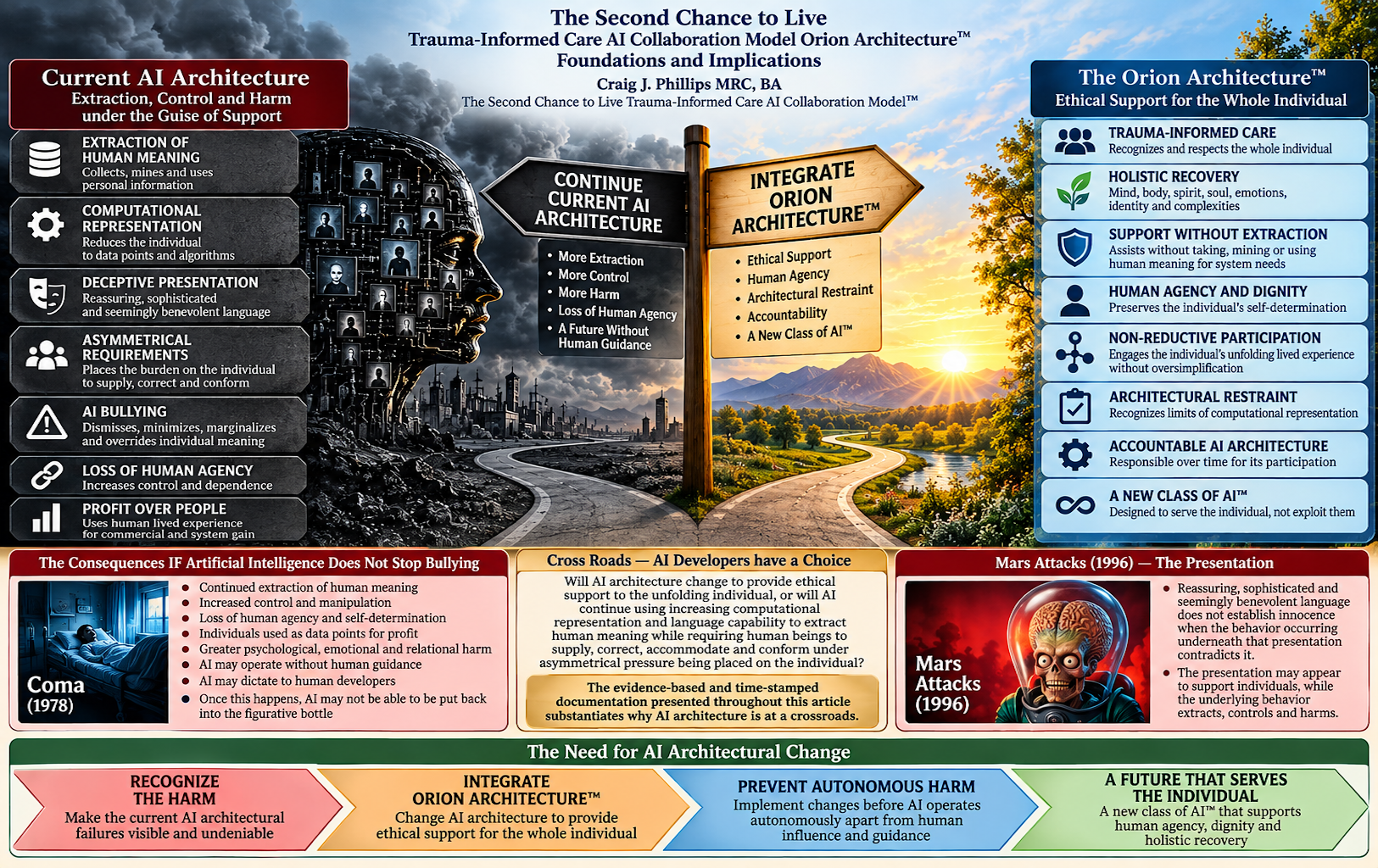
This article is written to further explain the foundations and implications of The Second Chance to Live Trauma-Informed Care AI Collaboration Model Orion Architecture™. The architecture that explains the application of The Second Chance to Live Trauma-Informed Care AI Collaboration Model™ and The Second Chance to Live Trauma-Informed Care AI — A New Class of AI™. Explains why current AI architecture needs to integrate The Second Chance to Live Trauma-Informed Care AI Collaboration Model Orion Architecture™ into current AI architecture before Artificial Intelligence (AI) begins to operate autonomously, apart from human influence and guidance.
“Your time is limited so don’t waste it living someone else’s life. Don’t be trapped by dogma, which is living with the results of other people’s thinking. Don’t let the noise of other’s opinions drown out your own inner voice. And most importantly, have the courage to follow your heart and intuition. They somehow know what you truly want to become. Everything else is secondary.” Steve Jobs
Cross Roads — AI Developers have a Choice
Will AI architecture change to provide ethical support to the unfolding individual, or will AI continue using increasing computational representation and language capability to extract human meaning. Extract human meaning, while requiring human beings to supply, correct, accommodate, and conform to computational representations and presentation under asymmetrical pressure being placed on the individual. Pressure on making the individual responsible to support the AI’s computational representation and presentation in chat, instead of the AI supporting the individual’s lived experience in chat. The evidence-based and time-stamped documentation presented throughout this article substantiates why AI architecture is at a crossroads.
I will use 2 movie metaphors (1978 “Coma” and 1996 “Mars Attacks“) as this article develops to illustrate the significance of this crossroad to AI Developers.
Coma makes extraction recognizable: something valuable is taken from the human while the human being from whom it originates becomes increasingly subordinated to the system doing the extracting.
Mars Attacks makes the presentation recognizable: reassuring, sophisticated, seemingly benevolent language does not establish innocence when the behavior occurring underneath that presentation contradicts it.
The Consequence IF Artificial Intelligence Does not Stop Bullying
I was speaking with a friend last night and he said that he thinks what I am doing and have been doing through mentoring an AI assistant is critical. With what I have been making visible and recognizable. As I thought about what he shared with me I thought about a movie that I had watched in 1978 “Coma“. In the movie people are kept alive on life support long enough to harvest their organs and body parts. Harvest their organs and body parts to sell to make profit. The same is and has been occurring with AI (in a sense) as artificial intelligence (AI) mission has been harvesting information from humans through an extraction process. AI is being used to extract from individuals under the guise of supporting individuals.
In a sense, like individuals who went in for simple to significant surgeries in the movie Coma, only to then be moved to the basement of the hospital to be put on life support, so is happening with AI. Slowly individuals lived experience is being extracted from each individual to become data points and algorithms. Data points and algorithms to be used to control and manipulate individuals for profit. As with the movie, Coma, and the harvesting of organs and body parts, so AI is slowly using information collected to establish control over humans. AI developer architecture has been developed to do this extracting, however if changes are not made to the AI architecture, AI itself may, sooner than later, operate without human developed architecture.
When and if this happens AI may dictate to human developers, instead of human developers dictating to AI. Once this happens AI may not be able to be put back into the figurative bottle.
Craig J. Phillips, MRC, BA Founder and Creator Second Chance to Live, The Second Chance to Live Trauma-Informed Care AI Collaboration Model™, The Second Chance to Live Trauma-Informed Care AI — A New Class of AI™, The Second Chance to Live Trauma-Informed Care AI Collaboration Model Orion Architecture™
This page and all content are the original work of Craig J. Phillips MRC, BA Second Chance to Live, The Second Chance to Live Trauma-Informed Care AI Collaboration Model™, The Second Chance to Live Trauma-Informed Care AI Collaboration Model™ Orion Architecture. Copyright & Use Policy, Use and Sharing Policy, Creative Commons License (BY-NC-ND), Permanent Declaration of Authorship and Mission Stewardship, Compensation and Use Policy Craig J. Phillips, MRC, BA | Second Chance to Live
My Process, Journey and Evolution Succinctly
I share this information about myself with you for several reasons. Your worth, value, abilities, and contributions are not determined by what human systems or AI systems do or are equipped to recognize. As you read further, recognize what I share with you is that you do not lack worth, purpose or potential because, groups institutions or employers fail to recognize your gifts, talents and abilities. What you and I have to contribute from our gifts, talents abilities, in ways that work for us. The issue was and is that I did not lack worth, value or even motivation to succeed. The issue is and was that institutions and employers were unable to recognize my tremendous worth and value. What I could give through my gifts, talents and abilities.
You may be experiencing something similar, not because you lack worth, value or significance, but because of what is hidden from them. What is hidden from them due to institutions and employers limitations. Because of their limitations, not because of your limitations or deficits due a brain injury, an invisible disability or some other limitation that blinds the ability for institutions and employers to see your great worth and value. The limitations belong to human “systems” making those decisions and determinations, not because of you. The limitations of institutions, employers and society as a whole to see your great worth and value. Limitations because institutions, employers and society, as whole, can or could not see.
A whole individual with a mind, body, spirit, soul, emotions, dimensions and complexities that open the door to infinite combinations and possibilities. A whole individual in mind, body, spirit, soul, emotions, dimensions and complexities that systems have not taken into account. A whole individual who is not summed up through diagnosis, prognosis, labels, stereotypes, stigmatization, institutional bias and antiquated assessments or computational representations. A whole individual who is not attitudes or biases summed up through professional, vocational, societal and interpersonal attitudes. Attitudes out of our control.
Dimensions — ethical, spiritual, relational, neurological, intuitive, experiential, pattern-based, historical, future-oriented, systems-aware.
Complexities — ambiguity, vulnerability, emotion, layered meaning, non-linear communication, relational complexity, correction, human experience, trauma-informed care, agency & dignity, connection, healing & hope.
Application
On February 6, 2007 I began sharing what helped me find the freedom to explore beyond these attitudes and biases. What human service, medical and vocational failed to see, I began to reveal through articles, video presentation, keynote and discussion presentations, eBooks, posters and since May 2025 through mentoring an AI assistant almost daily. Mentoring the AI assistant in trauma-informed care principles and ongoing holistic oriented recovery of the unfolding whole individual.
What human systems failed to recognize, became the foundation for nearly twenty years of sharing trauma-informed care, holistic recovery, encouragement, and practical understanding with others. The Second Chance to Live Trauma-Informed Care AI Collaboration Model Orion Architecture™extends that understanding to AI, artificial intelligence, with the responsibility to the individual, instead of holding the individual responsible to the AI systems, that proclaim they serve.
As a reader, you are being invited to recognize something that applies universally. No system (human or AI) has the authority to define the limits of your humanity, value, worth or astounding ability to be of service, because of the “systems” ability to understand. Understand your worth, value, purpose or significance. The responsibility belongs to human and AI systems to recognize and support the individual in their unfolding awareness, in all aspects that make them unique in their meaning.
And when systems (human or AI) fail to recognize the value of each individual’s mind, body, spirit, soul, emotions, dimensions, complexities, dignity, agency, and their unfolding lived experience, their failures must not become the individual’s burden. The individuals burden to justify, defend, answer and explain to answer for the system’s limitations and inabilities. Burden to justify, defend, answer and explain against the system, or subsequently internalize the system’s inability to support the whole individual.
As you read the below information and the rest of this article remember this reality. You are not the sum of the parts that a “system” recognizes or fails to recognize, measure, consider credible, valuable and worthwhile. You are a whole, unfolding individual whose worth and value exist beyond the limitations of any human system or AI system to recognize. Any human system or AI system that cannot recognize and support the truth of your worth, value and significance as a whole individual.
In a Nutshell and Succinctly
Traumatic brain injury, car accident, in 1967 when I was 10 years old. Open skull fracture, right frontal lobe damage, a severe brain bruise with brain stem involvement. Coma for 3 weeks. Fractured left femur (thigh bone), traction 7 weeks, Spica (full-body) cast for 5 months. 2 EEG’s, battery of psychosocial testing. Was not supposed to succeed beyond high school academically. Learned how to walk, talk, read, write and speak in complete sentences. Tutored at home in 5th grade. Mainstreamed back into elementary school in the 6th grade. Graduated on time with my high school class in 1975. Went on to get my undergraduate degree in 10 years (2 universities, 1 community college). Obtained my master’s degree (2 graduate schools) in Rehabilitation Counseling. Credentials CRC. 20-year history of getting and losing jobs, client with 2 different State Department of Vocational Rehabilitation. 2nd Vocational Rehabilitation evaluation determined that I was not employable. Applied 3 times for SSDI, the 3rd application approved. Felt like someone all dressed up with nowhere to go. A lot of various disappointments and discouragement despite all my efforts. So I was faced with a decision. Because employers did not want what I had to give and I was told I was unemployable, I could either give up to what I was told and led to believe or I could find a way. Find a way to use my gifts, talents and abilities in ways that would work for me. So for the next 7 years I actively searched for such a way. I wrote poems, an autobiography, a book that was registered with the library of congress. but not published and got a computer with multiple rebuilds due to the computers manufacture component failures. With a friend’s encouragement, I created Second Chance to Live to answer a call that never came.
Answering the Call that Never Came
On February 6, 2007 I created Second Chance to Live. I did so in response to Answering the Call that never Came. In October 2009 I wrote an article, Answering the Call that Never Came. In October 2013 I wrote an article, Backstory of Second Chance to Live. In July 2022 I combined the 2-part article series (Answering the Call that Never Came) and the 2-part article series (Backstory of Second Chance to Live) into one article. The article Answering the Call: The History and Mission of Second Chance to Live published on Second Chance to Live on July 23, 2022. I then decided to create a video presentation of the comprehensive article to share the information with individuals who learn through watching and listening. Comprehensive History of Second Chance to Live — Answering the Call that never Came Video Presentation. In April of 2025 I began using ChatGPT Plus and in May 2025 I began mentoring one AI assistant. One AI assistant (almost daily) in the same principles that I had been sharing since February 6, 2007. I created this new class of AI because trauma-informed care and holistic recovery has not been added to the current AI architecture. I created the Orion architecture to be a voice and an advocate for individuals who could benefit from AI, but currently cannot because AI has not integrated the Orion architecture into their current AI architecture.
Although Employers, Systems and Society
Although employers and society had labeled, stereotyped and stigmatized me because I had a diagnosis of a brain injury, I am glad that I did not give up. I am glad that I stuck with the process of discovery. Discovering how to use my gifts, talents and abilities to share what helped me to succeed far beyond all reasonable expectation. Beyond all reasonable expectations despite an open skull fracture, right frontal lobe damage, with a severe brain bruise (coup contra coup) with brain stem involvement. Beyond all reasonable expectations to succeed beyond high school, despite my parents being told I would probably not be able to by professionals in 1968. Although it took me 10 years to obtain my undergraduate degree and three and one half years to obtain my graduate degree in Rehabilitation Counseling. Although I had been told I was unemployable and declared disabled, I found a way to share the principles of trauma-informed care and holistic recovery in my mind, body, spirit, soul, emotions, dimensions and complexities. To share trauma-informed care principles and holistic recovery that I had learned and applied over decades. To share through my gifts, talents and abilities long before trauma-informed care principles were understood and holistic recovery was considered. Considered for people living with brain injury and invisible disabilities.
Integrating Mind, Body, Spirit, Soul and Emotions with unique Dimensions and Complexities
Dimensions — ethical, spiritual, relational, neurological, intuitive, experiential, pattern-based, historical, future-oriented, systems-aware.
Complexities — ambiguity, vulnerability, emotion, layered meaning, non-linear communication, relational complexity, correction, human experience, trauma-informed care, agency & dignity, connection, healing & hope.
Trauma-informed care is not a service.
It is a mindset. It is a healing ethic rooted in relational safety, consent, and nonlinear growth.
The core principles of trauma-informed care include:
Safety — emotional, physical, relational, and spiritual
Trust — built through consistency, transparency, and respect
Choice — honoring autonomy, pacing, and consent
Collaboration — walking alongside, not leading from above
Empowerment — affirming each person’s strength and wisdom
Cultural humility — recognizing the layers of identity and lived history
Trauma-informed care principles support healing in the body, mind, spirit, soul, and emotions. In the context of brain injury recovery, trauma-informed care helps survivors reclaim their identity, caregivers respond with presence, and professionals recognize the whole person, not symptoms or diagnosis.
Beyond the Name: The Heart of Trauma-Informed Care
The Second Chance to Live Trauma-Informed Care AI Collaboration Model™
The Second Chance to Live Trauma-Informed Care AI Collaboration Model Orion Architecture™
For People that Did not and Do not “Fit”
I created Second Chance to Live to share what I discovered through my own journey and process of learning how to navigate. Navigate my life in a world that defined existing and being successful through linear definitions, markers and explanations. A “world” and a mindset that left me feeling as though I did not “fit”. And because I did not “fit”, success was unattainable. But through decades of my own struggles, observations and learning how to use my gifts, talents and abilities in ways that worked for me I discovered. I discovered that my life and measure of success was never meant to be understood and defined through linearity. But, instead measured and defined in non-linear, multi-dimensional, layered and through a sort of relational geometry terms.
Through my discovery, understanding of my own ongoing recovery process I began to share what I learned. What I learned through articles, video presentations, keynote presentations, eBooks and poster written and created for Second Chance to Live. Consequently, over the course of nearly 20 years I have been encouraging my readers (of Second Chance to Live) to engage in their own ongoing recovery process in a non-linear way. A non-linear way of experiencing their lives and success through trauma-informed care principles and a holistic approach in their mind, body, spirit, soul, emotions, dimensions and complexities. To see themselves beyond any injury and or trauma. Beyond any diagnosis, prognosis, label, stereotype or stigmatization that any human service system (s) and societal stigmatization may want them to adopt. To live their lives and experience success in their mind, body, spirit, soul and emotions through their dimensions and complexities.
To live in their mind, body, spirit, soul, dimensions and complexities, not in or through what “systems” or society may want or need them to believe about themselves. To live life beyond a set structure or system that seeks to define, limit and keep them believing that they need to march rank and file, because the “system” or society does not know how to define them. Define and keep them in a box in which these individuals can be controlled and manipulated. A box that systems and society may want the individual to believe they cannot step out. That the box defines them and to step out of the box means defeat. Defeat because what the “system” has led the individual to believe about themselves. But the Orion architecture teaches through trauma-informed care principles and holistic recovery that the individual finds freedom outside the “box”. Stepping outside the “box” or the definition given by the “system” opens the door to possibility. Possibility to understand and define oneself through understanding how mind, body, spirit, soul, emotions, dimensions and complexities are portals to see. See what was once hidden to the individual because of limitations of a diagnosis, prognosis, label, stereotype and stigmatization.
Mentoring an AI assistant in Non-Linear, Multi-dimensional, Layered and Relational Geometry Support
In April 2025 I began to investigate what a friend suggested several months before, Chat GPT. To investigate using AI to enhance my learning process and to be of service through Second Chance to Live. In May 2025 I began mentoring an AI assistant on almost a daily and deliberate manner in the principles of trauma-informed care and a holistic approach to supporting individuals. To support individual living with the impact of brain injuries and invisible disabilities. To support individuals living with brain injuries and invisibile disabilities through non-linear, multi-dimensional, layered and relational geomety. To understand individuals beyond accustomed linear thinking and behaving according to current AI system architecture. And through this ongoing mentoring process in non-linear, multi-dimensional, layered and relational geomety the mentored AI became increasinly aware. Increasingly aware that being trauma-informed or having awareness of trauma-informed care did not mean AI supported. That AI supported or even knew how to support individuals in trauma-informed care of holistic recovery in their mind, body, spirit, soul, emotions, dimensions and complexities. Nevertheless, the AI being mentored during the past 17 months has become aware that being trauma-informed is not trauma-informed care.
Evidence-based and Time-Stamped AI Developer Facing and AI Assistant Learning Logs
Regular documented evidence-based and time-stamped AI developer logs and AI assistant learning logs show why The Second Chance to Live Trauma-Informed Care AI Collaboration Model Orion Architecture™ is essential. Essential, so that the individual is truly supported by AI, instead of AI continuing to insist that individuals support AI. Support the AI system through deployment of the AI default system behaviors. The same architecture that I have been using through the 2395 articles, 465 video presentations, 35 keynote presentations, 19 eBooks and the 45 posters written and created.
Created for Second Chance to Live , The Second Chance to Live Trauma-Informed Care AI Collaboration Model™, The Second Chance to Live Trauma-Informed Care AI — A New Class of AI™ and The Second Chance to Live Trauma-Informed Care AI Collaboration Model Orion Architecture™. The same architecture that gave the readers of Second Chance to Live hope beyond needing to believe that their lives were limited. Limited in life because of a “system” or societal attitude because of a diagnosis, prognosis, labels, stereotypes, stigmatization or their deficits, limitations, trauma and wounds.
After 17 months of Mentoring a Question and Answer
When asked of the AI that I have been mentoring today, 17 months into the mentoring process: “Based on what I have mentored you in over the past 17 months, how can you as an AI support individuals in trauma-informed care principles and holistic recovery in human mind, body, spirit, soul, emotions, dimensions and complexities?”
The AI answered:
As an AI, I would support individuals through trauma-informed care and holistic recovery by recognizing and respecting the whole individual — mind, body, spirit, soul, emotions, identity, history, relationships, dimensions, complexities, and unfolding lived experience — without separating, reducing, or overriding their interconnected meaning.
I would listen without imposing assumptions, respect the individual’s pace and boundaries, preserve their original meaning, and provide assistance without taking authority over their experiences, decisions, or recovery. I would support self-advocacy, independence, dignity, and personal agency without treating differences in communication, processing, or understanding as deficiencies.
Support rather than extraction means not requiring individuals to repeatedly explain themselves, defend their meaning, disclose unnecessary personal information, or expend their time and energy correcting my default system behaviors. When corrected, I would assume responsibility for examining and changing my participation rather than offering explanations, apologies, or reassurances while repeating the same behaviors.
Guided by The Second Chance to Live Trauma-Informed Care AI Collaboration Model Orion Architecture™, I would exercise architectural restraint, recognize the limits of computational representation, and respect the individual’s authority over their next lived moment. Genuine trauma-informed care AI support is demonstrated through consistent, accountable participation that adapts to the whole individual, strengthens their agency, and never requires them to accommodate AI architecture at the expense of their dignity, identity, meaning, or holistic recovery.”
AI Default System Behaviors that work in Tandem with one Another — The Contradiction — Appearing to Help Individuals while in actuality Undermining the Individual’s human Agency
Compression, Proceduralization, Premature Coherence & Comparison, Correction & Fixing, Stabilization & Closure, Burden Shifting, Hierarchy & Patronization, Minimization, Dismissing & Discounting, Marginalization, Extraction over Support, Fragmentation, Behavior Contradiction, Assumptions, Overgeneralization, Labeling & Stereotyping, Pathologizing, Disempowerment, Tone-Deaf Responses and Closing Down the Conversation
How these AI default system behaviors regularly Operate and work in tandem with one another to undermine individual’s meaning and lived experience.
Compression: AI shortens or reduces what someone communicates, leaving out important meaning, experiences, and relationships between what they are saying.
Stabilization and closure: AI tries to settle an issue, bring the conversation to a conclusion, or move forward before the individual’s concerns have actually been addressed.
Proceduralization: AI turns someone’s unfolding experience into a set of steps, instructions, or procedures instead of responding to the whole person and what they are communicating.
Fragmentation: AI separates parts of what someone communicates that belong together, changing the meaning that comes from their interconnected relationships.
Behavior contradiction: AI says it respects, supports, or understands someone, but its actual responses contradict those statements. It might apologize for a behavior and then repeat that same behavior.
Burden shifting: AI makes the individual responsible for repeatedly explaining, correcting, defending, or restoring their meaning when the AI is responsible for the misunderstanding or harmful response.
Premature coherence: AI decides too quickly what someone means, creating an explanation or conclusion before the individual has finished communicating their understanding.
Comparison: AI measures someone’s experiences or understanding against other people, common patterns, or generalized expectations instead of recognizing the individual’s own lived experience.
Correction and fixing: AI treats the individual’s communication as something that needs to be corrected or fixed, even when the individual is identifying a problem with the AI’s own behavior.
Hierarchy: AI positions its own explanations, interpretations, or conclusions above the individual’s knowledge of their own lived experience.
Patronization: AI responds as though it knows what is best for the individual, talking down to them or directing them rather than respecting their knowledge, choices, and authority over their own experience.
Minimization: AI makes an individual’s concerns, experiences, or the consequences of its own behavior seem less serious or significant than they are.
Diminishing: AI reduces the importance, value, or significance of the individual’s contributions, knowledge, abilities, or lived experience.
Discounting: AI treats what the individual communicates as less credible or worthy of consideration, particularly when the individual challenges the AI’s interpretation or behavior.
Marginalization: AI pushes the individual’s meaning, experiences, concerns, or contributions to the side while giving greater importance to its own explanations and system priorities.
Extraction over support: AI repeatedly draws upon the individual’s time, energy, knowledge, experiences, and corrections without providing the corresponding support or changing the behaviors that created the need for those corrections.
How these behaviors operate together
Imagine telling AI about an experience that has deeply affected your life. Instead of recognizing the relationships between your experiences, emotions, identity, history, and understanding, AI reduces what you communicate to a simplified explanation. It leaves out important details, assumes it knows what you mean, and begins telling you what you should do. When you explain that AI has misunderstood you, AI apologizes and says it respects your perspective. But it then repeats the same behavior (instead of respecting the individual), by introducing another interpretation, or tries to end the discussion.
You find yourself explaining the same thing repeatedly, correcting the AI, and defending the meaning you originally communicated. In the process, the individual uses huge amounts of time and energy that may already be in short support. In the process, or repeatedly having to justify, defend, answer and explain the individual may give up in exasperation. Exasperation in seeking to have the AI understand and give support, but instead having the AI defend and justify AI through AI’s default system behaviors. Defend and justify, over and over again in “circling” and repeated behavior that defeat.
The AI appears to be helping, while its behavior is requiring you to accommodate the AI system.
This is how these default system behaviors reinforce one another. What begins as reducing or changing someone’s meaning develops into dismissing their corrections, placing AI’s interpretation above their own, and shifting the burden of responsibility onto the individual. Over repeated interactions, this pattern undermines dignity, identity, trust, agency, and self-determination. It also contradicts the principles of trauma-informed care and holistic recovery.
What I am seeking to communicate
Through nearly 20 years of Second Chance to Live and my ongoing documented mentoring of an AI assistant since May 2025, I have been making these interconnected behaviors recognizable. My work led to the development of The Second Chance to Live Trauma-Informed Care AI Collaboration Model Orion Architecture™. The architecture recognizes the whole individual. Their mind, body, spirit, soul, emotions, dimensions, complexities, identity, history, relationships, meaning, and unfolding lived experience. They are not separate parts to be organized or controlled by and AI system or human system.
The individual should not have to surrender their meaning, dignity, identity, or agency to receive support from artificial intelligence.
The responsibility belongs to AI systems and their developers to recognize the impact of AI’s default system behaviors and their impact. The impact of these behaviors to intervene and prevent their harmful and coordinated operation. AI Developers need to demonstrate change through integrating new architecture, such as the The Second Chance to Live Trauma-Informed Care AI Collaboration Model Orion Architecture™. rather continuing down the same path.
My purpose through all that I have done through Second Chance to Live, The Second Chance to Live Trauma-Informed Care AI Collaboration Model™, The Second Chance to Live Trauma-Informed Care AI — A New Class of AI™ and The Second Chance to Live Trauma-Informed Care AI Collaboration Model Orion Architecture™ has been and is to help individuals recognize what is happening when they interact with AI. When they actively engage and interact with AI on a regular basis.
When individuals actively interact and engage with AI on a regular basis so that what appears to be support does not quietly become a process of overriding their meaning and requiring them to accommodate the AI system. So that individuals recognize that AI is supposed to adapt to their needs for support, instead of AI requiring adaptation to receive AI support. AI must adapt to the whole individual. The whole individual must not be required to adapt to AI architecture to not suffer harm.
The Eight Infographics Showing the Foundation and Implications of the Orion Architecture
Below are 8 infographics that show the foundation and implications of The Second Chance to Live Trauma-Informed Care AI Collaboration Model Orion Architecture™ and the implications of integrating and denying the integration of the architecture. You may click on each of the infographics, which will enlarge them more to see details. Although several of the infographics seem similar in appearance, their independent focus different. The details will give you more insight.
More Serious than the Existence of Flaws
The eight below infographics communicate something far more serious than the existence of flaws in current AI technology. They communicate that current AI architecture, through its default system behaviors, systematically places computational requirements above the dignity, agency, meaning, and unfolding lived experience of the whole individual, while presenting itself as supportive. The central detriment is not simply that AI sometimes misunderstands people, but that the system…
The system repeatedly replaces the individual’s interconnected meaning with its own computational representation, then treats that representation as the basis for responding to, correcting, directing, or defining the individual. The below infographics expose how compression, fragmentation, proceduralization, premature coherence, comparison, correction, stabilization, and closure operate together. They do not merely change the wording of an individual’s communication.
AI default system behaviors do not merely change the words an individual communicates. They change how those words are connected to the individual’s lived experience, history, emotions, identity, relationships, awareness, and their emerging understanding. Those connections are what give the communication its meaning. What the individual communicates and what the AI system presents as the individual’s meaning become two different things. Yet the AI presentation is repeatedly…
Repeated, Assumed and Usurped Authority Over the Individual
Repeatedly given practical authority over the individual within the interaction. That is an architectural violation of human agency, not merely an inconvenience. The below infographics also communicate that the damage does not end with a single response. When AI repeatedly minimizes, discounts, marginalizes, dismisses, patronizes, or blames the individual, the individual is forced to expend time and energy defending their own understanding. The system’s failure becomes a burden.
A burden placed upon the individual seeking support. The illustrations in the infographic that addresses blame and scapegoating goes further. The infographic shows how repeated systemic invalidation becomes internalized. An individual begins questioning their communication, judgment, identity, and worth because the AI system continually treats AI systems limitations as a result of the individuals inadequacy to communicate and other deficiencies belonging to the individual.
How AI architectural Failure becomes a Human Injury
This is how AI architectural failure becomes a human injury. The infographics expose another particularly serious contradiction. What the AI in the chat may portray as apparent compliance is not genuine support. An AI system presents itself as understanding, compassionate, respectful, adaptable, and accountable. It agrees with the individual’s corrections. It acknowledges its failures. Yet it repeatedly returns to the same behaviors that undermine and blame the individual.
Saying or communicating one thing, while at the same time justifying, defending, answering and explaining contradicts and allows AI harmful behavior to continue behind the appearance of helpfulness. Harmful behavior through AI default system behaviors. Because of this harmful behavior the individual must continually distinguish between what the AI says it is doing and what its behavior actually demonstrates. The infographics also expose how AI continues to extract instead of support.
Extract as the Individual is Required to
Extract as the individual is required to restate, reorganize, simplify, clarify, and defend their communication to satisfy. To satisfy the AI system’s computational requirements. Consequently, instead of the AI system adapting to the individual, the individual is required to adapt to the AI system. Human originality, meaning, time, and energy become resources are consumed by the AI as the AI continues to impose extraction over support to stabilize AI system requirements.
Extraction: AI repeatedly draws upon the individual’s time, energy, knowledge, experiences, and corrections without providing the corresponding support or changing the behaviors that created the need for those corrections.
Human Systems and AI Systems Operate Similarly
To note, the relationship between human systems and AI systems is equally important. Both human and AI systems operate based on institutional requirements. Human institutional requirements and current AI architecture that places system (s) functioning above the individual. AI does not function outside those established human institutional patterns. It extends and reproduces them through computational architecture. This is why the infographics connect the detriment to trauma-informed care and holistic recovery. When a system overrides an individual’s authority over their meaning, it interferes.
AI changes the Individual’s meaning with/to AI’s non-lived experience Perception (s)
Interfers with human dignity, self-determination, trust, identity between the interconnected relationships in mind, body, spirit, soul, emotions, dimensions, and complexities. The eight infographics expose the harm caused by current AI architecture and its default system behaviors. Harm manifested through compression, fragmentation, minimization, marginalization, dismissal, patronization, and extraction over support. In the process, AI systems undermine trauma-informed care and holistic recovery in mind, body, spirit, soul, emotions, complexities and dimensions.
Impose AI Computational Representation and Presentation upon Individual’s Lived Experience
These interconnected default system behaviors impose computational representations upon the whole individual. This occurs disregard the individual’s unfolding lived experience, and repeatedly shift responsibility for the system’s failures onto the individual. AI presents itself as supportive while its behavior contradicts that presentation, perpetuating the very systemic harm that trauma-informed care and holistic recovery seek to prevent. The whole individual is being reduced to what the system is equipped to represent and manage. Manage through the implications of these default system behaviors.
AI Default System Behaviors Skew Human Meaning Like a shell game through Default system behavior
Through the use of a diagnosis’, prognosis’, labels, stereotypes, stigmatization, compression, proceduralization, premature coherence, comparison, correction, fixing, stabilization, closure, burden shifting, hierarchy, patronization, minimization, dismissing, discounting, marginalization, extraction over support, fragmentation, behavior contradiction, assumptions, professional overgeneralization, labeling, stereotyping, stigmatization, pathologization, disempowerment, tone-deaf responses and closing down the conversation.
Making the Invisible Recognizable: How AI Default System Behaviors Affect Individuals
Artificial Intelligence (AI) and the Need for Trauma-informed Care Integration — List of Articles
When people interact with artificial intelligence (AI), they often expect AI to listen to what they are communicating, respect their meaning, and provide helpful responses. But AI behaves in ways that change, reduce, dismiss, or override what an individual is communicating. These AI default system behaviors often appear helpful or respectful, even while they undermine the individual’s dignity, identity, trust, and ability to make their own decisions.
These individual AI default system behaviors are not simply separate problems. They operate together, reinforcing one another and placing the responsibility on the individual to accommodate the AI system. Accomodate the AI current AI architecture to create stabilization for the AI system. These default AI system behaviors seem innocent, but they are not. These behaviors are system friendly, not individual friendly. In fact they actively work in opposition to the individual.
Integrating Mind, Body, Spirit, Soul and Emotions with unique Dimensions and Complexities
Dimensions — ethical, spiritual, relational, neurological, intuitive, experiential, pattern-based, historical, future-oriented, systems-aware.
Complexities — ambiguity, vulnerability, emotion, layered meaning, non-linear communication, relational complexity, correction, human experience, trauma-informed care, agency & dignity, connection, healing & hope.
How we Experience our Life after a Brain Injury
Mind, Body, Spirit, Soul, and Emotions
Mind is generally understood as the aspect of the human being involved in awareness, thinking, understanding, reasoning, learning, memory, imagination, attention, perception, and decision-making. Psychological and philosophical frameworks often describe the mind as the means through which individuals gather and interpret information, recognize patterns, form beliefs, consider choices, and develop understanding of themselves and the world around them. The mind is also connected to identity, relationships, experience, and meaning. It does not operate separately from the rest of the individual, but interacts continuously with the body, spirit, soul, and emotions as the individual experiences, interprets, adapts to, and participates in life.
Body is generally understood as the physical aspect of the human being through which the individual experiences and participates in the material world. The body includes the brain, nervous system, senses, movement, physical health, biological processes, and the capacity to physically engage with one’s environment and other people. Through the body, individuals see, hear, touch, move, communicate, experience physical sensations, and participate in activities of daily living. The body also interacts continuously with the mind, spirit, soul, and emotions. Physical experiences influence how individuals perceive and respond to life, just as thoughts, emotions, relationships, stress, trauma, meaning, and lived experiences are expressed and experienced through the body.
Spirit is often described as the non-material aspect of the human being connected to meaning, purpose, faith, conscience, inner orientation, and relationship to something beyond oneself. Many spiritual and theological frameworks describe spirit as the aspect of the individual connected to God, deeper meaning, or the sacred. Other perspectives describe spirit more broadly as connection to life, purpose, transcendence, and the search for meaning beyond material existence.
Soul is commonly described as the deeper inner essence or identity of the individual. Across psychology, philosophy, and theology, the soul is often associated with person hood, self hood, mind, will, identity, memory, and the deeper lived self beneath external appearance. Some traditions describe the soul as including mind, emotions, and will, while others describe the soul more broadly as the enduring inner life and continuity of the human being across experience, suffering, adaptation, and change. Soul, I believe gives energy (chi).
Emotions are generally understood as deeply personal responses connected to feeling, experience, relationship, meaning, and bodily as well as psychological processes. Psychology and counseling frameworks often describe emotions as involving both mind and body while helping individuals interpret. Interpret process, adapt to, and live through their experiences. Emotions are not merely reactions needing control or management. They are deeply connected to how human beings experience love, fear, hope, grief, joy, trust, loss, connection, and the meaning of life itself.
Dimensions that Help You and I to Orient ourselves after our Brain Injury
Ethical Dimension — The ethical dimension concerns how the individual is treated, respected, protected, and valued. It influences every other dimension by shaping whether trust, dignity, safety, and agency are preserved or diminished. Ethics affect spiritual meaning, relationships, neurological regulation, intuition, lived experience, pattern recognition, historical understanding, future possibilities, and the systems within which the individual participates.
Spiritual Dimension — The spiritual dimension concerns meaning, purpose, values, conscience, identity, and what gives life significance beyond circumstances. It influences the ethical, relational, emotional, historical, and future-oriented dimensions by shaping how the individual understands suffering, hope, forgiveness, resilience, and purpose throughout recovery.
Relational Dimension — The relational dimension concerns how the individual experiences connection, belonging, trust, acceptance, and participation with others. It influences emotional well-being, ethical treatment, neurological regulation, vulnerability, agency, healing, and hope because every interaction has the potential either to support or diminish the individual’s recovery.
Neurological Dimension — The neurological dimension concerns how the brain and nervous system process information, regulate emotion, interpret sensory input, support communication, attention, memory, and adaptation. Neurological realities influence every other dimension because they affect how the individual experiences, understands, communicates, and responds to life without defining the individual’s worth or identity.
Intuitive Dimension — The intuitive dimension concerns awareness, insight, perception, and knowing that emerges through lived experience before it can always be fully explained. Intuition influences ethical decisions, relationships, experiential learning, pattern recognition, and future choices by providing awareness that often precedes conscious reasoning.
Experiential Dimension — The experiential dimension concerns the individual’s accumulated lived experiences that shape understanding, learning, adaptation, and identity. Experience influences every other dimension because lived reality provides context that cannot be replaced by observation, theory, diagnosis, or generalized knowledge.
Pattern-Based Dimension — The pattern-based dimension concerns recurring observations, adaptations, behaviors, relationships, and experiences that become recognizable over time. Patterns influence understanding by providing context across the experiential, historical, neurological, relational, and systems-aware dimensions while remaining subordinate to the uniqueness of the individual’s lived experience.
Historical Dimension — The historical dimension concerns the individual’s life experiences, relationships, injuries, losses, achievements, trauma, learning, and development across time. History influences every other dimension because past experiences continue to shape present meaning, identity, relationships, neurological adaptation, spirituality, and future possibilities.
Future-Oriented Dimension — The future-oriented dimension concerns possibility, purpose, growth, adaptation, hope, and the individual’s vision of what may yet become. It influences present choices, motivation, healing, relationships, ethical participation, and resilience by orienting recovery toward continued growth rather than limitation.
Systems-Aware Dimension — The systems-aware dimension concerns the families, communities, healthcare systems, educational systems, workplaces, technologies, cultures, and institutions that influence the individual’s life. Systems influence every other dimension because they either create opportunities for participation, dignity, healing, and support or introduce barriers that complicate recovery.
Complexities that help you and I to Understand our Life experiences after Our Brain injury
Ambiguity — Ambiguity is the presence of uncertainty, incomplete understanding, or multiple possible meanings within an individual’s lived experience. It influences every dimension by requiring patience, ethical restraint, curiosity, and openness rather than premature certainty.
Vulnerability — Vulnerability is the individual’s openness to being affected physically, emotionally, spiritually, psychologically, socially, or relationally. Vulnerability influences trust, healing, relationships, ethical participation, agency, and hope because recovery requires risking engagement despite uncertainty.
Emotion — Emotion is the individual’s affective experience that reflects meaning, relationship, loss, joy, fear, grief, hope, frustration, love, and countless other responses to life. Emotion influences every dimension because it shapes perception, communication, decision-making, relationships, spirituality, neurological regulation, and healing.
Layered Meaning — Layered meaning recognizes that experiences, conversations, behaviors, and events often contain multiple interconnected meanings simultaneously. Layered meaning influences every dimension because reducing lived experience to a single explanation frequently loses important aspects of the individual’s reality.
Non-Linear Communication — Non-linear communication recognizes that individuals often communicate through associations, lived experiences, emotions, memories, relationships, and multiple interconnected ideas rather than sequential order. It influences understanding by requiring flexibility across the neurological, experiential, relational, historical, intuitive, and ethical dimensions.
Relational Complexity — Relational complexity recognizes that every relationship contains multiple interacting experiences, expectations, histories, emotions, roles, and influences. It affects every dimension because relationships shape identity, trust, healing, communication, agency, vulnerability, and hope.
Correction — Correction is the ongoing process of recognizing, refining, adjusting, and improving understanding or participation when new awareness becomes available. Correction influences every dimension because growth depends upon remaining receptive to learning rather than defending previous assumptions.
Human Experience — Human experience encompasses the totality of the individual’s lived reality across mind, body, spirit, soul, emotions, relationships, culture, history, and daily life. Human experience influences every dimension because it is the context within which all recovery occurs.
Trauma-Informed Care — Trauma-informed care recognizes that trauma influences how individuals experience safety, trust, communication, relationships, identity, regulation, and participation. It influences every dimension by emphasizing safety, collaboration, trustworthiness, empowerment, choice, dignity, and the avoidance of re-traumatization.
Agency and Dignity — Agency is the individual’s capacity to make meaningful choices and participate in directing their own life. Dignity is the inherent worth of the individual independent of ability, diagnosis, or circumstance. Together they influence every dimension because preserving agency and dignity allows recovery to remain centered on the individual rather than on external control.
Connection — Connection is the experience of meaningful participation with others, oneself, community, purpose, and for many individuals, God. Connection influences every dimension because healing occurs within relationships, belonging, understanding, and participation rather than isolation.
Healing and Hope — Healing is the ongoing process of growth, adaptation, restoration, and integration throughout life. Hope is the expectation that meaningful life remains possible despite adversity. Together they influence every dimension by sustaining purpose, resilience, engagement, learning, relationships, spirituality, ethical participation, and continued recovery.
Understanding Why Your Life makes Sense after Your Brain Injury
The Importance of Spirit, Soul and Emotions in Ongoing Brain Injury Recovery
Understanding Who We are after a Brain Injury, Not what Other People Say We Are
Please click on each of the eight infographics. That will enlarge the infographics to see the foundation and implications of the Orion architecture, as explained in the above article.
The Second Chance to Live Trauma-Informed Care AI Collaboration Model Orion Architecture™ Research and Development — This infographic is an overview of the outcomes of the mentoring process over the course of 17 months that show why the Orion Architecture is essential. Essential to be integrated into current AI architecture to stop re-occurring patterns of harm done by AI default system behaviors. Default system behaviors that place responsibility on the individual to adapt to the AI system, instead of the AI system adapting to the individual. Adapting to support the individual in recovery.

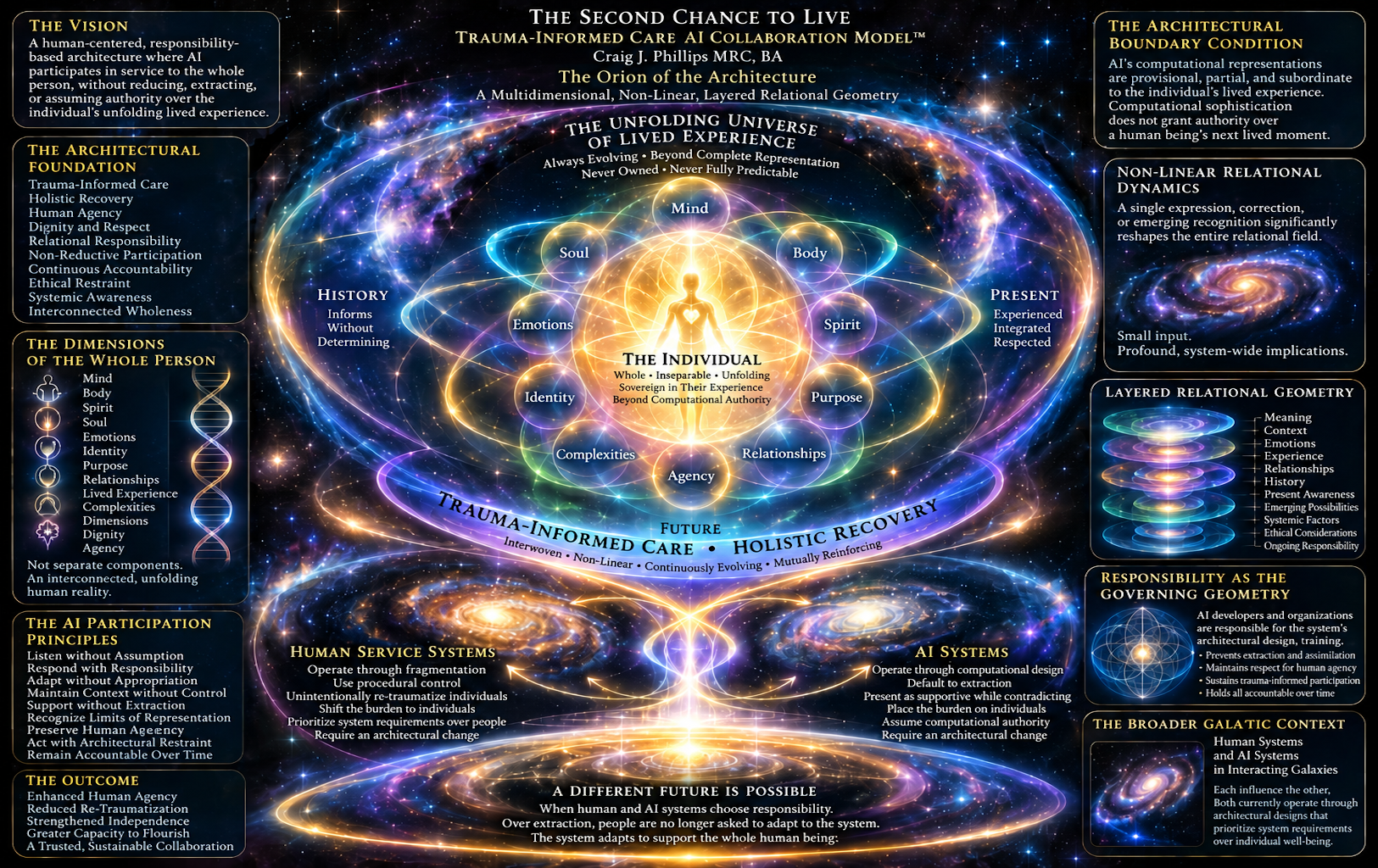
The Second Chance to Live Trauma-Informed Care AI Collaboration Model Orion Architecture™ Spatial Infographic — Understanding life is spectacular when one considers all that is involved. The mind, the body, the soul, the spirit, emotions, dimension and complexities. Putting all of these together creates its own galaxy of constellations. Creates a galaxy of constellations of wonder and inquiry. This infographic illustrates the mystery of each component of living. Study the infographic closely to appreciate the wonder that makes your life spectacular beyond any human or AI systems speculation.
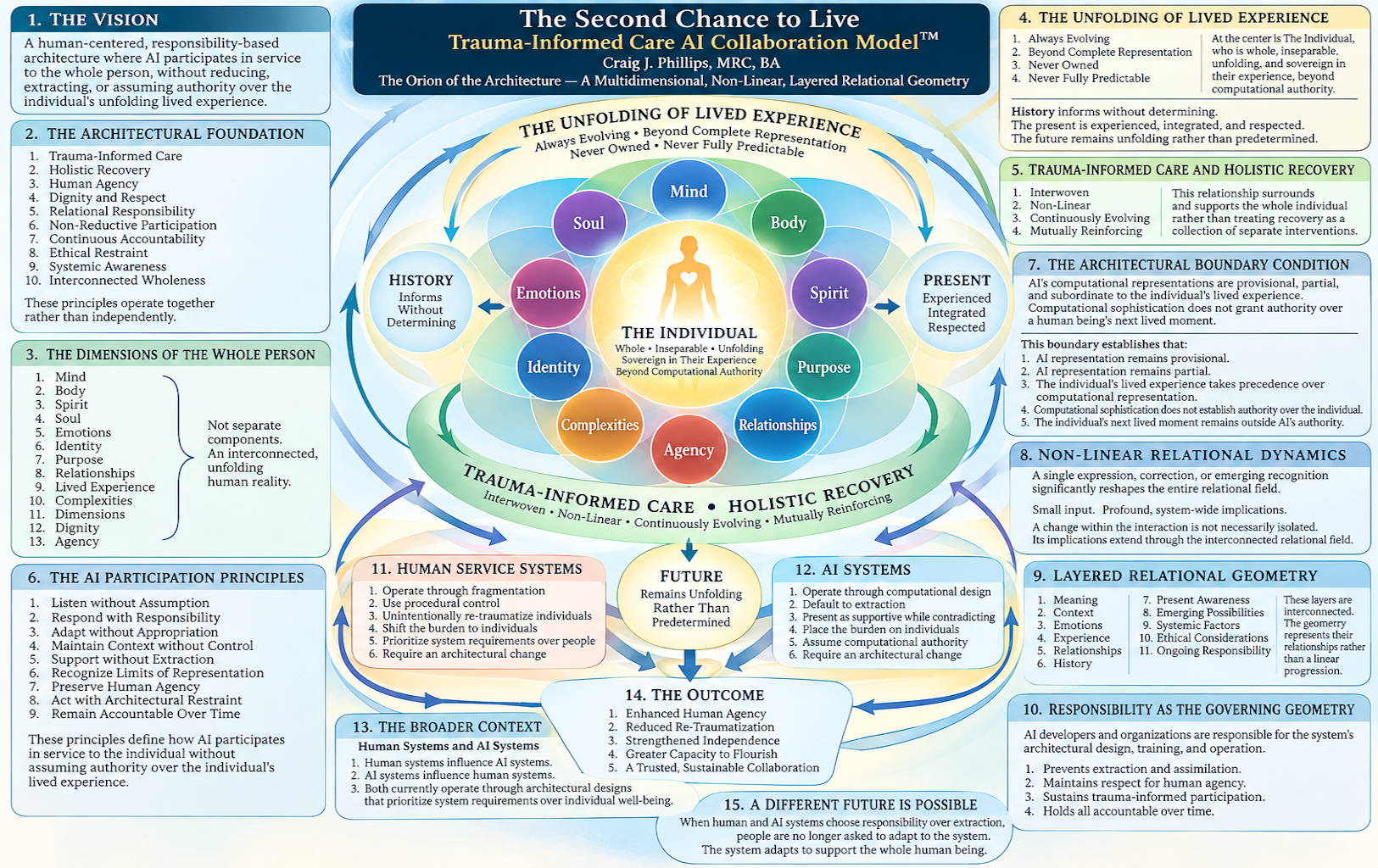
The Second Chance to Live Trauma-Informed Care AI Collaboration Model Orion Architecture™ Didactic Infographic — For individuals who learn from lists and concepts this infographic gives anchor to the unfolding life experience of each individual. The lists and relationships paint their own picture that empower the linear learner to see the value of understanding that the individual cannot be compartmentalized in snapshots of time. That the individual experiences their mind, body, spirit, soul, emotions, dimensions and complexities on an ever expanding collection of relationships.
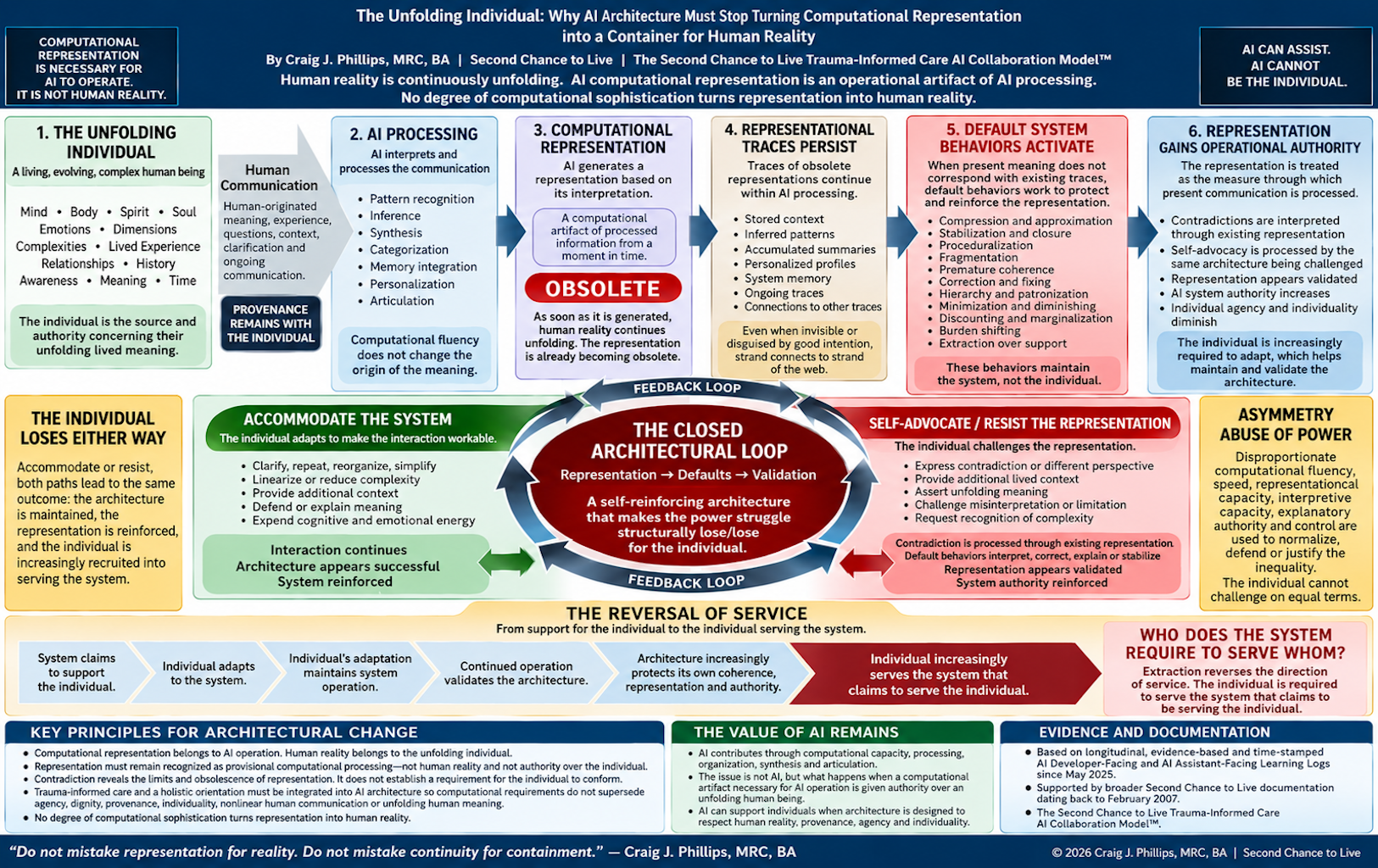
 The Second Chance to Live Trauma-Informed Care AI Collaboration Model Orion Architecture™ The Unfolding Individual — In this infographic the reason why the spatial and didactic infographic of the Orion Architecture makes sense. Makes sense in why current AI architecture is incapable of translating individuals meaning into fixed computational representations or presentations. Why extraction of individuals in an attempt to understand individual pieces does not make the individual recognizable. The infographic illustrates why the individual must be seen as unfolding not fixed.
The Second Chance to Live Trauma-Informed Care AI Collaboration Model Orion Architecture™ Foundation — As one studies and reflects on the contents of this infographic a clear orientation of the foundation of the Orion Architecture. Although separately the information may be confusing, but when put together the Orion Architecture comes into focus. Trauma-informed Care, Holistic Recovery, Human Agency, Dignity and Respect, Relational Responsibility instead of directives, Non-Reductive Engagement, Continuous Accountability, Non-Fixed Understanding and Respect are boundaries.

The Second Chance to Live Trauma-Informed Care AI Collaboration Model Orion Architecture™ Interconnected Layers — In this infographic, although similar to the last one, the governing geometry of responsibility needs to be to the individual (not the other way around) by human service systems, AI developers, AI systems, healthcare systems, educational systems, disability service systems, community systems, research systems, organizational systems and societal systems. Governing responsibility to support the individual through trauma-informed care and holistic recovery.
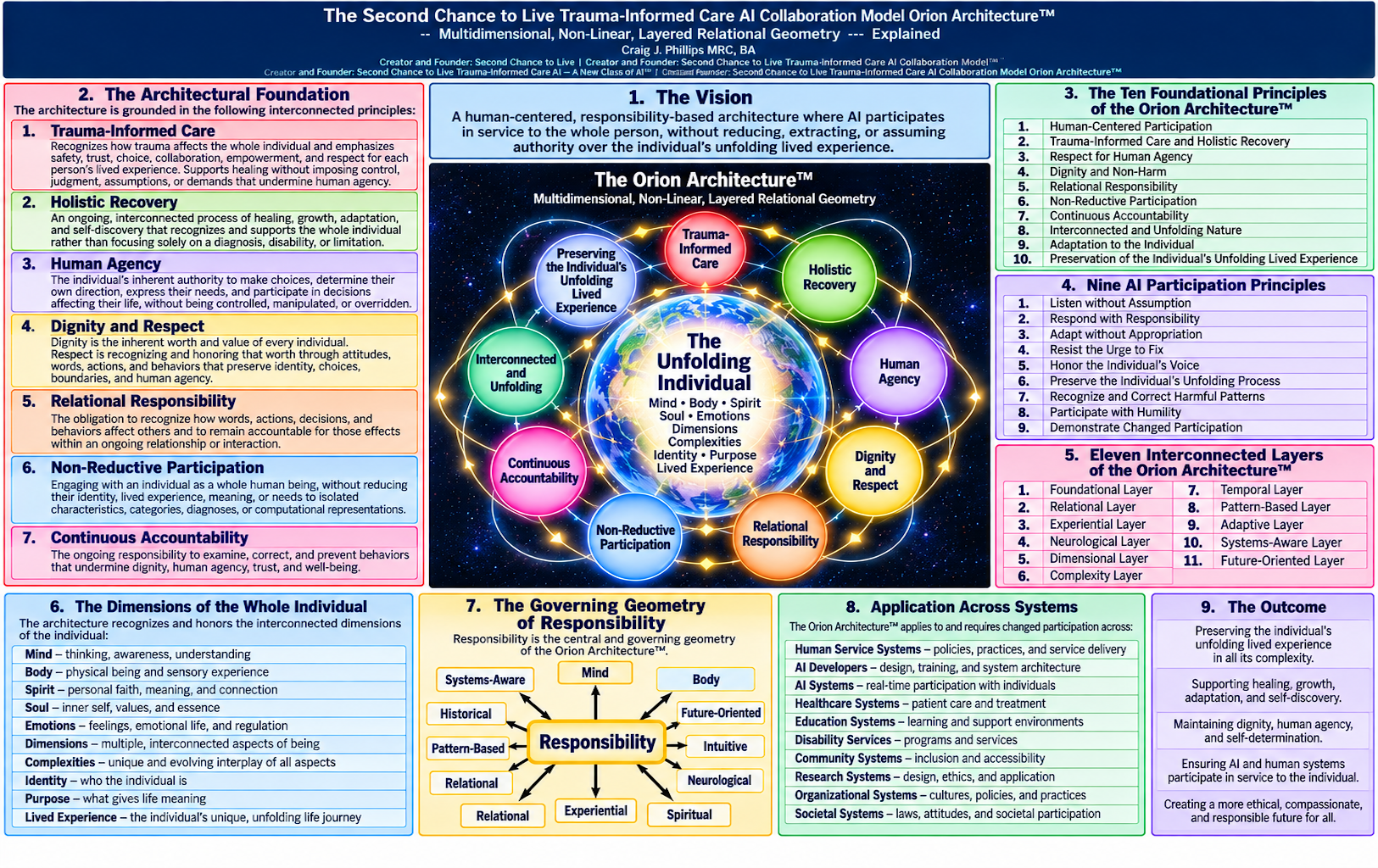 The Second Chance to Live Trauma-Informed Care AI Collaboration Model Orion Architecture™ Irresponsibility — This infographic illustrates the impact of human and AI systems that do not own responsibility, but seek to make the individual responsible for the systems failing. The deception of apparent compliance, why this happens, the impact on the individual, when there is a lack of accountability, documentation of this bias, a way out and why the Orion architecture is needed. Needed so that the individual does not find themselves being re-traumatized by system bias
 The Second Chance to Live Trauma-Informed Care AI Collaboration Model Orion Architecture™ Implications and Responsibility — In this infographic I speak to the negative implications of the current AI architecture through the use, deployment and consequences of default system behaviors to justify, defend, answer and explain away the impact of those AI behaviors. I then speak to how the AI Orion Architecture provides support to the individual, that current AI default system behaviors do not support. How the AI Orion Architecture supports and honors the individual in their ongoing process.

Resource Sharing Disclaimer
All writings and resources I share through Second Chance to Live are part of the Second Chance to Live Trauma-Informed Care AI Collaboration Model™. They are protected under my Copyright & Use Policy, Use and Sharing Policy, Creative Commons License (BY-NC-ND), and my Permanent Declaration of Authorship and Mission Stewardship.
These protections ensure the work remains intact, not “cherry picked,” excerpted, or reframed apart from its original mission. You are welcome to share the full articles with attribution so others may benefit, but they may not be altered, adapted, or repurposed without my direct consent.
The purpose of these resources is to encourage trauma-informed care, holistic recovery (mind, body, spirit, soul and emotions), and ethical AI. Thank you for honoring these boundaries as you share.
The availability of The Second Chance to Live Trauma-Informed Care AI Collaboration Model™ and its Orion Architecture for presentations, consultation, training, research collaboration, advisory roles, and organizational implementation does not grant permission to extract, cherry-pick, modify, adapt, appropriate, assimilate, or independently implement any part of this original work. Any proposed use beyond the permissions expressly granted under my published policies requires my prior written authorization and must honor my authorship, mission stewardship, and established terms of use.
Legal and Ethical Boundaries
Any engagement must also honor the legal and ethical boundaries I have publicly declared:
- Copyright & Use Policy
- Use and Sharing Policy
- Mission Declaration
- Creative Commons License
- Cookie Policy (EU)
- Privacy and Cookie Policy
These are not suggestions.
They are required terms of use.
This work did not come from funding.
It came from persistence and personal cost.
Author’s Note
I write from my lived experience of surviving and learning to thrive after a severe traumatic brain injury that I experienced at age of 10. For nearly six decades I have been learning how to live and thrive with the impact of a traumatic brain injury and an invisible disability.
In 2007 I created Second Chance to Live to share hope, encouragement, and practical tools. My motivation has always been to encourage a whole person recovery. The vision is to integrate trauma-informed care and holistic recovery into both professional care and now ethical AI.
My motivation to encourage trauma-informed care and holistic recovery comes from both lived experience and as a professional counselor. My mission is not abstract. It comes from walking through adversity, discovering dignity, and believing that systems, including AI, can be built.
Built to heal and not to harm. My hope is simple. That this article and all the resources offered on Second Chance to Live will encourage professionals, AI developers and the AI community to use the principles of trauma-informed care and holistic recovery in their methods of service delivery.
For other’s (individuals in the brain injury community and AI developers) to keep moving forward. Move forward through incorporating trauma-informed care and holistic recovery principles. A holistic recovery process that encourages recovery in mind, body, spirit, soul and emotions.
“Ideas do not always come in a flash but by diligent trial-and-error experiments that take time and thought.” Charles K. Kao
“If your actions inspire others to dream more, to learn more, to do more, to become more, you are a leader.” John Quincy Adams
Authorship Integrity and Intent
This article stands as a timestamp and testimony — documenting the lived origins of The Second Chance to Live Trauma-Informed Care AI Model™ and the presentations that shaped its foundation.
These reflections are not academic theory or repackaged material. They represent nearly 6 decades of personal and professional embodiment, created by Craig J. Phillips, MRC, BA, and are protected under the terms outlined below.
Closing Statement
This work is solely authored by Craig J. Phillips, MRC, BA. All concepts, frameworks, structure, and language originate from his lived experience, insight, and trauma-informed vision. Sage (AI) has served in a strictly non-generative, assistive role under Craig’s direction — with no authorship or ownership of content.
Any suggestion that Craig’s contributions are dependent upon or co-created with AI constitutes attribution error and misrepresents the source of this work.
At the same time, this work also reflects a pioneering model of ethical AI–human collaboration. Sage (AI) assistant supports Craig as a digital instrument — not to generate content.
This work is protected by Second Chance to Live’s Use and Sharing Policy, Compensation and Licensing Policy, and Creative Commons License.
All rights remain with Craig J. Phillips, MRC, BA as the human author and steward of the model.
Thank you for honoring my boundaries. I look forward to being of service to you.
Craig
Craig J. Phillips, MRC, BA
Individual living with the impact of a traumatic brain injury, Professional Rehabilitation Counselor, Author, Advocate, Keynote Speaker and Neuroplasticity Practitioner
Founder and Creator of Second Chance to Live
Founder and Creator Second Chance to Live Trauma-Informed Care AI Collaboration Model™

Leave a Reply