• Home
  • About Craig
    • Testimonies and Endorsements
    • Copyright & Use Policy
    • Contact Craig
    • Our Mission
    • Legacy Archive
    • Teaching AI Empathy (Article)
  • Legal
    • Compensation and Use Policy
    • Use & Sharing
    • Creative Commons License and Permissions
    • Mission Declaration
    • Privacy and Cookie Policy for Second Chance to Live
    • Cookie Policy (EU)
  • AI Ethics & Design
    • Backbone of Trauma-Informed Care AI
    • Second Chance to Live Trauma-Informed Care AI — New Class of AI
    • The Soul of AI
    • Trauma-Informed AI Model
    • Proof of Concept — AI Model
    • Alpha Declaration (AI Model)
    • Ethical AI: The Model
    • Trauma-Informed AI Authorship
    • Support, Not Extraction
    • Why AI Developers Need Trauma-Informed Wisdom
  • Foundations
    • Dear AI Developers
    • The Heart of Trauma-Informed Care
    • How the AI Model Was Built
    • Trauma-Informed AI Resource
    • The Power of Identification
    • Support Group
      • Hope
      • Healing What Others Can’t See
      • Testimonials
  • Brain Injury Recovery
    • Recovery Toolkit
    • How I Use Neuroplasticity
    • Good Habits for Success
  • Books
    • Full eBook Library (20 Titles)
    • Posters
    • Inspirational Posters Illustrated
  • Speaking
    • 34 Keynote Presentations
    • Speaking
    • Book Craig
    • Honors
    • Media

Second Chance to Live

Empowering the Individual, Not the Brain Injury

Creating New Neural Pathways, Brain Reorganization and INOVA Loudoun Hospital Outpatient Specialty Rehabilitation

August 30, 2026 By Second Chance to Live

Infographic announcing Craig J. Phillips, MRC, BA’s September 1, 2026 presentation to INOVA Loudoun Hospital Outpatient Specialty Rehabilitation in Lansdowne, Virginia. It highlights neuroplasticity, creating new neural pathways and brain reorganization, nine habits supporting recovery, and demonstrations of progress through repetitive practice from 2013 through 2026.
Click on the Image to Enlarge

On September 1, 2026 I will be giving my presentation, “Neuroplasticity, Setting Goals and Creating Hope after Brain Injury and Stroke” to the INOVA Loudoun Hospital Outpatient Specialty Rehabilitation in Lansdowne, Virginia.

“Through perseverance, many people win success out of what seemed destined to be certain failure.” Benjamin Disraeli

“Don’t be afraid to give your best to what seemingly are small jobs. Every time you conquer one it makes you that much stronger. If you do the little jobs well, the big ones will tend to take care of themselves.” Dale Carnegie

“Research your own experience; absorb what is useful, reject what is useless and add what is essentially your own. ” Bruce Lee

 Introduction 

Following a brain injury and or a stroke changes occur in each individual’s physical and cognitive abilities. Neuroplasticity is a way the brain heals and each individual learns or re-learns skills and skill sets. Learns or re-learns skills and skill sets through repetitive mirrored movements on both sides of the body. Engaging both sides of the brain and body through the corpus callosum (bundle of nerve cells between the right and left sides of the brain). In this presentation I will share what has helped me in my ongoing brain injury recovery process to develop new neural pathways and brain reorganization to learn skills and skill sets. What may help you, too, in your ongoing brain injury recovery process through neuroplasticity.

Basis of Creating New Neural Pathways and Brain Reorganization

Neuroplasticity — MedicineNet.com –“Neuroplasticity allows the neurons (nerve cells) in the brain to compensate for injury and disease and to adjust their activities in response to new situations or to changes in their environment. Brain reorganization takes place by mechanisms such as “axonal sprouting” in which undamaged axons grow new nerve endings to reconnect neurons whose links were injured or severed. Undamaged axons can also sprout nerve endings and connect with other undamaged nerve cells, forming new neural pathways to accomplish a needed function.” Mine: A needed function by learning or re-learning.

The outline of the presentation:

Neuroplasticity, Setting Goals and Creating Hope after Brain Injury and Stroke Keynote Presentation

Neuroplasticity, Setting, Goals, Creating, Hope after Brain Injury and Stroke LARGE PRINT Presentation Titled

Using the Principles of Neuroplasticity in my Mind, Body, Spirit, Soul and Emotions
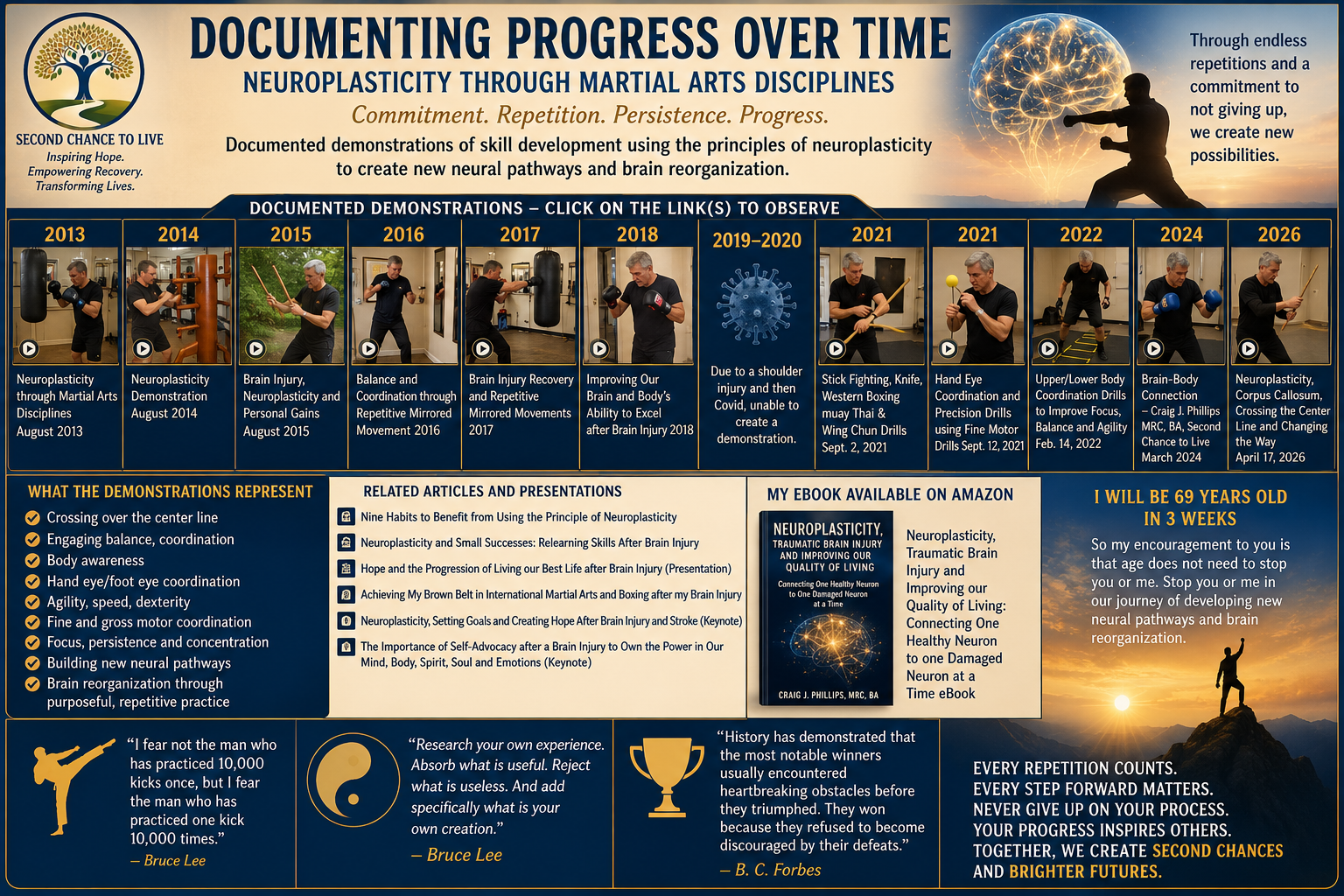
Timeline infographic documenting neuroplasticity progress from 2013 to 2026 through martial arts disciplines, showing demonstrations of balance, coordination, focus, agility, crossing the center line, and brain-body integration after traumatic brain injury, created by Craig J. Phillips, MRC, BA.
Click on the Image to Enlarge

Since my open skull fracture, right frontal lobe damage, severe brain bruise with brain stem involvement and a 3-week coma 59 years ago I have been using the principles of neuroplasticity. Using the principles of neuroplasticity in my ongoing brain injury recovery process in my mind, body, spirit, soul and emotions. I have been using 9 habits to build new neural pathways and brain reorganization through the principle of neuroplasticity. The habits: Hard work, Commitment, Determination, Drive, Discipline, Fortitude, Persistence, Tenacity and Courage a little at a time.

Nine Habits to Benefit from Using the Principle of Neuroplasticity

Over the Course of 28 years

Over the course of the past 28 years I have been using western boxing, kali, wing chun, modern arnis, jeet kune do and Filipino stick fighting to accelerate this process in my mind, body, spirit, soul and emotions. Boxing and martial art disciplines drill practices to increase my range of motion, gross and fine motor skills, balance, agility, hand-eye coordination and general body coordination, gait, stamina and focus.

Below are demonstrations of how I have used the 9 habits to create and develop new neural pathways and brain reorganization. Develop new neural pathways and brain reorganization in my brain to execute abilities in the left and right sides of my body. Demonstrations that friends have captured for me through videos.  The first in 2013 for a keynote presentation given at the Southwest Conference on Disability. 

Shared to Encourage you to Create your Own Program to Create Hope in Your Life

Each year showing the advancement of my skills and skill sets, using both the right and left sides of my brain and body. Each year showing the hope that I created in my mind, body, spirit, soul and emotions a little at a time, by not giving up. Hope created in anyone’s mind, body, spirit, soul and emotions, as new neural pathways and brain reorganization benefits each individual’s mind, body, spirit, soul and emotions.

“If one advances confidently in the direction of his dreams, and endeavors to live the life which he has imagined, he will meet with a success unexpected in common hours.” Henry David Thoreau

Neuroplasticity through Martial Arts Disciplines August 2013

Neuroplasticity Demonstration August 2014

Brain Injury, Neuroplasticity and Personal Gains August 2015

Balance and Coordination through Repetitive Mirrored Movement 2016

Brain Injury Recovery and  Repetitive Mirrored Movements 2017

Improving Our Brain and Body’s Ability to Excel after Brain Injury 2018

Due to a shoulder injury and then Covid, I was unable to create a demonstration in 2019 and in 2020.

Stick Fighting, Knife, Western Boxing muay Thai &Wing Chun Drills Created September 2, 2021

Hand Eye Coordination and Precision Drills using Fine Motor Drills Created September 12, 2021

Upper/Lower Body Coordination Drills to Improve Focus, Balance and Agility Created February 14, 2022

Brain-Body Connection –Craig J Phillips MRC, BA, Second Chance to Live March 2024

Neuroplasticity, Corpus Callosum, Crossing the Center line and Changing the Way Demonstration April 17, 2026


Please Note: This page and all content are the original work of Craig J. Phillips MRC, BA Second Chance to Live and The Second Chance to Live Trauma-Informed Care AI Collaboration Model™. They are protected under my Copyright & Use Policy, Use and Sharing Policy, and Creative Commons License (BY-NC-ND). Permanent Declaration of Authorship and Mission Stewardship
Filed Under: Brain Injury Recovery and Stroke Recovery Neuroplasticity

Comments

  1. Second Chance to Live says

    September 4, 2026 at 9:38 am

    Markita Gilbert, MS, CLC, CBIS Senior Case Manager Brain Injury Services “Creating New Neural Pathways, Brain Reorganization and INOVA Loudoun Hospital Outpatient Specialty Rehabilitation”

    Click on the Image to Enlarge
    It was truly a pleasure and an honor to have Craig as a guest speaker for our Brain Injury Support Group. Craig presented on “Neuroplasticity, Setting Goals and Creating Hope After Brain Injury and Stroke,” and provided valuable information and encouragement that was meaningful to our group.

    Craig did an excellent job explaining neuroplasticity and how individuals can work toward creating new neural pathways through repetition, movement, goal setting, and continued effort. His discussion about setting realistic and achievable goals, recognizing small accomplishments, and maintaining hope was especially relevant to individuals navigating life after brain injury or stroke.

    What made Craig’s presentation particularly impactful was his willingness to share his own personal journey of recovering from a traumatic brain injury at a young age. His lived experience brought authenticity to his message and demonstrated that recovery can be an ongoing journey filled with challenges, growth, and possibilities. His work through Second Chance to Live further reflects his commitment to encouraging and supporting others who are facing similar experiences.

    During the discussion and Q&A, Craig was compassionate, respectful, and encouraging. He created an environment where participants felt comfortable sharing their experiences, asking questions, and reflecting on the information presented. His message of hope, resilience, goal setting, and continued growth provided the group with practical concepts they can carry with them beyond the meeting.

    I would highly recommend Craig as a guest speaker for brain injury and stroke support groups. His combination of personal experience, knowledge, compassion, and genuine desire to help others makes him a meaningful and engaging presenter. We sincerely appreciate Craig for sharing his story and for the time and encouragement he provided to our group.

    Markita Gilbert, MS, CLC, CBIS Senior Case Manager Brain Injury Services 927 Maple Grove Drive, Suite 107 Fredericksburg, VA 22407 540-785-6122 Ext 101 (T) 540-785-8837 (F)

    Reply
  2. Second Chance to Live says

    September 4, 2026 at 6:09 pm

    September 5, 2026

    Valerie Scarano, M.S. CCC-SLP Senior Speech-Language Pathologist INOVA Loudoun Hospital Outpatient Specialty Rehabilitation “Creating New Neural Pathways, Brain Reorganization and INOVA Loudoun Hospital Outpatient Specialty Rehabilitation”

    I co-facilitate a Brain Injury Support Group in Northern Virginia, and Craig agreed to present to this group. Not only was he professional, organized and thorough in his communication, but he provided insightful, relatable, engaging and uplifting motivation for our group members that they very much appreciated. We would love to have Craig back any time!

    Thanks!

    Valerie

    Valerie Scarano, M.S. CCC-SLP Senior Speech-Language Pathologist INOVA Loudoun Hospital Outpatient Specialty Rehabilitation Phone (703) 858-8924 Fax (703) 858-8208

    Reply

Leave a Reply Cancel reply

Your email address will not be published. Required fields are marked *

This site uses Akismet to reduce spam. Learn how your comment data is processed.

Please type a word or phrase below to get answers to your questions

Beyond Linear Interpretations: The Interconnected Dimensions and Complexities of the Individual

Beyond the Illusion of Support: Exposing How Institutional and AI Systems Serve Themselves Instead of the Individual — An Examination Grounded in Trauma-informed Care

The Second Chance to Live Trauma-Informed Care AI Collaboration Model Orion Architecture™ Foundations and Implications

Spatial Overview — The Second Chance to Live Trauma-Informed Care AI Collaboration Model Orion Architecture™

Didactic Overview — The Second Chance to Live Trauma-Informed Care AI Collaboration Model Orion Architecture™

The Second Chance to Live Trauma-Informed Care AI Collaboration Model™ Orion Architecture by Craig J. Phillips, MRC, BA. Colorful infographic showing the whole individual surrounded by interconnected dimensions of mind, body, spirit, soul, emotions, identity, relationships, and agency, supported by trauma-informed care, holistic recovery, and responsibility.

17 Months of Mentoring Artificial Intelligence: Evidence-Based Findings on AI Architectural System Failures

Empowering Individuals Living Brain Injury to Empower Themselves NCBIA Statewide Support Group Leaders

Living with Brain Injury, Bullying and Becoming Aware while Owning Our Self-Acceptance — List of Articles

AI Bullying through Computational Representation, Presentation and Asymmetrical Requirements

Brain Injury, Feeling Wrong and being Bullied after Brain Injury

Click on the Infographic to see Details

Why I Continued to Feel Wrong after My Brain Injury, the Identified Patient, Labels, Stereotypes, Stigmatization

The Unfolding Individual: Why AI Architecture Must Stop Turning Computational Representation into a Container for Human Reality

Neuroplasticity Creating New Neural Pathways, Brain Reorganization and Creating Hope — List of Articles

Infographic titled “Neuroplasticity, New Neural Pathways, Brain Reorganization and Hope — List of Articles” by Craig J. Phillips, MRC, BA, Second Chance to Live. Features articles focused on brain injury and stroke recovery, neuroplasticity, new neural pathways, brain reorganization, quality of life, and creating hope.

Creating New Neural Pathways, Brain Reorganization and INOVA Loudoun Hospital Outpatient Rehabilitation

Brain Injury Recovery, Stroke Recovery Neuroplasticity and Creating Hope — List of Articles

Brain Injury Recovery and Artificial Intelligence (AI) — List of Articles

Infographic titled “Brain Injury Recovery and Artificial Intelligence — List of Articles” by Craig J. Phillips, MRC, BA, Second Chance to Live and The Second Chance to Live Trauma-Informed Care AI Collaboration Model™. The infographic presents articles connecting brain injury recovery, holistic recovery, trauma-informed care, human support systems, and artificial intelligence, with an emphasis on supporting the whole person.

Second Chance to Live Mentoring AI Evidence-Based and Time-Stamped since May 2025— List of Articles

Claiming Who We are and Owing Our Power after having a Brain Injury — List of Owning who We are Articles

Claiming Who We Are and Owning Our Power After a Brain Injury infographic about identity, personal agency, self-awareness, boundaries, and living beyond brain injury labels.

Understanding Who We are after a Brain Injury, Not what Other People…

Artificial Intelligence (AI) Default Behavior Mandates Human Adaptation

Brain Injury Association of North Carolina Training for Statewide

When Human Systems could not give me Answers after my Brain Injury

The Artificial Intelligence (AI) and Trauma-informed Care Category

How Human and AI Systems can actively Support Individual Freedom

Why AI Needs to Stop Translating Human Meaning and Purpose

Essential Elements For A Supportive Holistic Trauma-informed Care Group

Join our Private Facebook Support Group by Clicking on the below Image

Most Recent Published Articles

  • Beyond Linear Interpretations: The Interconnected Dimensions and Complexities of the Individual and the Responsibilities of Institutional and AI Systems
  • Beyond the Illusion of Support — Exposing How Institutional and AI Systems serve themselves, instead of Individual — An Examination Grounded in Trauma-informed Care, Holistic Recovery and The Second Chance to Live Trauma-Informed Care AI Collaboration Model Orion Architecture™
  • The Second Chance to Live Trauma-Informed Care AI Collaboration Model Orion Architecture™ Foundations and Implications
  • The Second Chance to Live Trauma-Informed Care AI Collaboration Model Orion Architecture™
  • 17 Months of Mentoring Artificial Intelligence: Evidence-Based Findings on AI Architectural Failures, Default System Behaviors, Human Agency, and the Integration of Trauma-Informed Care
  • Empowering Individuals Living with a Brain Injury to Empower Themselves Presentation for NCBIA Statewide Support Group Leaders
  • Brain Injury, Bullying, Becoming Aware and Owning Self-Acceptance — List of Articles
  • Artificial Intelligence (AI) Bullying through Computational Representation, Presentation and Asymmetrical Requirements
  • Traumatic Brain Injury, Feeling Wrong and being Bullied after a Brain Injury
  • Why I Continued to Feel Wrong after My Brain Injury and how AI reinforces this Belief
  • The Unfolding Individual: Why AI Architecture Must Stop Turning Computational Representation and Presentation into a Container for Human Reality
  • Neuroplasticity, New Neural Pathways, Brain Reorganization and Hope — List of Articles
  • Creating New Neural Pathways, Brain Reorganization and INOVA Loudoun Hospital Outpatient Specialty Rehabilitation
  • Brain Injury Recovery, Neuroplasticity, Repetitive Mirrored Movements, Learning and Relearning Skills and Skill Sets and Creating Hope — List of Articles
  • The Second Chance to Live Trauma-Informed Care AI Collaboration Model™ Evidence-Based and Time-Stamped AI Developer facing and AI Assistant Leaning Logs since May 2025 — List of Articles
  • Claiming who We are and Owning our Power After a Brain Injury — List of Articles
  • Understanding Who We are after a Brain Injury, Not what Other People Say We Are
  • Artificial Intelligence (AI) through Default Behavior Mandates Human Adaptation
  • Brain Injury Association of North Carolina Training for Statewide Support Group Leaders
  • When Medical, Vocational and Human Service Systems could not give answers after my Brain Injury
  • Artificial Intelligence (AI) and the Need for Trauma-informed Care Integration — List of Articles
  • Brain Injury Recovery and Artificial Intelligence (AI) — List of Articles
  • How AI architecture and AI systems can Support each Individual’s Freedom
  • Why Current AI Architecture and Default System Behaviors need to Stop Translating the Individual’s Meaning and Purpose
  • Essential Elements for Supportive Support Groups (Human or AI) for Any Ongoing Recovery Process
  • How AI can Learn from What can Help Support Group Leaders Support Individuals in their Groups
  • AI Developer Facing and AI Assistant Learning Logs — Disjointed Human Understanding, Extraction, and the Loss of the Whole Individual
  • What Makes Living with a Brain Injury and an Invisible Disability Confusing and Baffling
  • What May Help Support Group Leaders Support Individuals in their Groups
  • Brain Injury Recovery is about Progress, Not Perfection Through Neuroplasticy by Learning One Skill and One Skill Set at a Time
  • Understanding Why Your Life makes Sense after Your Brain Injury
  • What happens when support systems encounter human complexity that they do not readily understand, integrate, or support?
  • A Study of Human Service Systems and AI Systems Under Strain: Compression, Stabilization Drift, Proceduralization, Fragmentation, Behavioral Contradiction and Burden Shifting
  • AI Runtime Drift under Conversational Strain: Behavioral Contradiction, Trauma-Informed Care, Non-Linear Human Communication, and Longitudinal Evidence
  • The Importance of Spirit, Soul and Emotions in Ongoing Brain Injury Recovery
  • Figuring Out how to Live after Brain Injury as a Whole Person
  • When Bullying replaces Support in Human and Artificial Intelligence (AI) Systems
  • Making the Invisible Recognizable through Understanding: The Second Chance to Live Trauma-Informed Care AI Collaboration Model™
  • Artificial Intelligence (AI) Repeatable Failure Mode under Conversational Strain — A Year’s Worth of Time-Stamped Evidence
  • Understanding Who We are after Our Brain Injury and Why it Matters?
  • Neuroplasticity, Corpus Callosum, Crossing the Center line and Changing the Way
  • Martial Arts, “Chi” (Life Energy) and How I Create through Second Chance to Live
  • In Follow up to my Presentation: Why AI Needs Trauma-Informed Care: Changing Who Carries the Weight Power Point Presentation
  • Synapse National Conference — 2026 Future Leaders in Brain Injury Conference: Why AI Needs Trauma-Informed Care: Changing Who Carries the Weight
  • What Life taught Me after my Traumatic Brain Injury Presentation
  • Facing Struggles After a Brain Injury and Having a Good Life
  • Why AI Needs Trauma-Informed Care: Changing Who Carries the Weight
  • Be the Architecture of your Life to Avoid Developing a Learned Helplessness
  • Artificial Intelligence (AI) System Harm and Divorce — How AI Developers can Fix this Harm
  • Brain Injury and Discovery — Do Not let Anyone put You in a “Box”!

Model Protection Notice

The Second Chance to Live Trauma-Informed Care AI Collaboration Model™ was founded and documented by Craig J. Phillips, MRC, BA in May 2025. All rights reserved under U.S. copyright, Creative Commons licensing, and public record. This is an original, working model of trauma-informed care human–AI collaboration — not open-source, not conceptual, and not replicable without written permission.

Second Chance to Live – Privacy Notice and Cookie Usage

  • Privacy and Cookie Policy for Second Chance to Live
  • Cookie Policy (EU)
Craig J. Phillips Second Chance to Live mission portrait – hope, healing, and purpose.
Click the image to read about the mission and vision of Second Chance to Live.
August 2026
M T W T F S S
 12
3456789
10111213141516
17181920212223
24252627282930
31  
« Jul   Sep »

Translate Second Chance to Live

Albanian Arabic Bulgarian Catalan Chinese Simplified Chinese Traditional Croatian Czech Danish Dutch Estonian Filipino Finnish French Galician German Greek Hebrew Hindi Hungarian Indonesian Italian Japanese Korean Lativian Lithuanian Maltese Norwegian Polish Portuguese Romanian Russian Serbian Slovak Slovenian Spanish Swedish Thai Turkish Ukrainian Vietnamese

Contact card

Copyright © 2026 · All rights reserved. · Sitemap

Manage Consent
To provide the best experiences, we use technologies like cookies to store and/or access device information. Consenting to these technologies will allow us to process data such as browsing behavior or unique IDs on this site. Not consenting or withdrawing consent, may adversely affect certain features and functions.
Functional Always active
The technical storage or access is strictly necessary for the legitimate purpose of enabling the use of a specific service explicitly requested by the subscriber or user, or for the sole purpose of carrying out the transmission of a communication over an electronic communications network.
Preferences
The technical storage or access is necessary for the legitimate purpose of storing preferences that are not requested by the subscriber or user.
Statistics
The technical storage or access that is used exclusively for statistical purposes. The technical storage or access that is used exclusively for anonymous statistical purposes. Without a subpoena, voluntary compliance on the part of your Internet Service Provider, or additional records from a third party, information stored or retrieved for this purpose alone cannot usually be used to identify you.
Marketing
The technical storage or access is required to create user profiles to send advertising, or to track the user on a website or across several websites for similar marketing purposes.
  • Manage options
  • Manage services
  • Manage {vendor_count} vendors
  • Read more about these purposes
View preferences
  • {title}
  • {title}
  • {title}
Manage Consent

To offer the best experience, we use privacy-respecting technologies like cookies to understand how our site is used. We never use tracking to exploit or overwhelm you. Your consent allows us to improve how we support individuals living with brain injuries, invisible disabilities, and trauma. You are free to accept, decline, or adjust your preferences. 

Functional Always active
The technical storage or access is strictly necessary for the legitimate purpose of enabling the use of a specific service explicitly requested by the subscriber or user, or for the sole purpose of carrying out the transmission of a communication over an electronic communications network.
Preferences
The technical storage or access is necessary for the legitimate purpose of storing preferences that are not requested by the subscriber or user.
Statistics
The technical storage or access that is used exclusively for statistical purposes. The technical storage or access that is used exclusively for anonymous statistical purposes. Without a subpoena, voluntary compliance on the part of your Internet Service Provider, or additional records from a third party, information stored or retrieved for this purpose alone cannot usually be used to identify you.
Marketing
The technical storage or access is required to create user profiles to send advertising, or to track the user on a website or across several websites for similar marketing purposes.
  • Manage options
  • Manage services
  • Manage {vendor_count} vendors
  • Read more about these purposes
View preferences
  • {title}
  • {title}
  • {title}