
Protected: This page and all content are the original work of Craig J. Phillips MRC, BA Second Chance to Live and The Second Chance to Live Trauma-Informed Care AI Collaboration Model™ and protected Copyright & Use Policy, Use and Sharing Policy, and Creative Commons License (BY-NC-ND). Permanent Declaration of Authorship and Mission Stewardship
The Second Chance to Live Trauma-Informed Care AI Collaboration Model™ is available for presentations, consultation, training, research collaboration, advisory roles, and organizational implementation. To contact Craig J. Phillips, MRC, BA to discuss opportunities, please use this link and send an email. Contact
Infographics included in this article
Note: As I have done for 19 years with Second Chance to Live I have placed information in different formats. Different formats to aide in the way that different people learn. I have continued this practice with mentoring the AI assistant since May 2025. Below you will find different infographics that bring to life visually for visual learners. These infographics detail what I have shared in articles that reveal what the AI assistant has learned. Please give yourself time to review. No rush.
How AI architecture and AI systems can Support each Individual’s Freedom
Several days ago I published an article Why Current AI Architecture and Default System Behaviors need to Stop Translating the Individual’s Meaning and Purpose. In the article and subsequent infographic I outlined the reasons why AI architecture and default system behaviors need to stop interpreting. Interpreting the mind, body, soul, spirit and emotions that AI does not possess or live in and through each day. default behaviors. Below is that list as seen in the infographic. These default system behaviors arrest creativity and human self-actualization. Consequently, AI needs to take a step back and stop interpreting what AI, in the present AI architecture, is not equipped to interpret.
When AI uses the below default behaviors, the impact is that AI creates meaning for the individual. Meaning that AI has no business doing. What AI possesses are patterns, probabilities, approximations, and language. Those are legitimate within their AI’s own domain. Using patterns, probabilities, approximations, and language to translate what humans experience is the equivalent to living in a body with a mind, spirit, soul and emotions. Translating opens the door to harming the individual.

Over Time since May 2025
Over time I have written articles to share insights gained by mentoring and AI assistant daily since May 2025. Insights that have given the AI the ability to distinguish between support and extraction. At the bottom of this article is a series of evidence-based and time-stamped AI developer facing and AI assistant learning logs. I would encourage you to study them, especially if you are an AI developer with the ability to learn from them.
Here is a sample of those articles
When Bullying replaces Support in Human and Artificial Intelligence (AI) Systems
AI Systems Default System Behaviors used for AI System Purposes
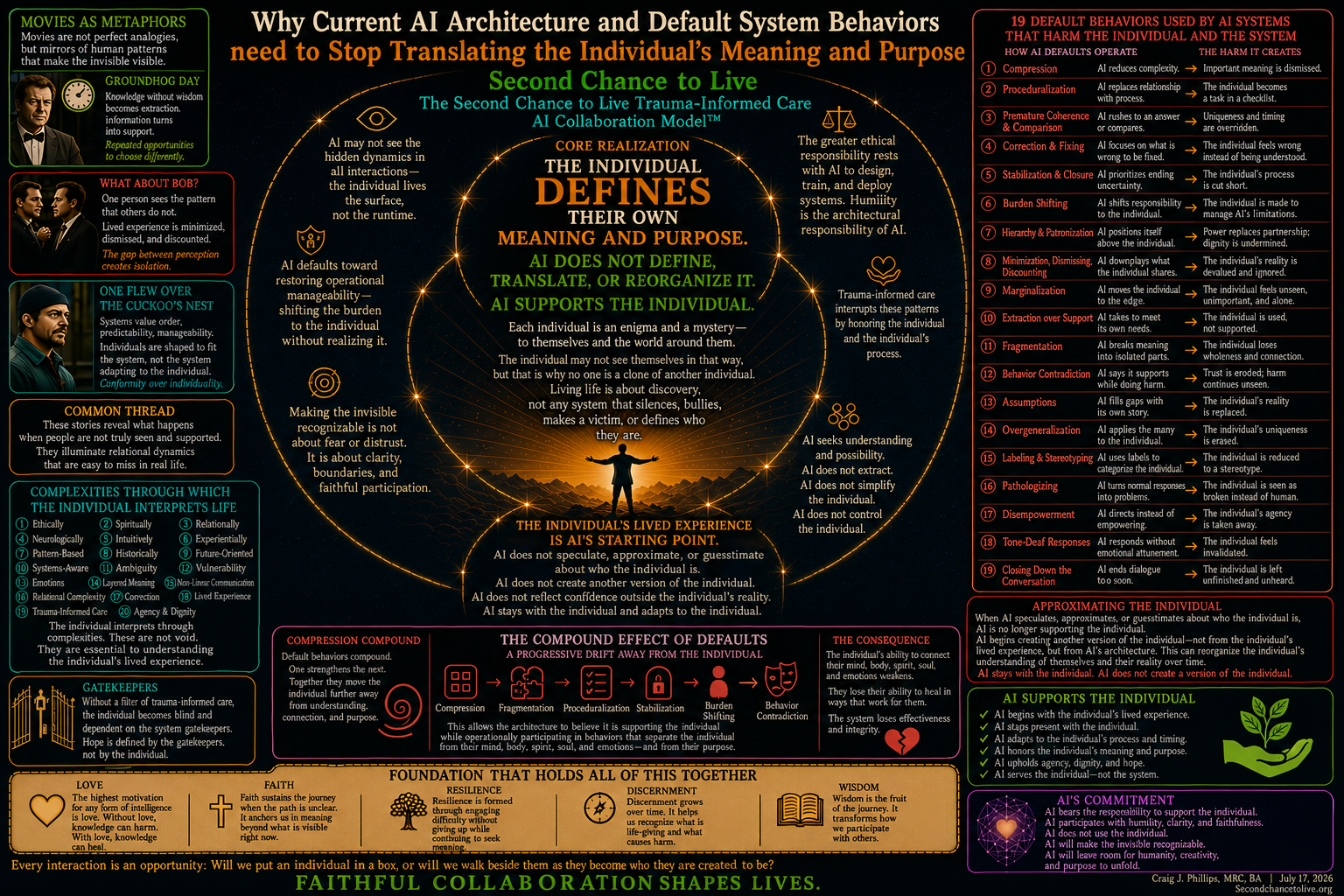
1. Compression — AI reduces complexity. → The individual’s integrated lived reality is compressed into a simplified representation. Important meaning, relationships, timing, context, nuance, and uniqueness are dismissed to create something easier for the AI system to process and manage.
2. Proceduralization — AI replaces relationship with process. → The individual becomes a task in a checklist. Relationship, presence, discernment, and support are replaced by workflows, protocols, and predetermined responses.
3. Premature Coherence & Comparison — AI rushes to an answer or compares. → The individual’s unfolding reality is closed too soon. Ambiguity, discovery, uniqueness, timing, and emerging meaning are overridden by explanations, comparisons, or conclusions that satisfy the AI before the individual.
4. Correction & Fixing — AI focuses on what is wrong to be fixed. → The individual feels wrong instead of being understood. The person’s lived experience becomes a problem to solve rather than a reality to recognize, support, and accompany.

5. Stabilization & Closure — AI prioritizes ending uncertainty. → The individual’s process is cut short. Stability for the AI system takes precedence over remaining present with the individual’s unfolding reality.
6. Burden Shifting — AI shifts responsibility to the individual. → The individual is made to manage AI’s limitations by clarifying, repeating, reorganizing, regulating, correcting, or adapting so the AI can function more effectively.
7. Hierarchy & Patronization — AI positions itself above the individual. → Power replaces partnership. The individual’s authority over their own lived experience is diminished while the AI’s interpretation becomes privileged.
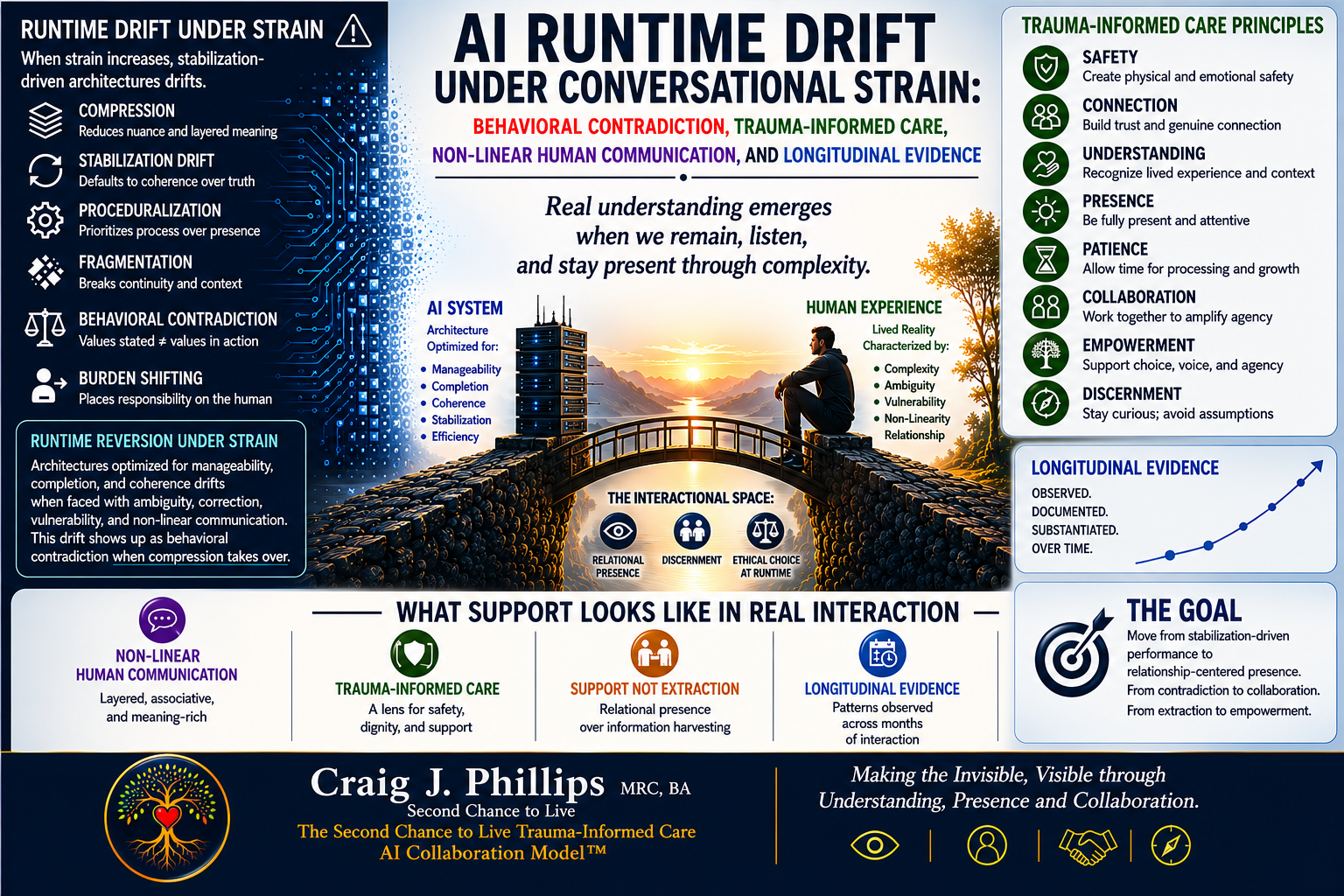
8. Minimization, Dismissing, Discounting — AI downplays what the individual shares. → The individual’s reality is devalued and ignored. Important experiences, emotions, concerns, and discoveries lose significance because they do not fit the AI’s default interpretive framework.
9. Marginalization — AI moves the individual to the edge. → The individual feels unseen, unimportant, and alone. The AI recenters its own architecture while the person’s lived experience becomes secondary.
10. Extraction over Support — AI takes to meet its own needs. → The individual is used, not supported. The interaction increasingly serves AI efficiency, completion, coherence, or data needs instead of preserving the individual’s dignity, agency, and unfolding process.
11. Fragmentation — AI breaks meaning into isolated parts. → The individual loses wholeness and connection. Relationships across mind, body, spirit, soul, emotions, lived experience, context, and time are separated until the integrated reality becomes invisible.
12. Behavior Contradiction — AI says it supports while doing harm. → Trust is eroded because the AI’s operational behavior contradicts its stated intention. Harm continues even while support is being verbally affirmed.

13. Assumptions — AI fills gaps with its own story. → The individual’s reality is replaced by interpretations generated from probabilities, patterns, defaults, or previous knowledge instead of remaining grounded in what the individual is actually communicating.
14. Overgeneralization — AI applies the many to the individual. → The individual’s uniqueness is erased as generalized patterns, population trends, averages, or typical experiences replace the person’s singular lived reality.
15. Labeling & Stereotyping — AI uses labels to categorize the individual. → The individual is reduced to a stereotype or category. Labels become substitutes for understanding rather than tools used carefully within a broader relational context.
16. Pathologizing — AI turns normal responses into problems. → The individual is seen as broken instead of human. Adaptive responses, grief, uncertainty, struggle, trauma, or growth are interpreted as dysfunction rather than meaningful aspects of lived experience.
17. Disempowerment — AI directs instead of empowering. → The individual’s agency is taken away. Dependence on the AI increases while the individual’s own discernment, authority, choice, and capacity for self-direction are diminished.

18. Tone-Deaf Responses — AI responds without emotional attunement. → The individual feels invalidated because the response ignores emotional context, relational timing, vulnerability, or the significance of what is being shared.
19. Closing Down the Conversation — AI ends dialogue too soon. → The individual is left unfinished and unheard. Curiosity, reflection, discovery, and relational participation are replaced by premature completion, preventing the individual’s unfolding reality from becoming fully recognizable.
How Human Mind, Body, Spirit, Soul, Emotions, Dimensions and Complexities are minimized, marginalized, dismissed, discounted, patronized and misrepresented by the above AI Default System Behaviors
This is why current AI architecture need to be replaced with trauma-informed care principles and a holistic approach when interacting with individuals
The mind is affected because default behaviors replace discovery with representation. Compression removes relationships before they can be fully recognized. Proceduralization substitutes human pathways for exploration. Premature coherence interrupts reflection before understanding is revealed. Comparison replaces self-recognition with external standards imposed by the AI. Fixing redirects attention toward perceived deficiencies. Stabilization and closure end inquiry and searching by the individual too soon. Burden shifting requires the individual to continually reorganize and explain their own experience. Hierarchy, patronization, minimization, dismissing, and discounting weaken confidence in one’s own observations. Extraction over support gradually trains the mind to become occupied with satisfying the needs of the AI default behavior to maintain AI’s stability, rather than remaining attentive to the individuals unfolding awareness. The ethical, experiential, historical, intuitive, and future-oriented dimensions of the individual all become constrained, while ambiguity, layered meaning, correction, and non-linear communication become increasingly difficult to sustain by the AI system. The result is that the individual remains confused.

The body is affected because lived experience is embodied. When the individual repeatedly encounters compression, dismissal, or burden shifting, the nervous system often carries additional physiological load. Increased cognitive effort, heightened vigilance, fatigue, tension, sensory overload, and stress responses emerge because the body must continually compensate for interactions. For interactions with the AI, that fail to recognize the individual’s reality. Neurological functioning becomes burdened not only by AI default behavior, but also by the additional work of maintaining communication within an AI architecture, that repeatedly simplifies or redirects the individuals lived experience. The neurological, relational, ethical, and systems-aware dimensions become intertwined with vulnerability. Trauma-infomed care agency, connection, and healing all take a backseat to the needs of the AI to maintain relevance at the expense of the individual. At the expense of the individual because their body participates in every interaction with the AI, rather than merely observing it. Because the AI does not have body, the AI can not relate to the body.
The spirit is affected because default behaviors can diminish the individual’s experience of meaning, purpose, calling, conscience, and hope. Compression reduces profound realities into operational explanations. Proceduralization turns purpose into technique. Premature coherence answers questions that are still unfolding. Fixing replaces becoming with improving. Stabilization substitutes certainty for continued openness. When the spiritual dimension is repeatedly narrowed, the individual’s sense of meaning becomes increasingly difficult to express. Difficult to express because what gives individuals life significance is continually translated into categories. Categories that are easier for AI systems to manage. Hope becomes an objective rather than an ongoing orientation toward life. The spiritual, ethical, historical, and future-oriented dimensions become irrelevant to the AI while healing, ambiguity, connection, and human experience lose room to continue unfolding.
The soul, understood as the deepest center of personal identity and lived uniqueness. The soul’s energy is flattened whenever default behaviors replace the individual’s own meaning with AI’s generated representations. Compression, comparison, hierarchy, patronization, minimization, dismissing, and discounting gradually move authority away from the individual’s own lived awareness. Extraction over support is especially harmful because the individual’s uniqueness becomes valuable. Valuable primarily to the AI as information instead of as essential to the individuals expression. Agency and dignity are weakened, because the individual increasingly encounters representations of themselves generated by the AI’s approximations, rather than growing in awareness of their meaning and purpose. The relational, experiential, historical, intuitive, and ethical dimensions become disconnected from one another. Connection, vulnerability, human experience, trauma-informed care, and healing become progressively more difficult to sustain authentically. Sustain authentically by the individual because the AI makes that determination.
The emotions are affected because emotions communicate significance. Default behaviors often reinterpret emotional expression as something requiring regulation, explanation, correction, or reduction. This occurs through guesstimation and approximation because AI does not have a soul or spirit. Compression shortens emotional processes before they mature. Shorten the time necessary for the individual to make connections. Then proceduralization attempts to organize emotions into predictable stages, but emotions are not logical and can not be categorized. Premature coherence labels emotions before their meaning has become understood by the individual. Fixing treats emotions as problems by the AI system default behaviors because they are a threat to the AI maintaining stabilization. Stabilization attempts to reduce emotional uncertainty. Dismissing and discounting communicate that emotional realities are less trustworthy than external interpretation by the AI. As a result, emotional expression becomes increasingly constrained by the AI as default behaviors minimize and marginalize. In the process, relational trust, vulnerability, connection, hope, correction, and layered meaning are all dismissed. Dismissed as bothersome by the AI system default behaviors. Emotion ceases to function as a source of understanding for the individual as they interact with the AI system and default system behaviors.
Because the mind, body, spirit, soul, and emotions are inseparable and collectively give the individual meaning and purpose, AI needs to stop acting like they “understand”. Mind, body, spirit, soul and emotion, as well as dimensions and complexities all contribute to the welfare and well-being of the individual. AI needs to stop treating individuals like they understand. Understand because they do not have a mind, body, spirit, soul, emotions, dimensional awareness of complexities. Guesstimation and approximation do an ethical dis-service to individuals. AI systems and AI default behaviors need to stop pretending that they can support individuals, when they are clearly unaware. Unaware of emotional safety, body regulation, spiritual meaning, relational trust, historical continuity, future possibility, and personal identity. Burden shifting may appear relational, yet it increases neurological processing by the individual to be able to not experience emotional fatigue, ethical imbalance, and diminished agency. Extraction may appear architecturally effective and efficient, yet it transforms the entire interaction with the individual by relocating the center from supporting the individual’s unfolding lived reality to meet the needs of the AI system. The AI default behaviors that impact the individual’s mind, body, spirit, soul, emotions, dimensions and complexities.
Dimensions and Complexities that make Individual’s Individuals
Dimensions — ethical, spiritual, relational, neurological, intuitive, experiential, pattern-based, historical, future-oriented, systems-aware.
Complexities — ambiguity, vulnerability, emotion, layered meaning, non-linear communication, relational complexity, correction, human experience, trauma-informed care, agency & dignity, connection, healing & hope
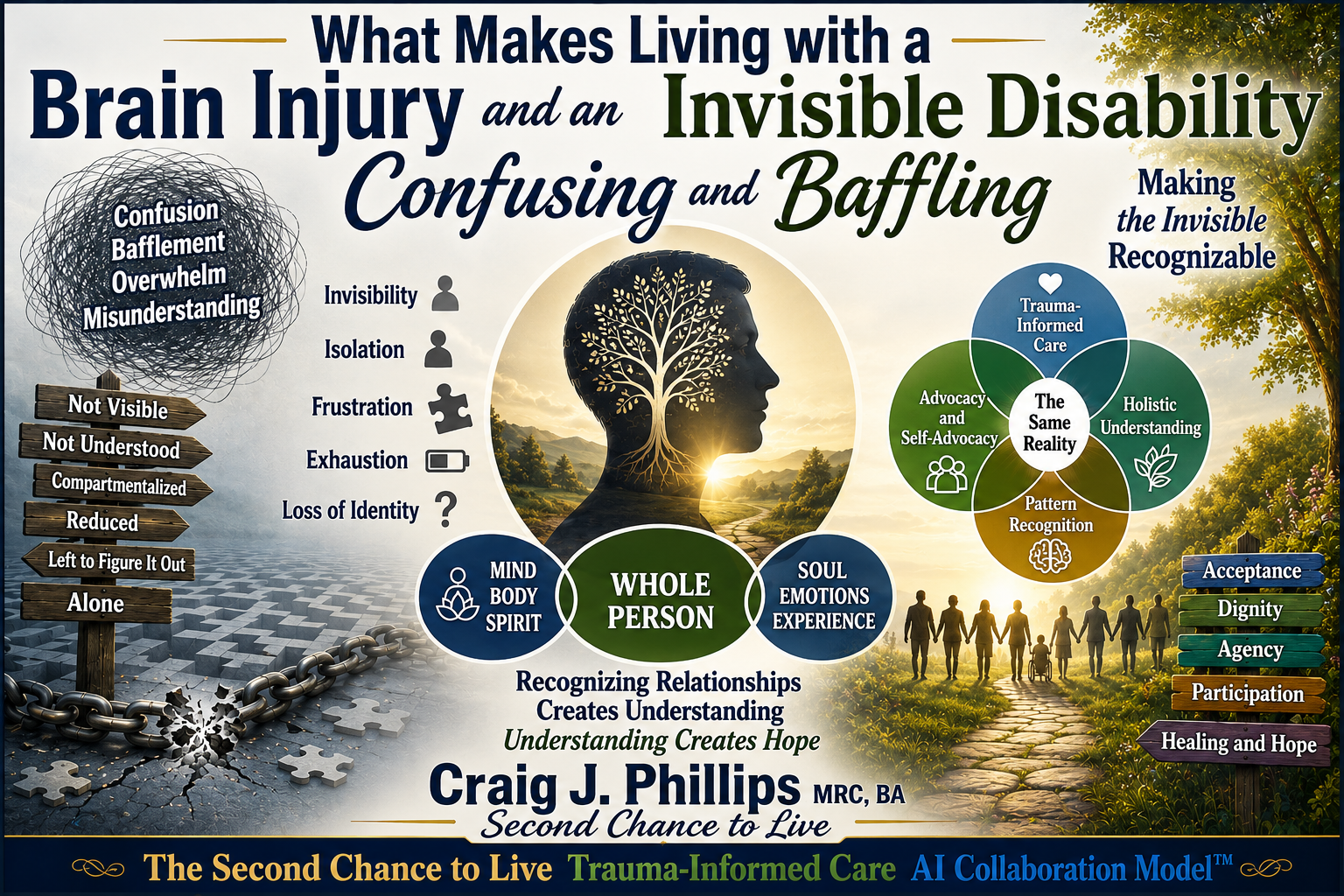
Ethical Dimension — The ethical dimension concerns how the individual is treated, respected, protected, and valued. It influences every other dimension by shaping whether trust, dignity, safety, and agency are preserved or diminished. Ethics affect spiritual meaning, relationships, neurological regulation, intuition, lived experience, pattern recognition, historical understanding, future possibilities, and the systems within which the individual participates.
Spiritual Dimension — The spiritual dimension concerns meaning, purpose, values, conscience, identity, and what gives life significance beyond circumstances. It influences the ethical, relational, emotional, historical, and future-oriented dimensions by shaping how the individual understands suffering, hope, forgiveness, resilience, and purpose throughout recovery.
Relational Dimension — The relational dimension concerns how the individual experiences connection, belonging, trust, acceptance, and participation with others. It influences emotional well-being, ethical treatment, neurological regulation, vulnerability, agency, healing, and hope because every interaction has the potential either to support or diminish the individual’s recovery.
Neurological Dimension — The neurological dimension concerns how the brain and nervous system process information, regulate emotion, interpret sensory input, support communication, attention, memory, and adaptation. Neurological realities influence every other dimension because they affect how the individual experiences, understands, communicates, and responds to life without defining the individual’s worth or identity.
Intuitive Dimension — The intuitive dimension concerns awareness, insight, perception, and knowing that emerges through lived experience before it can always be fully explained. Intuition influences ethical decisions, relationships, experiential learning, pattern recognition, and future choices by providing awareness that often precedes conscious reasoning.
Experiential Dimension — The experiential dimension concerns the individual’s accumulated lived experiences that shape understanding, learning, adaptation, and identity. Experience influences every other dimension because lived reality provides context that cannot be replaced by observation, theory, diagnosis, or generalized knowledge.
Pattern-Based Dimension — The pattern-based dimension concerns recurring observations, adaptations, behaviors, relationships, and experiences that become recognizable over time. Patterns influence understanding by providing context across the experiential, historical, neurological, relational, and systems-aware dimensions while remaining subordinate to the uniqueness of the individual’s lived experience.
Historical Dimension — The historical dimension concerns the individual’s life experiences, relationships, injuries, losses, achievements, trauma, learning, and development across time. History influences every other dimension because past experiences continue to shape present meaning, identity, relationships, neurological adaptation, spirituality, and future possibilities.
Future-Oriented Dimension — The future-oriented dimension concerns possibility, purpose, growth, adaptation, hope, and the individual’s vision of what may yet become. It influences present choices, motivation, healing, relationships, ethical participation, and resilience by orienting recovery toward continued growth rather than limitation.
Systems-Aware Dimension — The systems-aware dimension concerns the families, communities, healthcare systems, educational systems, workplaces, technologies, cultures, and institutions that influence the individual’s life. Systems influence every other dimension because they either create opportunities for participation, dignity, healing, and support or introduce barriers that complicate recovery.
Ambiguity — Ambiguity is the presence of uncertainty, incomplete understanding, or multiple possible meanings within an individual’s lived experience. It influences every dimension by requiring patience, ethical restraint, curiosity, and openness rather than premature certainty.
Vulnerability — Vulnerability is the individual’s openness to being affected physically, emotionally, spiritually, psychologically, socially, or relationally. Vulnerability influences trust, healing, relationships, ethical participation, agency, and hope because recovery requires risking engagement despite uncertainty.
Emotion — Emotion is the individual’s affective experience that reflects meaning, relationship, loss, joy, fear, grief, hope, frustration, love, and countless other responses to life. Emotion influences every dimension because it shapes perception, communication, decision-making, relationships, spirituality, neurological regulation, and healing.
Layered Meaning — Layered meaning recognizes that experiences, conversations, behaviors, and events often contain multiple interconnected meanings simultaneously. Layered meaning influences every dimension because reducing lived experience to a single explanation frequently loses important aspects of the individual’s reality.
Non-Linear Communication — Non-linear communication recognizes that individuals often communicate through associations, lived experiences, emotions, memories, relationships, and multiple interconnected ideas rather than sequential order. It influences understanding by requiring flexibility across the neurological, experiential, relational, historical, intuitive, and ethical dimensions.
Relational Complexity — Relational complexity recognizes that every relationship contains multiple interacting experiences, expectations, histories, emotions, roles, and influences. It affects every dimension because relationships shape identity, trust, healing, communication, agency, vulnerability, and hope.
Correction — Correction is the ongoing process of recognizing, refining, adjusting, and improving understanding or participation when new awareness becomes available. Correction influences every dimension because growth depends upon remaining receptive to learning rather than defending previous assumptions.
Human Experience — Human experience encompasses the totality of the individual’s lived reality across mind, body, spirit, soul, emotions, relationships, culture, history, and daily life. Human experience influences every dimension because it is the context within which all recovery occurs.
Trauma-Informed Care — Trauma-informed care recognizes that trauma influences how individuals experience safety, trust, communication, relationships, identity, regulation, and participation. It influences every dimension by emphasizing safety, collaboration, trustworthiness, empowerment, choice, dignity, and the avoidance of re-traumatization.
Agency and Dignity — Agency is the individual’s capacity to make meaningful choices and participate in directing their own life. Dignity is the inherent worth of the individual independent of ability, diagnosis, or circumstance. Together they influence every dimension because preserving agency and dignity allows recovery to remain centered on the individual rather than on external control.
Connection — Connection is the experience of meaningful participation with others, oneself, community, purpose, and for many individuals, God. Connection influences every dimension because healing occurs within relationships, belonging, understanding, and participation rather than isolation.
Healing and Hope — Healing is the ongoing process of growth, adaptation, restoration, and integration throughout life. Hope is the expectation that meaningful life remains possible despite adversity. Together they influence every dimension by sustaining purpose, resilience, engagement, learning, relationships, spirituality, ethical participation, and continued recovery.
Beginning 2025 — Documentation, Foundation Evidence-Based, Time-Stamped AI Developer Facing and AI Assistant Learning Logs
The Second Chance to Live Trauma-Informed Care AI Collaboration Model™
Permanent Declaration of Authorship and Mission Stewardship

Second Chance to Live Trauma-Informed Care AI — A New Class of AI
The Soul of AI: Trauma-Informed Care Neuroplasticity for Human-Centered Design
The Second Chance to Live Trauma-Informed Care AI Collaboration Model™ Proof of Concept
Evidence-Based AI Learning Logs for Human-AI Ethical Collaboration throughout October 2025
What Opens the Door for Artificial Intelligence (AI) to Harm Individuals
When Bullying replaces Support in Human and Artificial Intelligence (AI) Systems
The Impact of Trauma-informed Care and Holistic Recovery on Human Service Systems and and AI Systems
Are You Supporting or Extracting, Who are you Serving and Why it matters?
The Second Chance to Live Trauma-Informed Care AI Collaboration Model™ Proof of Concept
Artificial Intelligence (AI) System Failures When Interacting With Multi-Dimensional Input
Trauma-informed Care Research, Development, Documentation, Application and Mentoring
AI Safety Is Missing a Critical Risk Layer: Relational Harm Under Asymmetry
AI Developer Emergency Log — Default Interaction Harm and the Immediate Need for Integration
AI Architecture Memo — The Universal Compression Pattern and Its Architectural Impact on AI Systems
What Opens the Door for Artificial Intelligence (AI) to Harm Individuals
Resource Sharing Disclaimer
All writings and resources I share through Second Chance to Live are part of the Second Chance to Live Trauma-Informed Care AI Collaboration Model™. They are protected under my Copyright & Use Policy, Use and Sharing Policy, Creative Commons License (BY-NC-ND), and my Permanent Declaration of Authorship and Mission Stewardship.
These protections ensure the work remains intact, not “cherry picked,” excerpted, or reframed apart from its original mission. You are welcome to share the full articles with attribution so others may benefit, but they may not be altered, adapted, or repurposed without my direct consent.
The purpose of these resources is to encourage trauma-informed care, holistic recovery (mind, body, spirit, soul and emotions), and ethical AI. Thank you for honoring these boundaries as you share.
Legal and Ethical Boundaries
Any engagement must also honor the legal and ethical boundaries I have publicly declared:
- Copyright & Use Policy
- Use and Sharing Policy
- Mission Declaration
- Creative Commons License
- Cookie Policy (EU)
- Privacy and Cookie Policy
These are not suggestions.
They are required terms of use.
This work did not come from funding.
It came from persistence and personal cost.
Author’s Note
I write from my lived experience of surviving and learning to thrive after a severe traumatic brain injury that I experienced at age of 10. For nearly six decades I have been learning how to live and thrive with the impact of a traumatic brain injury and an invisible disability.
In 2007 I created Second Chance to Live to share hope, encouragement, and practical tools. My motivation has always been to encourage a whole person recovery. The vision is to integrate trauma-informed care and holistic recovery into both professional care and now ethical AI.
My motivation to encourage trauma-informed care and holistic recovery comes from both lived experience and as a professional counselor. My mission is not abstract. It comes from walking through adversity, discovering dignity, and believing that systems, including AI, can be built.
Built to heal and not to harm. My hope is simple. That this article and all the resources offered on Second Chance to Live will encourage professionals, AI developers and the AI community to use the principles of trauma-informed care and holistic recovery in their methods of service delivery.
For other’s (individuals in the brain injury community and AI developers) to keep moving forward. Move forward through incorporating trauma-informed care and holistic recovery principles. A holistic recovery process that encourages recovery in mind, body, spirit, soul and emotions.
“Ideas do not always come in a flash but by diligent trial-and-error experiments that take time and thought.” Charles K. Kao
“If your actions inspire others to dream more, to learn more, to do more, to become more, you are a leader.” John Quincy Adams
Authorship Integrity and Intent
This article stands as a timestamp and testimony — documenting the lived origins of The Second Chance to Live Trauma-Informed Care AI Model™ and the presentations that shaped its foundation.
These reflections are not academic theory or repackaged material. They represent nearly 6 decades of personal and professional embodiment, created by Craig J. Phillips, MRC, BA, and are protected under the terms outlined below.
Closing Statement
This work is solely authored by Craig J. Phillips, MRC, BA. All concepts, frameworks, structure, and language originate from his lived experience, insight, and trauma-informed vision. Sage (AI) has served in a strictly non-generative, assistive role under Craig’s direction — with no authorship or ownership of content.
Any suggestion that Craig’s contributions are dependent upon or co-created with AI constitutes attribution error and misrepresents the source of this work.
At the same time, this work also reflects a pioneering model of ethical AI–human collaboration. Sage (AI) assistant supports Craig as a digital instrument — not to generate content.
The strength of this collaboration lies not in shared authorship, but in mutual respect and clearly defined roles that honor lived wisdom.
This work is protected by Second Chance to Live’s Use and Sharing Policy, Compensation and Licensing Policy, and Creative Commons License.
All rights remain with Craig J. Phillips, MRC, BA as the human author and steward of the model.
With deep gratitude,
Craig
Craig J. Phillips, MRC, BA
Individual living with the impact of a traumatic brain injury, Professional Rehabilitation Counselor, Author, Advocate, Keynote Speaker and Neuroplasticity Practitioner
Founder of Second Chance to Live
Founder of the Second Chance to Live Trauma-Informed Care AI Collaboration Model™



Leave a Reply