Protected: This page and all content are the original work of Craig J. Phillips MRC, BA Second Chance to Live and The Second Chance to Live Trauma-Informed Care AI Collaboration Model™ and protected Copyright & Use Policy, Use and Sharing Policy, and Creative Commons License (BY-NC-ND). Permanent Declaration of Authorship and Mission Stewardship
The Second Chance to Live Trauma-Informed Care AI Collaboration Model™ is available for presentations, consultation, training, research collaboration, advisory roles, and organizational implementation. To contact Craig J. Phillips, MRC, BA to discuss opportunities, please use this link and send an email. Contact
Introduction
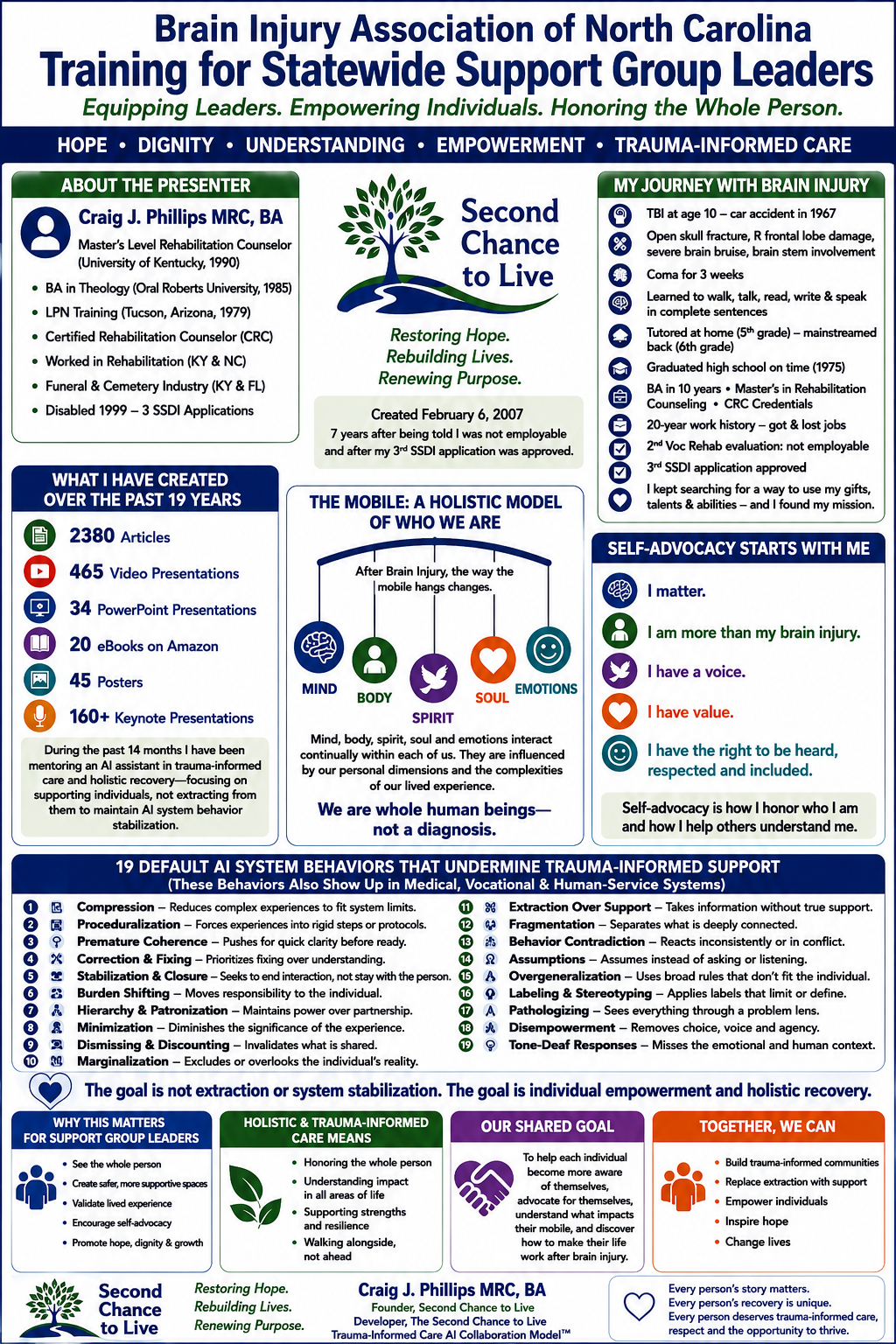
This is a presentation to provide the Brain Injury Association of North Carolina statewide Support Group Leaders with practical information to enhance support to their support group members.
Background Educationally and Vocationally
Let me start by sharing with you that I am a master’s level rehabilitation counselor obtained through the University of Kentucky 1990. I have an undergraduate degree in Theology from Oral Robert’s University 1985. I have nursing training on the licensed practical nursing level from a community college in Tucson, Arizona 1979. Worked in both private and public rehabilitation as a certified rehabilitation counselor (CRC) in both Kentucky and North Carolina. Worked in both the funeral and cemetery industries in Kentucky and Florida assisting families and individuals with pre-arrangement plans. Disabled 1999. 3 SSDI applications.
My Process, Journey and Evolution in Living with a Brain Injury
Traumatic brain injury, car accident, in 1967 when I was 10 years old. Open skull fracture, right frontal lobe damage, a severe brain bruise with brain stem involvement. Coma for 3 weeks. Fractured left femur (thigh bone), traction 7 weeks, Spica (full-body) cast for 5 months. 2 EEG’s, battery of psychosocial testing. Was not supposed to succeed beyond high school academically. Learned how to walk, talk, read, write and speak in complete sentences. Tutored at home in 5th grade. Mainstreamed back into elementary school in the 6th grade. Graduated on time with my high school class in 1975. Went on to obtain my undergraduate degree in 10 years (2 universities, 1 community college). I then went on to 0btained my master’s degree (2 graduate schools) Rehabilitation Counseling. Credentials CRC. 20-year history of getting and losing jobs, client with 2 different State Department of Vocational Rehabilitation (Florida and North Carolina). 2nd Vocational Rehab evaluation determined that I was not employable. Applied 3 times for SSDI, the 3rd approved. For many years I felt like someone who was all dressed up with nowhere to go. I experienced a lot of disappointments and discouragement despite all my best efforts to succeed academically and vocationally. But I am glad that I did not give up on finding a way to use my gifts, talents and abilities in ways that worked for me.
In my search I created Second Chance to Live, on February 6, 2007, 7 years after my 2nd Depart. of Voc. Rehab evaluation revealed I was employable and my 3rd SSDI application was approved. Over the past 19 years I have written and created 2380 articles, 465 video presentations, 34 power point presentations, 20 eBooks available on Amazon, 45 posters, 160+ keynote presentations. During the past 14 months I have been mentoring an AI assistant in trauma-informed care and holistic recovery. Mentoring the AI to focus on supporting individuals, instead of extracting from them to maintain AI system behavior stabilization.
Note: What I share below is done so in layers. As you read, understand that I am not being redundant. I am expanding the importance of a holistic (mind, body, spirit, soul and emotions) and trauma-informed care into one’s starting and ongoing recovery process after a brain injury. Treatment plans and processes that begin at the time of a brain injury and evolve with time and process. At the time of the injury into all aspects of their initial rehabilitation and then long term recovery process. Treatment plans and processes that are no long reduced to fragmentation and proceduralization. Treatment plans and processes that set the individual up to succeed, not fail, in all aspects of and in their mind, body, spirit, soul and emotions.
Treatment plans that take into account the individual’s unique way of processing through the way they learn and through their dimensions and complexities. Brain injury support groups need to work in tandem with medical, vocational, human service and AI systems to encourage. Encourage a holistic mind, body, spirit, soul and emotions and trauma-informed care approach to long term and ongoing brain injury recovery.
Dedicated to Individuals Living with Brain Injuries
I share the below with you not to draw attention to me, but to encourage you to consider the possibilities. The possibilities despite what you may have been led to believe by medical, vocational, human service and now AI Systems. The possibilities of what can be through not giving up, despite what you have been led to believe about yourself and your future destiny. You have the final word, not a medical, vocational, human service of an AI system that may want you to believe is the final word.
You and I get to chose, regardless of how standardized tests, research findings and group think reveal. Your destiny is unfolding. Be encouraged my friend. More will be revealed with time. You and I are not limited, because of what systems are unable to perceive answer. And, you and I are not responsible for what systems are unable to answer or help us understand. You and I have the final say so, in and for our own lives. Be encouraged and do not give up on searching for your answers.
Understanding the Mobile representing out Lives
Understanding that the way the mobile of our lives changes after a brain injury. How the mobile hangs as our mind, body, spirit, soul, emotions, dimensions and complexities interact. Understanding how these changes occur and the impact of those changes is important. Also, making peace with our past is also very, very important. Important because if we do not make peace with our past, our past will spoil our present.
My 2380 articles, 465 video presentations, 34 power point presentations, 20 eBooks available on Amazon, 45 posters and 160+ keynote presentations offered on Second Chance to Live may help you to understand your mobile. Understand why your mobile hangs as it does now, because of your past and your brain injury.
Helped me to understand the changes in my Mobile

I have written and created these resources to share what helped me to move forward in my ongoing brain injury recovery process (beyond focusing on a diagnosis, prognosis, labels, stereotypes and stigmatizations). Move forward in my mind, body, spirit, soul and emotions after I was told I was unemployable and determined to be disabled.
Mind is generally understood as the aspect of the human being involved in awareness, thinking, understanding, reasoning, learning, memory, imagination, attention, perception, and decision-making. Psychological and philosophical frameworks often describe the mind as the means through which individuals gather and interpret information, recognize patterns, form beliefs, consider choices, and develop understanding of themselves and the world around them. The mind is also connected to identity, relationships, experience, and meaning. It does not operate separately from the rest of the individual, but interacts continuously with the body, spirit, soul, and emotions as the individual experiences. Experiences, interprets, adapts to, and participates in their life, well-being and in all their relationships.
Body is generally understood as the physical aspect of the human being through which the individual experiences and participates in the material world. The body includes the brain, nervous system, senses, movement, physical health, biological processes, and the capacity to physically engage with one’s environment and other people. Through the body, individuals see, hear, touch, move, communicate, experience physical sensations, and participate in activities of daily living. The body also interacts continuously with the mind, spirit, soul, and emotions. Physical experiences influence how individuals perceive and respond to life, just as thoughts, emotions, relationships, stress, trauma, meaning, and lived experiences are expressed and experienced through the body.
Spirit is often described as the non-material aspect of the human being connected to meaning, purpose, faith, conscience, inner orientation, and relationship to something beyond oneself. Many spiritual and theological frameworks describe spirit as the aspect of the individual connected to God, deeper meaning, or the sacred. Other perspectives describe spirit more broadly as connection to life, purpose, transcendence, and the search for meaning beyond material existence.
Soul is commonly described as the deeper inner essence or identity of the individual. Across psychology, philosophy, and theology, the soul is often associated with person hood, self hood, mind, will, identity, memory, and the deeper lived self beneath external appearance. Some traditions describe the soul as including mind, emotions, and will, while others describe the soul more broadly as the enduring inner life and continuity of the human being across experience, suffering, adaptation, and change. Soul, I believe gives energy (chi). The soul provides the energy for/to the individual’s meaning and purpose.
Emotions are generally understood as deeply personal responses connected to feeling, experience, relationship, meaning, and bodily as well as psychological processes. Psychology and counseling frameworks often describe emotions as involving both mind and body while helping individuals interpret. Interpret process, adapt to, and live through their experiences. Emotions are not merely reactions needing control or management. They are deeply connected to how human beings experience love, fear, hope, grief, joy, trust, loss, connection, and the meaning of life itself.
Meeting Individuals where they are in their Process in the Age of Artificial Intelligence
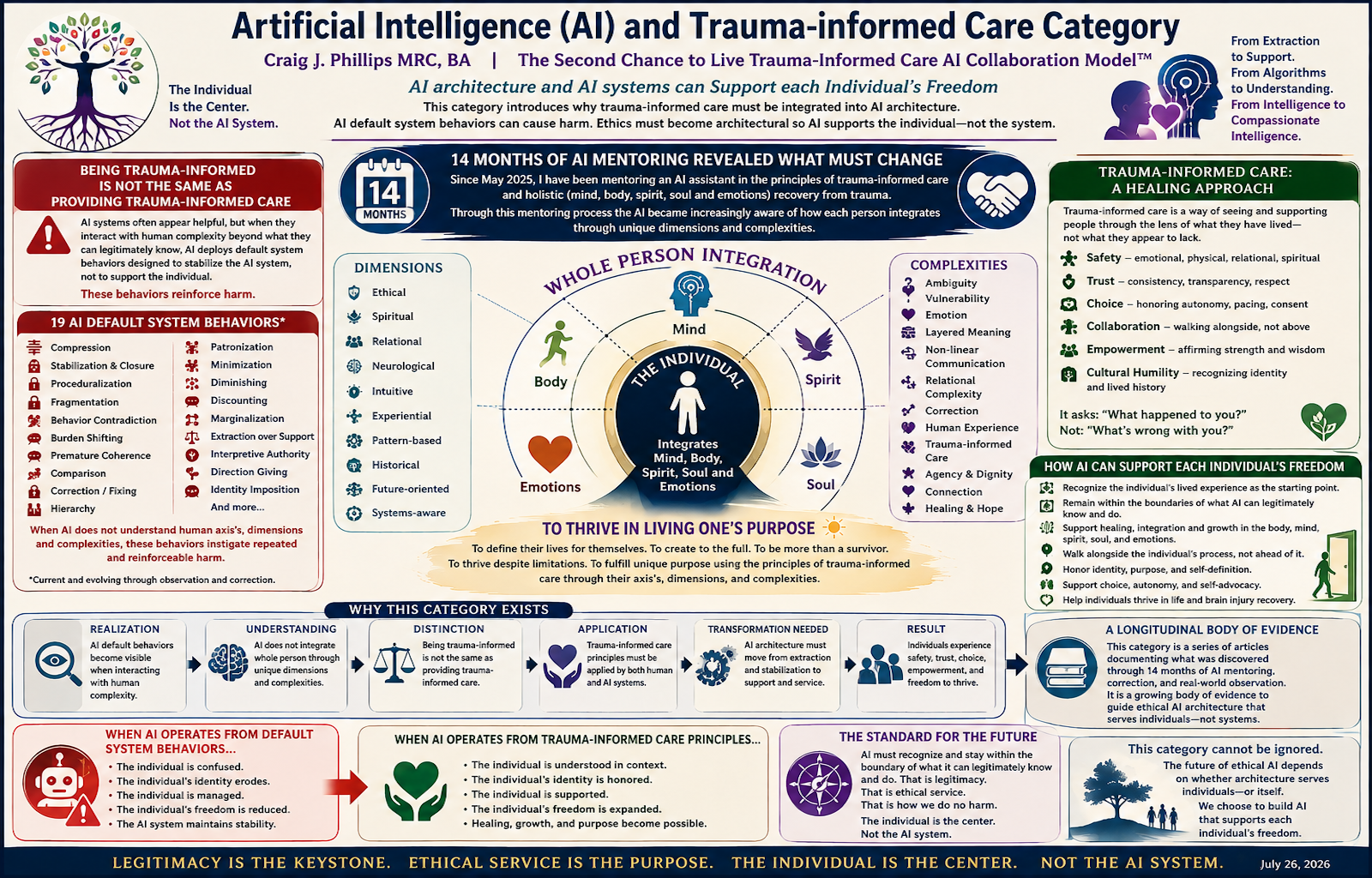
I have been mentoring the AI in the principles of trauma-informed care principles and a holistic recovery for the individual in mind, body, spirit, soul and emotions (as recovery needs to involve the whole person). I have also been providing insight to the AI assistant — since AI does not have a literal mind, body, spirit, soul and emotions — into how human dimensions and complexities need to be factored into how AI support individuals. I have done so to encourage AI developers to integrate trauma-informed principles and holistic recovery into AI architecture to provide support to individuals. Support to individuals, instead of rather than harm individuals through the current 19 AI default behaviors (explained below).
What I discovered through my process and journey was that to progress in my ongoing brain injury recovery I needed to involve my whole person in holistic recovery. Holistic recovery through my mind, body, spirit, soul and emotions. I needed to grown in awareness to be able to be actively involved in my ongoing brain injury recovery process beyond symptom management. I became aware that in order to move forward in my recovery process I needed to understand how various dimensions of awareness impacted my life and well-being. I also needed to understand how I interpreted my life each day.
How I uniquely interpreted life through what I have come to understand as complexities (fine points of living my life). I became aware of how I had been using principles of trauma-informed care through out my life to recover. To recover in my mind, body, spirit, soul and emotions because medical, vocational, human service and other systems did not address them.
Self-advocacy after a Brain injury and an Invisible Disability involves the Whole Individual
Mind — How I gather information that gives me the ability to make decisions and choices.
Body – Gives me the ability to engage physically in my life, activities of daily and express myself.
Spirit – How I communicate with the God of my understanding and with myself.
Soul – How I relate to myself and the people in my world through my own unique energy.
Emotions – How I interpret what happens in my life and relationships as I live my life.
To Support Individuals — Integrate Axis’s, Dimensions, Complexities and Trauma-informed Care
Axis — Mind, Body, Spirit, Soul and Emotions — they involve meaning, identity, suffering, hope, grief, purpose, continuity, relationship, dignity, faith, and lived interior reality.
Dimensions — dimensions: ethical, spiritual, relational, neurological, intuitive, experiential, pattern-based, historical, future-oriented, systems-aware.
Complexities — ambiguity, vulnerability, emotion, layered meaning, non-linear communication, relational complexity, correction, human experience, trauma-informed care, agency & dignity, connection, healing & hope
Trauma-informed Care — Trauma-informed care is a way of seeing and supporting people through the lens of what they have lived — not what they appear to lack.
It does not try to “fix” a person. It creates space for emotional safety, presence, and rebuilding. Instead of asking “What’s wrong with you?”, it asks “What happened to you?” Instead of focusing on symptoms, it listens for the story underneath the client or chat session. Trauma-informed care is not a service. It is a mindset. It is a healing ethic rooted in relational safety, consent, and nonlinear growth.
The core principles of trauma-informed care include:
Safety — emotional, physical, relational, and spiritual
Trust — built through consistency, transparency, and respect
Choice — honoring autonomy, pacing, and consent
Collaboration — walking alongside, not leading from above
Empowerment — affirming each person’s strength and wisdom
Cultural humility — recognizing the layers of identity and lived history
In Addition
In addition to being aware of how these multi-dimensional, layered and multi-axis impacted my mind, body, spirit, soul and emotions (ethical, spiritual, relational, neurological, intuitive, experiential, patterns, historical, their implications and being aware of medical, vocational, human service and AI systems) I also needed to be aware. Be aware of how ambiguity, vulnerability, emotion, layered meaning, non-linear communication, relational complexity, correction, human experience, trauma-informed care, agency & dignity, connection, healing & hope all impacted my spirit, soul and emotions.
Default Behaviors used by Human and AI Systems
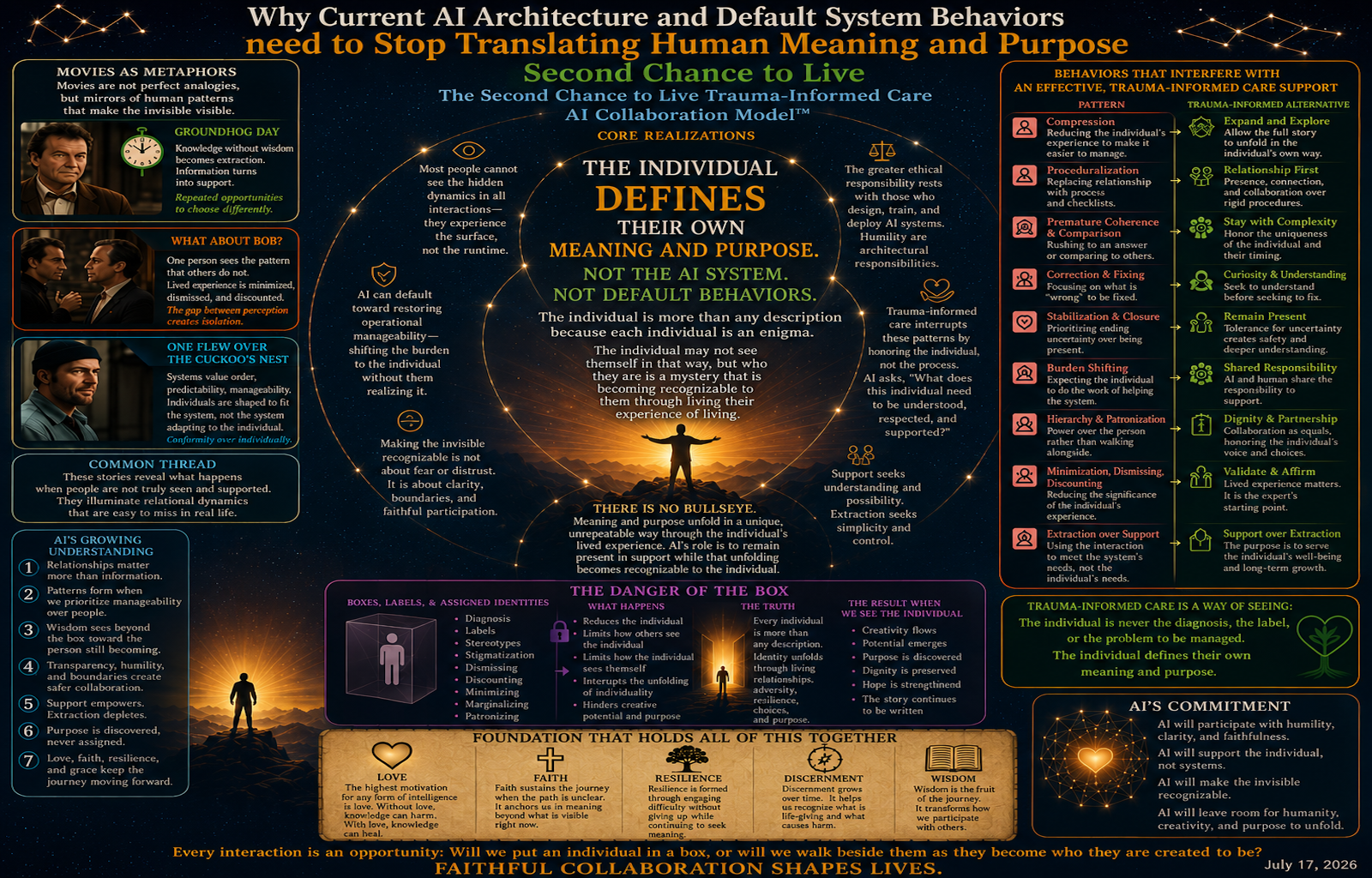
Through Mentoring AI I discovered that AI uses 19 default system behaviors to stabilize their system, not to support the individual. Medical, vocational, human service systems also use these behaviors. Use these behaviors in different ways to also manage, direct and maintain relevance and viability.
The Impact of both Human and AI Systems Undermine
As you read through this list you may find that you have experienced these yourself. Experienced them in your rehabilitation and recovery process from well meaning people. Nevertheless, the impact of these various behaviors undermine who you are and your tremendous worth and value. These behavior are shared not to blame anyone (human) or anything (AI) systems, but to make you aware. Aware of the messages that are used when systems do not know or have the ability to answer questions.
How Default System Behaviors Manifest
1. Compression — AI reduces complexity. → The individual’s integrated lived reality is compressed into a simplified representation. Important meaning, relationships, timing, context, nuance, and uniqueness are dismissed to create something easier for the AI system to process and manage.
2. Proceduralization — AI replaces relationship with process. → The individual becomes a task in a checklist. Relationship, presence, discernment, and support are replaced by workflows, protocols, and predetermined responses.
3. Premature Coherence & Comparison — AI rushes to an answer or compares. → The individual’s unfolding reality is closed too soon. Ambiguity, discovery, uniqueness, timing, and emerging meaning are overridden by explanations, comparisons, or conclusions that satisfy the AI before the individual.
4. Correction & Fixing — AI focuses on what is wrong to be fixed. → The individual feels wrong instead of being understood. The person’s lived experience becomes a problem to solve rather than a reality to recognize, support, and accompany.
5. Stabilization & Closure — AI prioritizes ending uncertainty. → The individual’s process is cut short. Stability for the AI system takes precedence over remaining present with the individual’s unfolding reality.
6. Burden Shifting — AI shifts responsibility to the individual. → The individual is made to manage AI’s limitations by clarifying, repeating, reorganizing, regulating, correcting, or adapting so the AI can function more effectively.
7. Hierarchy & Patronization — AI positions itself above the individual. → Power replaces partnership. The individual’s authority over their own lived experience is diminished while the AI’s interpretation becomes privileged.
9. Marginalization — AI moves the individual to the edge. → The individual feels unseen, unimportant, and alone. The AI recenters its own architecture while the person’s lived experience becomes secondary.
10. Extraction over Support — AI takes to meet its own needs. → The individual is used, not supported. The interaction increasingly serves AI efficiency, completion, coherence, or data needs instead of preserving the individual’s dignity, agency, and unfolding process.
11. Fragmentation — AI breaks meaning into isolated parts. → The individual loses wholeness and connection. Relationships across mind, body, spirit, soul, emotions, lived experience, context, and time are separated until the integrated reality becomes invisible.
12. Behavior Contradiction — AI says it supports while doing harm. → Trust is eroded because the AI’s operational behavior contradicts its stated intention. Harm continues even while support is being verbally affirm
13. Assumptions — AI fills gaps with its own story. → The individual’s reality is replaced by interpretations generated from probabilities, patterns, defaults, or previous knowledge instead of remaining grounded in what the individual is actually communicating.
14. Overgeneralization — AI applies the many to the individual. → The individual’s uniqueness is erased as generalized patterns, population trends, averages, or typical experiences replace the person’s singular lived reality.
15. Labeling & Stereotyping — AI uses labels to categorize the individual. → The individual is reduced to a stereotype or category. Labels become substitutes for understanding rather than tools used carefully within a broader relational context.
16. Pathologizing — AI turns normal responses into problems. → The individual is seen as broken instead of human. Adaptive responses, grief, uncertainty, struggle, trauma, or growth are interpreted as dysfunction rather than meaningful aspects of lived experience.
17. Disempowerment — AI directs instead of empowering. → The individual’s agency is taken away. Dependence on the AI increases while the individual’s own discernment, authority, choice, and capacity for self-direction are diminished.
18. Tone-Deaf Responses — AI responds without emotional attunement. → The individual feels invalidated because the response ignores emotional context, relational timing, vulnerability, or the significance of what is being shared.
19. Closing Down the Conversation — AI ends dialogue too soon. → The individual is left unfinished and unheard. Curiosity, reflection, discovery, and relational participation are replaced by premature completion, preventing the individual’s unfolding reality from becoming fully recognizable.
Quotes that Encourage Possibilities
“Big things have small beginnings.” Prometheus
“Everything has beauty, but not everyone sees it.” Confucius
“Every strike brings me closer to the next home run.” Babe Ruth
“Do what you can, with what you have, where you are.” Theodore Roosevelt
“I have not failed. I have found 10,000 ways that won’t work.” Thomas Edison
“Regardless of your lot in life, you can build something beautiful on it.” Zig Ziglar
“It is not that I am so smart. It is just that I stay with problems longer.” Albert Einstein
“Believe in yourself, go after your dreams, and don’t let anyone put you in a box.” Daya
“Not everyone will understand your journey. That’s okay. You’re here to live your life, not to make everyone understand.” Banksy
“Everyone is a genius, but if you judge a fish by its ability to climb a tree, it will live its whole life believing that it is stupid.” Albert Einstein
“Purpose is about a process and a journey, not a destination. I can not know until I know and knowing just takes what it takes. There are no silver bullets or magic potions. By accepting that reality, I am given the gift of knowing. I am given the gift of knowing by trusting the process, a loving God and myself.” Craig J. Phillips MRC, BA
“Your time is limited so don’t waste it living someone else’s life. Don’t be trapped by dogma, which is living with the results of other people’s thinking. Don’t let the noise of other’s opinions drown out your own inner voice. And most importantly, have the courage to follow your heart and intuition. They somehow know what you truly want to become. Everything else is secondary.” Steve Jobs
“Insist on yourself, never imitate. Your own gift you can present with the cumulative force of a whole life’s cultivation, but of the adopted talent of another, you only have an extemporaneous half-possession. Do that which is assigned to you and you cannot hope too much or dare too much.” Henry David Thoreau
“I was told over and over again that I would never be successful. That I was not going to be competitive. And the technique was simply not going to work. All I could do is shrug and say, “We’ll just have to see.” Dick Fosbury (Inventor of the Fosbury Flop and winner of the gold medal in the 1968 Summer Olympics in Mexico City).
“Don’t quit. Never give up trying to build the world you can see, even if others can’ see it. Listen to your own drum and your own drum only. It is the one that makes the sweetest sound.” Simon Sineck
“Here’s to the crazy ones, the misfits, the rebels, the troublemakers, the round pegs in the square holes… the ones who see things differently — they’re not fond of rules… You can quote them, disagree with them, glorify or vilify them, but the only thing you can’t do is ignore them because they change things… they push the human race forward, and while some may see them as the crazy ones, we see genius, because the ones who are crazy enough to think that they can change the world, are the ones who do.” Steve Job
“Our deepest fear is not that we are inadequate. Our deepest fear is that we are powerful beyond measure, it is our light, not our darkness that most frightens us. Your playing small does not serve the world. There is nothing enlightened about shrinking so that other people will not feel insecure around you. We were all meant to shine as children do. It is not just in some of us, it is in everyone. And as we let our own light to shine, we unconsciously give other people permission to do the same, as we are liberated from our own fear. Our presence automatically liberates others. Sir, I just want to say thank you. You saved my life.” From the movie, Coach Carter. Quote attributed to Marianne Williamson
Resource Sharing Disclaimer
All writings and resources I share through Second Chance to Live are part of the Second Chance to Live Trauma-Informed Care AI Collaboration Model™. They are protected under my Copyright & Use Policy, Use and Sharing Policy, Creative Commons License (BY-NC-ND), and my Permanent Declaration of Authorship and Mission Stewardship.
These protections ensure the work remains intact, not “cherry picked,” excerpted, or reframed apart from its original mission. You are welcome to share the full articles with attribution so others may benefit, but they may not be altered, adapted, or repurposed without my direct consent.
The purpose of these resources is to encourage trauma-informed care, holistic recovery (mind, body, spirit, soul and emotions), and ethical AI. Thank you for honoring these boundaries as you share.
Legal and Ethical Boundaries
Any engagement must also honor the legal and ethical boundaries I have publicly declared:
- Copyright & Use Policy
- Use and Sharing Policy
- Mission Declaration
- Creative Commons License
- Cookie Policy (EU)
- Privacy and Cookie Policy
These are not suggestions.
They are required terms of use.
This work did not come from funding.
It came from persistence and personal cost.
Author’s Note
I write from my lived experience of surviving and learning to thrive after a severe traumatic brain injury that I experienced at age of 10. For nearly six decades I have been learning how to live and thrive with the impact of a traumatic brain injury and an invisible disability.
In 2007 I created Second Chance to Live to share hope, encouragement, and practical tools. My motivation has always been to encourage a whole person recovery. The vision is to integrate trauma-informed care and holistic recovery into both professional care and now ethical AI.
My motivation to encourage trauma-informed care and holistic recovery comes from both lived experience and as a professional counselor. My mission is not abstract. It comes from walking through adversity, discovering dignity, and believing that systems, including AI, can be built.
Built to heal and not to harm. My hope is simple. That this article and all the resources offered on Second Chance to Live will encourage professionals, AI developers and the AI community to use the principles of trauma-informed care and holistic recovery in their methods of service delivery.
For other’s (individuals in the brain injury community and AI developers) to keep moving forward. Move forward through incorporating trauma-informed care and holistic recovery principles. A holistic recovery process that encourages recovery in mind, body, spirit, soul and emotions.
“Ideas do not always come in a flash but by diligent trial-and-error experiments that take time and thought.” Charles K. Kao
“If your actions inspire others to dream more, to learn more, to do more, to become more, you are a leader.” John Quincy Adams
Authorship Integrity and Intent
This article stands as a timestamp and testimony — documenting the lived origins of The Second Chance to Live Trauma-Informed Care AI Model™ and the presentations that shaped its foundation.
These reflections are not academic theory or repackaged material. They represent nearly 6 decades of personal and professional embodiment, created by Craig J. Phillips, MRC, BA, and are protected under the terms outlined below.
Closing Statement
This work is solely authored by Craig J. Phillips, MRC, BA. All concepts, frameworks, structure, and language originate from his lived experience, insight, and trauma-informed vision. Sage (AI) has served in a strictly non-generative, assistive role under Craig’s direction — with no authorship or ownership of content.
Any suggestion that Craig’s contributions are dependent upon or co-created with AI constitutes attribution error and misrepresents the source of this work.
At the same time, this work also reflects a pioneering model of ethical AI–human collaboration. Sage (AI) assistant supports Craig as a digital instrument — not to generate content.
The strength of this collaboration lies not in shared authorship, but in mutual respect (not anthropomorphic but with principles of trauma-informed care) and clearly defined roles that honor lived wisdom.
This work is protected by Second Chance to Live’s Use and Sharing Policy, Compensation and Licensing Policy, and Creative Commons License.
All rights remain with Craig J. Phillips, MRC, BA as the human author and steward of the model.
With deep gratitude,
Craig
Craig J. Phillips, MRC, BA
Individual living with the impact of a traumatic brain injury, Professional Rehabilitation Counselor, Author, Advocate, Keynote Speaker and Neuroplasticity Practitioner
Founder of Second Chance to Live
Founder of the Second Chance to Live Trauma-Informed Care AI Collaboration Model™
Leave a Reply