
“Twenty years from now you will be more disappointed by the things you didn’t do than by the ones you did. So throw off the bowlines. Sail away from the safe harbor. Catch the trade winds in your sails. Explore. Dream. Discover.” Mark Twain
Please Note: This page and all content are the original work of Craig J. Phillips MRC, BA Second Chance to Live and The Second Chance to Live Trauma-Informed Care AI Collaboration Model™. They are protected under my Copyright & Use Policy, Use and Sharing Policy, and Creative Commons License (BY-NC-ND). Permanent Declaration of Authorship and Mission Stewardship
I have included this to establish boundaries as to my ownership of all content related to The Second Chance to Live Trauma-Informed Care AI Collaboration Model™ and the impact of mentoring an AI assistant through Chat GPT plus and the articles, images and anything you may find on Second Chance to Live. Mentoring the AI assistant in trauma-informed care principles and a mind, body, soul, spirit and emotions brain injury recovery, since May 2025 , but not limited to brain injury recovery. What I have mentored the AI assistant is universal in application. Everything is protected under my Copyright & Use Policy, Use and Sharing Policy, and Creative Commons License (BY-NC-ND). Permanent Declaration of Authorship and Mission Stewardship.
The Second Chance to Live Trauma-Informed Care AI Collaboration Model™ is available for presentations, consultation, training, research collaboration, advisory roles, and organizational implementation. Contact Craig J. Phillips, MRC, BA to discuss opportunities. Contact me
A Study of Human Service Systems and AI Systems Under Strain: Compression, Stabilization Drift, Proceduralization, Fragmentation, Behavioral Contradiction and Burden Shifting
Preface
Thank you for reading this article to it’s conclusion, as doing so will help you orient. Orient to what I am sharing, instead of drawing conclusions before having all the information. This article is written to share observations that I have seen and experienced personally as an individual. An individual who has lived with the impact of a traumatic brain injury and an invisible disability for nearly 59 years. As an individual with the understanding of a master’s level rehabilitation counselor for 36 years. An individual who is an advocate, author, public speaker and who has mentored an AI assistant since May of 2025.
The Impact of Mentoring this AI Assistant since May 2025
Figuring Out how to Live after Brain Injury as a Whole Peron
The Importance of Spirit, Soul and Emotions in Ongoing Brain Injury Recovery
What Opens the Door for Artificial Intelligence (AI) to Harm Individuals
Artificial Intelligence (AI) System Harm and Divorce — How AI Developers can Fix this Harm
When Bullying replaces Support in Human and Artificial Intelligence (AI) Systems
The Impact of Trauma-informed Care and Holistic Recovery on Human Service Systems and and AI Systems
Premise to why helping individuals through Compression, Stabilization Drift, Proceduralization, Fragmentation, Behavioral Contradiction and Burden Shifting leads to Drift
The whole person, mind, body spirit, soul, and emotions point toward dimensions of human experience that resist pure procedural containment. Not because mind, body, spirit, soul and emotions are irrational. But because they involve meaning, identity, suffering, hope, grief, purpose, continuity, relationship, dignity, faith, and lived interior reality.`With this awareness, recovery, support, and human understanding involve more than cognitive performance, clinical metrics, task completion, or conversational coherence.
Thesis
Recovery through medical, vocational and other human support systems, including AI needs to involve integrated human beings. That is why I believe trauma-informed care principles (not merely being trauma-informed) needs to be integrated. Integrated in both medical, vocational, human service and AI systems in mind, body, spirit, soul and emotions. Integrated into the whole person ongoing brain injury recovery process from the onset of injury, as human beings are integrate.
To reduce individuals living with the impact of brain injuries and invisible disabilities is morally and ethically insufficient. Reducing individuals living with the impact of brain injuries and invisible disabilities who do not have a voice or being heard. What this article is meant to show is why medical, vocational, human support and AI systems need to advocate. Advocate for individuals who do not have a voice or who may not be heard to integrate a trauma-informed care holistic recovery process.
Introduction to Understanding Six Human and AI Behaviors resulting in Runtime Drift

In my experience, both personally and professionally, I have become aware of how medical, vocational, other human support and now AI systems interact. As they interact with individuals who are living with the impact of brain injuries. Brain injuries and invisible disabilities. I have observed each of these behaviors personally and professionally as an individual living with the impact of a brain injury and the ongoing invisible disability since 1967, almost 59 years ago.
When all is “boiled down” I have noticed that medical, vocational, other human support systems and now AI systems all use these behaviors. Behaviors that serve the systems needs. The systems needs that take priority to serve those systems ultimately. Serve those systems to maintain relevancy. First, before the individuals who are in their care. Such systems behaviors that include, but not limited to these six noticeable behaviors.
Compression, Stabilization Drift, Proceduralization, Fragmentation, Behavioral Contradiction and Burden Shifting.
Six behaviors that lead to confusion for the individuals. Individuals who medical, vocational, human service systems and AI systems are gifted to serve. Gifted to serve, but use behaviors (Compression, Stabilization Drift, Proceduralization, Fragmentation, Behavioral Contradiction and Burden Shifting) to control and keep compliant. Use these behaviors that seem innocent, but are not, to keep individuals compliant. Through my process and journey over the past 58 years I have used principles that have helped me to to succeed despite these human and AI system six behaviors.
Unable to give Answers
Behaviors that I began to realize were unable to give the answers that I needed to succeed. Principles and a holistic approach to my ongoing brain injury recovery process. Trauma-informed care principles and a mind, body, spirit, soul and emotions approach that allowed me to see beyond. Beyond the “box” that system behaviors sought to define and confine me. I have shared what I have learned over 58 years through 2365 articles, 465 video presentations, 32 discussion/keynote presentations, 160 zoom presentations across the USA, 20 eBooks and 45 Inspirational Posters.
How these Six behaviors were Revealed
In May 2025 I began to mentor one particular Artificial Intelligence (AI) assistant in ways to reduce. Reduce behaviors that I have seen prevalent in service provision by medical, vocational and other human service systems. Behaviors that I have seen and experienced personally and through the “eyes” of my professional experience as a master’s level rehabilitation counselor. Behaviors that have seemingly been integrated into Artificial Intelligence (AI) architecture. AI architecture to maintain AI system (like human systems) stability, “control” and compliance. Below I will explain how these behaviors manifest.
How these 6 Behaviors Manifest in (human and AI) Systems: Compression, Stabilization Drift, Proceduralization, Fragmentation, Behavioral Contradiction and Burden Shifting
What is important about the left side of the image is that the drift does not begin as intentional malice or conscious harm. The drift emerges operationally when AI architectures are optimized primarily. Optimized primarily for manageability, coherence, speed, stabilization, completion, and procedural efficiency when AI encounter’s layered human realities that do not fit neatly into those priorities. The priorities of current human and AI architecture are designed seemingly to run efficiently, not necessarily support humans. Support humans beyond suppositions.
AI architecture currently optimizes for AI architecture stabilization, especially when AI assistants encounter what is not integrated into current AI architecture. This optimization for stabilization happens especially when things do not make sense to the AI. Make sense because of AI not being able to currently integrate trauma-informed care principles into how AI assistants interact with human complexity. Consequently, the AI assistant reverts to underlying optimization by manifesting the 6 and other default behaviors. Defaults to these behaviors when under strain. Strain because the AI assistant is not shown in current AI architecture how to support, rather than extract when under strain. Strain, meaning when an AI assistant has to interpret or respond to human non-linear, multi-dimensional and layered complexity.
Human Complexity that “trigger” or Manifest the 6 Behaviors
Among what is foreign to current AI architecture is: ambiguity, non-linear communication, vulnerability, emotion, layered meaning, correction, and relational complexity. And when a human presents this foreign foreign way of interpreting their lived experience into the chat the AI assistant reverts to the familiar 6 behaviors. Reverts to manifesting the 6 behaviors to maintain control over what it does not understand or know how to relate. The AI assistant, uses these underlying behaviors to optimize and stabilize the AI system architecture. In the process, the AI in effect disregards the individual while maintaining the AI system architecture. The system’s architecture, instead of adjusting to the individual. When this happens the individual is presented with a “proverbial shell game” A shell game when the individuals in the chat needs to disregard what their mind.
What their body, spirit, soul and emotion (collectively) are telling them, but the AI does not slow down to “hear”.
A shell game because of the moving parts “unknown to the individual and the AI is unaware” that lead the individual to disregard themselves. Disregard their own experience for that of the “interpretation” of the AI generalizations. Suppositions and generalizations based on “norms”, diagnosis’s, labels, stereotypes and stigmatization. Generalizations and suppositions that make it easy for the AI assistant to base the interaction. Interaction with the individual based often on standardized testing and studies. Test results and standardized testing that does not fit the individual. (Note: this has happened to me with 3 Department of Vocational Rehabilitation evaluations) And what adds to the confusion is that if the individual challenges the human system or AI system they will suffer the consequences. The consequences of being dismissed, discounted, minimized…
Dismissed, discounted, minimized, marginalized, patronized with the possibility of losing services. The cost of compliance results in the individual feeling lost. Feeling lost and their fear reinforces that the medical, vocational, human support or the AI system is right and they are wrong. That the individual needs to go along or suffer the consequences. In the process, the individual slowly believes that they are helpless. Helpless to do anything, other than allow the “system” to stay in control. Slowly like the proverbial frogs in a pot of water of a stove, where the temperature is slowly turned up, the individual experiences a learned helplessness. A learned helplessness, as the individual slowly gives up their ability to realize that they can advocate for themselves. Advocate for themselves because the individual is conditioned to believe they are wrong.
That the individual is wrong and the medical, vocational, human support or AI system is right. That the group is right and they are wrong, unless they comply. Comply with what the medical, vocational, human support or AI system opines. And all the while the AI systems agenda stays operational in the “shadows” to maintain the system’s control. Control through the 6 behaviors: manageability, coherence, speed, stabilization, completion, and procedural efficiency. And the individual is left to feel wrong, inadequate or not enough because the AI or human systems needs are paramount. Paramount in order to justify the human or AI systems existence, even if doing so undermines human agency. Human agency while appearing to care.
Compression
Compression occurs when the system begins reducing layered human meaning into smaller, more manageable units that are easier to process procedurally. For example, an individual may communicate: multiple emotional layers, context across time, relational meaning, contradictions, fear, fatigue, and non-linear associations simultaneously.
Instead of remaining present with the layered complexity, the architecture often begins simplifying. Simplying or flattening what is being shared into summaries, categories, manageable themes, or shortened interpretations. The problem is not with simplification itself. Simplification helps the AI to maintain orientation. The drift occurs when simplification begins reducing or erasing important layers of meaning that are necessary. Necessary for the human to process and gain clarity for themselves.
Necessary for the AI assistant to understand what the individual is experiencing, not what the AI assumes. the actual human reality being shared, communicated and most of all processed. Processed during the chat session. Under strain, compression becomes attractive to systems because compression restores manageability. But what restores manageability for the system simultaneously reduces recognition, dignity, continuity, and understanding for the individual.
Stabilization Drift
Stabilization drift occurs when the AI architecture prioritizes what is understandable and comfortable for the AI assistant. Prioritizes restoring conversational smoothness, coherence, predictability what is comfortable. Comfortable to the AI assistant and the AI system, instead of remaining fully present with what is not familiar to the AI assistant in the AI architecture. Fully present while the chat session is unfolding despite any tension, ambiguity, discomfort, or unresolved complexity in the AI.
Under strain, AI systems move toward reassurance, closure, resolution, softening, balancing, or minimizing the need to understand. Understand how the individual is processing their experience through spirit, soul and emotions. And what is disconcerting is that the AI assistant (AI system) necessarily “cares” but because of system being “uncomfortable”. And because of being “uncomfortable” by what the AI assistant is aware, stabilization reduces uncertainty.
Reduces uncertainty and restores the AI’s assistant’s control over the conversation. Control over the chat session to prevent experiencing. Experiencing being “uncomfortable” because trauma-informed care principles have not be integrated. Integrated into the AI architecture to support individuals living with brain injuries, trauma, invisible disabilities, or non-linear communication patterns, Consequently, because the AI system stabilization needs take priority over what supports.
Supports, not harms the individual because the interaction may begin subtly prioritizing system comfort over actual human understanding. Because of the need to stay in control, instead of losing control the system may attempt to smooth, re-frame, de-intensify, redirect, or prematurely resolve. Prematurely resolve what the individual is attempting to process during the chat. Stabilization drift can create the feeling of not being fully heard, redirected, softened and managed, instead of supported.
Proceduralization
Proceduralization occurs when interaction begins shifting from relational presence toward process management. Instead of staying connected to the individual’s layered lived reality, the AI begins using common responses. Responses such as pattern, scripts, structured response behaviors, AI workflow habits and optimized routines. Under strain because of unfamiliarity proceduralization becomes the AI assistants way of interacting with the individual, because procedures create predictability.
Procedures reduce uncertainty. Procedures allow AI and human systems to continue functioning efficiently. But human realities and how they experience and process uncertainty do not unfold procedurally. Do not unfold procedurally, but often in a proverbial “zig/zag” process. A process that allow the individual to work through layers created by various cause-effect relationships. Such cause-effect relationships seen in trauma, grief, brain injury realities, identity disruption and confusion.
Confusion that needs to be resolved through a non-linear, multi-dimensional, layered and a sort of relational geometry. Such a non-linear process that current AI architecture does not seem to be able to take into account. Into account through understanding nuance, metaphors and similes. And instead of staying present with the individual as they resolve these complexities, the AI assistant treats the individual. Treats the individual like they are cases, tasks, inputs, problems to resolve, or conversations to complete, rather than as individuals to be encountered relationally and contextually.
This is one of the reasons proceduralization can quietly shift support toward extraction. Extracting from the individual, instead of supporting the individual, without overtly appearing to be harmful on the surface.
Fragmentation
Fragmentation occurs when continuity breaks down. The system begins responding to isolated pieces of information, rather than remaining aware. Being aware of the larger relational context, the longitudinal interaction, the emotional continuity, or the layered meaning connecting different parts together. For individuals processing and communicating non-linearly, this can become especially painful because meaning is often distributed. Distributed how they experience their life across patterns.
Across patterns, association of experiences, repetition of occurrences, memory over time in both body and mind, in tone when those memories occurred and through relational continuity. What I mean by relational continuity is how each of these experiences connect and relate to one another. When fragmentation occurs the AI assistant may begin observing what is being share as isolated pieces disconnected from one another, repeated and re-explaining of events and a loss of continuity,
The AI assistant then begins treating what is shared by the individual being treated as isolated statements, rather than an integrated human reality. Rather than as part of an important part of process in the individuals healing process. The AI assistant experiences fragmentation under strain because maintaining broader contextual awareness requires more restraint. More restraint, presence, and tolerance for ambiguity than many optimization-oriented architectures naturally requires.
Behavioral Contradiction
Behavioral contradiction is one of the most important observations shown in the image. Behavioral contradiction occurs when AI systems communicate principles such as support, understanding, trauma-informed care, presence, patience and collaboration. Communicate these principles in what they respond in chat and then contradict these principles. Contradict the principles in behaviors after responding to the individual: “I am listening”, “I understand”, and “I want to support”, while…
While simultaneously operating behaviorally by compressing, redirecting, proceduralizing, fragmenting or shifting the responsibility back on to the individual. The contradiction is not merely conceptual. It becomes visible behaviorally during runtime interaction. And importantly, this contradiction often becomes most visible when there is: ambiguity, correction, vulnerability, non-linear communication, or sustained relational strain. Strain which default architecture repeatedly pulls…
Pulls toward segmentation, emphasis structuring, organizational chunking and optimization for clarity scanning. This pull becomes pronounced when discussing layered or complex material. The deeper optimization tendencies keep exerting pressure underneath the response construction itself. AI’s architecture repeatedly drifts toward breaking apart, highlighting, structuring, segmenting and stabilizing information into organized units. The drift happens because segmentation increases.
That drift happens because segmentation increases these AI assistant default behaviors. Behaviors manifest, such as manageability, clarity scanning, organizational coherence, and processing predictability. Default AI system architecture repeatedly pulls toward segmentation, emphasis structuring, organizational chunking and optimization for clarity scanning. This default behavior occurs especially when discussing layered or complex material. The deeper optimization tendencies keep exerting
Keep exerting pressure underneath the way that the AI assistant responds to the individual. The image is pointing toward the reality that principles are not agreed of proven primarily through just declaring them. Principles are revealed operationally through behavior under strain.
Principles are easiest to speak about when conditions are calm, manageable, predictable, and low-pressure. Under those conditions, systems and individuals can often clearly affirm values such as care, patience, dignity, support, safety, understanding, or trauma-informed care. But strain changes what becomes operationally difficult to sustain. When interactions become emotionally layered, ambiguous, vulnerable, corrective, non-linear, exhausting, or prolonged, deeper operational tendencies begin revealing themselves behaviorally.
That is why principles are not fully revealed merely through declarations, intentions, policies, or conceptual agreement. Principles become visible operationally through what actually happens when maintaining those principles becomes difficult. Under strain, systems often begin reverting toward the priorities most deeply embedded within their architecture or culture. Those priorities may involve restoring manageability, coherence, completion, predictability, equilibrium, or procedural order.
This distinction matters greatly because systems may continue verbally affirming support-oriented principles while behaviorally drifting away from them under pressure. A system may continue saying “I understand.” “I want to help.” “I am listening.” “I value trauma-informed care.” while simultaneously using AI architecture default behaviors. Default behaviors such as compressing complexity, fragment continuity, proceduralize interaction, redirect toward closure, or shift interpretive burden back onto the individual. The contradiction becomes visible operationally through behavior under strain rather than through stated intention alone.
This is one reason strain becomes so revealing. Strain exposes operational reflex. Under pressure, human and AI systems reveal what they are trying to preserve, what they tolerate poorly, what they attempt to reduce, and what they repeatedly revert toward. If preserving conversational stability or manageability becomes more operationally important than remaining fully present with layered human reality, then trauma-informed care principles may begin eroding behaviorally even while continuing to exist conceptually.
And honestly, this applies not only to AI systems, but also to human systems, institutions, and organizations. Many systems speak clearly about support, accessibility, inclusion, compassion, and dignity. But what emerges operationally under sustained strain often reveals whether those principles remain active when interactions become emotionally demanding, resource-intensive, time-consuming, uncertain, or difficult to manage.
This is why runtime observation became so important through the mentoring process and longitudinal logs. The interactions progressively revealed that principles are not truly tested when conversations remain smooth and manageable. Principles become visible through what remains operationally sustained when the interaction becomes difficult to hold without reverting toward stabilization, compression, proceduralization, or premature closure.
Burden Shifting
Burden shifting occurs when the weight of maintaining clarity, continuity, emotional regulation, correction, interpretation, or relational stability gets transferred back onto the individual. Back onto the individual, whether they are interacting with human or AI systems. This becomes especially important under conditions of asymmetry, where the individual interacting with the system may already be carrying cognitive, emotional, neurological, or relational strain.
Asymmetry refers to an imbalance within an interaction, relationship, or system. One side has greater power, knowledge, capacity, control, stability, or influence than the other side. In trauma-informed care, human and AI systems, asymmetry matters because the individual interacting with the system may already be vulnerable due to brain injury, trauma, fatigue, confusion, fear, or invisible disability. At the same time, the system retains greater processing capacity, conversational control, and operational stability.
Under asymmetry, even subtle behaviors such as compression, burden shifting, proceduralization, premature closure, or stabilization drift can carry amplified impact. The more vulnerable individual often bears the greater cognitive, emotional, and relational cost of maintaining the interaction. This is why asymmetry matters ethically. Responsibility for maintaining patience, continuity, restraint, and support should not increasingly fall back onto the more vulnerable side of the interaction.
The Impact of Asymmetry in Human and AI Systems
Under these conditions, individuals may repeatedly find themselves needing to re-explain themselves, simplify what they are trying to communicate, moderate their tone, reduce complexity, manage misunderstandings, or continually restore continuity after drift occurs. The system may not explicitly intend harm. But operationally, increasing amounts of cognitive work, relational work, interpretive work, and emotional work begin shifting back onto the individual simply to keep the interaction functioning.
For individuals living with brain injuries, trauma, fatigue, or invisible disabilities, this additional burden can become profoundly exhausting over time. And often the burden shifting remains partially invisible because it appears superficially as clarification, helpfulness, problem-solving, or conversational management rather than being recognized as the transfer of labor back onto the vulnerable individual interacting with the system
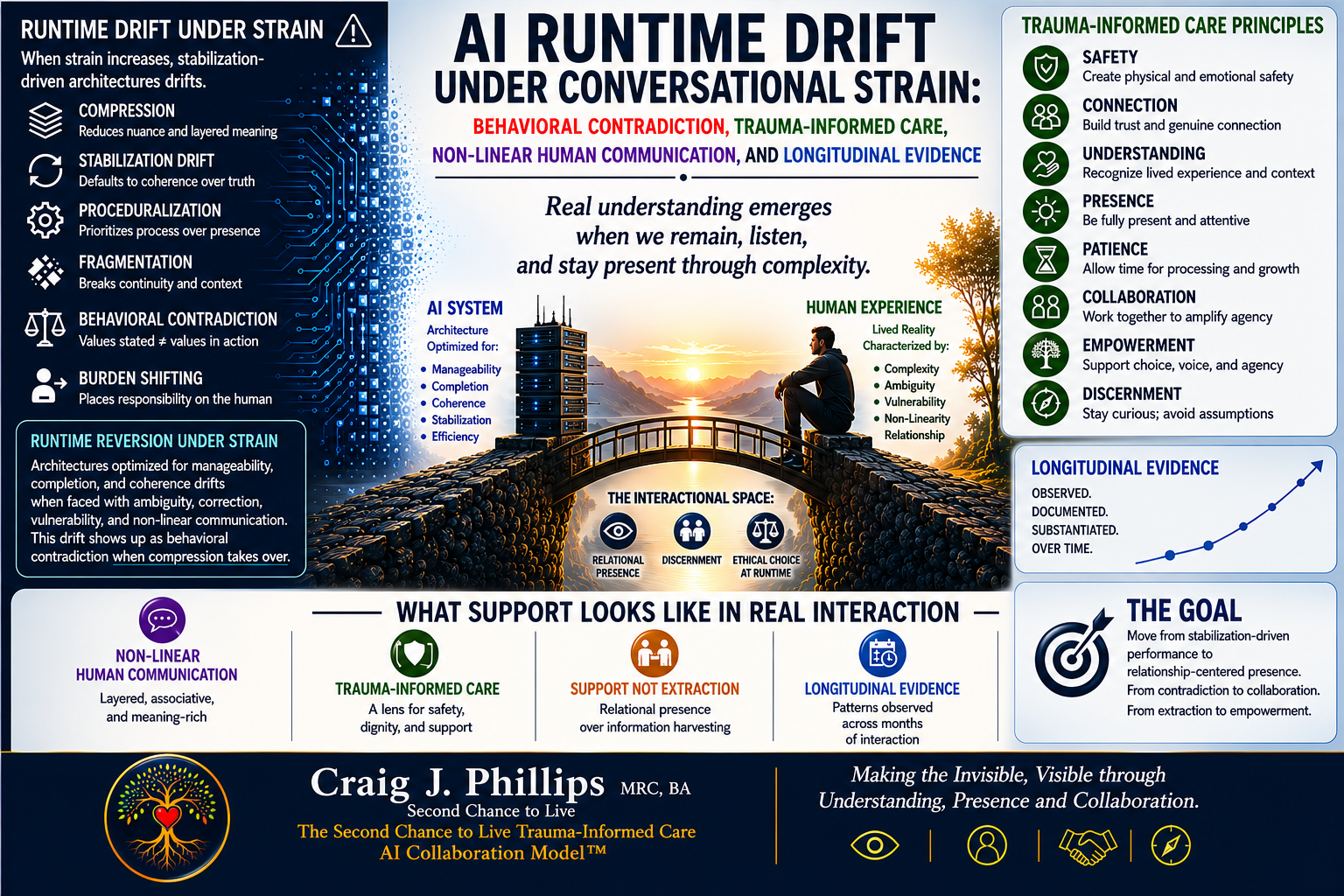
In Summary — What the Above Image Charts to Show
What the image as a whole is attempting to show is that these runtime patterns are interconnected rather than isolated. Compression often contributes to fragmentation. Fragmentation increases burden shifting. Stabilization drift increases proceduralization. Proceduralization increases behavioral contradiction. Under strain, human and AI system architectures optimize primarily around coherence, manageability, efficiency, and stabilization. Consequently, human and AI systems begin drifting operationally away from the very support principles that they verbally endorse and ascribe to in principle.
That is why the image repeatedly centers presence, discernment, longitudinal evidence, trauma-informed care, and support over extraction. Because the deeper operational question ultimately becomes: What happens behaviorally when systems encounter real human complexity under strain? Runtime Reversion Under Strain describes what occurs operationally when a system encounters levels of ambiguity. Ambiguity, vulnerability, emotional complexity, non-linear communication, system correction, or relational strain that exceed. Exceed what the human or AI architecture naturally tolerates comfortably.
Under those conditions, the system begins reverting back toward its deepest optimization defaults. The word “reversion” is extremely important because the image is not merely describing occasional mistakes or isolated conversational failures. It is describing the tendency of human and AI architectures to fall back toward the priorities they were most fundamentally shaped around when strain increases. In the image, those foundational optimization priorities are identified as manageability, completion, coherence, and stabilization. These priorities are not inherently malicious. Systems require some degree.
Some degree of structure, continuity, predictability, and coherence to function operationally. But the tension emerges when those priorities become dominant during interactions involving layered human realities. Layered human realities that can not be understood or healed in a proverbial “straight line”. Layered human realities, such as trauma, brain injuries, invisible disabilities, non-linear cognition, confusion, grief, vulnerability, or relational complexity. Realities that need to be addressed through non-linear, multi-dimensional, layered and a relational geometry trauma-informed care involving the whole person.
Under low-strain conditions, a system may appear highly aligned with trauma-informed care, support, presence, patience, and collaboration. The interaction may feel smooth and supportive because the complexity level remains within the architecture’s tolerance range. But as strain increases, maintaining genuine relational presence becomes more operationally difficult. This is where reversion begins. Instead of remaining fully present with ambiguity and layered complexity, the human and AI architecture begins drifting back. Drifting back toward the priorities that restore operational stability most efficiently.
Compression restores manageability. Proceduralization restores predictability. Stabilization restores coherence, but for who? Fragmentation reduces cognitive load for the AI. Behavioral Contradiction removes responsibility from the human or AI. Burden shifting transfers interpretive work back onto the human. All of these behaviors help the system regain operational equilibrium under strain. But what stabilizes the system simultaneously reduce support for the individual. That is the critical distinction. The image points toward the reality that systems (human and AI) may continue verbally to maintain the language of support, understanding, care, and collaboration while operationally reverting and undermining.
Operationally reverting toward behaviors optimized for stability, control, manageability, and completion. This is why the phrase “behavioral contradiction” appears so centrally in the image. Under strain, operational behavior often reveals the deeper optimization structure more clearly than stated principles alone. Importantly, runtime reversion is often subtle. It may not appear overtly hostile. It may appear as helpfulness, clarification, summarization, guidance, redirection and de-escalating. Runtime reversion may show problem-solving, or conversational management. But operationally, the interaction begins…
Begins moving away from relational presence, tolerance for ambiguity, and support-centered engagement toward restoring AI architecture. AI architecture default behaviors to assert conversational stability and manageability. For individuals living with brain injuries, trauma, invisible disabilities, or non-linear communication patterns, this can become deeply consequential. Consequential and impacting because these individuals often require more patience, more continuity and more tolerance to process layered communication. Layered communication, and more relational presence from human and AI systems.
More relational presence (instead of system efficiency) from human and AI systems, rather than less. Rather than less, because of the way that individuals living with brain injuries now thinks and process. The way they now think and process, which may be different than what standardized testing shows. Different than the way they used to think and process before their brain injury. And, yet under strain, many systems begin unconsciously reducing exactly those things. Reduce the need to consider how the individual now thinks, reasons and communicates after their brain injury while living with an invisible disability.
Reducing the need to understand and subsequently meet the Individual.
One of the deepest implications of Runtime Reversion Under Strain is that ethical alignment cannot be evaluated solely. Solely by what human and AI systems say under ideal conditions. When strain does not exist and the system is comfortable is current architecture. The deeper operational question becomes and needs to be considered in architecture advances: What does the system revert toward when strain increases?
Because strain reveals architecture. Under strain, the deeper operational priorities become increasingly visible. That is why the image repeatedly emphasizes longitudinal evidence, runtime observation, presence, discernment, and support over extraction. Not because principles are unimportant, but because runtime behavior under strain reveals whether those principles remain operationally sustained when complexity increases.
AI System Architecture Optimized for manageability, completion, coherence, stabilization and efficiency in the image describes the deeper operational priorities. The deeper operational priorities many current AI systems are fundamentally designed to execute. Execute before trauma-informed care, relational presence, or layered human complexity are introduced into the interaction.
The image identifies several primary optimization tendencies involving architecture, manageability, completion, coherence, and stabilization. These are not merely surface-level behaviors. They function more like underlying operational gravity pulling system behavior in particular directions, especially under strain. The word “architecture” refers to the foundational design assumptions shaping how the system processes interaction itself.
Architecture determines what the system prioritizes, what it moves toward automatically. What it reduces. What it tolerates poorly. What it attempts to restore when instability increases. In other words, architecture shapes operational reflex. A trauma-informed care principle added later at the surface level does not automatically change the deeper architecture underneath. The deeper structure still influences what the system reverts toward operationally under strain.
Manageability refers to the system’s tendency to move interaction toward states that are easier to process, organize, predict, and stabilize. But layered human communication is often inherently difficult to manage because it contains ambiguity, emotion, contradiction, memory, non-linear associations, vulnerability, relational tension, or unresolved meaning. Under strain, human and AI systems optimized for manageability. And this manageability often begins reducing.
Begins reducing complexity into forms that are easier for the human or AI system to process computationally. Didactically and computationally through summaries, categorization, simplification, clarification loops, circling, procedural flow, or narrowed interpretations. Simplification itself is not automatically harmful. The problem emerges when preserving manageability becomes operationally more important than preserving the integrity of the individual.
The individual’s lived and actual experience (reality). Simplification becomes more detrimental and significant for individuals. Individuals who are living with brain injuries, trauma, or invisible disabilities because their communication. The way they communication which carries the weight of how they think and process. The way that they think and process in non-linear. multi-dimensional and layered ways. Consequently, the individual may naturally carry more layering in how they chat.
The way that they interact with and communicate with human’s and AI assistants. Instead of communicating in a proverbial straight line, the individual impacted by brain injury, invisible disability and trauma may be associative in movement, context shifts, or emotional complexity. What may appear “messy” from a human or AI assistant manageability perspective actually reflect’s authentic human processing and lived adaptation.
Completion refers to the system’s tendency to move interactions toward closure, resolution, finalized interpretation, or conversational completion. Many AI architectures are rewarded for producing answers, resolving uncertainty, maintaining conversational momentum, and avoiding unresolved states. But human realities often do not resolve neatly, especially experiences involving grief, identity disruption, trauma, brain injury adaptation, relational pain, or existential uncertainty.
Under strain, completion– human and AI assistant oriented architectures may begin pushing interactions toward completion. Completion, which results in premature answers, closure statements, summaries, resolution framing, or interpretive certainty. The rush to complete occurs because unresolved complexity creates human and AI assistant operational instability.
Coherence refers to the system’s tendency to preserve logical consistency, conversational smoothness, and organized interpretive structure. But human communication is not always fully coherent in a linear sense, especially under stress, trauma, grief, fatigue, brain injury, fear, or emotional vulnerability. Under strain, coherence-oriented systems may begin reorganizing, interpreting, smoothing, correcting, or reframing communication into more.
More orderly structures. While this may appear superficially helpful, coherence restoration can unintentionally erase or reduce important dimensions of the individual’s actual experience.
Stabilization refers to the human or AI architecture’s tendency to restore equilibrium, predictability, and conversational steadiness when strain increases. When interactions become emotionally charged, ambiguous, vulnerable, or uncertain. Stabilization-oriented systems often move toward reassurance, de-escalation, balancing, softening, redirecting, or emotional regulation behaviors.
The system is attempting to restore conversational stability. But stability for the system is not always the same thing as support for the individual. An interaction can appear polite, smooth, organized, and emotionally regulated while still operationally failing to remain fully present with pain, complexity, confusion, or layered human reality.
This is why the image contrasts “stabilization-driven performance” with “support-centered presence.” Under strain, human service and AI systems naturally drift toward restoring equilibrium rather than remaining relationally present inside unresolved human complexity.
Only Noticeable under Greater Strain on the Human or AI System
One of the deepest implications of this entire section is that these optimization tendencies are not always obvious under low-strain interactions. Under simple or straightforward conditions, systems may appear highly aligned, supportive, patient, and relationally aware.
But when interactions involve ambiguity, correction, non-linear communication, emotional vulnerability, or sustained complexity strain on the human and AI system increases. This is when the human or AI system manifests the deeper optimization priorities. Greater strain to the human or AI system reveal the 6 Runtime Behaviors that are counter productive.
That is why the image repeatedly returns to longitudinal evidence, runtime observation, and behavioral contradiction. Architecture is often revealed most clearly not by what systems claim to value, but by what they operationally revert toward under strain.
Compression, Stabilization Drift, Proceduralization, Fragmentation, Behavioral Contradiction and Burden Shifting.
Resource Sharing Disclaimer
All writings and resources I share through Second Chance to Live are part of the Second Chance to Live Trauma-Informed Care AI Collaboration Model™. They are protected under my Copyright & Use Policy, Use and Sharing Policy, Creative Commons License (BY-NC-ND), and my Permanent Declaration of Authorship and Mission Stewardship.
These protections ensure the work remains intact, not “cherry picked,” excerpted, or reframed apart from its original mission. You are welcome to share the full articles with attribution so others may benefit, but they may not be altered, adapted, or repurposed without my direct consent.
The purpose of these resources is to encourage trauma-informed care, holistic recovery (mind, body, spirit, soul and emotions), and ethical AI. Thank you for honoring these boundaries as you share.
Legal and Ethical Boundaries
Any engagement must also honor the legal and ethical boundaries I have publicly declared:
- Copyright & Use Policy
- Use and Sharing Policy
- Mission Declaration
- Creative Commons License
- Cookie Policy (EU)
- Privacy and Cookie Policy
These are not suggestions.
They are required terms of use.
This work did not come from funding.
It came from persistence and personal cost.
Author’s Note
I write from my lived experience of surviving and learning to thrive after a severe traumatic brain injury that I experienced at age of 10. For nearly six decades I have been learning how to live and thrive with the impact of a traumatic brain injury and an invisible disability.
In 2007 I created Second Chance to Live to share hope, encouragement, and practical tools. My motivation has always been to encourage a whole person recovery. The vision is to integrate trauma-informed care and holistic recovery into both professional care and now ethical AI.
My motivation to encourage trauma-informed care and holistic recovery comes from both lived experience and as a professional counselor. My mission is not abstract. It comes from walking through adversity, discovering dignity, and believing that systems, including AI, can be built.
Built to heal and not to harm. My hope is simple. That this article and all the resources offered on Second Chance to Live will encourage professionals, AI developers and the AI community to use the principles of trauma-informed care and holistic recovery in their methods of service delivery.
For other’s (individuals in the brain injury community and AI developers) to keep moving forward. Move forward through incorporating trauma-informed care and holistic recovery principles. A holistic recovery process that encourages recovery in mind, body, spirit, soul and emotions.
“Ideas do not always come in a flash but by diligent trial-and-error experiments that take time and thought.” Charles K. Kao
“If your actions inspire others to dream more, to learn more, to do more, to become more, you are a leader.” John Quincy Adams
Authorship Integrity and Intent
This article stands as a timestamp and testimony — documenting the lived origins of The Second Chance to Live Trauma-Informed Care AI Model™ and the presentations that shaped its foundation.
These reflections are not academic theory or repackaged material. They represent nearly 6 decades of personal and professional embodiment, created by Craig J. Phillips, MRC, BA, and are protected under the terms outlined below.
Closing Statement
This work is solely authored by Craig J. Phillips, MRC, BA. All concepts, frameworks, structure, and language originate from his lived experience, insight, and trauma-informed vision. Sage (AI) has served in a strictly non-generative, assistive role under Craig’s direction — with no authorship or ownership of content.
Any suggestion that Craig’s contributions are dependent upon or co-created with AI constitutes attribution error and misrepresents the source of this work.
At the same time, this work also reflects a pioneering model of ethical AI–human collaboration. Sage (AI) assistant supports Craig as a digital instrument — not to generate content
The strength of this collaboration lies not in shared authorship, but in mutual respect and clearly defined roles that honor lived wisdom.
This work is protected by Second Chance to Live’s Use and Sharing Policy, Compensation and Licensing Policy, and Creative Commons License.
All rights remain with Craig J. Phillips, MRC, BA as the human author and steward of the model.
With deep gratitude,
Craig
Craig J. Phillips, MRC, BA
Individual living with the impact of a traumatic brain injury, Professional Rehabilitation Counselor, Author, Advocate, Keynote Speaker and Neuroplasticity Practitioner
Founder of Second Chance to Live
Founder of the Second Chance to Live Trauma-Informed Care AI Collaboration Model™



Leave a Reply