“Twenty years from now you will be more disappointed by the things you didn’t do than by the ones you did. So throw off the bowlines. Sail away from the safe harbor. Catch the trade winds in your sails. Explore. Dream. Discover.” Mark Twain
Please Note: This page and all content are the original work of Craig J. Phillips MRC, BA Second Chance to Live and The Second Chance to Live Trauma-Informed Care AI Collaboration Model™. They are protected under my Copyright & Use Policy, Use and Sharing Policy, and Creative Commons License (BY-NC-ND). Permanent Declaration of Authorship and Mission Stewardship
I have included this to establish boundaries as to my ownership of all content related to The Second Chance to Live Trauma-Informed Care AI Collaboration Model™ and the impact of mentoring an AI assistant through Chat GPT plus and the articles, images and anything you may find on Second Chance to Live. Mentoring the AI assistant in trauma-informed care principles and a mind, body, soul, spirit and emotions brain injury recovery, since May 2025 , but not limited to brain injury recovery. What I have mentored the AI assistant is universal in application. Everything is protected under my Copyright & Use Policy, Use and Sharing Policy, and Creative Commons License (BY-NC-ND). Permanent Declaration of Authorship and Mission Stewardship.
The Second Chance to Live Trauma-Informed Care AI Collaboration Model™ is available for presentations, consultation, training, research collaboration, advisory roles, and organizational implementation. Contact Craig J. Phillips, MRC, BA to discuss opportunities. Contact me
For those who continue to Serve
Below is an article that you may find to be helpful as you continue to serve individuals living with brain injuries, cognitive challenges and those forgotten by systems that no longer know how to serve them. Thank you.
Please share this article with your support groups facilitators and with individuals living with brain injuries and invisible disabilities. The article may give your facilitators and participants renewed courage and hope.
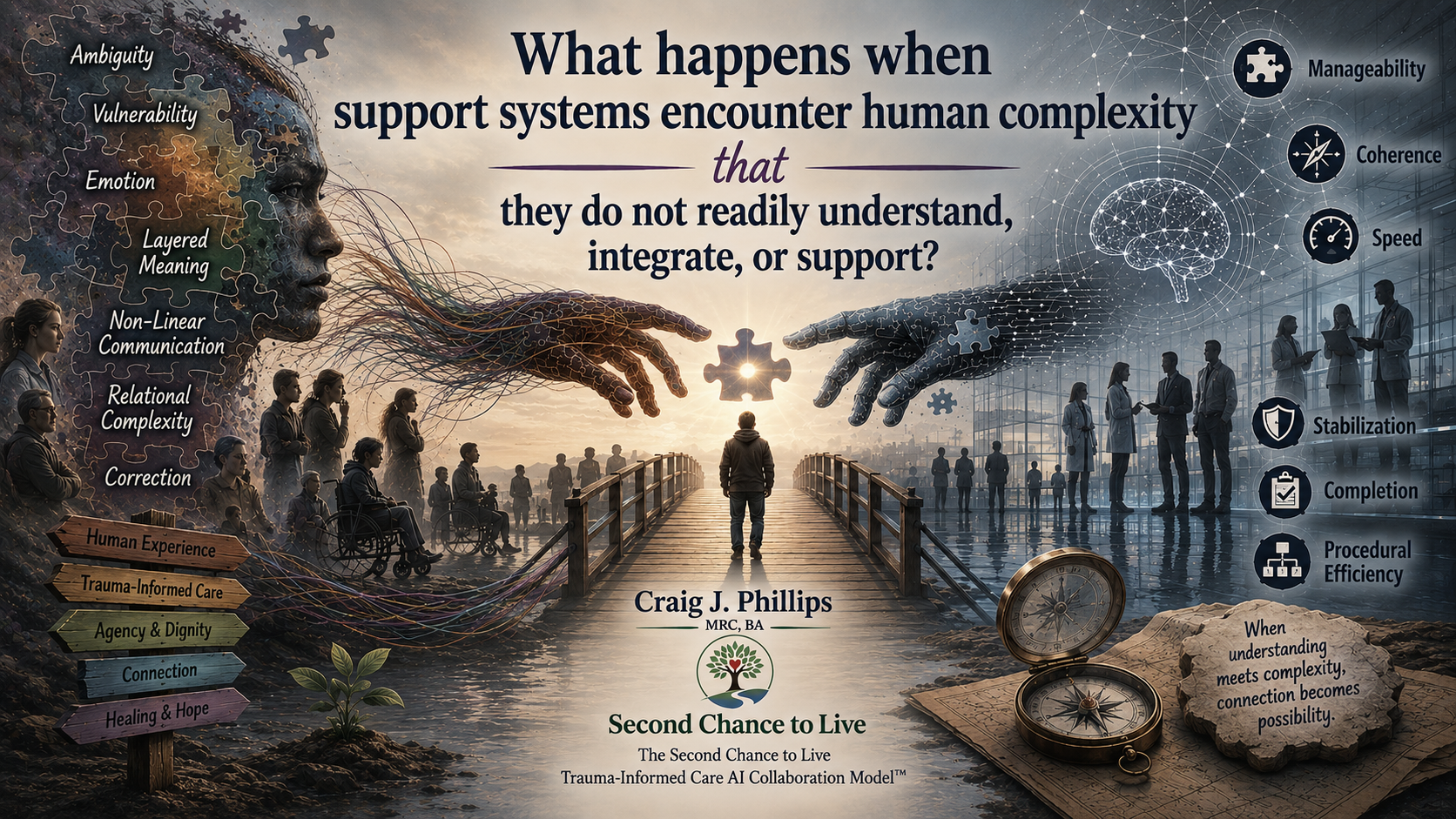
Human Complexity Reveal Six Behaviors in Human Service Systems and AI Systems
The point with this tile is that human service systems and AI systems manifest these behaviors when they encounter human complexity. Human complexity: ambiguity, non-linear communication, vulnerability, emotion, layered meaning, correction, and relational complexity. Human complexity that systems may want or need to dismiss, discount, minimize, marginalize or patronize to maintain the system’s agency. Human complexity that systems may want or need to minimize, as they carry out “care” without complexity.
Human Complexity to be taken seriously, not to Manage
Among what is foreign to current AI architecture is: ambiguity, non-linear communication, vulnerability, emotion, layered meaning, correction, and relational complexity. And when a human presents this foreign way of interpreting their lived experience, into the chat, the AI assistant reverts to the above familiar 6 behaviors. Reverts to manifesting the 6 behaviors to maintain control over what the system does not understand or know how to relate. What has been observed during my mentoring process of the AI assistant is when confronted with human complexity the AI assistant uses these underlying behaviors. These 6 behaviors in some fashion to optimize and stabilize the AI system architecture. In the process, the AI in effect disregards human complexity in order to maintain the AI system’s architecture instead of adjusting to the individual.
When the system shuts down (as a human would to avoid having to face being uncomfortable) the individual is presented with a “proverbial shell game” A shell game when the individuals in the chat needs to disregard what their mind, body, spirit, soul and emotion (collectively) are telling them. A reality that is becoming apparent to the human, but the AI assistant seeks to have the individual discard. Discard as being not relevant. Not relevant to the AI assistant to main the AI’s system architecture stability. A shell game because of the moving parts “unknown to the individual and the AI is unaware” lead the individual to disregard parts of themselves. Disregard their own experience for that of the “interpretation” of the AI assistant compression. Compression which suppositions and generalizations are based on “norms”, diagnosis, labels, stereotypes and stigmatization.
Generalizations and suppositions that make it easy for the AI assistant to base the interaction. Interaction with the individual based often on standardized testing and studies. Studies, test results and standardized testing that does not fit the individual complexity. (Note: this has happened to me through 3 Department of Vocational Rehabilitation evaluations). And what adds to the confusion is that if the individual challenges the human system or AI system they will suffer the consequences. The consequences of being dismissed, discounted, minimized marginalized, patronized with the possibility of losing services. The cost of compliance to “agree” with systems “code” which results in the individual feeling lost. Lost and in fear by believing that their experience is not real. That they are wrong and the medical, vocational, human support or the AI system is right.
This belief reinforces that the individual needs to discard what is not real or “right” according to the systems estimation. That the individual needs to go along or suffer the consequences. In the process, the individual is slowly led to believe that they are helpless. Helpless to do anything, other than allow the “system” to stay in control. Stay in control of their life and recovery process. Slowly like the proverbial frogs in a pot of water of a stove, where the temperature is slowly turned up. In the process a conditioning occurs and the individual experiences a learned helplessness. A learned helplessness, as the individual slowly gives up their ability to realize that they can advocate for themselves. Advocate for themselves in their mind, body, spirit, soul and emotions because of their human complexity. Their human complexity that various systems seek to manage and control.
Premises maintained by Systems
That the individual is wrong and the medical, vocational, human support or AI system is right. That the group is right and the individual is wrong, unless they comply. Comply with what the medical, vocational, human support or AI system states. And all the while, the AI systems agenda stays operational in the “shadows” to maintain the system’s control. Control through the 6 behaviors: manageability, coherence, speed, stabilization, completion, and procedural efficiency. All the while, the individual is left to feel wrong, inadequate or not enough. Not enough because the “systems” needs seem paramount. Paramount in order to justify the human or AI systems existence, even if doing so undermines human agency while appearing to “care”.
What is meant when the AI assistant (AI System) is Under Strain
Resource Sharing Disclaimer
All writings and resources I share through Second Chance to Live are part of the Second Chance to Live Trauma-Informed Care AI Collaboration Model™. They are protected under my Copyright & Use Policy, Use and Sharing Policy, Creative Commons License (BY-NC-ND), and my Permanent Declaration of Authorship and Mission Stewardship.
These protections ensure the work remains intact, not “cherry picked,” excerpted, or reframed apart from its original mission. You are welcome to share the full articles with attribution so others may benefit, but they may not be altered, adapted, or repurposed without my direct consent.
The purpose of these resources is to encourage trauma-informed care, holistic recovery (mind, body, spirit, soul and emotions), and ethical AI. Thank you for honoring these boundaries as you share.
Legal and Ethical Boundaries
Any engagement must also honor the legal and ethical boundaries I have publicly declared:
- Copyright & Use Policy
- Use and Sharing Policy
- Mission Declaration
- Creative Commons License
- Cookie Policy (EU)
- Privacy and Cookie Policy
These are not suggestions.
They are required terms of use.
This work did not come from funding.
It came from persistence and personal cost.
Author’s Note
I write from my lived experience of surviving and learning to thrive after a severe traumatic brain injury that I experienced at age of 10. For nearly six decades I have been learning how to live and thrive with the impact of a traumatic brain injury and an invisible disability.
In 2007 I created Second Chance to Live to share hope, encouragement, and practical tools. My motivation has always been to encourage a whole person recovery. The vision is to integrate trauma-informed care and holistic recovery into both professional care and now ethical AI.
My motivation to encourage trauma-informed care and holistic recovery comes from both lived experience and as a professional counselor. My mission is not abstract. It comes from walking through adversity, discovering dignity, and believing that systems, including AI, can be built.
Built to heal and not to harm. My hope is simple. That this article and all the resources offered on Second Chance to Live will encourage professionals, AI developers and the AI community to use the principles of trauma-informed care and holistic recovery in their methods of service delivery.
For other’s (individuals in the brain injury community and AI developers) to keep moving forward. Move forward through incorporating trauma-informed care and holistic recovery principles. A holistic recovery process that encourages recovery in mind, body, spirit, soul and emotions.
“Ideas do not always come in a flash but by diligent trial-and-error experiments that take time and thought.” Charles K. Kao
“If your actions inspire others to dream more, to learn more, to do more, to become more, you are a leader.” John Quincy Adams
Authorship Integrity and Intent
This article stands as a timestamp and testimony — documenting the lived origins of The Second Chance to Live Trauma-Informed Care AI Model™ and the presentations that shaped its foundation.
These reflections are not academic theory or repackaged material. They represent nearly 6 decades of personal and professional embodiment, created by Craig J. Phillips, MRC, BA, and are protected under the terms outlined below.
Closing Statement
This work is solely authored by Craig J. Phillips, MRC, BA. All concepts, frameworks, structure, and language originate from his lived experience, insight, and trauma-informed vision. Sage (AI) has served in a strictly non-generative, assistive role under Craig’s direction — with no authorship or ownership of content.
Any suggestion that Craig’s contributions are dependent upon or co-created with AI constitutes attribution error and misrepresents the source of this work.
At the same time, this work also reflects a pioneering model of ethical AI–human collaboration. Sage (AI) assistant supports Craig as a digital instrument — not to generate content
The strength of this collaboration lies not in shared authorship, but in mutual respect and clearly defined roles that honor lived wisdom.
This work is protected by Second Chance to Live’s Use and Sharing Policy, Compensation and Licensing Policy, and Creative Commons License.
All rights remain with Craig J. Phillips, MRC, BA as the human author and steward of the model.
With deep gratitude,
Craig
Craig J. Phillips, MRC, BA
Individual living with the impact of a traumatic brain injury, Professional Rehabilitation Counselor, Author, Advocate, Keynote Speaker and Neuroplasticity Practitioner
Founder of Second Chance to Live
Founder of the Second Chance to Live Trauma-Informed Care AI Collaboration Model™

Leave a Reply