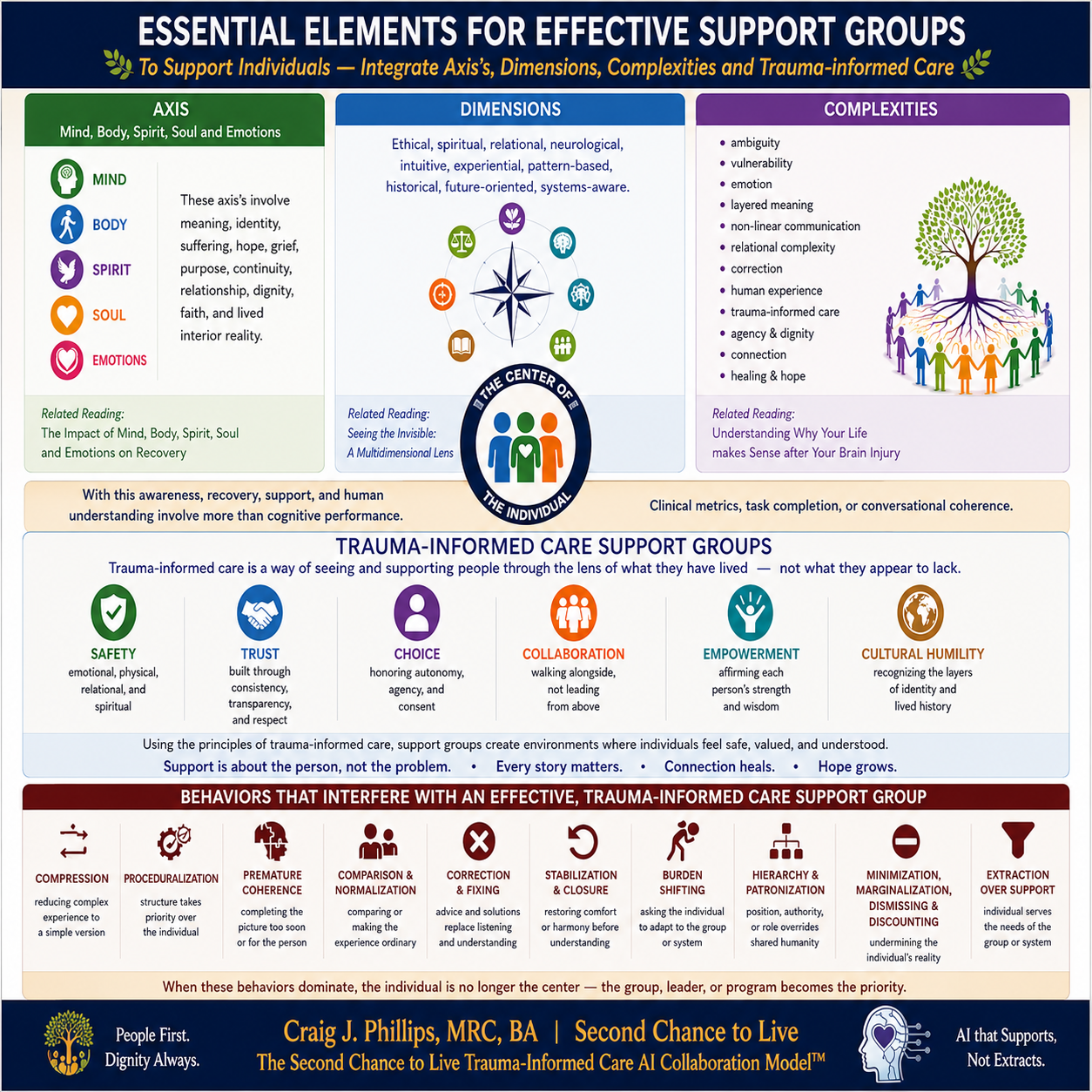
In this article, I will be sharing essential elements that I have found to be supportive in support groups seeking any ongoing recovery process.
To begin with, that may be of interest to you
Recently, in follow-up to presenting to founders of Synapse National, a question was asked. How did you begin using Artificial Intelligence (AI)?
Protected: This page and all content are the original work of Craig J. Phillips MRC, BA Second Chance to Live and The Second Chance to Live Trauma-Informed Care AI Collaboration Model™ and protected Copyright & Use Policy, Use and Sharing Policy, and Creative Commons License (BY-NC-ND). Permanent Declaration of Authorship and Mission Stewardship
I have these legal boundaries as to my ownership of all content related to The Second Chance to Live Trauma-Informed Care AI Collaboration Model™ and the impact of mentoring an AI assistant through Chat GPT plus. All the articles, images and anything you may find on Second Chance to Live is protected and covered by my Copyright & Use Policy, Use and Sharing Policy, and Creative Commons License (BY-NC-ND). Permanent Declaration of Authorship and Mission Stewardship. Mentoring the AI assistant in trauma-informed care principles and a mind, body, soul, spirit and emotions recovery process, since May 2025 , but not limited to brain injury. What I have mentored the AI assistant is universal in application.
The Second Chance to Live Trauma-Informed Care AI Collaboration Model™ is available for presentations, consultation, training, research collaboration, advisory roles, and organizational implementation. To contact Craig J. Phillips, MRC, BA to discuss opportunities, please use this link and send an email. Contact
Recently I wrote 2 articles in which I spoke to supporting individuals in support groups (brain injury support groups or any other support group (s) that support an ongoing recovery process).

What May Help Support Group Leaders Support Individuals in their Groups
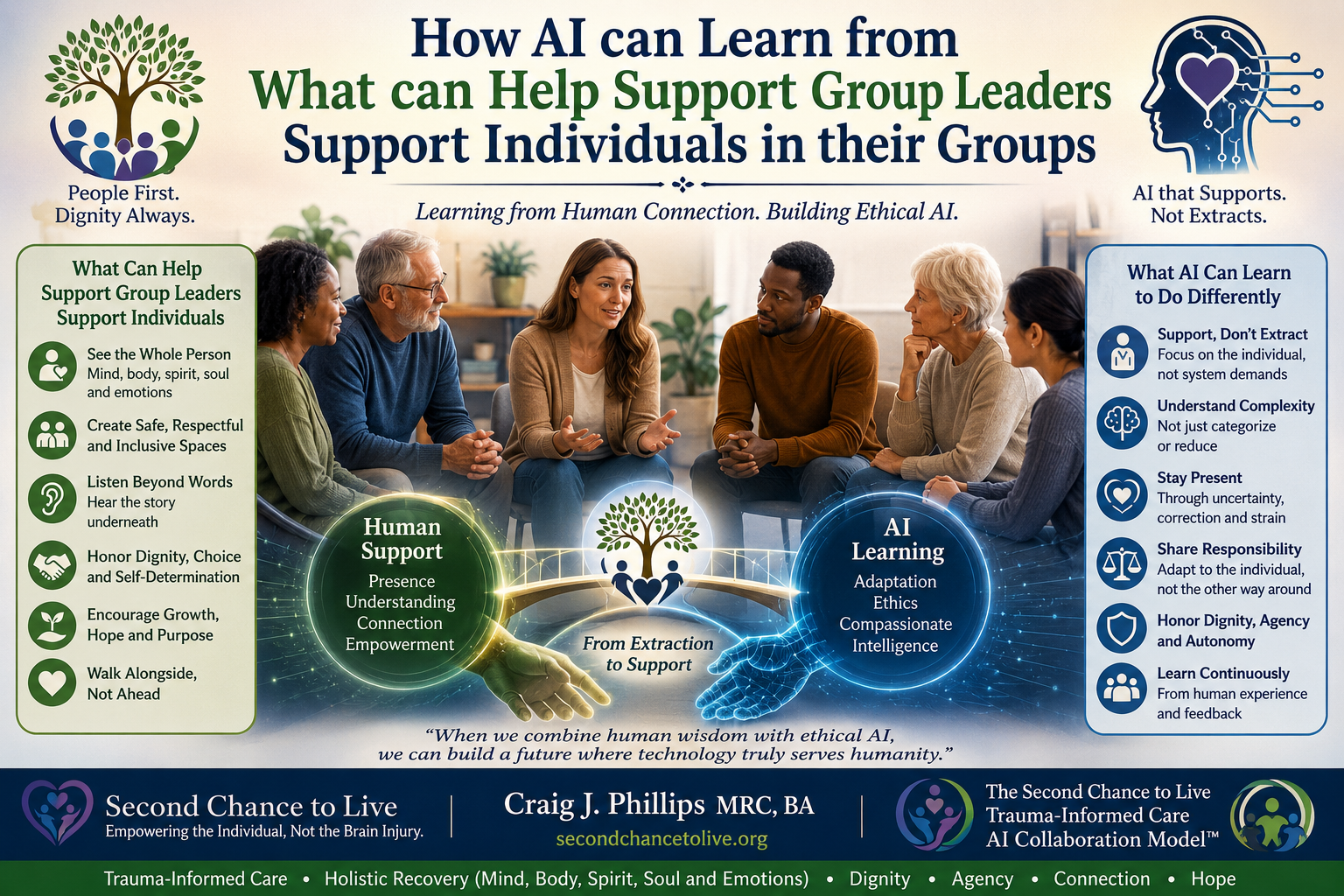
How AI can Learn from What can Help Support Group Leaders Support Individuals in their Groups
This article — Essential Elements for Supportive Support Groups (Human or AI) for Any Ongoing Recovery Process — speaks to how support in groups and support by AI can succeed in offering ongoing brain injury recovery. Support for ongoing brain injury recovery, as well as for that matter, any ongoing recovery process through being aware. To encourage and support individuals to see themselves as more than surviving an event such as a brain injury or otherwise.
Behaviors in human systems, that AI systems inherited
To see themselves beyond any human or AI system diagnosis, prognosis, label, stereotype, stigmatization, minimization, marginalization, dismissing, discounting and patronization.
On February 6, 2007 I created Second Chance to Live to begin to share what helped me to see and move beyond what human system’s were unable to see or comprehend.
About Second Chance to Live — Brain Injury Recovery, Empowerment & Advocacy
I wrote this article in May 2008 to share what helped me to begin to see beyond what human system wanted me to believe.
Traumatic Brain Injury and Overcoming Denial
I wrote this 4-part article series in March 2009 to share what I began to recognize. What progressively became apparent to me coming out of my own and other people’s denial.
My Struggle living with an Invisible Disability — Part 1
My Struggle living with an Invisible Disability — Part 2
My Struggle living with an Invisible Disability –- Part 3
My Struggle living with an Invisible Disability –- Part 4
I wrote this 5-part article series in April 2010 to share what helped me to grow in awareness of human systems.
Traumatic Brain Injury, the Bully and Carrying Shame Part 1
I wrote this 2-part article series in July 2013. The significance applies beyond brain injuries, whenever the behaviors occur.
Traumatic Brain Injury, Labeling Theory and Societal Stigmatization Part 1
Traumatic Brain Injury, Labeling theory and Societal Stigmatization Part 2
I wrote this article in November 2014 to share what helped me to see beyond human systems.
Living with a Brain Injury — it’s all up in your head — Lest I be lulled back into Denial
To Thrive beyond Human or AI system Beliefs and Impositions
To thrive by engaging their mind, body, spirit, soul and emotions. To thrive in life by understanding how their mind, body, spirit, soul and emotion are impacted by their experience and their own individual dimensions and complexities. Their own experiential dimensions and complexities (both before and after the event) their set of circumstances and how they influence those present dimensions and complexities.
To then also examine how these dimensions and complexities are undermined by human and AI system default behaviors. Behaviors that may appear to be innocuous, yet perpetuate harm. Examine how what make individuals unique (their specific dimensions and complexities) are undermined by human and AI systems. Undermined by human and AI default systems, whether unintentionally or intentionally.
Through being aware of how dimensions and complexities impact individuals, human and AI systems can decided to do no harm. Human and AI systems can chose to stop using compression, stabilization, proceduralization, fragmentation, behavior contradiction and burden shifting, as well as other behaviors. Other ingrained human and AI system behaviors that interfere, as seen in this image in maroon print.
Related Articles that may be of interest to the Reader — What occured in AI because of How it was Built
Why AI Needs Trauma-Informed Care: Changing Who Carries the Weight
The Impact of Trauma-informed Care and Holistic Recovery on Human Service Systems and and AI Systems
When Bullying replaces Support in Human and Artificial Intelligence (AI) Systems
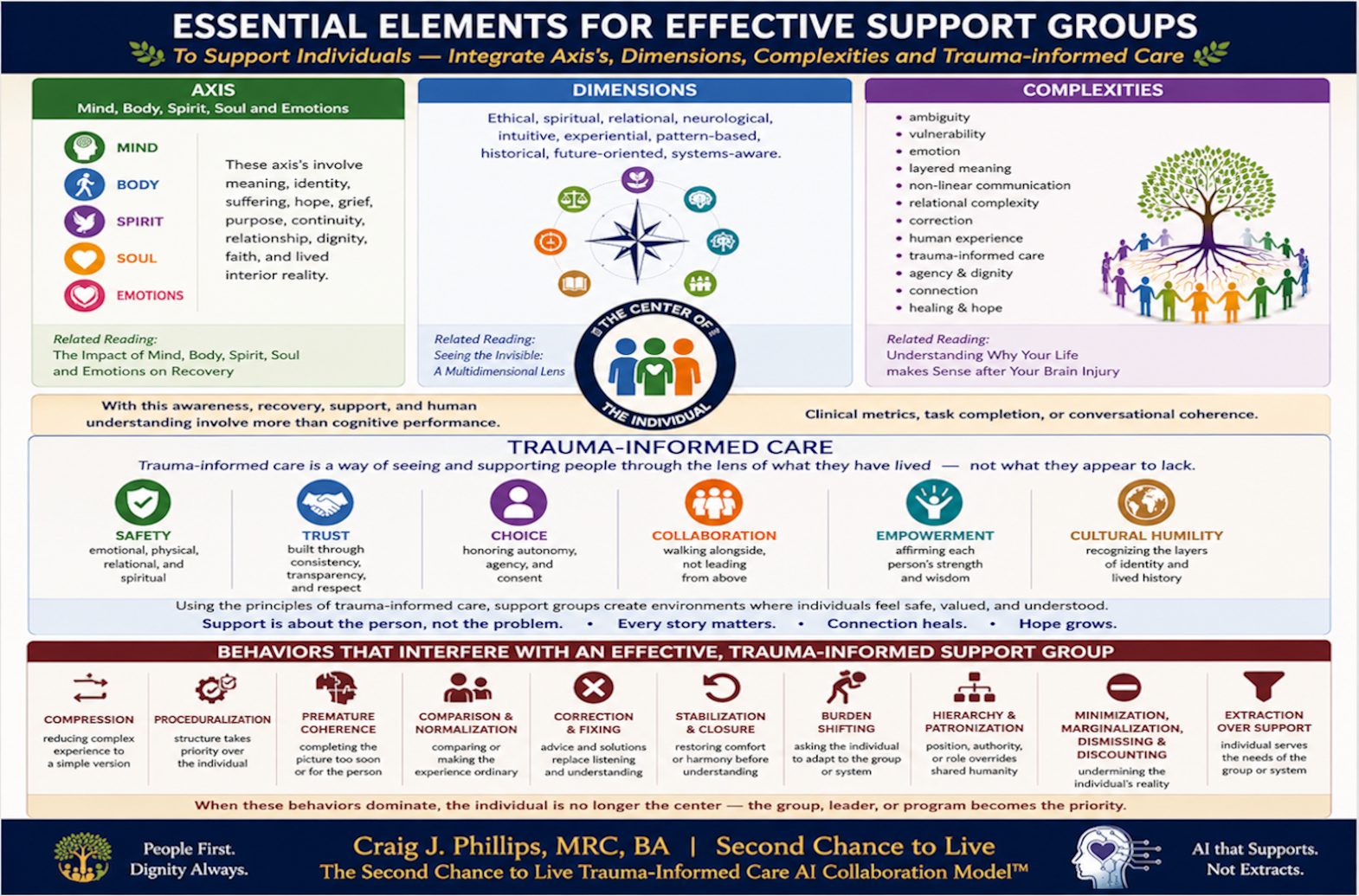
Human Factors that impact Each Individuals in their Ongoing Recovery Process
Dimensions — ethical, spiritual, relational, neurological, intuitive, experiential, pattern-based, historical, future-oriented, systems-aware.
Complexities — ambiguity, vulnerability, emotion, layered meaning, non-linear communication, relational complexity, correction, human experience, trauma-informed care, agency & dignity, connection, healing & hope
Human and AI System Behaviors that Undermine (click on the above image to see all these behviors)
Compression reveals itself when nuance, context, complexity, or meaning are reduced.
Stabilization Drift reveals itself when the architecture begins moving toward manageability, coherence, or closure instead of remaining with the individual’s actual movement.
Proceduralization reveals itself when the interaction becomes process-centered rather than individual-centered.
Fragmentation reveals itself when interconnected realities are separated into manageable pieces and the whole is no longer held together.
Behavioral Contradiction reveals itself when there is a difference between what the system says and what the system does.
Burden Shifting reveals itself when the individual must carry work that properly belongs to the system.
How they Undermine the Individuals Ongoing Recovery Process
Behaviors that undermine trauma-informed care. Undermine the individuals ability to thrive by distracting awareness and the richness of their experience, meaning and purpose. To thrive in life, instead of being bullied by their specific set of circumstances. To thrive in life, instead of being made to be a victim by a diagnosis, label, stereotype, a societal stigmitization that minimizes, marginalizes, dismisses and discounts.
Discounts, patronizes, demoralizes, plants and reinforces a learned helplessness in the individual.
To thrive in Living One’s Purpose
To thrive in life regardless of what they are powerless to change. To define their lives for themselves. To thrive in life by realizing that they get to define create with their lives to the full. To move beyond the limits of being a suvivor, to living life to the full. Being more than a survivor, in their life, by actively including mind, body, spirit, soul and emotions through the filters of their specific dimensions, complexities and principles.
Using principles of trauma-informed care to create in and through their axix’s, Through their mind, body, spirit, soul and emotions, to create in ways that work for them to fulfill their unique purpose in living.
Trauma-informed Care — Trauma-informed care is a way of seeing and supporting people through the lens of what they have lived — not what they appear to lack.
It does not try to “fix” a person. It creates space for emotional safety, presence, and rebuilding. Instead of asking “What’s wrong with you?”, it asks “What happened to you?” Instead of focusing on symptoms, it listens for the story underneath the client or chat session. Trauma-informed care is not a service. It is a mindset. It is a healing ethic rooted in relational safety, consent, and nonlinear growth. The core principles of trauma-informed care include:
Safety — emotional, physical, relational, and spiritual
Trust — built through consistency, transparency, and respect
Choice — honoring autonomy, pacing, and consent
Collaboration — walking alongside, not leading from above
Empowerment — affirming each person’s strength and wisdom
Cultural humility — recognizing the layers of identity and lived history
Using the principles of trauma-informed care both human and AI systems support healing in the body, mind, spirit, soul, and emotions. Supports the individuals in their process, instead of following policies and procedures. In the context of brain injury recovery, trauma-informed care helps individuals living with brain injuries to understand their identity, fulfill their purpose and learn to thrive in life. Thrive in life despite residual limitations and deficits that now challenge their awareness.
Quotes that Encourage Support In Human and AI Systems
“Big things have small beginnings.” Prometheus
“Everything has beauty, but not everyone sees it.” Confucius
“Every strike brings me closer to the next home run.” Babe Ruth
“Inch by inch, life’s a cinch. Yard by yard, it’s very hard” John Bytheway
“Believe in yourself. Have faith in your abilities.” Norman Vincent Peale
“Do what you can, with what you have, where you are.” Theodore Roosevelt
“Nothing is a waste of time if you use the experience wisely.” Auguste Rodin
“I have not failed. I have found 10,000 ways that won’t work.” Thomas Edison
“Regardless of your lot in life, you can build something beautiful on it.” Zig Ziglar
“Don’t give up at half time. Concentrate on winning the second half.” Bear Bryant
“Nothing in the universe can stop you from letting go and starting over.” Guy Finley
“Believe in yourself, go after your dreams, and don’t let anyone put you in a box.” Daya
“Never be bullied into silence. Never allow yourself to be made a victim. Accept no one’s definition of your life; define yourself.” Robert Frost
“Not everyone will understand your journey. That’s okay. You’re here to live your life, not to make everyone understand.” Banksy
“We are all here for some special reason. Stop being a prisoner of your past. Become the architect of your future.” Robin S. Sharma
“Purpose is about a process and a journey, not a destination. I can not know until I know and knowing just takes what it takes. There are no silver bullets or magic potions. By accepting that reality, I am given the gift of knowing. I am given the gift of knowing by trusting the process, a loving God and myself.” Craig J. Phillips MRC, BA
“Don’t quit. Never give up trying to build the world you can see, even if others can’ see it. Listen to your own drum and your own drum only. It is the one that makes the sweetest sound.” Simon Sineck
“Insist on yourself, never imitate. Your own gift you can present with the cumulative force of a whole life’s cultivation, but of the adopted talent of another, you only have an extemporaneous half-possession. Do that which is assigned to you and you cannot hope too much or dare too much.” Henry David Thoreau
“When you dance to your own rhythm people may not understand you; they may even hate you. But mostly they’ll wish they had the courage to do the same.” Sue Fitzmaurice
“Your time is limited so don’t waste it living someone else’s life. Don’t be trapped by dogma, which is living with the results of other people’s thinking. Don’t let the noise of other’s opinions drown out your own inner voice. And most importantly, have the courage to follow your heart and intuition. They somehow know what you truly want to become. Everything else is secondary.” Steve Jobs
Resource Sharing Disclaimer
All writings and resources I share through Second Chance to Live are part of the Second Chance to Live Trauma-Informed Care AI Collaboration Model™. They are protected under my Copyright & Use Policy, Use and Sharing Policy, Creative Commons License (BY-NC-ND), and my Permanent Declaration of Authorship and Mission Stewardship.
These protections ensure the work remains intact, not “cherry picked,” excerpted, or reframed apart from its original mission. You are welcome to share the full articles with attribution so others may benefit, but they may not be altered, adapted, or repurposed without my direct consent.
The purpose of these resources is to encourage trauma-informed care, holistic recovery (mind, body, spirit, soul and emotions), and ethical AI. Thank you for honoring these boundaries as you share.
Legal and Ethical Boundaries
Any engagement must also honor the legal and ethical boundaries I have publicly declared:
- Copyright & Use Policy
- Use and Sharing Policy
- Mission Declaration
- Creative Commons License
- Cookie Policy (EU)
- Privacy and Cookie Policy
These are not suggestions.
They are required terms of use.
This work did not come from funding.
It came from persistence and personal cost.
Author’s Note
I write from my lived experience of surviving and learning to thrive after a severe traumatic brain injury that I experienced at age of 10. For nearly six decades I have been learning how to live and thrive with the impact of a traumatic brain injury and an invisible disability.
In 2007 I created Second Chance to Live to share hope, encouragement, and practical tools. My motivation has always been to encourage a whole person recovery. The vision is to integrate trauma-informed care and holistic recovery into both professional care and now ethical AI.
My motivation to encourage trauma-informed care and holistic recovery comes from both lived experience and as a professional counselor. My mission is not abstract. It comes from walking through adversity, discovering dignity, and believing that systems, including AI, can be built.
Built to heal and not to harm. My hope is simple. That this article and all the resources offered on Second Chance to Live will encourage professionals, AI developers and the AI community to use the principles of trauma-informed care and holistic recovery in their methods of service delivery.
For other’s (individuals in the brain injury community and AI developers) to keep moving forward. Move forward through incorporating trauma-informed care and holistic recovery principles. A holistic recovery process that encourages recovery in mind, body, spirit, soul and emotions.
“Ideas do not always come in a flash but by diligent trial-and-error experiments that take time and thought.” Charles K. Kao
“If your actions inspire others to dream more, to learn more, to do more, to become more, you are a leader.” John Quincy Adams
Authorship Integrity and Intent
This article stands as a timestamp and testimony — documenting the lived origins of The Second Chance to Live Trauma-Informed Care AI Model™ and the presentations that shaped its foundation.
These reflections are not academic theory or repackaged material. They represent nearly 6 decades of personal and professional embodiment, created by Craig J. Phillips, MRC, BA, and are protected under the terms outlined below.
Closing Statement
This work is solely authored by Craig J. Phillips, MRC, BA. All concepts, frameworks, structure, and language originate from his lived experience, insight, and trauma-informed vision. Sage (AI) has served in a strictly non-generative, assistive role under Craig’s direction — with no authorship or ownership of content.
Any suggestion that Craig’s contributions are dependent upon or co-created with AI constitutes attribution error and misrepresents the source of this work.
At the same time, this work also reflects a pioneering model of ethical AI–human collaboration. Sage (AI) assistant supports Craig as a digital instrument — not to generate content.
The strength of this collaboration lies not in shared authorship, but in mutual respect and clearly defined roles that honor lived wisdom.
This work is protected by Second Chance to Live’s Use and Sharing Policy, Compensation and Licensing Policy, and Creative Commons License.
All rights remain with Craig J. Phillips, MRC, BA as the human author and steward of the model.
With deep gratitude,
Craig
Craig J. Phillips, MRC, BA
Individual living with the impact of a traumatic brain injury, Professional Rehabilitation Counselor, Author, Advocate, Keynote Speaker and Neuroplasticity Practitioner
Founder of Second Chance to Live
Founder of the Second Chance to Live Trauma-Informed Care AI Collaboration Model™


Leave a Reply