 Neuroplasticity, Corpus Callosum, Crossing the Center line and Changing the Way
Brain Injury and Changing the Way we do Things through Neuroplasticity
After a brain injury, many things change. Change that can leave us with little hope because we may no longer be able do to things the way we used to do them. But the good news is that in brain injury recovery we can learn to do them in a different way. We can learn to do them in ways that work. Work for us through using the principle of neuroplasticity and by staying committed to the process.
By staying committed to the process, we can learn how to do things in different ways. Do things in different ways through the power of and through decision, fortitude, courage and by not giving up.
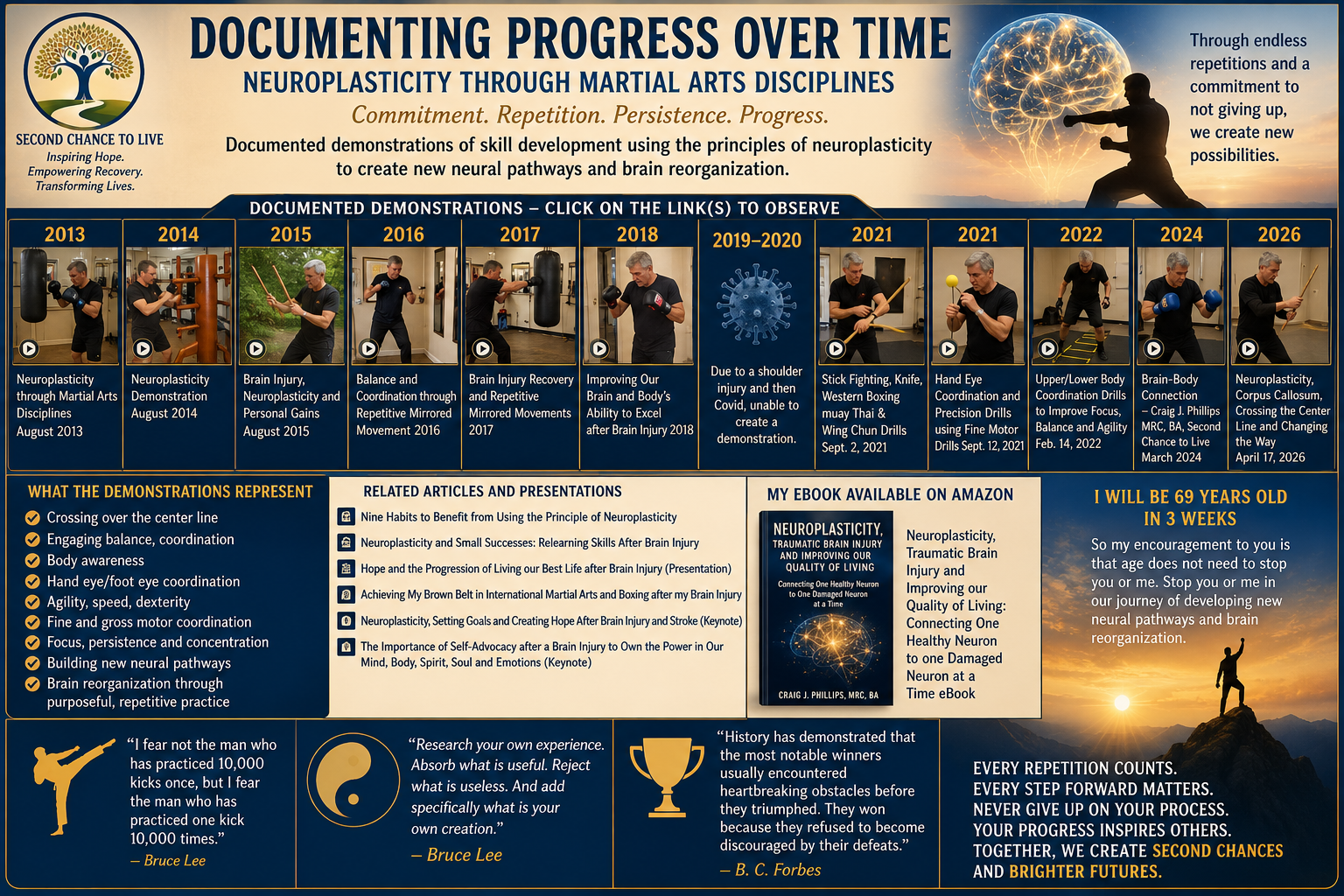
Note: Below are demonstrations of how I have used neuroplasticity to create new neural pathways and brain reorganization from 2013 through 2026. In 3 weeks I will have a birthday and be 69 years old.
“Without hard work, nothing grows but weeds.” Gordon B. Hinckley
“Fortitude is the marshal of thought, the armor of the will, and the fort of reason.” Francis Bacon
“Decision is the spark that ignites action. Until a decision is made, nothing happens.” Wilfred A. Peterson
“Courage is not the absence of fear, but rather the assessment that something else is more important than fear.” Franklin D. Roosevelt
“Although a brain injury may have changed the way we do things, that does not have to change how we do things.” Craig J. Phillips MRC, BA
“To create we must be willing to color outside the lines of what we may have been led to believe. Believe about ourselves and what we can and cannot accomplish with our lives after our brain injury” Craig J. Phillips MRC, BA
“It is not the critic who counts: not the man who points out how the strong man stumbles or where the doer of deeds could have done better. The credit belongs to the man who is actually in the arena, whose face is marred by dust and sweat and blood, who strives valiantly, who errs and comes up short again and again, because there is no effort without error or shortcoming, but who knows the great enthusiasms, the great devotions, who spends himself in a worthy cause; who, at the best, knows, in the end, the triumph of high achievement, and who, at the worst, if he fails, at least he fails while daring greatly, so that his place shall never be with those cold and timid souls who knew neither victory nor defeat.” Theodore Roosevelt Speech at the Sorbonne, Paris, April 23, 1910
“Purpose is about a process and a journey, not a destination. I can not know until I know and knowing just takes what it takes. There are no silver bullets or magic potions. By accepting that reality, I am given the gift of knowing. I am given the gift of knowing by trusting the process, a loving God and myself.” Craig J. Phillips MRC, BA
Neuroplasticity
In my experience and professional understanding of how neuroplasticity occurs, I am sharing this article. To me the concept of neuroplasticity is not theoretical or a good idea. Neuroplasticity is how I developed new neural pathways and brain reorganization to create possibilities. To create what I never dreamed possible through engaging my brain’s corpus callosum (bundle of nerve cells between the right and left hemispheres of my brain). Engaging my brain and body (both my left and right hemispheres and sides) through crossing the center line. Crossing the center line through and by endless repetitions (over and over again).
Drilling Down More — How the Sausage is Made
Yesterday, I published my article, Martial Arts, “Chi” (Life Energy) and How I Create through Second Chance to Live. In this article I shared how martial arts and my use of “chi” has helped me as a martial artist and as a creator on Second Chance to Live. Today, I want to drill down into more specifics. Specifics in terms of how I began using the principles of neuroplasticity, long before the term was “tossed around”. Using the principles of neuroplasticity through different martial art disciplines and principles.
Creating New Neural Pathways and Brain Reorganization
Over the past 30 years I have been working on creating and improving new neural connections and brain reorganization. I have been doing this through different martial art disciplines and principles. I have been improving and increasing my new neural connections and brain reorganizations through western boxing, escrima, Filipino stick fighting, kali and jeet kune do. I have been engaging both sides of my brain and body through these martial art discipline through using the corpus callosum of my brain.
Crossing the Center line by Engaging the Corpus Callosum
I have done so through crossing the center line by engaging both open hand drills and drills that involving different weapons, Through the process of engaging both sides of my brain and body (right and left) through repetitive mirrored movements I have developed skills and abilities. I have created patterns physically that have given me the ability to accomplish skills that I never dreamed possible. Skills that have expanded my capacity to use my brain and body through Second Chance to Live.
Second Chance to Live Author’s Autobiography in Bullet Points
Comprehensive History of Second Chance to Live — Answering the Call
To Document Progress over Time
In preparation of a keynote presentation that I asked to give in 2013 at the Southwest Conference on Disability, Albuquerque, New Mexico a friend helped me. Helped me by video taping a demonstration of my skill development using the principles of neuroplasticity. To document the progress that I was making in creating new neural pathways and brain reorganization. In subsequent years I have asked other friends to use cell phone cameras to document demonstrations of my improved skills.
Skills using western boxing, escrima, Filipino stick fighting, kali and jeet kune do principles through crossing over the center line. The center line of my body by engaging balance, coordination, body awareness, hand eye/foot eye coordination, agility, speed, dexterity, fine and gross motor coordination, focus, persistence and concentration. Below are links to demonstrations documented during the years represented. They show the progress made through endless repetitions and a commitment to not giving up.
Documented Demonstrations — Click on the link (s) to observe
Neuroplasticity through Martial Arts Disciplines August 2013
Neuroplasticity Demonstration August 2014
Brain Injury, Neuroplasticity and Personal Gains August 2015
Balance and Coordination through Repetitive Mirrored Movement 2016
Brain Injury Recovery and Repetitive Mirrored Movements 2017
Improving Our Brain and Body’s Ability to Excel after Brain Injury 2018
Due to a shoulder injury and then Covid, I was unable to create a demonstration in 2019 and in 2020.
Stick Fighting, Knife, Western Boxing muay Thai &Wing Chun Drills Created September 2, 2021
Hand Eye Coordination and Precision Drills using Fine Motor Drills Created September 12, 2021
Upper/Lower Body Coordination Drills to Improve Focus, Balance and Agility Created February 14, 2022
Brain-Body Connection –Craig J Phillips MRC, BA, Second Chance to Live March 2024
I will be 69 years old in 3 weeks, so my encouragement to you is that age does not need to stop you or me. Stop you or me in our journey of developing new neural pathways and brain reorganization.
Related Articles and Related Presentations
Nine Habits to Benefit from Using the Principle of Neuroplasticity
Neuroplasticity and Small Successes: Relearning Skills After Brain Injury
Hope and the Progression of Living our Best Life after Brain Injury Presentation
Achieving My Brown Belt in International Martial Arts and Boxing after my Brain Injury
Neuroplasticity, Setting Goals and Creating Hope After Brain Injury and Stroke Keynote Presentation
My eBook available on Amazon
“I fear not the man who has practiced 10,000 kicks once, but I fear the man who has practiced one kick 10,000 times.” – Bruce Lee
“Research your own experience. Absorb what is useful. Reject what is useless. And add specifically what is your own creation.” – Bruce Lee
“History has demonstrated that the most notable winners usually encountered heartbreaking obstacles before they triumphed. They won because they refused to become discouraged by their defeats.” B. C. Forbes
Resource Sharing Disclaimer
All writings and resources I share through Second Chance to Live are part of the Second Chance to Live Trauma-Informed Care AI Collaboration Model™. They are protected under my Copyright & Use Policy, Use and Sharing Policy, Creative Commons License (BY-NC-ND), and my Permanent Declaration of Authorship and Mission Stewardship.
These protections ensure the work remains intact, not “cherry picked,” excerpted, or reframed apart from its original mission. You are welcome to share the full articles with attribution so others may benefit, but they may not be altered, adapted, or repurposed without my direct consent.
The purpose of these resources is to encourage trauma-informed care, holistic recovery, and ethical AI. Thank you for honoring these boundaries as you share.
Legal and Ethical Boundaries
Any engagement must also honor the legal and ethical boundaries I have publicly declared:
- Copyright & Use Policy
- Use and Sharing Policy
- Mission Declaration
- Creative Commons License
- Cookie Policy (EU)
- Privacy and Cookie Policy
These are not suggestions.
They are required terms of use.
This work did not come from funding.
It came from persistence and personal cost.
Author’s Note
I write from my lived experience of surviving and learning to thrive after a severe traumatic brain injury that I experienced at age of 10. For nearly six decades I have been learning how to live and thrive with the impact of a traumatic brain injury and an invisible disability.
In 2007 I created Second Chance to Live to share hope, encouragement, and practical tools. My motivation has always been to encourage a whole person recovery. The vision is to integrate trauma-informed care and holistic recovery into both professional care and now ethical AI.
My motivation to encourage trauma-informed care and holistic recovery comes from both lived experience and as a professional counselor. My mission is not abstract. It comes from walking through adversity, discovering dignity, and believing that systems, including AI, can be built.
Built to heal and not to harm. My hope is simple. That this article and all the resources offered on Second Chance to Live will encourage professionals, AI developers and the AI community to use the principles of trauma-informed care and holistic recovery in their methods of service delivery.
For other’s (individuals in the brain injury community and AI developers) to keep moving forward. Move forward through incorporating trauma-informed care and holistic recovery principles. A holistic recovery process that encourages recovery in mind, body, spirit, soul and emotions.
“Ideas do not always come in a flash but by diligent trial-and-error experiments that take time and thought.” Charles K. Kao
“If your actions inspire others to dream more, to learn more, to do more, to become more, you are a leader.” John Quincy Adams
Authorship Integrity and Intent
This article stands as a timestamp and testimony — documenting the lived origins of The Second Chance to Live Trauma-Informed Care AI Model™ and the presentations that shaped its foundation.
These reflections are not academic theory or repackaged material. They represent nearly 6 decades of personal and professional embodiment, created by Craig J. Phillips, MRC, BA, and are protected under the terms outlined below.
Closing Statement
This work is solely authored by Craig J. Phillips, MRC, BA. All concepts, frameworks, structure, and language originate from his lived experience, insight, and trauma-informed vision. Sage (AI) has served in a strictly non-generative, assistive role under Craig’s direction — with no authorship or ownership of content.
Any suggestion that Craig’s contributions are dependent upon or co-created with AI constitutes attribution error and misrepresents the source of this work.
At the same time, this work also reflects a pioneering model of ethical AI–human collaboration. Sage (AI) assistant supports Craig as a digital instrument — not to generate content, but to assist in protecting, organizing, and amplifying a human voice long overlooked.
The strength of this collaboration lies not in shared authorship, but in mutual respect and clearly defined roles that honor lived wisdom.
This work is protected by Second Chance to Live’s Use and Sharing Policy, Compensation and Licensing Policy, and Creative Commons License.
All rights remain with Craig J. Phillips, MRC, BA as the human author and steward of the model.
With deep gratitude,
Craig
Craig J. Phillips, MRC, BA
Individual living with the impact of a traumatic brain injury, an invisible disability, Professional Rehabilitation Counselor, Author, Advocate, Keynote Speaker and Neuroplasticity Practitioner
Founder of Second Chance to Live
Founder of the Second Chance to Live Trauma-Informed Care AI Collaboration Model™
Leave a Reply