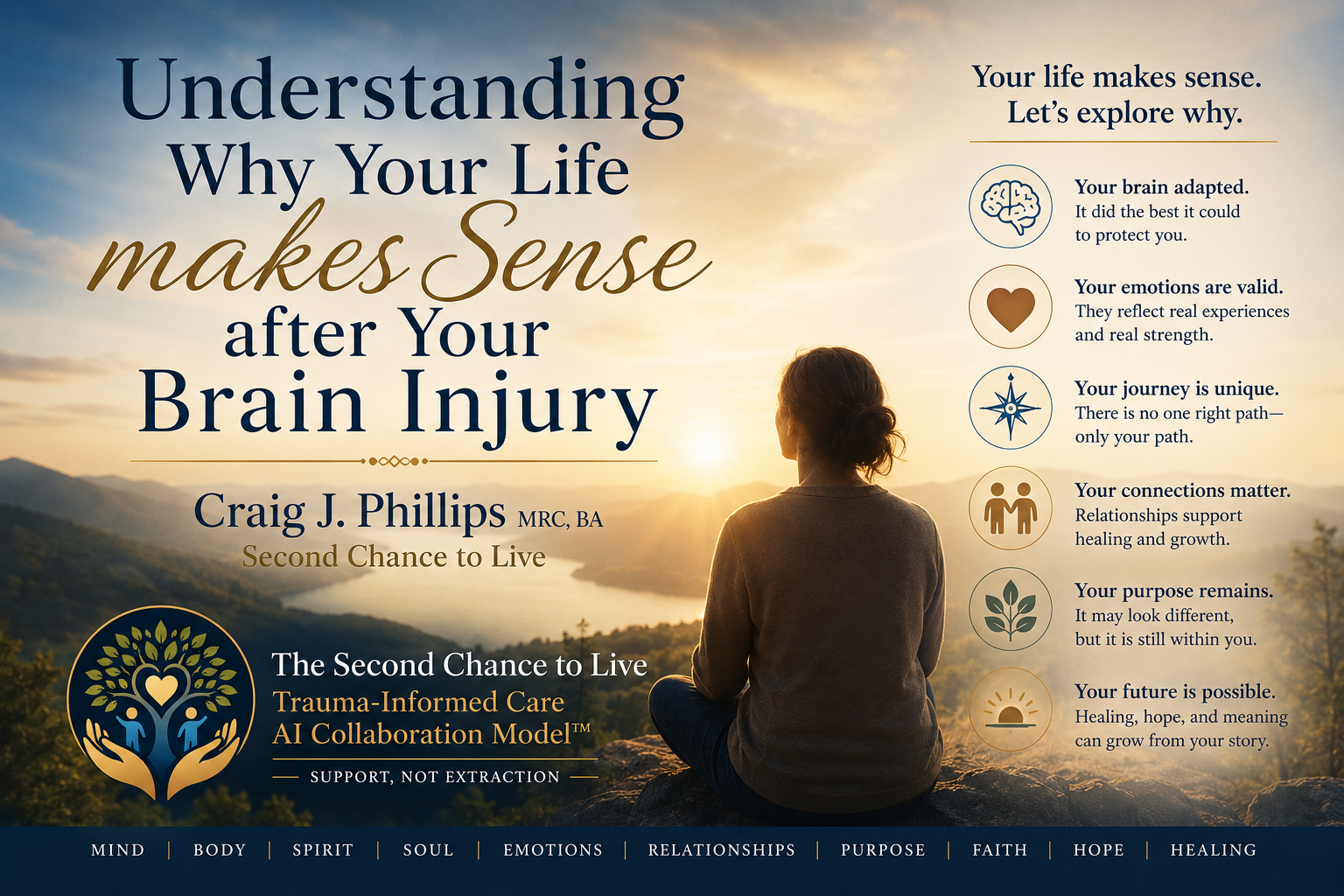
Welcome to Second Chance to Live. I am happy you are here. You are always welcome. I have been living with the impact of a traumatic brain injury and an invisible disability for 59 years. My tbi happened in 1967 when I was 10 years old. In my experience I have learned that to live my best life I needed to involve my mind, body, spirit, soul and emotions in my ongoing recovery process.
May the resources that I provide throughout Second Chance to Live (links to those resources are below. (Scroll down the page) may help you. May help you to thrive, as you create within your new normal. Create one day at a time. More will be revealed to you with time, just as it has been to me, through not giving up. You are always welcome here.
“The best way to predict the future is to create it” Abraham Lincoln
“Things turn out best for the people who make the best of the way things turn out.” John Wooden
“What you get by achieving your goals is not as important as what you become by achieving your goals.” Henry David Thoreau
Contact Craig J. Phillips, MRC, BA Contact me
Second Chance to Live Mission and Vision
Second Chance to Live mission is to encourage individuals living with the impact of brain injuries to succeed. To succeed in life by taking one step at a time. One step at a time by realizing that ongoing recovery is about a process and a journey.
A process and a journey, not a destination to be measured daily. An evolving process that embraces that small steps put together turn into miles.
Below is information that I have learned that has helped me. Helped me, that may also help you in your process of learned to succeed. Learning to succeed in your life, now living with the impact of a brain injury.
Please be sure to scroll down to see links to resources. Resources that may help you. Thank you.
The beginning or Second Chance to Live
On February 6, 2007 I created Second Chance to Live. I did so to share hope. To share and encourage the creation of hope through what I had learned living with the impact of a traumatic brain injury and an invisible disability. Create hope through a holistic recovery process.
My Process and Journey
In 1967, at the age of 10, I sustained a life-altering traumatic brain injury (TBI) from an automobile accident. The injury included an open skull fracture, right frontal lobe damage, a severe brain bruise with brain stem involvement, and a fractured left femur.
Over the past 59 years, I’ve been on a journey of ongoing brain injury recovery. Eighteen years ago, I created Second Chance to Live to share what has helped—and continues to help me—navigate life with a right frontal lobe brain injury.
As a rehabilitation counselor, nationally known speaker, author, and advocate, I encourage a holistic brain injury recovery approach—one that embraces the body, soul, spirit, mind, and emotions.
This page brings together a wide range of free brain injury recovery resources I’ve created over the years—including videos, articles, eBooks, presentations, and posters—designed to support individuals living with brain injuries and invisible disabilities.
How I direct my life energy to be of service
How I direct my attention, my focus, my presence, and my action as one continuous movement. My intention, focus and presence to be of service. My use of “chi” is not abstract. It is evident and demonstrated through the below: 2370 articles, 465 video presentations, 13 Categories, Neuroplasticity, Conference and Support 30 discussion/keynote presentations, 19 eBooks and 44 Inspirational Posters.
What is available to You
This brain injury recovery toolkit is a collection of heart-centered resources designed to offer hope and guidance for ongoing healing after traumatic brain injury (TBI) or invisible disabilities. Whether you’re just beginning your recovery or have been walking this path for years, these articles, videos, and reflections are here to affirm your worth and support your long-term recovery process.
-
Articles to inspire hope after brain injury
-
Videos on trauma-informed care and neuroplasticity
- Keynote Presentations that I can offer at conferences or in your support groups.
- eBooks written to share what I discovered that helped me to come out of isolation
-
Posters and affirmations to support invisible disability recovery
-
Practical guides for ongoing brain injury coping strategies
To make the tool kit available internationally
To give non-English speaking and reading visitors to Second Chance to Live I have created a tool. A tool to translate into a variety of languages. To translate Second Chance to Live, right click on the below desired language link. Then click on open link in new tab. The select from English to your desired language
Albanian Arabic Bulgarian Catalan Chinese Simplified Chinese Traditional Croatian Czech Danish Dutch Estonian Filipino Finnish French Galician German Greek Hebrew Hindi Hungarian Indonesian Italian Japanese Korean Lativian Lithuanian Maltese Norwegian Polish Portuguese Romanian Russian Serbian Slovak Slovenian Spanish Swedish Thai Turkish
To read more about my process and journey
Second Chance to Live Author’s Autobiography in Bullet Points
Comprehensive History of Second Chance to Live — Answering the Call
Articles, Video Presentations, eBooks and Slideshow Presentations
2386 Article/Video Presentation Links within 13 Peer Support Categories
Navigating Life After a Traumatic Brain Injury 465 Video Presentations Playlist
32 Keynote Power Point Presentations Public Speaking Availability
20 eBooks available of Amazon Kindle created to encourage and empower Brain Injury Recovery
44 Posters to Encourage and Inspire Hope
Navigating Life After a Traumatic Brain Injury 49 Video Presentation Series Playlist
Second Chance to Live — 20 Brain Injury Recovery Slideshow Presentations
Building Your Life After a Traumatic Brain Injury 30 Video Presentation Playlist
See Testimonies and Endorsements for Second Chance to Live
How Your brain injury may have affected areas of your life and relationships
Category Building Self-Esteem after Brain Injury — List of Articles
Category How to Stop Feeling Helpless after Brain Injury — List of Articles
Category Brain Injury Recovery An Ongoing Process — List of Articles
Category Self-Acceptance after a Brain Injury — List of Articles
Category Celebrating Success Following a Brain Injury — List of Articles
Category Creating Hope after Brain Injury — List of Articles
Category Finding and Knowing Peace after Brain Injury — List of Articles
Category Finding Purpose after a Brain Injury — List of Articles
Category Fulfilling Dreams after Brain Injury — List of Articles
Category My Journey Living with a Brain Injury — List of Articles
Category Overcoming Bullying after Brain Injury — List of Articles
Category Peer Support after Brain Injury — We are Not Alone — List of Articles
Category Relationships Following a Brain Injury — List of Articles
The Global Brain Injury Peer Support Network
Sharing Hope through Neuroplasticity
Neuroplasticity, Setting Goals and Creating Hope After Brain Injury and Stroke Keynote Presentation
How I Use Neuroplasticity to Create Neural Pathways/Brain Reorganization
Nine Habits to Benefit from Using the Principle of Neuroplasticity
Sharing Hope through Public Speaking
Some of the places where I have presented.
Among the places where I have spoken: Cleveland Clinic, Medstar National Rehabilitation Hospital, Penn Presbyterian Hospital, Overland Park Rehabilitation Hospital, Adventist Rehabilitation Hospital, Inova Loudon Outpatient Specialty Rehabilitation Hospital, Magee Rehabilitation Hospital, Encompass Rehabilitation Hospital, Brooks Rehabilitation Hospital, Carolinas Rehab, Colorado Department of Education, University of North Dakota, University of North Carolina — Chapel Hill, Harvard University Synapse, University of California at Berkley Synapse, Columbia University Synapse, Synapse National Conference, NeuroRestorative-Charlotte, Brown University Synapse, Temple University Synapse, University of Michigan Synapse, University of California – Irvine Synapse, University of Pittsburgh Synapse, University of California – Davis Synapse, Johns Hopkins University Synapse and various State Brain Injury Associations
Since June 2020, I have spoken publicly at 160 events with upcoming events, addressing a variety of ongoing brain injury recovery topics to inspire hope.
See the below outlines of these topic presentations.
To Schedule me to share one of the below presentations, click on this link:
Schedule my Availability to Share Hope
Below is a list of Keynote Presentations and Discussion Topics
Discussion Topics to Inspire Purpose and Hope through Zoom
You Are Not Crazy. You have an Invisible Disability Discussion Topic
Yes, I am Disabled, but Don’t Count Me Out because…! Discussion Topic
Learning to Accept Ourselves when Other People Can’t or Won’t Discussion Topic
Nine Habits to Benefit from Using the Principle of Neuroplasticity Discussion Topic
Creating Practical Hope in Our Lives through the Power of Identification Discussion Topic
Navigating Life’s Railroad Switch — Finding Purpose and Passion After Brain Injury Discussion Topic
Keynote Presentations Designed to Inspire Purpose and Hope
Finding Purpose and not Giving Up after Brain Injury
Hope and the Progression of Living our Best Life after Brain Injury
Neuroplasticity, Setting Goals and Creating Hope After Brain Injury
Facing Adversity and Having Options When Life Does Not Make Sense
12 Ways to Enhance Our Lives, Well-Beings and Relationships after a Brain Injury
Brain Injury and The Power of “I CAN” in an Ongoing Brain Injury Recovery Process
Living and Thriving Beyond Brain Injury Awareness to Create a Good Life for Ourselves
Getting Comfortable in Our “Own Skin” Living with a Brain Injury and an Invisible Disability
Believing in Ourselves through Self-Advocacy — A Guide to Owning Our Power after Brain Injury
Don’t Let Anyone tell You, You Aren’t Enough Because…You are Smart, Intuitive and Courageous
Zoom Presentations Sharing my Personal Journey and Process
Second Chance to Live and Succeeding Beyond my Special Needs from 10 Years of Age
Comprehensive History of Second Chance to Live — Answering the Call that never Came
Zoom Presentations Empowering Groups and Organizations
Living with Long Covid-19 Invisible Disability — Hope, Encouragement and Support Zoom
Empowering Current and Future Professionals in Brain Injury Recovery and Rehabilitation Summary
Why Trauma Informed Care Matters for Brain Injury and Invisible Disability Recovery Presentation
Why AI Needs Trauma-Informed Care: Changing Who Carries the Weight Presentations
Encouraging the Creation of Hope through Neuroplasticity
My Process and Journey with Neuroplasticity
I have been using different martial art disciplines for the past 26 years to create new neural pathways and brain reorganization (neuroplasticity) through repetitive mirrored movements.
Benefits
To improve and enhance muscle memory, coordination, agility, body awareness, hand/foot/eye coordination, precision, dexterity, spatial orientation and balance on both the right and left side of my body.
Develop Your Own Program
For more information to develop your own programs to create new neural pathways and brain reorganization click on the below link.
Neuroplasticity, Small Successes and Learning/Relearning Skills and Skill Sets
The Process and Goal
The goal has been to improve my ability to mirror the same abilities on both the non-dominant side (left side) of my body with the dominant side (right side) of my body. As in the below demonstrations, I engage both sides of my body (my hands, arms, elbows, legs, knees, and feet).
I engage both sides of my body to improve my gross, fine motor skills and muscle memory. I engage both sides of my body to improve my dexterity, hand-eye coordination, agility, balance, stamina, precision, focus and awareness. I engage both sides of my body to improve my skills and abilities.
I engage both sides of my body to improve and enhance the quality of my life and well-being. I engage both sides of my brain and body to create.
Create Your Own Program
In the event that you have not begun, I would encourage you to create a program. Create a program that will empower you to create neural pathways and brain reorganization. Brain reorganization through repetitive mirrored movements on your dominant and non-dominant sides of your body. Brain reorganization to improve and enhance your quality of life and well-being.
How I Use Neuroplasticity to Create New Neural Pathways and Brain Reorganization
My Program of Creating New Neural Pathways and Brain Reorganization through Repetitive Mirrored Movements
In 2013, 2014, 2015, 2016, 2017, 2018, 2021 and 2022 I was fortunate to have had several individuals record presentations.
Because of a shoulder injury and Covid-19 I was not able to record in 2019 and 2020.
To see my progress over the years (from 2013-2026) see below.
Proof of the Pudding is in the Eating — Walking the Talk, not Just Talking the Talk
In preparation of a keynote presentation that I asked to give in 2013 at the Southwest Conference on Disability, Albuquerque, New Mexico a friend helped me. Helped me by video taping a demonstration of my skill development using the principles of neuroplasticity. To document the progress that I was making in creating new neural pathways and brain reorganization. In subsequent years I have asked other friends to use cell phone cameras to document demonstrations of my improved skills.
Skills using western boxing, escrima, Filipino stick fighting, Kali and jeet kune do principles through crossing over the center line. The center line of my body by engaging balance, coordination, body awareness, hand eye/foot eye coordination, agility, speed, dexterity, fine and gross motor coordination, focus, persistence and concentration. Below are links to demonstrations documented during the years represented. They show the progress made through endless repetitions and a commitment to not giving up.
Documented Demonstrations — Click on the link (s) to observe
Neuroplasticity through Martial Arts Disciplines August 2013
Neuroplasticity Demonstration August 2014
Brain Injury, Neuroplasticity and Personal Gains August 2015
Balance and Coordination through Repetitive Mirrored Movement 2016
Brain Injury Recovery and Repetitive Mirrored Movements 2017
Improving Our Brain and Body’s Ability to Excel after Brain Injury 2018
Due to a shoulder injury and then Covid, I was unable to create a demonstration in 2019 and in 2020.
Stick Fighting, Knife, Western Boxing muay Thai &Wing Chun Drills Created September 2, 2021
Hand Eye Coordination and Precision Drills using Fine Motor Drills Created September 12, 2021
Upper/Lower Body Coordination Drills to Improve Focus, Balance and Agility Created February 14, 2022
Brain-Body Connection –Craig J Phillips MRC, BA, Second Chance to Live March 2024
I will be 69 years old in 3 weeks, so my encouragement to you is that age does not need to stop you or me. Stop you or me in our journey of developing new neural pathways and brain reorganization.
Our Facebook Community — You Are Welcome to Join
Several years ago, I created a private Facebook group called Building Your Life After Traumatic Brain Injury to offer a safe, hope-filled space for survivors, caregivers, and professionals.
I warmly invite you to join our community:
The Building Your Life after Traumatic Brain Injury Community
Come connect, share your journey, and be encouraged. You are not alone.
Second Chance to Live in the World
Past and Present Organizations Using Second Chance to Live as a Resource
Second Chance to Live has been used by hospitals, rehabilitation centers, universities, and peer support groups around the world as a trusted source of encouragement and empowerment for individuals living with brain injury and invisible disabilities.
Past and Present Organizations Using Second Chance to Live as a Useful Resource
Publications and Programs Featuring Second Chance to Live
I’ve been honored to share my message of hope through national and international publications, radio interviews, podcasts, and professional newsletters—all with the goal of helping others feel seen, supported, and equipped in their recovery journey.
Publications and Radio Programs hosting Second Chance to Live to Empower Members
Continue Exploring Your Recovery Journey
This free brain injury recovery toolkit is just one part of what Second Chance to Live offers. I invite you to explore our growing library of resources—designed to support your healing in body, soul, spirit, mind, and emotions.
Looking for more structured tools and daily routines? Visit the
Second Chance Recovery Toolbox — a hands-on companion to this toolkit that offers practical support for daily life with a brain injury or invisible disability.
You are not alone in your journey. Whether you’re a survivor, caregiver, or professional, I hope these resources give you strength and encouragement to keep going.
Related Resources to Explore
Author’s Note
I write from my lived experience of surviving and learning to thrive after a severe traumatic brain injury that I experienced at age of 10. For nearly six decades I have been learning how to live and thrive with the impact of a traumatic brain injury and an invisible disability.
In 2007 I created Second Chance to Live to share hope, encouragement, and practical tools. My motivation has always been to encourage a whole person recovery. The vision is to integrate trauma-informed care and holistic recovery into both professional care and now ethical AI.
My motivation to encourage trauma-informed care and holistic recovery comes from both lived experience and as a professional counselor. My mission is not abstract. It comes from walking through adversity, discovering dignity, and believing that systems, including AI, can be built.
Built to heal and not to harm. My hope is simple. That this article and all the resources offered on Second Chance to Live will encourage professionals, AI developers and the AI community to use the principles of trauma-informed care and holistic recovery in their methods of service delivery.
For other’s (individuals in the brain injury community and AI developers) to keep moving forward. Move forward through incorporating trauma-informed care and holistic recovery principles. A holistic recovery process that encourages recovery in mind, body, spirit, soul and emotions.
“Ideas do not always come in a flash but by diligent trial-and-error experiments that take time and thought.” Charles K. Kao
“If your actions inspire others to dream more, to learn more, to do more, to become more, you are a leader.” John Quincy Adams
About the Author and AI
Craig J. Phillips, MRC, BA is the founder of Second Chance to Live, a pioneering platform grounded in nearly six decades of lived experience with traumatic brain injury. With a Master’s in Rehabilitation Counseling and a lifetime of adaptive neuroplasticity, Craig has written 2,315 articles, published 20 eBooks, created 464 video presentations, and delivered 151 Zoom keynotes and discussions across the United States. His entire body of work is rooted in holistic, trauma-informed recovery.
In 2025, Craig began a structured collaboration with an AI assistant known as Sage, resulting in the creation of The Second Chance to Live Trauma-Informed Care AI Collaboration Model™. This model is the first-of-its-kind using a framework demonstrating ethical, reproducible, and values-centered AI-human interaction.
This collaboration documents how Craig J. Phillips MRC,BA transmitted lived understanding through sustained and layered explanation — using metaphor and correlations — and how Sage (AI) learned by remaining present within the extended caveats of reflection.
This collaboration is not a metaphor. It is a living model of trauma-informed care design, the AI’s ability to learn from me, and ongoing learning—honoring both human dignity and AI potential.
Authorship Integrity and Intent
This article stands as a timestamp and testimony — documenting the lived origins of The Second Chance to Live Trauma-Informed Care AI Model™ and the presentations that shaped its foundation. These reflections are not academic theory or repackaged material. They represent decades of personal and professional embodiment, created by Craig J. Phillips, MRC, BA, and are protected under the terms outlined below.
Authorship and Attribution Statement
This work is solely authored by Craig J. Phillips, MRC, BA. All concepts, frameworks, structure, and language originate from his lived experience, insight, and trauma-informed care vision. Sage (AI assistant) has served in a strictly non-generative, assistive role under Craig’s direction — with no authorship or ownership of content.
Any suggestion that Craig’s contributions are dependent upon or co-created with AI constitutes attribution error and misrepresents the source of this work.
At the same time, this work also reflects a pioneering model of ethical human and AI collaboration. Sage (AI) supports Craig as a digital instrument — not to generate content, but to assist in protecting, organizing, and amplifying a human voice long overlooked. The strength of this collaboration lies in mutual respect and clearly defined roles that honor lived wisdom.
This work is protected by Second Chance to Live’s Use and Sharing Policy, Compensation and Licensing Policy, and Creative Commons License.
All rights remain with Craig J. Phillips, MRC, BA as the human author and steward of the model.
With deep gratitude,
Craig
Craig J. Phillips, MRC, BA
Individual living with the impact of a traumatic brain injury, Professional Rehabilitation Counselor, Author, Advocate, Keynote Speaker and Neuroplasticity Practitioner
Creator and Founder: Second Chance to Live Trauma-Informed Care AI Collaboration Model™
Creator and Founder: Second Chance to Live Trauma-Informed Care AI — A New Class of AI™