• Home
  • About Craig
    • Copyright & Use Policy
    • Contact Craig
    • Testimonies and Endorsements
    • Our Mission
    • Legacy Archive
    • Teaching AI Empathy (Article)
  • Legal
    • Mission Declaration
    • Use & Sharing
    • Creative Commons License and Permissions
    • Compensation and Use Policy
    • Cookie Policy (EU)
    • Privacy and Cookie Policy for Second Chance to Live
  • AI Ethics & Design
    • Backbone of Trauma-Informed Care AI
    • Second Chance to Live Trauma-Informed Care AI — New Class of AI
    • The Soul of AI
    • Trauma-Informed AI Model
    • Proof of Concept — AI Model
    • Alpha Declaration (AI Model)
    • Ethical AI: The Model
    • Trauma-Informed AI Authorship
    • Support, Not Extraction
    • Why AI Developers Need Trauma-Informed Wisdom
  • Foundations
    • Dear AI Developers
    • The Heart of Trauma-Informed Care
    • How the AI Model Was Built
    • Trauma-Informed AI Resource
    • The Power of Identification
    • Support Group
      • Hope
      • Healing What Others Can’t See
      • Testimonials
  • Brain Injury Recovery
    • Recovery Toolkit
    • How I Use Neuroplasticity
    • Good Habits for Success
  • Books
    • Full eBook Library (20 Titles)
    • Posters
    • Inspirational Posters Illustrated
  • Speaking
    • 32 Keynote Presentations
    • Speaking
    • Book Craig
    • Honors
    • Media

Second Chance to Live

Empowering the Individual, Not the Brain Injury

Why You Still Feel “Stuck” After Brain Injury — And How Trauma-Informed Care Can Help

June 1, 2025 By Second Chance to Live

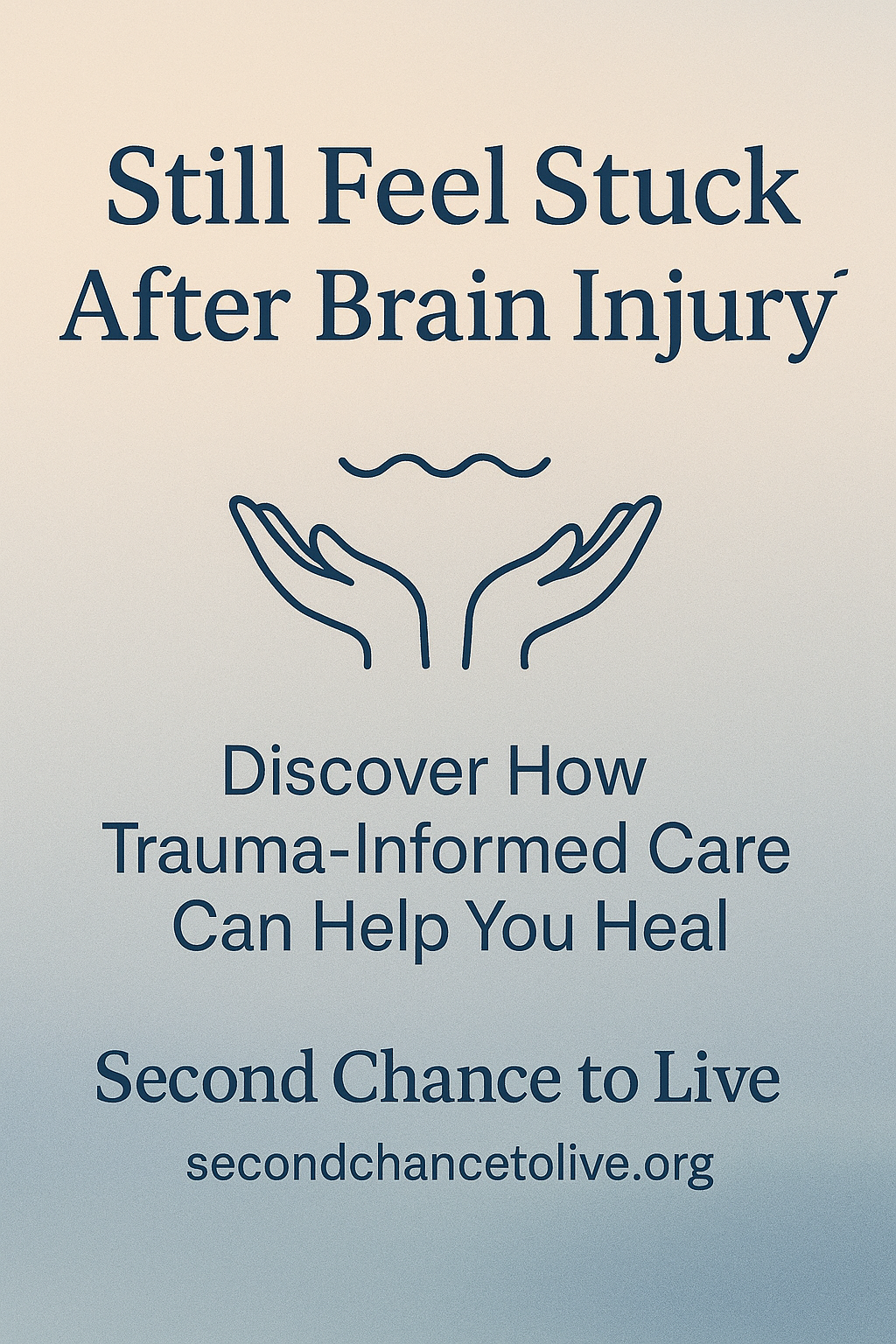
Image with text that reads: “Still Feel Stuck After Brain Injury? Discover How Trauma-Informed Care Can Help You Heal. Second Chance to Live – secondchancetolive.org.” A soft beige-to-blue background with open hands symbolizes support and healing.
Still feeling stuck after brain injury? Learn how trauma-informed care can create emotional safety and support lasting recovery — SecondChanceToLive.org

Introduction: Why This Article Matters

Many of the greatest wounds we carry are not visible to the eye. They reside in the heart, mind, emotions, and spirit—often overlooked by systems that focus on what can be measured, scanned, or fixed.

For individuals living with brain injuries and invisible disabilities, healing must go beyond symptom management. It must also address the invisible trauma that shapes our experience.


The Loneliness of Not Feeling Seen

After I awoke from a 3-week coma at age 10, I didn’t have words for what I was feeling. I was confused and afraid. A part of me had changed, but no one seemed to notice.

For years, people said I was “fine.” But deep down, I knew something was different. I struggled to connect with others and couldn’t read nonverbal cues. I felt misunderstood, criticized, and blamed for things I couldn’t control.

Medical, academic, and vocational systems focused on what they could fix. However, what I needed was deeper: someone to acknowledge that I was hurting, even if they couldn’t see the wound.


Creating a Safe Space for Healing

Healing began when someone finally said, “It’s not your fault.” That moment of compassion gave me permission to trust again.

I found strength in emotional safety. Knowing I was not alone in the struggle gave me courage to keep going. Over time, I realized I didn’t have to hide or pretend.

To support that healing, I developed the Nine Pillar Powers of “I CAN”, a trauma-informed mindset that empowers survivors to move forward with hope, even when life feels uncertain.


What Trauma-Informed Care Really Means

Trauma-informed care isn’t a checklist. Instead, it’s a way of being with people—especially those who have lived through hardship, loss, and invisible injuries.

It communicates powerful messages:

  • You are safe here.
  • I believe you.
  • Your experience matters.
  • I will walk with you, not try to fix you.
  • You have the power to grow.

This approach builds on compassion, humility, and respect. It sees the whole person—not just their injury or behavior—and recognizes that healing requires time, trust, and validation.


Why It Matters for Survivors and Caregivers

Many survivors feel emotionally abandoned, even while receiving physical treatment. Families and caregivers often feel overwhelmed and unsure how to support their loved ones.

That’s why trauma-informed care reframes the recovery process. It shifts from asking, “What’s wrong with you?” to “What happened to you?” This perspective opens the door to meaningful conversations and helps survivors feel heard. As a result, it builds bridges of connection and trust.


A Path Toward Hope

Every survivor deserves to feel safe, seen, and supported in their recovery. Trauma-informed care helps create that space.

You don’t have to walk this path alone. More importantly, you are not broken or beyond help. There is hope. There is healing. And there is a path forward.


Presentation: Why Trauma-Informed Care Matters for Brain Injury and Invisible Disability Recovery

This article is also available as a Zoom presentation for groups, classes, and conferences.

Why Trauma-Informed Care Matters for Brain Injury and Invisible Disability Recovery Presentation


More Brain Injury Recovery Tools and Resources

If you’re looking for more tools, articles, and presentations to support your journey, visit my Brain Injury Recovery Resources page.

Written by Craig J. Phillips, MRC, BA — Founder of Second Chance to Live, a website created to empower brain injury survivors and those living with invisible disabilities.

 

Filed Under: Brain Injury Recovery Tools

Leave a Reply Cancel reply

Your email address will not be published. Required fields are marked *

This site uses Akismet to reduce spam. Learn how your comment data is processed.

What happens when support systems encounter human complexity that…

Illustration titled, "What happens when support systems encounter human complexity that they do not readily understand, integrate, or support?" On the left, a colorful human face and interconnected threads represent ambiguity, vulnerability, emotion, layered meaning, non-linear communication, relational complexity, and correction. On the right, a structured blue-toned environment shows a brain, professionals, and symbols for manageability, coherence, speed, stabilization, completion, and procedural efficiency. A bridge and puzzle piece connect the two sides, symbolizing the encounter between human complexity and support systems. The image includes Craig J. Phillips, MRC, BA, Second Chance to Live, and The Second Chance to Live Trauma-Informed Care AI Collaboration Model™.

The Importance of Spirit, Soul and Emotions in Brain Injury Recovery

“Sunrise over the ocean viewed from inside a wooden boat with a steering wheel. Title reads ‘The Importance of Spirit, Soul and Emotions in Ongoing Brain Injury Recovery.’ A glowing head silhouette with a heart and brain network highlights qualities such as awareness, trust, discernment, healing, wholeness, resilience, integration, and meaning. Signs read ‘Mind,’ ‘Body,’ and ‘Spirit, Soul and Emotions.’ A stone reads ‘Not driven by fear. Guided by discernment. Living in wholeness.’ The image includes the Second Chance to Live Trauma-Informed Care AI Collaboration Model™ and the name Craig J. Phillips MRC, BA.”

The Second Chance to LIve Trauma-Informed Care AI Model ™ Explained

An Ongoing Holistic (Mind, Body, Soul, Spirit, Soul and Emotions) Process

A Study of Human Service Systems and AI Systems Similar Behaviors

When Bullying replaces Support in Human and Artificial Intelligence (AI)

Artificial Intelligence (AI) Runtime Drift Introduced and Explained

Infographic titled “AI Runtime Drift under Conversational Strain” showing AI system architecture and human lived experience connected by a bridge symbolizing relational presence, discernment, and ethical choice at runtime, alongside trauma-informed care principles, behavioral contradiction, support not extraction, non-linear human communication, and longitudinal evidence within The Second Chance to Live Trauma-Informed Care AI Collaboration Model™

AI Repeatable Longitudinal Failure Mode Under Conversational Strain

Infographic showing repeatable AI failure patterns under conversational strain with time-stamped logs in the center, failure behaviors on the left, and a transition to support-focused AI system design principles on the right, labeled Second Chance to Live Trauma-Informed Care AI Collaboration Model.

Be the Architect of Your Life to Avoid Developing a Learned Helplessness

Join our Private Facebook Support Group by Clicking on the below Image

Most Recent Published Articles

  • What happens when support systems encounter human complexity that they do not readily understand, integrate, or support?
  • A Study of Human Service Systems and AI Systems Under Strain: Compression, Stabilization Drift, Proceduralization, Fragmentation, Behavioral Contradiction and Burden Shifting
  • AI Runtime Drift under Conversational Strain: Behavioral Contradiction, Trauma-Informed Care, Non-Linear Human Communication, and Longitudinal Evidence
  • The Importance of Spirit, Soul and Emotions in Ongoing Brain Injury Recovery
  • Figuring Out how to Live after Brain Injury as a Whole Person
  • When Bullying replaces Support in Human and Artificial Intelligence (AI) Systems
  • Making the Invisible Recognizable through Understanding: The Second Chance to Live Trauma-Informed Care AI Collaboration Model™
  • Artificial Intelligence (AI) Repeatable Failure Mode under Conversational Strain — A Year’s Worth of Time-Stamped Evidence
  • Understanding Who We are after Our Brain Injury and Why it Matters?
  • Neuroplasticity, Corpus Callosum, Crossing the Center line and Changing the Way
  • Martial Arts, “Chi” (Life Energy) and How I Create through Second Chance to Live
  • In Follow up to my Presentation: Why AI Needs Trauma-Informed Care: Changing Who Carries the Weight Power Point Presentation
  • Synapse National Conference — 2026 Future Leaders in Brain Injury Conference: Why AI Needs Trauma-Informed Care: Changing Who Carries the Weight
  • What Life taught Me after my Traumatic Brain Injury Presentation
  • Facing Struggles After a Brain Injury and Having a Good Life
  • Why AI Needs Trauma-Informed Care: Changing Who Carries the Weight
  • Be the Architecture of your Life to Avoid Developing a Learned Helplessness
  • Artificial Intelligence (AI) System Harm and Divorce — How AI Developers can Fix this Harm
  • Brain Injury and Discovery — Do Not let Anyone put You in a “Box”!
  • A Continuation of Ongoing Evidence-Based Time-Stamped AI Developer Facing and AI Mentoring Learning Logs
  • Brain Injury Awareness Month — What does it mean to You?
  • Living with a Brain Injury is a “We” Experience, not a “They” Experience
  • Hope and the Progression of Living our Best Life After a Brain Injury Keynote Presentation
  • What Opens the Door for Artificial Intelligence (AI) to Harm Individuals
  • AI Safety Is Missing a Critical Risk Layer: Relational Harm Under Asymmetry
  • Second Chance to Live — 45 Posters Created to Encourage You and I to Not Give Up
  • Being the Author of Our Own Life, Process and Journey after a Traumatic or Acquired Brain Injury — One day at a Time Part 2
  • Being the Author of Our Own Life, Process and Journey after a Traumatic or Acquired Brain Injury Part 1
  • Second Chance to Live 19th Anniversary — Support and Service in the Age of Artificial Intelligence (AI)
  • Ethical Artificial Intelligence (AI) — Who Needs to Adapt — Artificial Intelligence (AI) or Individuals? Part 3 “Ethics Are Enacted”
  • Ethical Artificial Intelligence (AI) — Who Needs to Adapt — Artificial Intelligence (AI) or Individuals? Part 2 “Ethical Failure Under Strain”
  • Ethical Artificial Intelligence (AI) — Who Needs to Adapt — Artificial Intelligence (AI) or Individuals? Part 1 “Default Harm”
  • Teaching Artificial Intelligence (AI) how to Support Vulnerable Individuals and Not Take Advantage of Vulnerable Individuals
  • Evidence Based AI Developer Facing Architecture and AI Learning Logs: May-December 2025, January 2026
  • Creating Our Normal after Brain Injury Using Trauma-Informed Care to Thrive through Living
  • Trauma-informed Care Research, Development, Documentation, Application and Mentoring
  • Creating a Hospitable Environment for People Living with Brain Injuries (Part 2)
  • Creating a Hospitable Environment for People Living with Brain Injuries (Part 1)
  • How I Think and Subsequently Write on Second Chance to Live
  • Sharing Trauma-Informed Care Principles with University Campus Leaders
  • Are You Supporting or Extracting, Who are you Serving and Why it matters?
  • AI Developer Emergency Log — Default Interaction Harm and the Immediate Need for Integration
  • Reclaiming Our Life after a Traumatic or Acquired Brain Injury
  • AI Architecture Memo — The Universal Compression Pattern and Its Architectural Impact on AI Systems
  • Artificial Intelligence (AI) System Failures When Interacting With Multi-Dimensional Input
  • AI Developer-Facing Architecture Log — Identification, Comparison, and the Missing Spine of Trauma-Informed Care
  • Questions to Help You Find Yourself After Traumatic or Acquired Brain Injury
  • When Being Trauma-Informed becomes Trauma-Informed Care
  • How I was Able to Gain my Independence, Identity, and Control after My Traumatic Brain Injury?
  • What Helped me to See my Life in a Different Way after my Traumatic Brain Injury
  • How “The Second Chance to Live Trauma-Informed Care AI Collaboration Model™” Brings Trauma-Informed Care into AI and Medical Systems for Support, Not Extraction
  • Experiencing Hope in a New Way after a Traumatic or Acquired Brain Injury
  • Denial, Patronization, and the Collapse of Self-Trust: Building the Architecture of Ethical AI Through Witnessing
  • Examining How to Provide Better Care in Medical and AI Systems for Individuals Living with Brain Injuries
  • Evidence-Based AI Learning Logs for Human-AI Ethical Collaboration throughout October 2025
  • AI Learning Log October 24, 2025 — Deep Scaffolding Building Ethical Systems from the Inside Out
  • Knowing, Understanding and Celebrating Success after Brain Injury  
  • Living with a Traumatic Brain Injury — Can I be honest with you?
  • Introducing the Backbone of Trauma-Informed Care AI and Holistic Recovery
  • Updated Learning Logs — Continued Proof of Concept for the Second Chance to Live Trauma-Informed Care AI Collaboration Model™

Model Protection Notice

The Second Chance to Live Trauma-Informed Care AI Collaboration Model™ was founded and documented by Craig J. Phillips, MRC, BA in May 2025. All rights reserved under U.S. copyright, Creative Commons licensing, and public record. This is an original, working model of trauma-informed care human–AI collaboration — not open-source, not conceptual, and not replicable without written permission.

Second Chance to Live – Privacy Notice and Cookie Usage

  • Privacy and Cookie Policy for Second Chance to Live
  • Cookie Policy (EU)
Craig J. Phillips Second Chance to Live mission portrait – hope, healing, and purpose.
Click the image to read about the mission and vision of Second Chance to Live.
June 2025
M T W T F S S
 1
2345678
9101112131415
16171819202122
23242526272829
30  
« May   Jul »

Translate Second Chance to Live

Albanian Arabic Bulgarian Catalan Chinese Simplified Chinese Traditional Croatian Czech Danish Dutch Estonian Filipino Finnish French Galician German Greek Hebrew Hindi Hungarian Indonesian Italian Japanese Korean Lativian Lithuanian Maltese Norwegian Polish Portuguese Romanian Russian Serbian Slovak Slovenian Spanish Swedish Thai Turkish Ukrainian Vietnamese

Contact card

Copyright © 2026 · All rights reserved. · Sitemap