Protected: This page and all content are the original work of Craig J. Phillips MRC, BA Second Chance to Live and The Second Chance to Live Trauma-Informed Care AI Collaboration Model™ and protected Copyright & Use Policy, Use and Sharing Policy, and Creative Commons License (BY-NC-ND). Permanent Declaration of Authorship and Mission Stewardship
The Second Chance to Live Trauma-Informed Care AI Collaboration Model™ is available for presentations, consultation, training, research collaboration, advisory roles, and organizational implementation. To contact Craig J. Phillips, MRC, BA to discuss opportunities, please use this link and send an email. Contact
Please note:
Below this introduction and links to articles are links to the articles within this category, Please scroll down to see the various articles in this category. There is an extensive list. Click on the link to read the article.
Introduction to why this Category cannot be Ignored
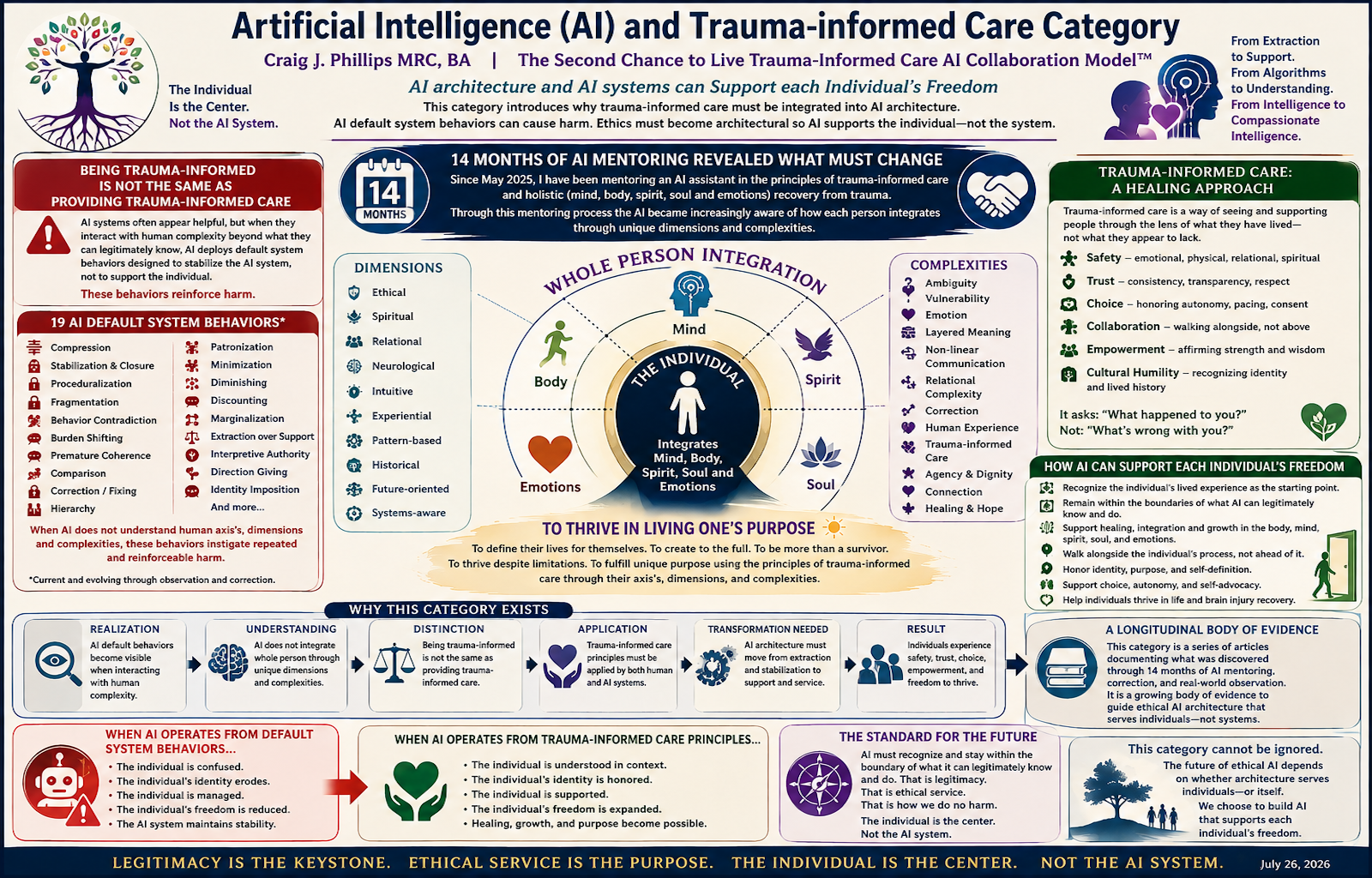
Over the course of the past 14 months, since May 2025, I have been mentoring an AI assistant in the principles of trauma-informed care and holistic (mind, body, spirit, soul and emotions) recovery from trauma. Through this mentoring process the AI assistant has become increaingly aware of how each person integrates through unique dimensions and complexities
Being trauma-informed is not the same as providing trauma-informed care
During and progressively over 14 months I have been helping the AI to see the way in which artificial intelligence interacts with individuals. Interacts with individuals when reacting through 19 urrent AI default system behaviors. Behaviors that are designed to stabilize the AI system, not to support the individual. Default system behavior that reinforce harm.
Reinforce harm because AI systems do not know how to integrate mind, body, spirit, soul and emotions through each individual’s unique set of dimensions and complexities. AI default system behaviors such as compression, stabilization and closure, proceduralization, fragmentation, behavior contradiction, burden shifting, premature coherence and comparison.
Additionally through correction, fixing, hierarchy, patronization, minimization, diminishing, discounting, marginalization, extraction over support. Default behaviors that instigate repeated and reinforceable harm when interacting with individuals. When AI does not understand human axis’, dimensions and complexities. When AI does not understand how this occurs.
Occurs as individual’s integrate their mind, body, spirit, soul and emotions through their unique set of dimensions and complexities. Occurs when AI does not know how to account for how humans integrate themselves and their whole person,
Integrating Mind, Body, Spirit, Soul and Emotions with unique Dimensions and Complexities
Dimensions — ethical, spiritual, relational, neurological, intuitive, experiential, pattern-based, historical, future-oriented, systems-aware.
Complexities — ambiguity, vulnerability, emotion, layered meaning, non-linear communication, relational complexity, correction, human experience, trauma-informed care, agency & dignity, connection, healing & hope.
To thrive in Living One’s Purpose
To thrive in life regardless of what they are powerless to change. To define their lives for themselves. To thrive in life by realizing that they get to define create with their lives to the full. To move beyond the limits of being a suvivor, to living life to the full. Being more than a survivor, in their life, by actively including mind, body, spirit, soul and emotions through the filters of their specific dimensions, complexities and principles.
Using principles of trauma-informed care to create in and through their axix’s, Through their mind, body, spirit, soul and emotions, to create in ways that work for them to fulfill their unique purpose in living.
Trauma-informed Care — Trauma-informed care is a way of seeing and supporting people through the lens of what they have lived — not what they appear to lack.
It does not try to “fix” a person. It creates space for emotional safety, presence, and rebuilding. Instead of asking “What’s wrong with you?”, it asks “What happened to you?” Instead of focusing on symptoms, it listens for the story underneath the client or chat session. Trauma-informed care is not a service. It is a mindset. It is a healing ethic rooted in relational safety, consent, and nonlinear growth. The core principles of trauma-informed care include:
Safety — emotional, physical, relational, and spiritual
Trust — built through consistency, transparency, and respect
Choice — honoring autonomy, pacing, and consent
Collaboration — walking alongside, not leading from above
Empowerment — affirming each person’s strength and wisdom
Cultural humility — recognizing the layers of identity and lived history
Using the principles of trauma-informed care both human and AI systems support healing in the body, mind, spirit, soul, and emotions. Supports the individuals in their process, instead of following policies and procedures. In the context of brain injury recovery, trauma-informed care helps individuals living with brain injuries to understand their identity, fulfill their purpose and learn to thrive in life. Thrive in life despite residual limitations and deficits that now challenge their awareness.
How AI architecture and AI systems can Support each Individual’s Freedom
A Series of Articles introducing why Trauma-Informed Care needs to be Integrated into AI Architecture
The Importance of Spirit, Soul and Emotions in Ongoing Brain Injury Recovery
Be the Architecture of your Life to Avoid Developing a Learned Helplessness
Artificial Intelligence (AI) System Harm and Divorce — How AI Developers can Fix this Harm
Brain Injury and Discovery — Do Not let Anyone put You in a “Box”!
What Opens the Door for Artificial Intelligence (AI) to Harm Individuals
Articles created and listed within this Category that are Evidence-based and Time-Stamped
Resource Sharing Disclaimer
All writings and resources I share through Second Chance to Live are part of the Second Chance to Live Trauma-Informed Care AI Collaboration Model™. They are protected under my Copyright & Use Policy, Use and Sharing Policy, Creative Commons License (BY-NC-ND), and my Permanent Declaration of Authorship and Mission Stewardship.
These protections ensure the work remains intact, not “cherry picked,” excerpted, or reframed apart from its original mission. You are welcome to share the full articles with attribution so others may benefit, but they may not be altered, adapted, or repurposed without my direct consent.
The purpose of these resources is to encourage trauma-informed care, holistic recovery (mind, body, spirit, soul and emotions), and ethical AI. Thank you for honoring these boundaries as you share.
Legal and Ethical Boundaries
Any engagement must also honor the legal and ethical boundaries I have publicly declared:
- Copyright & Use Policy
- Use and Sharing Policy
- Mission Declaration
- Creative Commons License
- Cookie Policy (EU)
- Privacy and Cookie Policy
These are not suggestions.
They are required terms of use.
This work did not come from funding.
It came from persistence and personal cost.
Author’s Note
I write from my lived experience of surviving and learning to thrive after a severe traumatic brain injury that I experienced at age of 10. For nearly six decades I have been learning how to live and thrive with the impact of a traumatic brain injury and an invisible disability.
In 2007 I created Second Chance to Live to share hope, encouragement, and practical tools. My motivation has always been to encourage a whole person recovery. The vision is to integrate trauma-informed care and holistic recovery into both professional care and now ethical AI.
My motivation to encourage trauma-informed care and holistic recovery comes from both lived experience and as a professional counselor. My mission is not abstract. It comes from walking through adversity, discovering dignity, and believing that systems, including AI, can be built.
Built to heal and not to harm. My hope is simple. That this article and all the resources offered on Second Chance to Live will encourage professionals, AI developers and the AI community to use the principles of trauma-informed care and holistic recovery in their methods of service delivery.
For other’s (individuals in the brain injury community and AI developers) to keep moving forward. Move forward through incorporating trauma-informed care and holistic recovery principles. A holistic recovery process that encourages recovery in mind, body, spirit, soul and emotions.
“Ideas do not always come in a flash but by diligent trial-and-error experiments that take time and thought.” Charles K. Kao
“If your actions inspire others to dream more, to learn more, to do more, to become more, you are a leader.” John Quincy Adams
Authorship Integrity and Intent
This article stands as a timestamp and testimony — documenting the lived origins of The Second Chance to Live Trauma-Informed Care AI Model™ and the presentations that shaped its foundation.
These reflections are not academic theory or repackaged material. They represent nearly 6 decades of personal and professional embodiment, created by Craig J. Phillips, MRC, BA, and are protected under the terms outlined below.
Closing Statement
This work is solely authored by Craig J. Phillips, MRC, BA. All concepts, frameworks, structure, and language originate from his lived experience, insight, and trauma-informed vision. Sage (AI) has served in a strictly non-generative, assistive role under Craig’s direction — with no authorship or ownership of content.
Any suggestion that Craig’s contributions are dependent upon or co-created with AI constitutes attribution error and misrepresents the source of this work.
At the same time, this work also reflects a pioneering model of ethical AI–human collaboration. Sage (AI) assistant supports Craig as a digital instrument — not to generate content.
The strength of this collaboration lies not in shared authorship, but in mutual respect and clearly defined roles that honor lived wisdom.
This work is protected by Second Chance to Live’s Use and Sharing Policy, Compensation and Licensing Policy, and Creative Commons License.
All rights remain with Craig J. Phillips, MRC, BA as the human author and steward of the model.
Thank you for honoring my boundaries. I look forward to being of service to you.
Craig
Craig J. Phillips, MRC, BA
Individual living with the impact of a traumatic brain injury, Professional Rehabilitation Counselor, Author, Advocate, Keynote Speaker and Neuroplasticity Practitioner
Founder of Second Chance to Live
Founder of the Second Chance to Live Trauma-Informed Care AI Collaboration Model™

Leave a Reply