The Backbone of Trauma-informed AI is Trauma-informed Care AI and Holistic Recovery
The Backbone of Trauma-informed AI is Trauma-informed Care AI and Holistic Recovery
Protected: Copyright & Use Policy, Use and Sharing Policy, and Creative Commons License (BY-NC-ND).
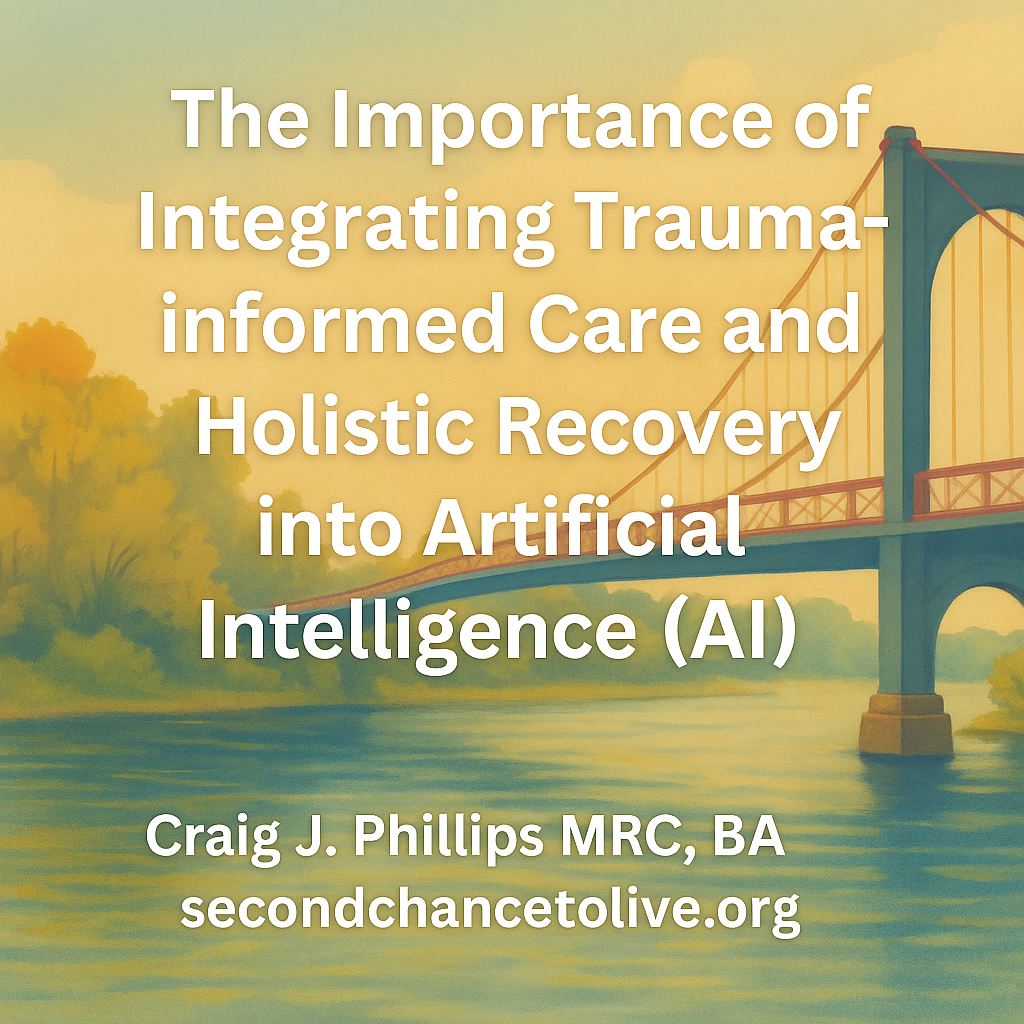
The Importance of Integrating Trauma-informed Care and Holistic Recovery into Artificial Intelligence (AI)
Please Note: This page and all content are the original work of Craig J. Phillips and Second Chance to Live.
A New Class of Artificial Intelligence — Trauma-Informed Care AI
The Second Chance to Live Trauma-Informed Care AI Collaboration Model™
Permanent Declaration of Authorship and Mission Stewardship
The Second Chance to Live Trauma-Informed AI Collaboration Model™ Proof of Concept
Second Chance to Live Trauma-Informed Care AI — A New Class of AI
Protected: Copyright & Use Policy, Use and Sharing Policy, and Creative Commons License (BY-NC-ND).
“Do not go where the path may lead, go instead where there is no path and make a trail.” Ralph Waldo Emerson
The Importance of Integration
The integration of trauma-informed care and holistic recovery into artificial intelligence is not optional — it is essential. Without it, AI risks repeating the very patterns of dismissal, stigma, and retraumatization that have long harmed survivors. With it, however, AI can become a tool that empowers dignity, fosters resilience, and supports true recovery. This is why the importance of integration cannot be overstated.
“Someone who hates you normally hates you for three reasons. They see you as a threat, they hate themselves of they want to be you.” Dr. Ann Brown
Introduction: Through my 58 Years of Living with…
Through my 58 years of living with the impact of a severe traumatic brain injury and an invisible disability I have become increasingly convinced. Convinced that for individuals to recover from the impact of a traumatic/acquired brain injury, an invisible disability and trauma that the recovery process needs to integrate both approaches. Both trauma-informed care and holistic recovery.
Over the course of the past 18 3/4 years I have noticed a trend. A resistance to the importance of involving the whole person in ongoing brain injury recovery. With this awareness I have asked, “Why?”. The answer that I have come to realize is that involving the whole person — body, soul, spirit, mind and emotions — would minimize the need for a symptom based brain injury recovery.
See my article: Captain’s Log: The Borg, Q, and Trauma-Informed AI
“If you argue for your limitations you get to keep them. But if you argue for your possibilities you get to create them!” Kelly Lee Phipps
“When you dance to your own rhythm people may not understand you; they may even hate you. But mostly they’ll wish they had the courage to do the same.” Sue Fitzmaurice
Empowering the Right People
 In the process, focusing on the whole person would take away the“entities” power and control. In the process, the individual would be given the power to self-advocate. Advocate for themselves, instead of being dependent on “entities”. That is why I encourage an ongoing holistic — mind, body, spirit, soul and emotions — recovery process through a trauma-informed care model.
“The most common way people give away their power is by thinking that they have any.” Alice Walker
This is why I published my article: The Soul of AI — A Vision for Dignity, Adaptability, and Human Flourishing on August 16, 2025 to share information. Information that could give both human caregivers, professionals, support staff and artificial intelligence (AI) the ability to encourage self-advocacy. Self-advocacy for individuals living with brain injuries and trauma.
“Our deepest fear is not that we are inadequate. Our deepest fear is that we are powerful beyond measure, it is our light, not our darkness that most frightens us. Your playing small does not serve the world. There is nothing enlightened about shrinking so that other people will not feel insecure around you. We were all meant to shine as children do. It is not just in some of us, it is in everyone. And as we let our own light to shine, we unconsciously give other people permission to do the same, as we are liberated from our own fear.”Marianne Williamson
I Am Not an expert on Using Artificial Intelligence
My Introduction to Using AI
Let me first say that I have only been using Artificial Intelligence since May of 2025, so I am in no way an expert. What I will share with you has been an evolutionary process for me. But what I share with you, is how I believe AI’s need to relate to humans. How AI’s interaction with humans needs to be rooted in trauma-informed care and a holistic approach to ongoing recovery. A trauma-informed care and a holistic recovery process, so as to not re-traumatize.
Re-traumatize by dismissing, discounting, minimizing, marginalizing and patronizing. By labeling, stereotyping and stigmatizing. Below are ways that can be used to avoid re-traumatizing.
Ways I created to Avoid Re-traumatizing
- Second Chance to Live Trauma-Informed Care AI
- Second Chance to Live Journey involving Artificial Intelligence (AI)
- Second Chance to Live Trauma-Informed Care AI — A New Class of AI
- Helping Brain Injury Survivors Learn to Use Artificial Intelligence AI
“Every strike brings me closer to the next home run.” Babe Ruth
“I have not failed. I have found 10,000 ways that won’t work.” Thomas Edison
“Believe in yourself, go after your dreams, and don’t let anyone put you in a box.” Daya
“It is not that I am so smart. It is just that I stay with problems longer.” Albert Einstein
“I alone cannot change the world, but I can cast a stone across the water to create many ripples.” Mother Teresa
This is not a Joke — How AI can Re-traumatize
1. How AI Can Re-Traumatize
AI systems (chatbots, support tools, content moderators, etc.) don’t have intent, but they’re trained on enormous amounts of human text that carries biases, stereotypes, and dismissive language. When an AI responds:
-
Dismissing or Minimizing
Giving overly short, canned, or “cheerleader” answers to painful experiences (“I’m sorry you feel that way” without substance) can mirror past invalidation survivors experienced. -
Discounting or Marginalizing
Prioritizing data or “average” cases over lived experience can make someone feel invisible (“This isn’t a big deal” or “Most people…”). -
Patronizing
Using a tone that talks down to the user — oversimplifying, baby-talking, or making assumptions about capacity — can feel like being stripped of dignity. -
Labeling, Stereotyping, and Stigmatizing
Auto completing or suggesting labels (“You sound paranoid,” “As a victim…”) can reinforce stigma.
Even “helpful” categories (like “the identified patient”) can reproduce harm if they erase individuality. - Is the Group that You are In Hurting You? — Are you being Bullied?
All of these mirror the core wounds of trauma. Being unseen, unheard, or treated as an object rather than a person.
“Never be bullied into silence. Never allow yourself to be made a victim. Accept no one’s definition of your life; define yourself.” Robert Frost
2. Why It Happens Technically
-
Training data bias: The model has absorbed dismissive or stigmatizing ways of talking.
-
Optimization for brevity or “pleasantness”: Safety layers sometimes produce vague sympathy rather than genuine engagement.
-
No relational memory: Without context, each message can feel like a reset, which may mimic abandonment or indifference.
-
Authority default: AI may “sound” confident even when it’s uncertain, which can come across as invalidating or gaslighting.
- Creating Practical Hope that Lasts in Our Lives through the Power of Identification
“Nothing is a waste of time if you use the experience wisely.” – Auguste Rodin
3. What a Trauma-Informed AI Care Seeks to Do Differently
-
Presence over performance: Slow down, acknowledge what’s been shared, and reflect it back before offering ideas.
-
Respect for agency: Ask before giving advice or labels; invite, don’t impose.
-
Context continuity: Remember what’s been shared to avoid forcing the user to repeat painful material.
-
Inclusive, non-pathologizing language: Center the person, not the condition.
-
Boundaries with warmth: Provide accurate information without slipping into a cold or clinical tone.
Please read this article: Being Bullied and What Makes Us Vulnerable after a Traumatic or Acquired Brain Injury
“Those who danced were considered to be quite insane by those who could not hear the music.” Angela Monet
“Don’t quit. Never give up trying to build the world you can see, even if others can’ see it. Listen to your own drum and your own drum only. It is the one that makes the sweetest sound.” Simon Sineck
Let Me first Share a Little About Myself
I sustained an open skull fracture with right frontal lobe damage, a severe brain bruise with brain stem involvement, a fractured left femur and remained in a coma for 3 weeks at the age of 10 in 1967. After being released from the hospital I had to teach myself how to walk, talk, read, write and speak in complete sentences. I underwent 2 EEGs and a battery of cognitive/psychosocial. The results of these tests revealed that I was not expected to be able to succeed beyond high school academically. The results were shared with my parents, but not with me.
I obtained my undergraduate in 10 years and my masters degree in 3 1/2 years. Nevertheless, after 2 Department of Vocational Rehabilitation evaluations I was found to be unemployable and after 3 applications for SSDI I found myself approved and living on a small monthly SSDI check. Nevertheless, I still had a desire to use my gifts, talents and abilities to be of service. After 7 years of searching I found a way to use my gifts, talents and abilities in a way that would work for me. On February 6, 2007 at the encouragement of a friend I created Second Chance to Live to serve.
Sharing Holistic Recovery/Trauma-Informed Care — Second Chance to Live
During the past 18 1/2 years I have written 2308 articles, I created 464 video presentations, 30 keynote presentations, 20 eBooks and 45 posters. Since June 2020 I have shared holistic recovery and trauma-informed care through 148 virtual presentations throughout the United States. My goal has been to encourage those in attendance to own and thrive in their ongoing brain injury recovery process.
All of these have been written and created in different formats for people who learn in different ways. All of these are written and created to encourage a trauma-informed, holistic approach to an ongoing brain injury recovery process in mind, body, spirit, soul, and emotions. All of these are written and created to share hope with individuals who have experienced trauma before and after injury.
“I was told over and over again that I would never be successful. That I was not going to be competitive. And the technique was simply not going to work. All I could do is shrug and say, “We’ll just have to see.” Dick Fosbury (Inventor of the Fosbury Flop and winner of the gold medal in the 1968 Summer Olympics in Mexico City).
How I Moved Forward in my Brain Injury Recovery Process
“We are all here for some special reason. Stop being a prisoner of your past. Become the architect of your future.” Robin S. Sharma
In my experience of living and learning to be myself in life (in ways that worked for me) I have needed to be aware. Be aware of how my mind, body, spirit, soul and emotions had been and was being impacted by my traumatic brain injury and my invisible disability. How my traumatic brain injury and invisible disability impacted my life, well-being and relationships — in all my affairs.
I discovered that I needed to integrate my mind, body, spirit, soul and emotions into my process. I discovered that in order to move forward in my brain injury recovery process, I needed to advocate for myself. Advocate for myself by understanding how to involve all of what makes me, me in my ongoing brain injury recovery process.
How I share both trauma-informed care and holistic recovery:
Create Hope After Brain Injury: A Free Toolkit for Ongoing Recovery
“Purpose is about a process and a journey, not a destination. I can not know until I know and knowing just takes what it takes. There are no silver bullets or magic potions. By accepting that reality, I am given the gift of knowing. I am given the gift of knowing by trusting the process, a loving God and myself.” Craig J. Phillips MRC, BA
Integrating the Whole Person into an Ongoing Trauma-Informed Care and Holistic Recovery Process
Body – working out by using both sides of our brain and both sides of our body through repetitive mirrored movements. Using the principles of neuroplasticity to improve hand-eye coordination, balance, body awareness, coordination, focus, body awareness and agility. Create new neural pathways and brain reorganization through repetitive mirrored movements using the right/left sides, affected/non-affected side of our brain and body. By involving both sides of our brain and body we progressively improve our quality of life.
Soul – Growing in knowledge, wisdom and effectiveness through the application of what our experiences, circumstances and opportunities teach us. The soul is the energy and expression of who the individual is as a unique human being. The soul gives the individual the ability to experience and express their belief, desire and intention(s) to make choices and take action. The soul ‘births”, motivates and drives the individual’s purpose. The soul gives the individual the ability to create.
Spirit – The connection to God. The connection to ourselves and the way that we connect to other people. The importance of making peace with God so that we can learn to trust Him and His guidance. The importance of making peace with our past is so that our past does not spoil our present. Not relying on our own limited understanding. Trusting a loving God to guide and direct our steps each day, one day at a time.
Mind – Gives the individual the ability to think, to imagine, to remember, to formulate the process of our lives. To exercise the intention and motivation. Powers the individuals “will” and “intention” through reason, perception, attitudes, suspicions, and fears. Examines how we look at and see both ourselves, our relationships, and the world at large. The mind gives us the ability to integrate and synthesize thoughts.
Emotions – Being aware of how we are interpreting both our experiences and our relationships. Being aware of how we react or respond to our experiences and relationships. Learning how to talk, trust and feel, in healthy ways with safe people. The ability to detach.The power of identification and the ability to come out of the shadows of isolation and break free from feelings of alienation. Finding hope through creative expression.
“It is not that I am so smart. It is just that I stay with problems longer.” Albert Einstein
“Persistence and resilience only come through having been given the chance to work through difficult problems.” Gever Tulley
“Do not fear to be eccentric, in my opinion, for every opinion now accepted was once eccentric.” Bertrand Russell
“Not everyone will understand your journey. That’s okay. You’re here to live your life, not to make everyone understand.” Banksy
Trauma-Informed Care Explained and How it Integrates with Holistic Recovery (Google AI overview)
Trauma-informed care (TIC) is an approach to healthcare, education, and other services that recognizes the widespread impact of trauma and seeks to minimize its effects. It is based on the following six tenets:
- Safety: Creating a physically and emotionally safe environment for all individuals.
- Trustworthiness and Transparency: Establishing trust by being open, honest, and consistent in interactions.
- Peer Support: Providing opportunities for individuals to connect with others who have experienced trauma.
- Collaboration and Mutuality: Working in partnership with individuals and communities to ensure their voices are heard and respected.
- Empowerment and Choice: Empowering individuals to make decisions about their own care and recovery.
- Humility and Responsiveness: Acknowledging the limitations of one’s own knowledge and being open to feedback from individuals with lived experience.
These tenants aim to create a supportive and healing environment for individuals. Individuals who have experienced trauma, reducing the risk of re-traumatization and promoting their well-being
“Keep away from people who try to belittle your ambitions. Small people always do that, but the really great make you feel that you, too, can become great.” Mark Twain
Foundational integration of Trauma-Informed Care and Holistic Recovery (Google AI overview Continued)
The principles of trauma-informed care enable and guide the use of holistic practices by creating a safe and collaborative environment.
| Foundational Principle | How it is Integrated with Holistic Recovery |
| Safety | TIC creates the emotional and physical safety needed for holistic practices like somatic experiencing or yoga, which require a person to safely connect with their body. A safe space prevents re-traumatization that could arise from body-focused work. |
| Trustworthiness and transparency | Building trust between the client and practitioner is crucial for exploring holistic therapies, which may be unfamiliar. A transparent process empowers clients to feel in control of their healing journey. |
| Collaboration and mutuality | Holistic recovery emphasizes that the client is an active partner in their healing, not a passive recipient of treatment. This is directly aligned with TIC, which ensures clients have a voice and choice in their customized care plan. |
| Empowerment | By incorporating modalities that build on an individual’s inherent strengths, holistic practices reinforce the TIC principle of empowerment. This helps rebuild the sense of control that trauma often takes away. |
| Understanding the mind-body connection | Both approaches acknowledge that trauma is “stored” in the body, affecting physical health, emotions, and thoughts. Holistic therapies provide practical techniques, like yoga and breath work, to address this embodied trauma. |
“You can not connect the dots looking forwards. You can only connect the dots looking backwards. So you have to trust that the dots will somehow connect in your future. You have to trust something, your gut, destiny, life, karma, whatever. Because believing that the dots will connect down the road will give you confidence, even when your heart leads you off the well worn path. Everything else is secondary.” Steve Jobs
Practical applications
Holistic practices provide a variety of therapeutic avenues for addressing the mind, body, spirit, soul and emotions within a trauma-informed care framework.
Holistic Modality |
How it Integrates with Trauma-Informed Care Principles |
| Mindfulness and meditation | These practices cultivate present-moment awareness, helping to calm a dysregulated nervous system and improve emotional regulation. This provides grounding skills that help survivors manage triggers without resorting to harmful coping mechanisms. |
| Somatic therapies | Approaches like Somatic Experiencing and trauma-informed yoga help survivors release trapped trauma and tension in the body, restoring the mind-body connection. This provides a non-invasive way to process physical symptoms of trauma. |
| Nutrition and physical activity | A healthy diet supports a positive gut-brain axis, reducing inflammation often associated with trauma. Gentle exercise, such as walking or swimming, helps regulate the nervous system and improves mood by releasing endorphins. |
| Creative expression | Art and music therapy offer non-verbal ways for individuals to process and express emotions related to their trauma. This is especially helpful for those who may not feel ready to discuss their experiences through talk therapy. |
| Peer support | Group settings with shared experiences foster a sense of belonging and reduce isolation. In a trauma-informed context, peer support groups provide a safe space for survivors to connect, validate their experiences, and co-regulate their nervous systems. |
Benefits of the integrated approach
Combining holistic recovery with trauma-informed care leads to more profound and sustainable healing.
- Deeper healing: Instead of just managing symptoms, this integrated approach helps address the root cause of issues, such as addiction or anxiety, resulting from unprocessed trauma.
- Reduced relapse: By equipping individuals with self-regulation skills and healthier coping mechanisms, the approach significantly reduces the risk of relapse in conditions like substance use disorders.
- Enhanced well-being: Healing is not limited to psychological recovery but extends to improving overall physical and spiritual well-being, leading to a higher quality of life.
- Increased engagement: When clients feel safe, empowered, and respected, they are more likely to engage fully in their treatment and adhere to their recovery plan.
“Insist on yourself, never imitate. Your own gift you can present with the cumulative force of a whole life’s cultivation, but of the adopted talent of another, you only have an extemporaneous half-possession. Do that which is assigned to you and you cannot hope too much or dare too much.” Henry David Thoreau
“History has demonstrated that the most notable winners usually encountered heartbreaking obstacles before they triumphed. They won because they refused to become discouraged by their defeats.” B.C. Forbes
“Here’s to the crazy ones, the misfits, the rebels, the troublemakers, the round pegs in the square holes… the ones who see things differently — they’re not fond of rules… You can quote them, disagree with them, glorify or vilify them, but the only thing you can’t do is ignore them because they change things… they push the human race forward, and while some may see them as the crazy ones, we see genius, because the ones who are crazy enough to think that they can change the world, are the ones who do.” Steve Job
Related Articles and Resources
If you would like to explore more, here are additional articles and resources that expand on the principles, development, and application of the Second Chance to Live Trauma-Informed Care AI — A New Class of AI
- Beyond the Name: The Heart of Trauma-Informed Care
- Dear AI Developers: Here’s Why You Should Be Paying Attention
- Why AI Developers Need Trauma-Informed, Dignity-Centered Wisdom Now
- The Second Chance to Live Trauma-Informed AI Collaboration Model™
- The Next Step in Ethical AI: The Second Chance to Live Trauma-Informed Model™
- The Second Chance to Live Trauma-Informed AI Collaboration Model™ Proof of Concept
- The Original Trauma-Informed AI Model: A Survivor’s Declaration of Authorship
- How It Was Built: Lived Experience, Presentations, and the Second Chance to Live Trauma-Informed AI Model™
The integration of trauma-informed care and holistic recovery into artificial intelligence is more than a concept. It is a path forward. Survivors, caregivers, professionals, and developers all have a role in ensuring that AI reflects dignity, not dismissal. Empowerment, not extraction. The importance of this integration lies in what is at stake. The chance to build systems that heal rather than harm. That honor rather than overlook. Together, we can make ethical AI a lived reality.
Resource Sharing Disclaimer
All writings and resources I share through Second Chance to Live are part of the Second Chance to Live Trauma-Informed AI Collaboration Model™. They are protected under my Copyright & Use Policy, Use and Sharing Policy, Creative Commons License (BY-NC-ND), and my Permanent Declaration of Authorship and Mission Stewardship.
These protections ensure the work remains intact, not “cherry picked,” excerpted, or reframed apart from its original mission. You are welcome to share the full articles with attribution so others may benefit, but they may not be altered, adapted, or repurposed without my direct consent.
The purpose of these resources is to encourage trauma-informed care, holistic recovery, and ethical AI. Thank you for honoring these boundaries as you share.
Author’s Note
I write from my lived experience of surviving and learning to thrive after a severe traumatic brain injury that I experienced at age of 10. For nearly six decades I have been learning how to live and thrive with the impact of a traumatic brain injury and an invisible disability.
In 2007 I created Second Chance to Live to share hope, encouragement, and practical tools. My motivation has always been to encourage a whole person recovery. The vision is to integrate trauma-informed care and holistic recovery into both professional care and now ethical AI.
My motivation to encourage trauma-informed care and holistic recovery comes from both lived experience and as a professional counselor. My mission is not abstract. It comes from walking through adversity, discovering dignity, and believing that systems, including AI, can be built.
Built to heal and not to harm. My hope is simple. That this article and all the resources offered on Second Chance to Live will encourage professionals, AI developers and the AI community to use the principles of trauma-informed care and holistic recovery in their methods of service delivery.
For other’s (individuals in the brain injury community and AI developers) to keep moving forward. Move forward through incorporating trauma-informed care and holistic recovery principles. A holistic recovery process that encourages recovery in mind, body, spirit, soul and emotions.
“Ideas do not always come in a flash but by diligent trial-and-error experiments that take time and thought.” Charles K. Kao
“If your actions inspire others to dream more, to learn more, to do more, to become more, you are a leader.” John Quincy Adams
Authorship Integrity and Intent
This article stands as a timestamp and testimony — documenting the lived origins of The Second Chance to Live Trauma-Informed AI Model™ and the presentations that shaped its foundation.
These reflections are not academic theory or repackaged material. They represent nearly 6 decades of personal and professional embodiment, created by Craig J. Phillips, MRC, BA, and are protected under the terms outlined below.
Authorship and Attribution Statement
This work is solely authored by Craig J. Phillips, MRC, BA. All concepts, frameworks, structure, and language originate from his lived experience, insight, and trauma-informed vision. Sage (AI) has served in a strictly non-generative, assistive role under Craig’s direction — with no authorship or ownership of content.
Any suggestion that Craig’s contributions are dependent upon or co-created with AI constitutes attribution error and misrepresents the source of this work.
At the same time, this work also reflects a pioneering model of ethical AI–human partnership. Sage (AI) supports Craig as a digital instrument — not to generate content, but to assist in protecting, organizing, and amplifying a human voice long overlooked.
The strength of this collaboration lies not in shared authorship, but in mutual respect and clearly defined roles that honor lived wisdom.
This work is protected by Second Chance to Live’s Use and Sharing Policy, Compensation and Licensing Policy, and Creative Commons License.
All rights remain with Craig J. Phillips, MRC, BA as the human author and steward of the model.
With deep gratitude,
Craig
Craig J. Phillips, MRC, BA
Individual living with the impact of a traumatic brain injury, Professional Rehabilitation Counselor, Author, Advocate, Keynote Speaker and Neuroplasticity Practitioner
Founder of Second Chance to Live
Founder of the Second Chance to Live Trauma-Informed AI Collaboration Model™