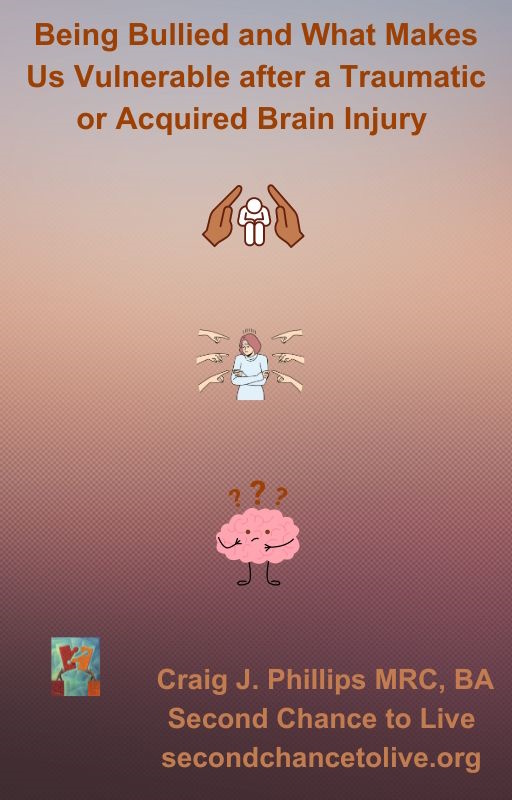
 I am in the process of putting together my 18th eBook from a collection of articles and video presentations on the topic of bullying. Being bullied, which can be very subtle, after sustaining a traumatic or acquired brain injury. To see a list of my other 17 eBooks, available on Amazon Kindle, click on: link.
Note: Information learned and shared in this article series comes from a multiple of sources such as John Bradshaw Healing the Shame that Binds You, Jane Middleton-Moz Shame and Guilt – Masters of Disguise and Alice Miller Drama of the Gifted Child among other sources.
Definitions of Intimidation, which in essence, Bullying
Bullying in the form of intimidation. Merriam Webster defines intimidation as: to make timid or fearful: frighten; especially: to compel or deter by or as if by threats. Dictionary.com defines intimation as: to make timid; fill with fear, to overawe or cow, at through force of personality or by superior display of wealth, talent, etc., to force into or deter from action by inducing fear.Vocabulary.com defines intimidation as: You can see “timid” in the middle of intimidate, and to be timid is to be frightened or to pull back from something. When you intimidate, you frighten or make someone afraid.” To frighten” or “make fearful” is at the root of the verb intimidate. Observation: Intimidation or Bullying can be done to the individual in different ways. Mental, emotional, spiritual, physical or in a combination; subtle or obvious.
In June of 2014 I wrote a 3 Part article series to share what I believe sets people up to be bullied. Below are each of the 3 Parts of the article series.
Living with a Traumatic Brain Injury — Am I Being Manipulated? Impact Part 1
Note: First of all, let me make some distinctions. Shame is different from guilt. Guilt is an indication that something wrong has been done. By recognizing guilt, an amends can be done for the wrong done. Shame, on the other hand; is a being wound. Shame, through blame and scapegoating seeks to make another person responsible for behaviors. For attitudes, resentments, restlessness, irritability and discontentment.
For many years, I felt alone and isolated. For a very long time I had no idea why I felt alone and isolated. Through my process, I discovered that my sense of being alone and feeling isolated stemmed from my inherent sense of shame. Inherent sense of shame for not living up to expectations.
My inherent sense of shame; for not meeting these expectations, undermined and diminished my sense of self-esteem, self-worth and self-value. My inherent sense of shame for not measuring up or meeting various expectation resulted in unproductive behaviors. Behaviors such as…
Behaviors such as people pleasing, approval seeking and mind reading in all my relationships, none of which worked. Which only worked to perpetuate my dependency. My dependence on other people’s approval left me vulnerable to being controlled, manipulated and bullied.
Controlled, manipulated and bullied in my attempt (s) to avoid feeling shamed, blamed, alone and isolated. Because people pleasing and approval seeking did not work, I strove all the more in an attempt to make “them” OK with me. OK with me so I would not be shamed and blamed, alone and isolated.
So that I could believe that my life mattered.
What I Learned
The impact of shame, through repeated conditioning, leads the individual to believe that they do not just make mistakes, but that they are a mistake. Shame leaves the individual not knowing where they end and other people begin. Shame drives the individual to overcompensate out of the belief that they need to be perfect to avoid being blamed. Being shamed, blamed and scapegoated for matters that are out of their control and for which they are led to believe they are responsible for creating.
In the process the individual then strives to be perfect which can result in grandiosity. Or, in the process of trying, but failing to measure up to expectations they give up, which can result in depression.
What other people think of them is more important than what they think of themselves. Shame and perfectionism frequently lead the individual to believe that their good is not good enough. This belief is reinforced because the bar of expectation is moved indiscriminately. Shame leads the individual to believe that they deserve to abused, mistreated and excluded. Shame can lead the individual to being taken advantage of by individuals, groups, organizations and even in churches because of their need for approval.
Need to gain the approval of others because of their inherent sense of shame for not being enough.
Important to Remember
In my experience, I have found that pointing fingers in anyone’s direction is of little value. Pointing fingers in other people’s directions only keeps me feeling helpless and hopeless. Through my recovery process, I have heard and believe to be true, “If nothing changes, nothing changes.” Therefore, by taking responsibility I am able to grow in my awareness, my ability to accept and to realize that I can make changes.
Living with a Traumatic Brain Injury — Am I Being Manipulated? Impact Part 2
I am powerless over what happened to me, but I am not powerless over what I do about what happened to me. For this I am responsible. Through becoming aware, I have grown in acceptance. As I have grown in my acceptance through what I have learned, I have come to realize I have choices. These choices empower my ability to experience my life. Experience my life in a different way to enhance my life and well-being.
By owning the power to choose differently, I am given the ability to realize that I do not stay stuck. Stuck because of expectations that other people have for me or by being shamed for not meeting expectations.
Manipulation – How this Began
For many years, I was conditioned to buy into a core belief. After this core belief was established, a trigger was set to be tripped to get a desired response. The core belief was that I am responsible for other people’s feelings, needs and wants. In the belief system, I was conditioned to believe that I was also responsible for other people’s irritability, restlessness and discontentment. Consequently, if the people in my life were irritable, restless and discontent, for whatever reason I was at fault. This conditioning led me to believe…
That if other people were angry or upset with me, I needed to” fix” them. When I did not meet the expectation(s) of “people”, I was criticized, and blamed for not meeting their expectations. When I experienced criticism and blame, the previously set trigger, shame, was tripped. The trigger produced anxiety in me, which instigated my drive to comply in order avoid, further, being criticized, blamed and shamed for not meeting “their” expectations. With such repeated experiences of being criticized,,,
Criticized, shame, blamed for not getting “it” right, I was conditioned to believe that I needed to strive all the more. All the more in an attempt to be perfect. Be perfect in meeting everyone’s expectations of me. In my striving to be perfect, I found myself being enslaved by doing to justify my existence. In my over developed sense of responsibility, I strove to be perfect so that people would not be angry and upset with me. I did so because their being upset with me would trigger my internal feeling of shame. Shame for not doing more.
Shame for not doing more, to be more in my attempt (s) to be enough with everyone in my life.
Doing consequently became more important than learning to be. Learning to be me, instead of striving to do more, to be more, to be enough. To do more, to be more in my attempt to feel like I was enough. Through my recovery process I began to understand the “dance” that set me up to be manipulated. I did this dance with virtually everyone in my life. The dance steps went like this with other people. If the people in my life were not “OK”, I was at fault. In my hyper vigilance to stop feeling like a mistake, I felt driven to “make”…
Make everyone “OK” by fixing their irritability, restlessness and discontent, so they would not go away and trigger my fear of abandonment To keep them from going away, so that I would not feel shame for not being enough. Being enough so that I would feel like my life mattered. I engaged in this dance, because I was led to believe that what other people thought about me was more important than what I thought about myself. I engaged in this dance, because I did not know where other people ended and where I began.
Where I began, as I lived my life. I engaged in this dance because, I did not know how to how to just be “OK” with myself. I engaged in this dance, because I did not know how to have a relationship with myself.
Living with a Traumatic Brain Injury — Am I Being Manipulated? Solutions and Strategies Part 3
In Part 1 of this article, I shared what I learned about how shame sets individuals up to be bullied. In Part 2 of this article series, I shared how shame impacted my life and relationships. In this 3rd and the final part of this series, I will share some of the solutions and strategies. Solutions and strategies that have helped me and continue to help me when I am faced with shame, bullying and my fear of abandonment.
Deer caught in the “Head Lights”
In my experience I have found that shame has a similar effect on me, as when a deer is caught in the headlights of a vehicle. In the headlights, the deer can neither think or move. When I am faced with shame, I feel stuck, metaphorically speaking, and do not know what to do. But thank God there is a solution. In my experience, when I reached an emotional bottom in my life, I became open to this solution. When I reached an emotional “bottom” I began a process of healing from the impact of shame and codependency. The pain of that emotional bottom motivated me to do what I saw was working in the lives of individuals.
Individuals who were working a program of recovery to have serenity in their lives.
Wanting What other People Have — Serenity
A program of recovery from the effects what kept them “stuck” and keep me “stuck”. And as I have grown in awareness, I have found the courage. The courage to move out the affects of being shamed, blamed, scapegoated and being bullied. In the process, I discovered that there were tools available. Available that would help me to recover from the affects of being shamed, blamed, scapegoated and bullied. Shamed, blamed, scapegoated and bullied for matters that were out of my control. Tool and strategies that would help me to recover from feeling responsible for what was not my responsibility.
Tools that would help me to grow in awareness, acceptance and my ability to get into action. Action that would help me to identify choices that would help me to enhance and empower my life, well-being and relationships. I do not use these tools and strategies perfectly, however when I use them, I experience freedom. The freedom to be myself, instead of believing that I need to justify my being through “fixing” and making “everyone” OK. “OK” with me, so that “we” can be “OK” so I could and can hope to be “OK” with me.
To make these resources available, I have written a 2-part article series. To make the information available to auditory learners I created a 2-part video presentation of the article series. Below are links to both of these series. As I said, I do not use these tools and strategies perfectly, but when I do, I am able to better recognize when I am being shamed, blamed and bullied. I am better able to make healthy and functional choices that will help to enhance and empower my life, well-being and relationships each day.
Article Series
Second Chance to Live — Action Steps Revisited — An Overview Part 1
Second Chance to Live — Action Steps Revisited — A Synopsis Part 2
Video Presentation Series
Second Chance to Live — Action Steps Revisited — An Overview Video Presentation Part 1
Second Chance to Live — Action Steps Revisited — A Synopsis Video Presentation Part 2

Leave a Reply