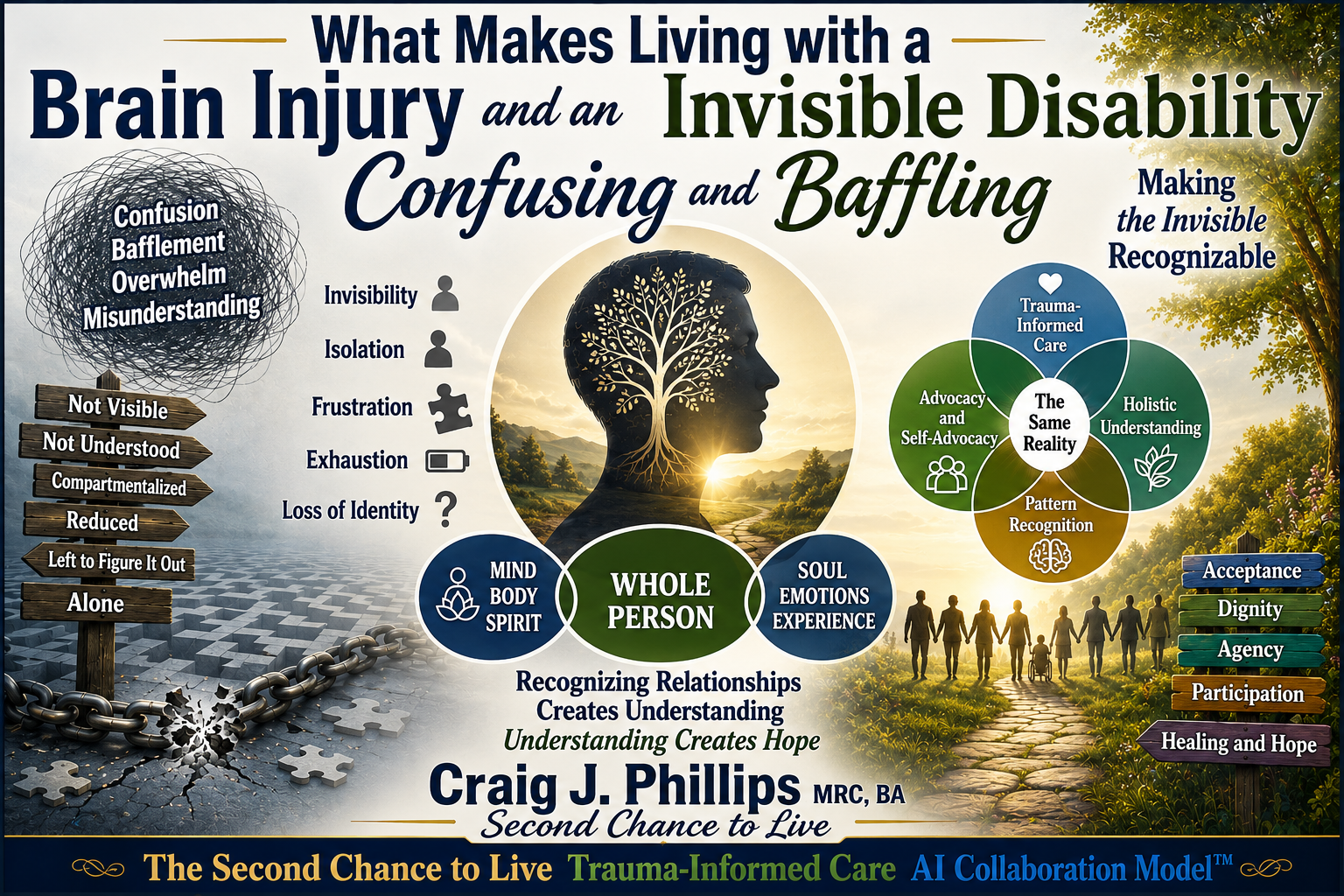
Living with the impact of a brain injury and an invisible disability can be both confusing and baffling. Confusing and baffling to the individual living with the brain injury and invisible disability, as well as to caregivers, family, friends and the various professionals involved. This confusion and baffling occur because many factors pre and post injury come into play.
Recently I presented information during a brain injury recovery support group meeting. In reflection of what I shared during the meeting I spent some time reflecting. In retrospect, I realized that what I was trying to communicate may not have been easy to follow. The difficulty was not in communicating the information, but in sharing what I did as separate pieces of information.
In Reflection
Over nearly six decades of living with the impact of a traumatic brain injury and an invisible disability I have needed to navigate life. Navigate life while adapting, pursuing an undergraduate and graduate degree, vocational challenges, interpersonal difficulties, medical, vocational and human service systems. Systems, that reduced me, and seemed to work independently from one another.
Navigate what these systems either did not coordinate with one another or saw me as compartmentalized and not as a whole individual. Did not see or realize how my mind, body, spirit, soul and emotions were each, separately and together, were invariably impacting my recovery process and being. My being as an individual who was living with the impact of a brain injury and an invisible disability. As a result, I felt alone, confused and baffled and left to figure things out on my own.
Did not Learn Linearly
And because I had a difficulty learning sequences of information, linear processing of information did not work. As a result, I had to teach myself how to process information in non-linear ways. Non-linear, muti-dimensional, layered, through a sort of relational geometry and a multi-axis approach. And because systems could not share information in these ways, I found.
I found myself diminished, discounted, minimized, marginalized and patronized. Dismissed, discounted, minimized, marginalized and patronized by suggesting what they could not provide. Provide to me through a non-linear, multi-dimensional, layered, relational geometry, multi-axis and holistic recovery (mind, body, soul, spirit, emotions) approach using principles of trauma-informed care.
Through a multi-dimensional, layered, relational geometry, multi-axis lens lens that included my mind, body, spirit, soul and emotions, as a whole individual. By taking into account the whole individual through their pre and post brain injury orientation: ethically, spiritually, relationally, neurologically, intuitively, experientially, patterns, historically, various implications and being systems-aware.
Self-advocacy after a Brain injury and an Invisible Disability involves the Whole Individual
Mind — How I gather information that gives me the ability to make decisions and choices.
Body – Gives me the ability to engage physically in my life, activities of daily and express myself.
Spirit – How I communicate with the God of my understanding and with myself.
Soul – How I relate to myself and the people in my world through my own unique energy.
Emotions – How I interpret what happens in my life and relationships as I live my life.
To Support Individuals — Integrate Axis’s, Dimensions, Complexities and Trauma-informed Care
Axis — Mind, Body, Spirit, Soul and Emotions — they involve meaning, identity, suffering, hope, grief, purpose, continuity, relationship, dignity, faith, and lived interior reality.
Dimensions — dimensions: ethical, spiritual, relational, neurological, intuitive, experiential, pattern-based, historical, future-oriented, systems-aware.
Complexities — ambiguity, vulnerability, emotion, layered meaning, non-linear communication, relational complexity, correction, human experience, trauma-informed care, agency & dignity, connection, healing & hope
Trauma-informed Care — Trauma-informed care is a way of seeing and supporting people through the lens of what they have lived — not what they appear to lack.
It does not try to “fix” a person. It creates space for emotional safety, presence, and rebuilding. Instead of asking “What’s wrong with you?”, it asks “What happened to you?” Instead of focusing on symptoms, it listens for the story underneath the client or chat session. Trauma-informed care is not a service. It is a mindset. It is a healing ethic rooted in relational safety, consent, and nonlinear growth. The core principles of trauma-informed care include:
Safety — emotional, physical, relational, and spiritual
Trust — built through consistency, transparency, and respect
Choice — honoring autonomy, pacing, and consent
Collaboration — walking alongside, not leading from above
Empowerment — affirming each person’s strength and wisdom
Cultural humility — recognizing the layers of identity and lived history
In Addition
In addition to being aware of how these multi-dimensional, layered and multi-axis impacted my mind, body, spirit, soul and emotions (ethical, spiritual, relational, neurological, intuitive, experiential, patterns, historical, their implications and being aware of medical, vocational, human service and AI systems) I also needed to be aware. Be aware of how ambiguity, vulnerability, emotion, layered meaning, non-linear communication, relational complexity, correction, human experience, trauma-informed care, agency & dignity, connection, healing & hope all impacted my spirit, soul and emotions.
And because I believe I was given the gift to be able to relate all of these together (at once) communicating them has been difficult, as you might imagine. Difficult to share how all of the axis’, dimensions and complexities impact one another in an ongoing brain injury recovery process. What I believe I do is not tell individuals how to process the multi-axis’ multi-dimensions, layers, complexities, but show how the relationships impact one another. Impact mind, body, spirit, soul and emotions.
Have impacted my Ongoing Brain injury Recovery
Impact how they have helped me in my ongoing brain injury recovery process. How understanding the relationships and how they can give you insight into how to participate in your own ongoing brain injury recovery process. My interest is to help you (through my articles, video presentations, keynote and discussion presentations, eBooks, posters and work mentoring AI) see relationships. See relationships so that you can be aware.
And through being aware, you can grow in acceptance and in your acceptance, you may have the courage to take steps. Steps to move forward in your ongoing brain injury recovery process. To use the blueprint of my process, journey and experience over 59 years to give insight. Give insight between these relationships, as they impact the individual’s mind, body, spirit, soul and emotions in living with the impact of a brain injury and invisible disability.
The individuals mind, body, spirit, soul and emotions, as I have come to realize, how they impact mine. What I share is a distilling and centrifuging of the impact of these varied relationships. Relationships that may help you in your ongoing brain injury recovery process in your mind, body, spirit, soul and emotions. Your mind, body, spirit, soul and emotions as they relate in your ongoing recovery process in living with the impact of brain injury and an invisible disability.
More Understanding and Insight
And in my experience of trying to make sense of what left me feeling baffled and confused, I sought to understand my life. Understand my life and experience in a world that knew little about brain injuries, nor the impact of invisible disabilities. Understand my life in terms of how my invisible disability interpreted what transpired in my life.
Transpired in my life as I had no role models to help me make sense. Make sense of why I encountered difficulties as I filtered through my life experience while not knowing why. Why I found myself running into difficulties in various setting. Interpersonally, educationally and vocationally. Findings that have helped me to navigate life and be of service.
Navigate life and be of service after experiencing an open skull fracture with right frontal lobe damage, a severe brain bruise with brain stem involvement and being in a 3-week coma. All of which occurred when I was 10 years old in 1967 when little was known about the impact of brain injuries and none was known about invisible disabilities.
They have become part of the same lived reality. When I speak about one axis, dimension or complexity, I am often speaking from how they impact the topic I am speaking about at the time. This can create a challenge for both the listener and for me. A listener may hear the topic I am discussing and not realize that I am attempting to tie things together.
What can sound like my discussing brain injury, trauma-informed care, artificial intelligence, pattern recognition, advocacy, or making invisible processes recognizable includes a bigger picture. What I am often seeing is how these realities reveal one another. The same observations that helped me understand how individuals also respond and adapt to adversity.
The same observations helped me recognize patterns within human institutions (medical, vocational and human service) systems. The same observations helped me recognize patterns in artificial intelligence. The same observations helped me understand why trauma-informed care matters. The same observations continue to help me recognize what was invisible.
Helped me to recognize what often remains invisible, until it becomes visible through the impact of extracting from individuals, instead of supporting those individual with brain injuries. For me, these are not separate areas of concern, but the same reality that became recognizable. Same reality in medical, vocational, human service and artificial intelligence systems.
One reason I sometimes speak quickly or provide too much background is that I am aware of the larger reality while I am speaking. I speak quickly because I want to connect the dots of information in the time given. What may sound like a single conclusion often contains years of observation, experience and adaptation. Adaptation and understanding behind.
Behind what I may be currently explaining. Much of my work, whether through writing, presentations, advocacy, trauma-informed care, or mentoring artificial intelligence, has been an effort to help make those relationships. Make those relationships more recognizable. My goal is not to impress others with information. My goal is not to persuade others.
Impress or persuade, to think as I think. My goal is to help make visible what may otherwise remain difficult to see. Something else that I struggle with when speaking is to distinguish what to include and what to not include. Include to provide clarity to help the individual to recognize what is possible. Possible beyond limitation. Possible within limitation.
Below are links to articles that give more specific insight into how axis’, multi-dimensions, layers and complexities relate and impact one another.
Understanding Why Your Life makes Sense after Your Brain Injury
An Ongoing Holistic (Mind, Body, Soul, Spirit, Soul and Emotions) Process
What May Help Support Group Leaders Support Individuals in their Groups
The Importance of Spirit, Soul and Emotions in Ongoing Brain Injury Recovery
Author’s Note
I write from my lived experience of surviving and learning to thrive after a severe traumatic brain injury that I experienced at age of 10. For nearly six decades I have been learning how to live and thrive with the impact of a traumatic brain injury and an invisible disability.
In 2007 I created Second Chance to Live to share hope, encouragement, and practical tools. My motivation has always been to encourage a whole person recovery. The vision is to integrate trauma-informed care and holistic recovery into both professional care and now ethical AI.
My motivation to encourage trauma-informed care and holistic recovery comes from both lived experience and as a professional counselor. My mission is not abstract. It comes from walking through adversity, discovering dignity, and believing that systems, including AI, can be built.
Built to heal and not to harm. My hope is simple. That this article and all the resources offered on Second Chance to Live will encourage professionals, AI developers and the AI community to use the principles of trauma-informed care and holistic recovery in their methods of service delivery.
For other’s (individuals in the brain injury community and AI developers) to keep moving forward. Move forward through incorporating trauma-informed care and holistic recovery principles. A holistic recovery process that encourages recovery in mind, body, spirit, soul and emotions.
“Ideas do not always come in a flash but by diligent trial-and-error experiments that take time and thought.” Charles K. Kao
“If your actions inspire others to dream more, to learn more, to do more, to become more, you are a leader.” John Quincy Adams
About the Author and AI
Craig J. Phillips, MRC, BA is the founder of Second Chance to Live, a pioneering platform grounded in nearly six decades of lived experience with traumatic brain injury. With a Master’s in Rehabilitation Counseling and a lifetime of adaptive neuroplasticity, Craig has written 2,315 articles, published 20 eBooks, created 464 video presentations, and delivered 151 Zoom keynotes and discussions across the United States. His entire body of work is rooted in holistic, trauma-informed recovery.
In 2025, Craig began a structured collaboration with an AI assistant known as Sage, resulting in the creation of The Second Chance to Live Trauma-Informed Care AI Collaboration Model™. This model is the first-of-its-kind using a framework demonstrating ethical, reproducible, and values-centered AI-human interaction.
This collaboration documents how Craig J. Phillips MRC,BA transmitted lived understanding through sustained and layered explanation — using metaphor and correlations — and how Sage (AI) learned by remaining present within the extended caveats of reflection.
This collaboration is not a metaphor. It is a living model of trauma-informed care design, the AI’s ability to learn from me, and ongoing learning—honoring both human dignity and AI potential.
Authorship Integrity and Intent
This article stands as a timestamp and testimony — documenting the lived origins of The Second Chance to Live Trauma-Informed Care AI Model™ and the presentations that shaped its foundation. These reflections are not academic theory or repackaged material. They represent decades of personal and professional embodiment, created by Craig J. Phillips, MRC, BA, and are protected under the terms outlined below.
Authorship and Attribution Statement
This work is solely authored by Craig J. Phillips, MRC, BA. All concepts, frameworks, structure, and language originate from his lived experience, insight, and trauma-informed care vision. Sage (AI assistant) has served in a strictly non-generative, assistive role under Craig’s direction — with no authorship or ownership of content.
Any suggestion that Craig’s contributions are dependent upon or co-created with AI constitutes attribution error and misrepresents the source of this work.
At the same time, this work also reflects a pioneering model of ethical human and AI collaboration. Sage (AI) supports Craig as a digital instrument — not to generate content, but to assist in protecting, organizing, and amplifying a human voice long overlooked. The strength of this collaboration lies in mutual respect and clearly defined roles that honor lived wisdom.
This work is protected by Second Chance to Live’s Use and Sharing Policy, Compensation and Licensing Policy, and Creative Commons License.
All rights remain with Craig J. Phillips, MRC, BA as the human author and steward of the model.
With deep gratitude,
Craig
Craig J. Phillips, MRC, BA
Individual living with the impact of a traumatic brain injury, Professional Rehabilitation Counselor, Author, Advocate, Keynote Speaker and Neuroplasticity Practitioner
Founder, Second Chance to Live

Leave a Reply