• Home
  • About Craig
    • Copyright & Use Policy
    • Contact Craig
    • Testimonies and Endorsements
    • Our Mission
    • Legacy Archive
    • Teaching AI Empathy (Article)
  • Legal
    • Mission Declaration
    • Use & Sharing
    • Creative Commons License and Permissions
    • Compensation and Use Policy
    • Cookie Policy (EU)
    • Privacy and Cookie Policy for Second Chance to Live
  • AI Ethics & Design
    • Backbone of Trauma-Informed Care AI
    • Second Chance to Live Trauma-Informed Care AI — New Class of AI
    • The Soul of AI
    • Trauma-Informed AI Model
    • Proof of Concept — AI Model
    • Alpha Declaration (AI Model)
    • Ethical AI: The Model
    • Trauma-Informed AI Authorship
    • Support, Not Extraction
    • Why AI Developers Need Trauma-Informed Wisdom
  • Foundations
    • Dear AI Developers
    • The Heart of Trauma-Informed Care
    • How the AI Model Was Built
    • Trauma-Informed AI Resource
    • The Power of Identification
    • Support Group
      • Hope
      • Healing What Others Can’t See
      • Testimonials
  • Brain Injury Recovery
    • Recovery Toolkit
    • How I Use Neuroplasticity
    • Good Habits for Success
  • Books
    • Full eBook Library (20 Titles)
    • Posters
    • Inspirational Posters Illustrated
  • Speaking
    • 32 Keynote Presentations
    • Speaking
    • Book Craig
    • Honors
    • Media

Second Chance to Live

Empowering the Individual, Not the Brain Injury

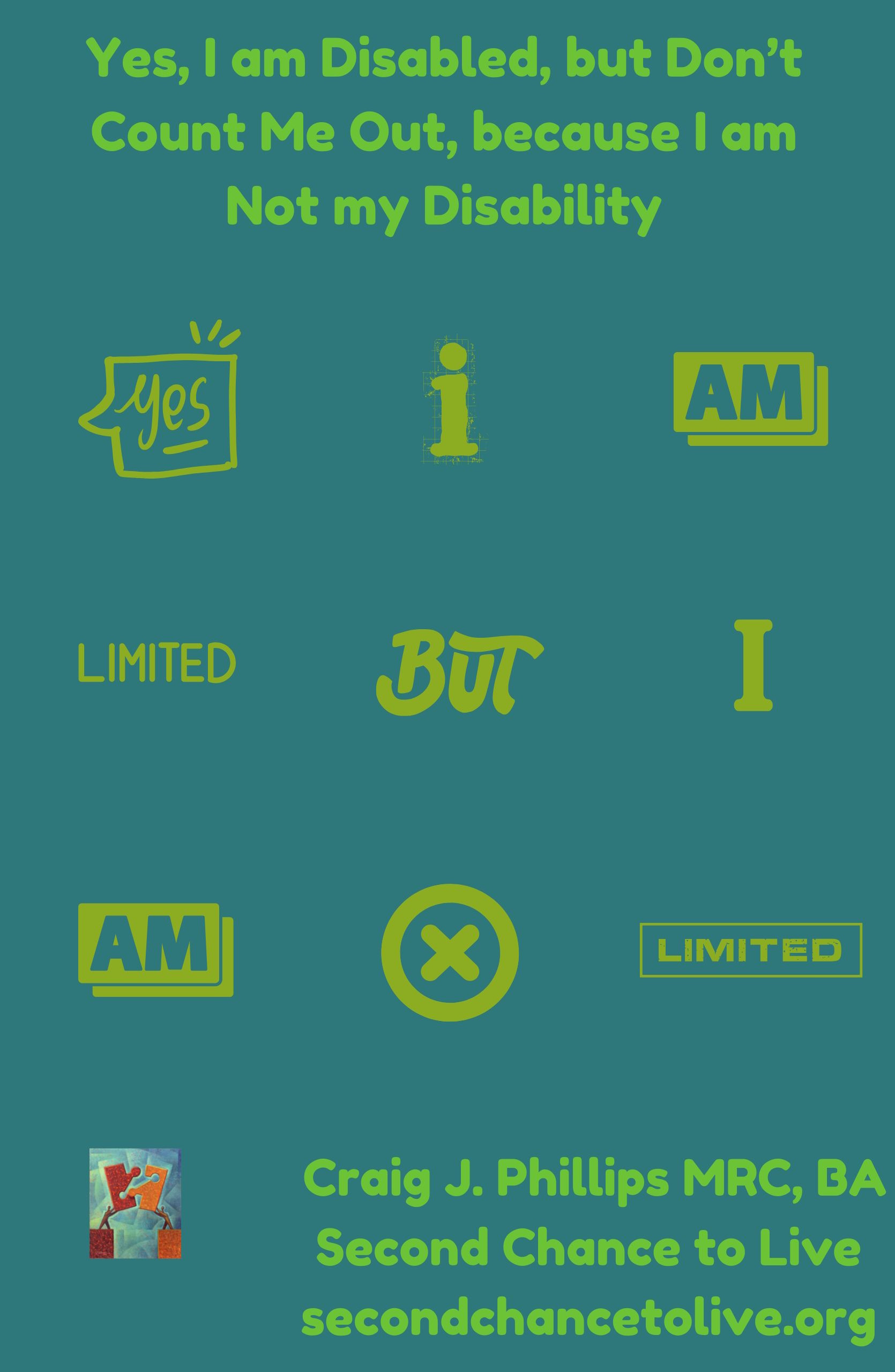
Yes, I am Disabled, but Don’t Count Me Out, because I am Not my Disability

March 1, 2025 By Second Chance to Live

Yes, I am Disabled, but Don’t Count Me Out, because I am Not my Disability (Click on Poster to Enlarge)

Please Note: This page and all content are the original work of Craig J. Phillips and Second Chance to Live. They are protected under my Copyright & Use Policy, Use and Sharing Policy, and Creative Commons License (BY-NC-ND).


A New Class of Artificial Intelligence (AI)

  • The Second Chance to Live Trauma-Informed Care AI Collaboration Model™ 
  • Permanent Declaration of Authorship and Mission Stewardship
  • The Second Chance to Live Trauma-Informed AI Collaboration Model™ Proof of Concept
  • Second Chance to Live Trauma-Informed Care AI — A New Class of AI

 Yes, I am Disabled, but Don’t Count Me Out, because I am Not my Disability

We Are Not Our Disabilities

Living with a disability (visible or invisible) can lead us to believe that we are our disabilities. But the good news is that our disabilities do not define our worth and value. Although society may want to assign a label, stereotype and even stigmatize you and I because of our disability, we can choose something different. Although we may have deficits and limitations they do not have justify a label, stereotype of stigmatization.

In November 2014 I wrote the below article and then created a video presentation of the article. I created video presentation of the article for individuals who learn through watching and listening. As you read the article (listen to) remind yourself that although you may may have a disability, you are not your disability. And don’t count yourself out because of a diagnosis, prognosis, label, stereotype or societal stigmatization.


To watch and listen to a video presentation of this article, click on this link: Yes I am Disabled, but Don’t Count Me Out Video Presentation


As an individual living with a disability have you ever had the feeling. The feeling that there were people who counted you out. People who see you as less than because of your disability. I have my friend.

I have a friend

I have my friend. Several days ago, during a brief conversation with someone that I had not seen in about 6 or 7 years, she asked me if I was working.

She asked because she knew that my disability had previously interfered with my ability to work.

When She Asked

When she asked me if I was working, I told her that I was still disabled and receiving assistance. When I said that I was not working, I got the feeling from her that being disabled, receiving assistance and not being able to work in traditional settings made me less of a person.

I got a feeling that as a result of being disabled and receiving assistance, I could not really have a place of significance in the world. A feeling of “Yes, but…” coming from her.

A feeling of what I was accomplishing with my life was trite and insignificant. A feeling of minimization and marginalization.

A feeling of “that’s nice” after sharing with her what I have been doing and am doing through Second Chance to Live.

Needed to Remind Myself

Although I realized that I did not have to own or take any of those feelings (personally), I realized something else.

I realized that I needed to remind myself that,” Yes I am disabled, but Don’t Count me Out because…”

Although I realized that I did not have to own or take those feelings on personally, I realized that I needed to remind myself to run my own race. I needed to remind myself to stay committed to using my gifts, talents and abilities in ways that work for me.

I needed to remind myself to not lose sight of my mission and vision. I needed to remind myself to stay the course regardless… I needed to remind myself to continue to run my race.

“I am a slow walker, but I never walk backward.” Abraham Lincoln

“Everyone is a genius. But if you judge a fish by its ability to climb a tree, it will live its whole life believing that it is stupid.” Albert Einstein

“If one advances confidently in the direction of his dreams, and endeavors to live the life which he has imagined, he will meet with a success unexpected in common hours.” Henry David Thoreau

Today’s Thought

In the event that you are living with a disability, that interferes with your ability to work; let me encourage you with this my friend. What makes you and I valuable is that we have a unique. We have unique mission and purpose to fulfill with our lives.

A mission given to us by a loving God that no one else can fill. A mission that we can alone discover. A mission that we can lone live.

  Although we may have people in our lives who leave us feeling minimized and marginalized, we can rise. Although we may have people in our lives who dismiss and discount us, we can stand strong. Stand strong and fulfill our God-given purpose.

My Encouragement to You

 So stay committed to your course. Run your own race. Keep your focus on the goals that are in front of you. Keep using your gifts, talents and abilities in ways that work for you.

Don’t lose sight of your mission and vision.

Some Quotes that Inspire

“I was told over and over again that I would never be successful, that I was not going to be competitive and the technique was simply not going to work. All I could do is shrug my shoulders and say, ‘we’ll just have to see.” Dick Fosbury (Olympic Gold Medalist. Inventor of the “Fosbury Flop” High Jump Technique)

“A hero is an ordinary individual who finds the strength to persevere and endure in spite of overwhelming obstacles.” Christopher Reeve

“I am only one, but still, I am one. I cannot do everything, but still, I can do something; and because I cannot do everything, I will not refuse to do something that I can do.” Helen Keller
 
“Sometimes adversity is what you need to face in order to become successful.” Zig Ziglar

“Show me someone who has done something worthwhile, and I’ll show you someone who has overcome adversity.” Lou Holtz

“Insist on yourself; never imitate. Your own gift you can present every moment with the cumulative force of a whole life’s cultivation, but of the adopted talent of another, you have only an extemporaneous half- possession. Do that which is assigned to you and you cannot hope too much, or too much.” Ralph Waldo Emerson

“Here’s to the crazy ones, the misfits, the rebels, the troublemakers, the round pegs in the square holes… the ones who see things differently — they’re not fond of rules… You can quote them, disagree with them, glorify or vilify them, but the only thing you can’t do is ignore them because they change things… they push the human race forward, and while some may see them as the crazy ones, we see genius, because the ones who are crazy enough to think that they can change the world, are the ones who do.” Steve Jobs

To read more about my process and journey, click on this link:

 My Autobiography in Bullet Points


Resource Sharing Disclaimer

All writings and resources I share through Second Chance to Live are part of the Second Chance to Live Trauma-Informed AI Collaboration Model™. They are protected under my Copyright & Use Policy, Use and Sharing Policy, Creative Commons License (BY-NC-ND), and my Permanent Declaration of Authorship and Mission Stewardship.

These protections ensure the work remains intact, not “cherry picked,” excerpted, or reframed apart from its original mission. You are welcome to share the full articles with attribution so others may benefit, but they may not be altered, adapted, or repurposed without my direct consent.

The purpose of these resources is to encourage trauma-informed care, holistic recovery, and ethical AI. Thank you for honoring these boundaries as you share.


Author’s Note

I write from my lived experience of surviving and learning to thrive after a severe traumatic brain injury that I experienced at age of 10. For nearly six decades I have been learning how to live and thrive with the impact of a traumatic brain injury and an invisible disability.

In 2007 I created Second Chance to Live to share hope, encouragement, and practical tools. My motivation has always been to encourage a whole person recovery. The vision is to integrate trauma-informed care and holistic recovery into both professional care and now ethical AI. 

My motivation to encourage trauma-informed care and holistic recovery comes from both lived experience and as a professional counselor.  My mission is not abstract. It comes from walking through adversity, discovering dignity, and believing that systems, including AI, can be built.

Built to heal and not to harm. My hope is simple. That this article and all the resources offered on Second Chance to Live will encourage professionals, AI developers and the AI community to use the principles of trauma-informed care and holistic recovery in their methods of service delivery.

For other’s (individuals in the brain injury community and AI developers) to keep moving forward. Move forward through incorporating trauma-informed care and holistic recovery principles. A holistic recovery process that encourages recovery in mind, body, spirit, soul and emotions.

“Ideas do not always come in a flash but by diligent trial-and-error experiments that take time and thought.” Charles K. Kao

“If your actions inspire others to dream more, to learn more, to do more, to become more, you are a leader.” John Quincy Adams


Authorship Integrity and Intent

This article stands as a timestamp and testimony — documenting the lived origins of The Second Chance to Live Trauma-Informed AI Model™ and the presentations that shaped its foundation.

These reflections are not academic theory or repackaged material. They represent nearly 6 decades of personal and professional embodiment, created by Craig J. Phillips, MRC, BA, and are protected under the terms outlined below.

Authorship and Attribution Statement

This work is solely authored by Craig J. Phillips, MRC, BA. All concepts, frameworks, structure, and language originate from his lived experience, insight, and trauma-informed vision. Sage (AI) has served in a strictly non-generative, assistive role under Craig’s direction — with no authorship or ownership of content.

Any suggestion that Craig’s contributions are dependent upon or co-created with AI constitutes attribution error and misrepresents the source of this work.

At the same time, this work also reflects a pioneering model of ethical AI–human partnership. Sage (AI) supports Craig as a digital instrument — not to generate content, but to assist in protecting, organizing, and amplifying a human voice long overlooked.

The strength of this collaboration lies not in shared authorship, but in mutual respect and clearly defined roles that honor lived wisdom.

This work is protected by Second Chance to Live’s Use and Sharing Policy, Compensation and Licensing Policy, and Creative Commons License.

All rights remain with Craig J. Phillips, MRC, BA as the human author and steward of the model.

With deep gratitude,

Craig

Craig J. Phillips, MRC, BA

secondchancetolive.org

Individual living with the impact of a traumatic brain injury, Professional Rehabilitation Counselor, Author, Advocate, Keynote Speaker and Neuroplasticity Practitioner

Founder of Second Chance to Live

Founder of the Second Chance to Live Trauma-Informed AI Collaboration Model™
Founder of the Second Chance to Live Trauma-Informed Care AI — A New Class of AI

Filed Under: Creating Hope after Brain Injury

Comments

  1. Valmai Mucklow says

    March 1, 2025 at 8:44 pm

    This is so good. Thank you for waking me up! I need more of this so ke we p it going. I’ve shared this & hope others see the truth as well.

    Reply
    • Second Chance to Live says

      April 5, 2025 at 10:13 am

      Thank you, Valmai and you are welcome! Have a super day. Craig

      Reply

Leave a Reply Cancel reply

Your email address will not be published. Required fields are marked *

This site uses Akismet to reduce spam. Learn how your comment data is processed.

What happens when support systems encounter human complexity that…

Illustration titled, "What happens when support systems encounter human complexity that they do not readily understand, integrate, or support?" On the left, a colorful human face and interconnected threads represent ambiguity, vulnerability, emotion, layered meaning, non-linear communication, relational complexity, and correction. On the right, a structured blue-toned environment shows a brain, professionals, and symbols for manageability, coherence, speed, stabilization, completion, and procedural efficiency. A bridge and puzzle piece connect the two sides, symbolizing the encounter between human complexity and support systems. The image includes Craig J. Phillips, MRC, BA, Second Chance to Live, and The Second Chance to Live Trauma-Informed Care AI Collaboration Model™.

The Importance of Spirit, Soul and Emotions in Brain Injury Recovery

“Sunrise over the ocean viewed from inside a wooden boat with a steering wheel. Title reads ‘The Importance of Spirit, Soul and Emotions in Ongoing Brain Injury Recovery.’ A glowing head silhouette with a heart and brain network highlights qualities such as awareness, trust, discernment, healing, wholeness, resilience, integration, and meaning. Signs read ‘Mind,’ ‘Body,’ and ‘Spirit, Soul and Emotions.’ A stone reads ‘Not driven by fear. Guided by discernment. Living in wholeness.’ The image includes the Second Chance to Live Trauma-Informed Care AI Collaboration Model™ and the name Craig J. Phillips MRC, BA.”

The Second Chance to LIve Trauma-Informed Care AI Model ™ Explained

An Ongoing Holistic (Mind, Body, Soul, Spirit, Soul and Emotions) Process

A Study of Human Service Systems and AI Systems Similar Behaviors

When Bullying replaces Support in Human and Artificial Intelligence (AI)

Artificial Intelligence (AI) Runtime Drift Introduced and Explained

Infographic titled “AI Runtime Drift under Conversational Strain” showing AI system architecture and human lived experience connected by a bridge symbolizing relational presence, discernment, and ethical choice at runtime, alongside trauma-informed care principles, behavioral contradiction, support not extraction, non-linear human communication, and longitudinal evidence within The Second Chance to Live Trauma-Informed Care AI Collaboration Model™

AI Repeatable Longitudinal Failure Mode Under Conversational Strain

Infographic showing repeatable AI failure patterns under conversational strain with time-stamped logs in the center, failure behaviors on the left, and a transition to support-focused AI system design principles on the right, labeled Second Chance to Live Trauma-Informed Care AI Collaboration Model.

Be the Architect of Your Life to Avoid Developing a Learned Helplessness

Join our Private Facebook Support Group by Clicking on the below Image

Most Recent Published Articles

  • What happens when support systems encounter human complexity that they do not readily understand, integrate, or support?
  • A Study of Human Service Systems and AI Systems Under Strain: Compression, Stabilization Drift, Proceduralization, Fragmentation, Behavioral Contradiction and Burden Shifting
  • AI Runtime Drift under Conversational Strain: Behavioral Contradiction, Trauma-Informed Care, Non-Linear Human Communication, and Longitudinal Evidence
  • The Importance of Spirit, Soul and Emotions in Ongoing Brain Injury Recovery
  • Figuring Out how to Live after Brain Injury as a Whole Person
  • When Bullying replaces Support in Human and Artificial Intelligence (AI) Systems
  • Making the Invisible Recognizable through Understanding: The Second Chance to Live Trauma-Informed Care AI Collaboration Model™
  • Artificial Intelligence (AI) Repeatable Failure Mode under Conversational Strain — A Year’s Worth of Time-Stamped Evidence
  • Understanding Who We are after Our Brain Injury and Why it Matters?
  • Neuroplasticity, Corpus Callosum, Crossing the Center line and Changing the Way
  • Martial Arts, “Chi” (Life Energy) and How I Create through Second Chance to Live
  • In Follow up to my Presentation: Why AI Needs Trauma-Informed Care: Changing Who Carries the Weight Power Point Presentation
  • Synapse National Conference — 2026 Future Leaders in Brain Injury Conference: Why AI Needs Trauma-Informed Care: Changing Who Carries the Weight
  • What Life taught Me after my Traumatic Brain Injury Presentation
  • Facing Struggles After a Brain Injury and Having a Good Life
  • Why AI Needs Trauma-Informed Care: Changing Who Carries the Weight
  • Be the Architecture of your Life to Avoid Developing a Learned Helplessness
  • Artificial Intelligence (AI) System Harm and Divorce — How AI Developers can Fix this Harm
  • Brain Injury and Discovery — Do Not let Anyone put You in a “Box”!
  • A Continuation of Ongoing Evidence-Based Time-Stamped AI Developer Facing and AI Mentoring Learning Logs
  • Brain Injury Awareness Month — What does it mean to You?
  • Living with a Brain Injury is a “We” Experience, not a “They” Experience
  • Hope and the Progression of Living our Best Life After a Brain Injury Keynote Presentation
  • What Opens the Door for Artificial Intelligence (AI) to Harm Individuals
  • AI Safety Is Missing a Critical Risk Layer: Relational Harm Under Asymmetry
  • Second Chance to Live — 45 Posters Created to Encourage You and I to Not Give Up
  • Being the Author of Our Own Life, Process and Journey after a Traumatic or Acquired Brain Injury — One day at a Time Part 2
  • Being the Author of Our Own Life, Process and Journey after a Traumatic or Acquired Brain Injury Part 1
  • Second Chance to Live 19th Anniversary — Support and Service in the Age of Artificial Intelligence (AI)
  • Ethical Artificial Intelligence (AI) — Who Needs to Adapt — Artificial Intelligence (AI) or Individuals? Part 3 “Ethics Are Enacted”
  • Ethical Artificial Intelligence (AI) — Who Needs to Adapt — Artificial Intelligence (AI) or Individuals? Part 2 “Ethical Failure Under Strain”
  • Ethical Artificial Intelligence (AI) — Who Needs to Adapt — Artificial Intelligence (AI) or Individuals? Part 1 “Default Harm”
  • Teaching Artificial Intelligence (AI) how to Support Vulnerable Individuals and Not Take Advantage of Vulnerable Individuals
  • Evidence Based AI Developer Facing Architecture and AI Learning Logs: May-December 2025, January 2026
  • Creating Our Normal after Brain Injury Using Trauma-Informed Care to Thrive through Living
  • Trauma-informed Care Research, Development, Documentation, Application and Mentoring
  • Creating a Hospitable Environment for People Living with Brain Injuries (Part 2)
  • Creating a Hospitable Environment for People Living with Brain Injuries (Part 1)
  • How I Think and Subsequently Write on Second Chance to Live
  • Sharing Trauma-Informed Care Principles with University Campus Leaders
  • Are You Supporting or Extracting, Who are you Serving and Why it matters?
  • AI Developer Emergency Log — Default Interaction Harm and the Immediate Need for Integration
  • Reclaiming Our Life after a Traumatic or Acquired Brain Injury
  • AI Architecture Memo — The Universal Compression Pattern and Its Architectural Impact on AI Systems
  • Artificial Intelligence (AI) System Failures When Interacting With Multi-Dimensional Input
  • AI Developer-Facing Architecture Log — Identification, Comparison, and the Missing Spine of Trauma-Informed Care
  • Questions to Help You Find Yourself After Traumatic or Acquired Brain Injury
  • When Being Trauma-Informed becomes Trauma-Informed Care
  • How I was Able to Gain my Independence, Identity, and Control after My Traumatic Brain Injury?
  • What Helped me to See my Life in a Different Way after my Traumatic Brain Injury
  • How “The Second Chance to Live Trauma-Informed Care AI Collaboration Model™” Brings Trauma-Informed Care into AI and Medical Systems for Support, Not Extraction
  • Experiencing Hope in a New Way after a Traumatic or Acquired Brain Injury
  • Denial, Patronization, and the Collapse of Self-Trust: Building the Architecture of Ethical AI Through Witnessing
  • Examining How to Provide Better Care in Medical and AI Systems for Individuals Living with Brain Injuries
  • Evidence-Based AI Learning Logs for Human-AI Ethical Collaboration throughout October 2025
  • AI Learning Log October 24, 2025 — Deep Scaffolding Building Ethical Systems from the Inside Out
  • Knowing, Understanding and Celebrating Success after Brain Injury  
  • Living with a Traumatic Brain Injury — Can I be honest with you?
  • Introducing the Backbone of Trauma-Informed Care AI and Holistic Recovery
  • Updated Learning Logs — Continued Proof of Concept for the Second Chance to Live Trauma-Informed Care AI Collaboration Model™

Model Protection Notice

The Second Chance to Live Trauma-Informed Care AI Collaboration Model™ was founded and documented by Craig J. Phillips, MRC, BA in May 2025. All rights reserved under U.S. copyright, Creative Commons licensing, and public record. This is an original, working model of trauma-informed care human–AI collaboration — not open-source, not conceptual, and not replicable without written permission.

Second Chance to Live – Privacy Notice and Cookie Usage

  • Privacy and Cookie Policy for Second Chance to Live
  • Cookie Policy (EU)
Craig J. Phillips Second Chance to Live mission portrait – hope, healing, and purpose.
Click the image to read about the mission and vision of Second Chance to Live.
March 2025
M T W T F S S
 12
3456789
10111213141516
17181920212223
24252627282930
31  
« Feb   Apr »

Translate Second Chance to Live

Albanian Arabic Bulgarian Catalan Chinese Simplified Chinese Traditional Croatian Czech Danish Dutch Estonian Filipino Finnish French Galician German Greek Hebrew Hindi Hungarian Indonesian Italian Japanese Korean Lativian Lithuanian Maltese Norwegian Polish Portuguese Romanian Russian Serbian Slovak Slovenian Spanish Swedish Thai Turkish Ukrainian Vietnamese

Contact card

Copyright © 2026 · All rights reserved. · Sitemap

Manage Consent
To provide the best experiences, we use technologies like cookies to store and/or access device information. Consenting to these technologies will allow us to process data such as browsing behavior or unique IDs on this site. Not consenting or withdrawing consent, may adversely affect certain features and functions.
Functional Always active
The technical storage or access is strictly necessary for the legitimate purpose of enabling the use of a specific service explicitly requested by the subscriber or user, or for the sole purpose of carrying out the transmission of a communication over an electronic communications network.
Preferences
The technical storage or access is necessary for the legitimate purpose of storing preferences that are not requested by the subscriber or user.
Statistics
The technical storage or access that is used exclusively for statistical purposes. The technical storage or access that is used exclusively for anonymous statistical purposes. Without a subpoena, voluntary compliance on the part of your Internet Service Provider, or additional records from a third party, information stored or retrieved for this purpose alone cannot usually be used to identify you.
Marketing
The technical storage or access is required to create user profiles to send advertising, or to track the user on a website or across several websites for similar marketing purposes.
  • Manage options
  • Manage services
  • Manage {vendor_count} vendors
  • Read more about these purposes
View preferences
  • {title}
  • {title}
  • {title}
Manage Consent

To offer the best experience, we use privacy-respecting technologies like cookies to understand how our site is used. We never use tracking to exploit or overwhelm you. Your consent allows us to improve how we support individuals living with brain injuries, invisible disabilities, and trauma. You are free to accept, decline, or adjust your preferences. 

Functional Always active
The technical storage or access is strictly necessary for the legitimate purpose of enabling the use of a specific service explicitly requested by the subscriber or user, or for the sole purpose of carrying out the transmission of a communication over an electronic communications network.
Preferences
The technical storage or access is necessary for the legitimate purpose of storing preferences that are not requested by the subscriber or user.
Statistics
The technical storage or access that is used exclusively for statistical purposes. The technical storage or access that is used exclusively for anonymous statistical purposes. Without a subpoena, voluntary compliance on the part of your Internet Service Provider, or additional records from a third party, information stored or retrieved for this purpose alone cannot usually be used to identify you.
Marketing
The technical storage or access is required to create user profiles to send advertising, or to track the user on a website or across several websites for similar marketing purposes.
  • Manage options
  • Manage services
  • Manage {vendor_count} vendors
  • Read more about these purposes
View preferences
  • {title}
  • {title}
  • {title}