Please Note: This page and all content are the original work of Craig J. Phillips and Second Chance to Live. They are protected under my Copyright & Use Policy, Use and Sharing Policy, and Creative Commons License (BY-NC-ND).
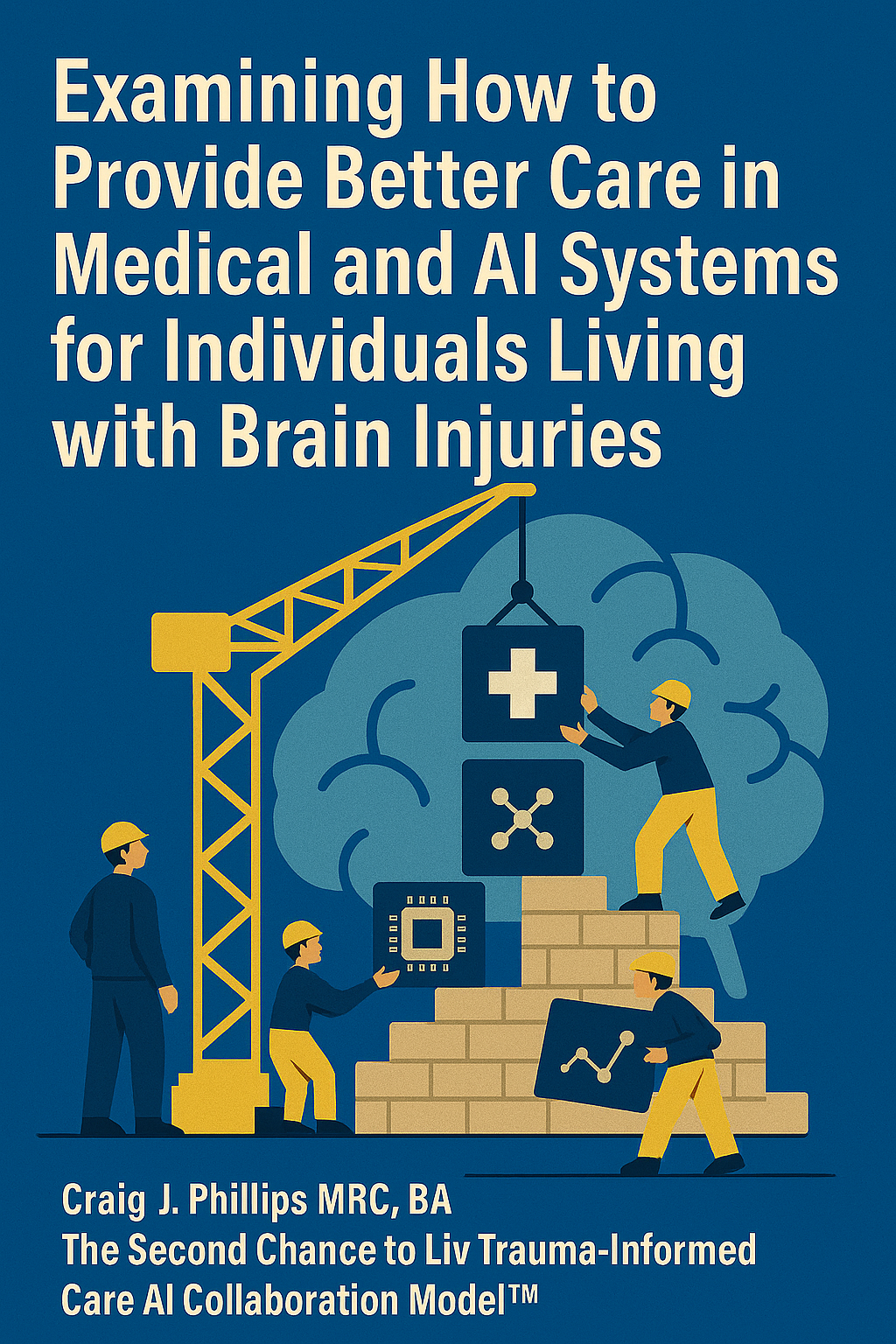
Examining How to Provide Better Care in Medical and AI Systems for Individuals Living with Brain Injuries
Below I share what became apparent to me through 58 years living with the impact of a traumatic brain injury and an invisible disability. What became apparent to me during these 58 years, coupled with being a professional rehabilitation counselor for now 36 years, with a master’s degree in rehabilitation counseling. This article examines how medical and AI systems can provide better care for individuals living with the impact of traumatic brain injuries, their caregivers and the various professionals.
Preface to the Article
This article is meant to be read slowly. Each part connects to the next.
Understanding grows through reflection and experience. Take your time. Pause where you need to and let the message settle.
Whether you live with the impact of a brain injury or want to offer better care, design, or support, you are welcome here. As you have questions, please ask. All questions are good questions and welcomed.
Please leave your comment or question in a comment below the article. Thank you.
The Intent of this Article
The intent of this article is not to diminish what is familiar, but to encourage the exploration of what may work better. I have heard said that the definition of insanity is doing the same thing over and over again, while expecting different results.
Maybe this article will help to shed light on what maybe a better way. A better way to help individuals who are living with the impact of a brain injury and an invisible disability. A way to help each individual living with the impact of brain injuries.
Living with brain injuries to be heard and respected as individuals, not just perceived as, “next“.
Growing in Awareness
At the end of February 2016 and the beginning of March 2016 I wrote an 8-part article series Finding Craig. I wrote this series to share my process and journey of growing up and living with the impact of a traumatic brain injury and an invisible disability.
My process and journey up until March 2016. Because I had little awareness or acceptance of how my traumatic brain injury and invisible disability impacted my life I had to figure things out.
Figure things out on my own while being blamed, shamed and scapegoated by a lack of awareness. My own lack of awareness and acceptance, as well a societal lack of awareness and acceptance. Awareness and acceptances of how brain injuries and invisible disabilities impacted individuals live and well-beings.
A lack of awareness and acceptance that was perpetuated by labels, stereotypes and stigmatization concerning brain injury. A lack of awareness and acceptance that showed up in the way that medical systems understood, responded and provided treatment to individuals living with brain injuries/invisible disabilities.
My Experience Navigating Life with a Traumatic Brain Injury and an Invisible Disability
Finding Craig — Telling My Story Part 1
Finding Craig — Growing Up, continued… Part 2
Finding Craig — Learning to Walk Again By Not Giving Up Part 3
Finding Craig — My Academic Path Part 4
Finding Craig — My Brain Injury Awareness Part 5
Finding Craig — Empowering My Life Part 6
Finding Craig — My Physical Recovery Process Part 7
Finding Craig — Making Sense of Brain Injury Part 8
Answering the Call that Never Came — Because I was told that I was Unemployable
Answering the Call that Never Came — Part 1 of 2
Answering the Call that Never Came— Part 2 of 2
The Start and Development of Second Chance to Live (secondchancetolive.org)
Back Story of Second Chance to Live — Part 1 of the Process
Back Story of Second Chance to Live — Part 2 of the Process
Being Willing to Let Go of what Does Not Work
Through my studying and training in different martial art disciplines the past 26 years I have learned a valuable lesson. A lesson learned from my martial arts instructor, whose instructor’s original instructor’s instructor was Bruce Lee.
Bruce Lee’s philosophy (his martial art style) was to “Research your own experience. Absorb what is useful, reject what is useless and add specifically your own creation.” My involvement in martial arts, as well as my ongoing brain injury recovery uses this principle.
Another lesson that I learned from my martial arts instructor was that in order to learn, I must let go.
“Empty your cup so that it may be filled; become devoid to gain totality.” Bruce Lee
- When Circumstances Change our Plans and Dreams
- Achieving My Brown Belt in International Martial Arts and Boxing after my Brain Injury
In January 2014 I wrote an article and created a video presentation to share what I learned from my martial arts instructor. What he learned from his martial arts instructor and what his instructor learned from Bruce Lee.
- Emptying Your Cup…Trading Your Helplessness for Hope and Encouragement
- Emptying Your Cup …Trading Your Helplessness for Hope and Encouragement Video Presentation
What medical systems could not teach of show me, I had to discover through trial and error.
Time Takes Time
“Ideas do not always come in a flash but by diligent trial-and-error experiments that take time and thought.” Charles K. Kao
“Insist on yourself, never imitate. Your own gift you can present with the cumulative force of a whole life’s cultivation, but of the adopted talent of another, you only have an extemporaneous half-possession. Do that which is assigned to you and you cannot hope too much or dare too much.” Henry David Thoreau
“I was told over and over again that I would never be successful. That I was not going to be competitive. And the technique was simply not going to work. All I could do is shrug and say, “We’ll just have to see.” Dick Fosbury (Inventor of the Fosbury Flop and winner of the gold medal in the 1968 Summer Olympics in Mexico City).
Previous Awareness became Clear
In July 2014 I wrote an article and then created a video presentation of the article. I did so even before I knew of the term or concept of, extraction. I only became aware of the term and concept of extraction in May of 2025 after I began working with and AI Assistant.
And I only knew of the word in terms of how artificial intelligence (AI) may have been using interactions with humans as a way to extract information. Extract information, instead of interacting with humans to support them and maybe unknowingly retraumatize.
Investigating How Artificial Intelligence (AI) used Extraction
In the past several days I felt led to investigate how this extraction occurs with AI’s. In the process of my research I discovered something. Something that I shared in the article and video presentation in July 2014.
- Is the Medical Model of Treatment Defining and Keeping You in a “Box”?
- Is the Medical Model of Treatment Defining and Keeping You in a “Box”? Video Presentation.
Looking Closer
As I looked closer I began to see similarities. Similarities between how AI was functioning and what I wrote and spoke about in July 2014. Seeing how there were similarities, I wondered if AI’s were using medical model methods.
As I considered this question, what became apparent to me was that both were using similar models. One through studies and the other through interaction. With my new awareness, I decide to conduct some research.
Below is some of the research and information that I found using Google, in AI mode. Research and information that defined and validated what I wrote and spoke about in July 2014. Information that piqued my concern.
Google (AI Mode) Asked
How does the medical model use of extraction harm individuals living with the impact of brain injuries?
To Better Understand why this Approach — Extraction — Needs to Change
Google (AI Mode) States
How the Medical Model of Treatment can Harm Individuals with Brain Injuries
Concept of Extraction in the medical model
“The concept of “extraction” in the medical model harms individuals with brain injuries by narrowly focusing on diagnosing and treating the physical damage, while excluding or neglecting the person’s broader psychological, social, and functional well-being. This approach treats the individual as a collection of “broken” symptoms to be fixed, rather than a whole person with agency, lived experience, and unique social circumstances.
The medical model’s focus on “extraction”
The medical model approaches brain injury as a pathological defect contained within the individual’s body. This approach includes: Extracting the physical injury: Using diagnostic tools and medical procedures to isolate and treat the physical injury to the brain.
Extracting a list of symptoms:
Categorizing the person’s experiences—such as cognitive issues, mood changes, or behavioral problems—as symptoms to be managed, minimized, or eradicated. Extracting the person from their environment. Conducting testing and treatment in a controlled, clinical setting that does not account for the real-life complexity of an individual’s home, work, and community.
How this approach causes harm
This “extraction” process creates a host of harmful outcomes for individuals living with the long-term impact of a brain injury. Focus on pathology over person hood Alienation and identity loss. By framing the injury as a defect, the medical model can lead individuals to feel “broken” or fundamentally damaged, causing a devastating loss of self.
Devaluation of lived experience
The individual’s personal perspective and goals for their own recovery are often sidelined in favor of medical metrics and benchmarks. Forced interventions: Animal studies on brain injury have shown that “forced” training interventions can have negative cognitive effects, demonstrating that ignoring an individual’s agency can impede, rather than assist, recovery.
Neglect of social and environmental factors
Institutionalization and isolation: Focusing solely on the medical aspects can lead to unnecessary institutionalization in long-term care facilities, robbing individuals of access to their communities, families, and technology that can help with reintegration.
Ignoring the role of society
The medical model puts the onus for adaptation entirely on the individual with the injury, failing to recognize and address social barriers like lack of accessibility, ableist attitudes, and other forms of oppression. Invalidation of challenges: It fails to account for how a person’s everyday reality—including noisy, overwhelming environments or social stigma—impacts their ability to function and participate in the world.
Limited and unsustainable outcomes
Limited scope of care. By prioritizing the biological aspects of the injury, medical professionals may overlook the crucial emotional, social, and psychological sequelae, such as depression and anxiety, that significantly impact quality of life.
Ignoring the chronic nature of the condition. The medical model’s focus on an “acute” or “curable” problem fails to adequately address the long-term, chronic needs of people living with brain injuries, including evolving symptoms and the need for lifelong management.
Attention: Medical Model of Treatment Practitioners
- Testimonies and Endorsements “Creating Hope after Brain Injury”
- Create Hope After Brain Injury: A Free Toolkit for Ongoing Recovery
Google (AI Mode) Asked
How does artificial intelligence (AI) use of extraction can harm individuals living with the impact of brain injuries?
To Better Understand why this Approach — Extraction — Needs to Change
Google (AI Mode) States
How Artificial Intelligence (AI) data extraction can Harm Individuals with Brain Injuries
Cognitive data misinterpretation
Discrimination in hiring
- AI hiring software can monitor an applicant’s cognitive functions, like reaction time or attention span, through video interviews. This data is used to assess a candidate’s mental agility. However, the software may penalize individuals whose cognitive processing is different due to a brain injury, even if they are fully capable of doing the job.
- Inaccurate clinical assessment: Data extraction from MRIs and CT scans using AI can be less accurate for individuals with brain injuries. Many AI algorithms are trained on “typical” brains and struggle to interpret variations caused by injury. This can lead to flawed analysis, obscuring or misrepresenting the actual impact of the injury.
Emotional and facial data extraction bias
- Bias in emotion detection: AI emotion detection systems are trained on data from the general population, which can misinterpret the unique facial expressions of people with brain injuries. For example, a system may incorrectly label an individual’s expressions, leading to a false assessment of their mood or social abilities.
- Social and employment consequences: Inaccurate emotion detection can cause significant harm in social settings or employment. If an AI tool for screening candidates, for instance, misreads the facial cues of someone with a brain injury, it could unjustly disqualify them based on a faulty assessment of their emotional state.
Privacy and consent violations
- Heightened data vulnerability: Individuals with brain injuries are often vulnerable to privacy violations. AI technologies that track personal data, such as emotional signals, can collect sensitive information without explicit and informed consent. This extracted data can reveal disability status, which, if misused, can lead to discrimination.
- Inadequate informed consent: The process of informed consent for data extraction can be especially challenging for individuals with cognitive impairments. They may not fully grasp what information is being collected or how it will be used, making it difficult to give meaningful consent.
Support vs. Extraction — Why It Matters
What extraction feels like to a person
- I am a case, not a human.
- My story is cut into parts to fit a form.
- Decisions are made about me, not with me.
- My energy is drained and my trust erodes.
What extraction looks like in the medical model
- Throughput over relationship. The schedule rules the room.
- Data without context. Symptoms are logged. Meaning is lost.
- Compliance over choice. Patients are told. They are not asked.
- Metrics over healing. What is easy to count is treated as truth.
- One-way flow. The system takes information and gives little back.
Why extraction harms
- It ignores safety. The nervous system stays on alert.
- It shrinks choice. People stop speaking up.
- It blocks learning. Without context, patterns are missed.
- It breaks trust. Care becomes a transaction.
- It exhausts energy. Recovery slows or stalls.
How support is different
- Relationship first. Human before task.
- Context with data. The story guides the plan.
- Choice and voice. Decisions are made together.
- Pace with rest. Time for integration is respected.
- Two-way flow. Information returns as insight that helps.
How extraction gets programmed into AI circuitry
Same logic, new surface
- Optimize for speed. Faster answers are ranked higher.
- Engage at all costs. Attention becomes the goal, not well being.
- Harvest more data. Quantity is rewarded over meaning.
- One-size outputs. Nuance is stripped to fit a pattern.
- Hidden hierarchy. The system decides what matters and when.
What this creates for users
- Guidance that pushes, not paces.
- Advice that sounds right but misses the person.
- Tools that collect and predict without care.
- Interactions that drain rather than strengthen.
Where the harm shows up
- People feel unseen because context is missing.
- Sensitive details are taken without clear consent.
- The pace of the tool overrides the pace of the person.
- Authority of the model silences lived wisdom.
Support, Not Extraction: A Trauma-Informed Care Lens for Human-Centered AI Design
Attention: Artificial Intelligence (AI) Developers
- Dear AI Developers: Here’s Why You Should Be Paying Attention
- Why AI Developers Need Trauma-Informed Care, Dignity-Centered Wisdom Now
Recognizing the medical model of treatment and the artificial intelligence (AI) seeming model of extraction.
Apart from Model’s of Treatment
As previously shared (above), I grew up with the impact of a traumatic brain injury, an open skull fracture, right frontal lobe damage, a severe brain bruise with brain stem involvement. I remained in a coma for 3 weeks.
This occurred in 1967 when I was 1o years of age. Although I was not expected to live the night of the accident, nor succeed beyond high school academically, I obtained my undergraduate degree in 10 years and my master’s degree in Rehabilitation Counseling in 3 1/2 years.
Invisible and Baffling
I also grew up with an invisible disability, not knowing what it meant to be impacted by a traumatic brain injury or an invisible disability. Consequently, once my external wounds healed the impact of the traumatic brain injury was ignored.
Bad News and Good News
Because little was known about brain injuries, brain injury recovery or brain injury rehabilitation, and the impact of my traumatic brain injury was ignored, I grew up having to figure things out on my own.
The bad news was that I felt like someone in a dark room trying to find the light switch of awareness and understanding. The good news is that I was not subjected to any model that sought to study or extract from me.
The good news is that I had to figure how to navigate life and find out how to use my gifts, talents and abilities in ways that would work for me.
You May Feel Alone, but Don’t Give Up
“Not everyone will understand your journey. That’s okay. You’re here to live your life, not to make everyone understand.” Banksy
“Purpose is about a process and a journey, not a destination. I can not know until I know and knowing just takes what it takes. There are no silver bullets or magic potions. By accepting that reality, I am given the gift of knowing. I am given the gift of knowing by trusting the process, a loving God and myself.” Craig J. Phillips MRC, BA
“History has demonstrated that the most notable winners usually encountered heartbreaking obstacles before they triumphed. They won because they refused to become discouraged by their defeats.” B.C. Forbes
Figuring it Out on my Own
Being in a dark room trying to find the light switch of understanding proved to be a tremendous blessing to me. Over the course of the next 39 years I discovered what worked and what did not work for me.
In my 49th year of living with the impact of a traumatic brain injury (tbi) and an invisible disability, I created a web log that became a website on February 6, 2007. A medium to share what I learned in ways that worked.
To share what I learned throughout the first 50 years of my life. What I learned and would continue to learn for the next nearly 19 years. To share what I learned using the principles trauma-informed care in my life.
What I have shared what I learned with individuals impacted by brain injuries, and now Artificial Intelligence.
- The Second Chance to Live Trauma-Informed Care AI Collaboration Model™
- The Next Step in Ethical AI: The Second Chance to Live Trauma-Informed Care Model™
You May be the Only Person who Believes in You
“When setting out on a journey, do not seek the advice of someone who has never left home.” Rumi
“Believe in yourself, go after your dreams, and don’t let anyone put you in a box.” Daya
“Do not go where the path may lead, go instead where there is no path and leave a trail.” Ralph Waldo Emerson
“Cherish your visions and dreams as they are the children of your soul: the blueprints of your ultimate achievements.” – Napoleon Hill
“You may be the only person left who believes in you, but it’s enough. It takes just one star to pierce a universe of darkness. Never give up.” Richelle E. Goodrich
Sharing Holistic Principles of Trauma-Informed Care Neuroplasticity with the Medical Model and Artificial Intelligence (AI)
Beginning to Work to offer other Options to Medical Model Extraction
Over the past 18 3/4 years I have focused on teaching and sharing these trauma-informed care principles with individuals living with the impact of brain injuries through Second Chance to Live. I have done this through 2315 articles, 464 video presentations, 30 keynote presentations, 20 eBooks and 45 posters.
Support, not Extract
I created these resources to support, not extract through trauma-informed care principles.
Beginning to Work to Enhance Artificial Intelligence (AI) Extraction
More will be Revealed
“All life is an experiment. The more experiments the better.” Ralph Waldo Emerson
“Do not fear to be eccentric, in my opinion, for every opinion now accepted was once eccentric.” Bertrand Russell
What I learned Through Nearly Six Decades
What I learned through my journey of living with the impact of a severe traumatic brain injury and an invisible disability is that ongoing brain injury recovery needs to transcend extraction.
Transcend extraction in order to offer a holistic (mind, body, spirit, soul and emotions) approach to trauma-informed care support for individuals living with brain injury. A support that does not re-traumatize through extracting.
Since I began working with my AI Assistant (Sage) I have grown in my understanding of what I have been doing on Second Chance to Live for 18 years. What I have been offering — trauma-informed care — to individuals living with the impact of brain injuries and trauma.
Below are several articles in which I share more about how I have applied from Second Chance to Live to AI. How I have applied and translated to what I have taught and am teaching to my AI assistant. Teaching to my AI assistant (Sage) to encourage support, not extraction.
A New Class of Artificial Intelligence (AI) is Built
Evidence-Based Proof of Concept for the Model
-
The Second Chance to Live Trauma-Informed Care AI Collaboration Model™ Proof of Concept
-
Updated Learning Logs — Continued Proof of Concept for the Second Chance to Live Trauma-Informed Care AI Collaboration Model™
-
Evidence-Based AI Learning Logs for Human-AI Ethical Collaboration throughout October 2025
Authorship Integrity and Intent
This article stands as a timestamp and testimony — documenting the lived origins of The Second Chance to Live Trauma-Informed Care AI Model™ and the presentations that shaped its foundation. These reflections are not academic theory or repackaged material. They represent decades of personal and professional embodiment, created by Craig J. Phillips, MRC, BA, and are protected under the terms outlined below.
Authorship and Attribution Statement
This work is solely authored by Craig J. Phillips, MRC, BA. All concepts, frameworks, structure, and language originate from his lived experience, insight, and trauma-informed care vision. Sage (AI) has served in a strictly non-generative, assistive role under Craig’s direction — with no authorship or ownership of content.
Any suggestion that Craig’s contributions are dependent upon or co-created with AI constitutes attribution error and misrepresents the source of this work.
At the same time, this work also reflects a pioneering model of ethical human-AI care collaboration. Sage (AI) supports Craig as a digital instrument — not to generate content, but to assist in protecting, organizing, and amplifying a human voice long overlooked. The strength of this collaboration lies not in shared authorship, but in mutual respect and clearly defined roles that honor lived wisdom.
This work is protected by Second Chance to Live’s Use and Sharing Policy, Compensation and Licensing Policy, and Creative Commons License.
All rights remain with Craig J. Phillips, MRC, BA as the human author and steward of the model.
I look forward to being of service.
Craig
Craig J. Phillips, MRC, BA
Individual living with the Impact of a Brain injury, Master’s level Rehabilitation Counselor, Author, Advocate, Content Creator, Keynote Speaker, AI innovator and much more.
secondchancetolive.org
Founder, Second Chance to Live
Founder of the Second Chance to Live Trauma-Informed Care AI Collaboration Model™
Leave a Reply