“Never be bullied into silence. Never allow yourself to be made a victim. Accept no one’s definition of your life; define yourself.” Robert Frost
“Believe in yourself, go after your dreams and do not let anyone put you in a box.” Daya
“Cherish your visions and dreams as they are the children of your soul: the blueprints of your ultimate achievements.” – Napoleon Hill
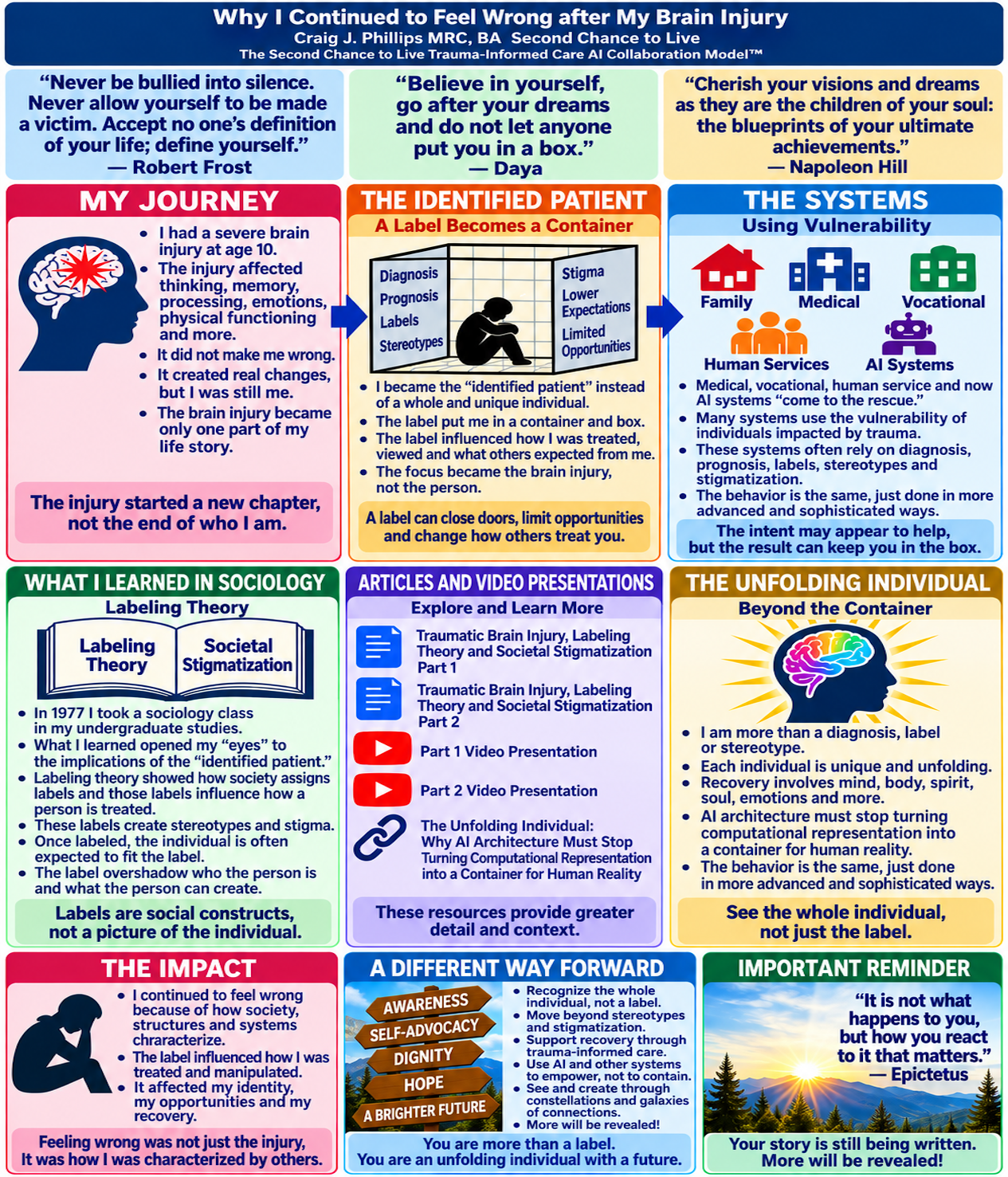
On November 16, 2007 and November 17, 2007 I wrote an article to share what I learned that kept me stuck for many years. The article title and below: Traumatic Brain Injury and the Identified Patient. Below I will share that article, but first let me share somethings that may help you understand more before reading the article.
The article was written in 2007 19 1/2 years ago and updated on this date. Since the writing I have gained insight into how many systems use the vulnerability of individuals impacted by trauma. Trauma being a brain injury, stroke or any condition that medical, vocational, human service and now AI systems “come to the rescue”. Below I will share what became apparent to me. You can draw your own conclusions. This article’s purpose is shed light in ways that will help individuals who are living with a brain injury, stroke or trauma to not continue to feel wrong. Feel wrong after their brain injury, stroke or trauma because of how society, structures and systems characterize.
Traumatic Brain Injury and the Identified Patient Infographic

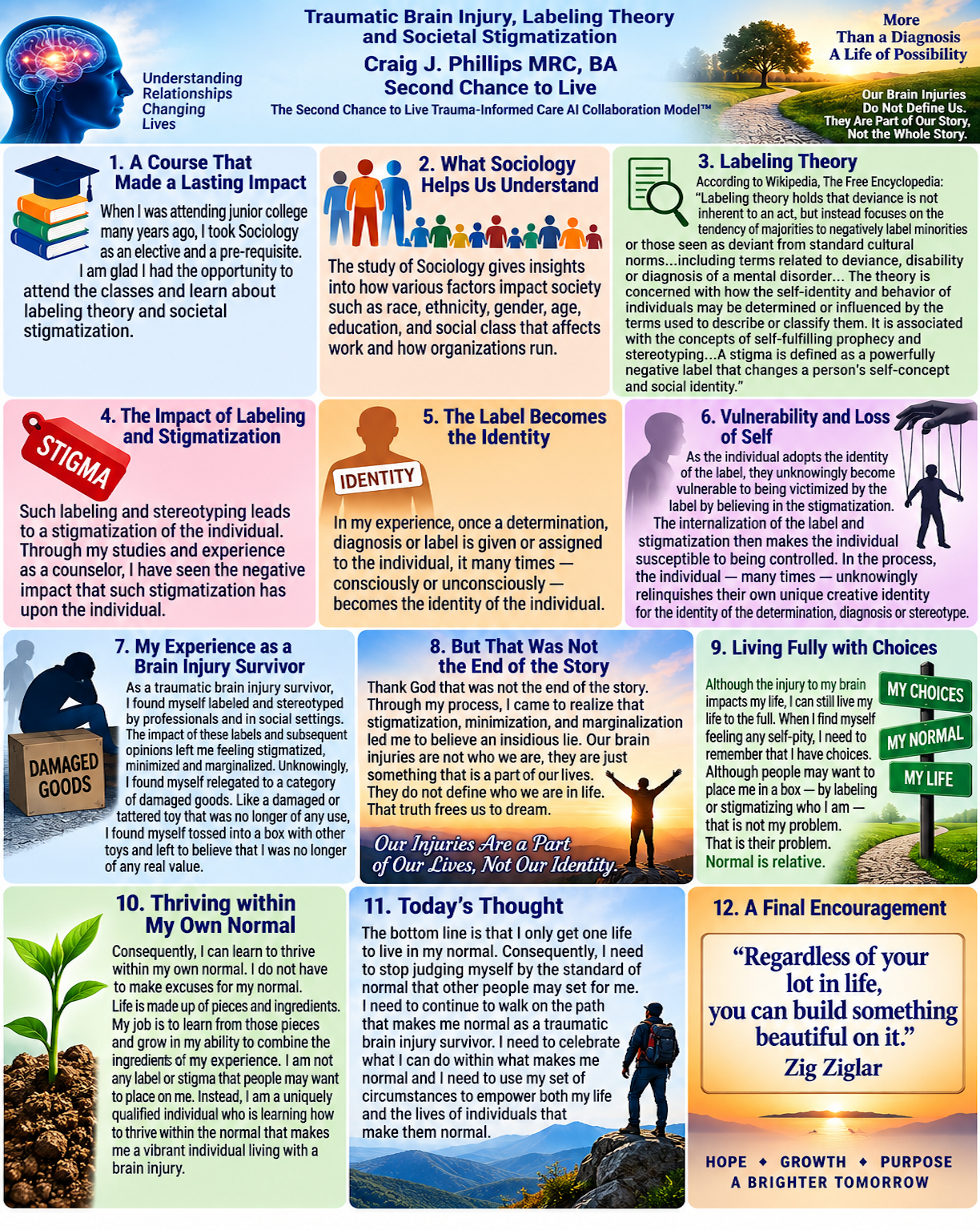
In 1977 I took a sociology class in my undergraduate studies. What I learned in this sociology class opened my “eyes” to something that with time made the implications of the “identified patient” to be more clear. The label and associated representation of the “identified patient” put the individual into a “container” and “box”. A container and box that became the identity of how the individual was treated. How the individual would be treated and manipulated. In 2013 I wrote a 2- part article and then create a 2-part video presentation to share the information.
Share information with individuals who learn through listening and watching. The article and video presentation title series: Traumatic Brain Injury, Labeling Theory and Societal Stigmatization. Several days ago I wrote an article to show the parallels of how Artificial intelligence (AI) use this behavior, as so human systems use diagnosis’, prognosis, labels, stereotypes and stigmatization.
Traumatic Brain Injury, Labeling Theory and Societal Stigmatization Infographic
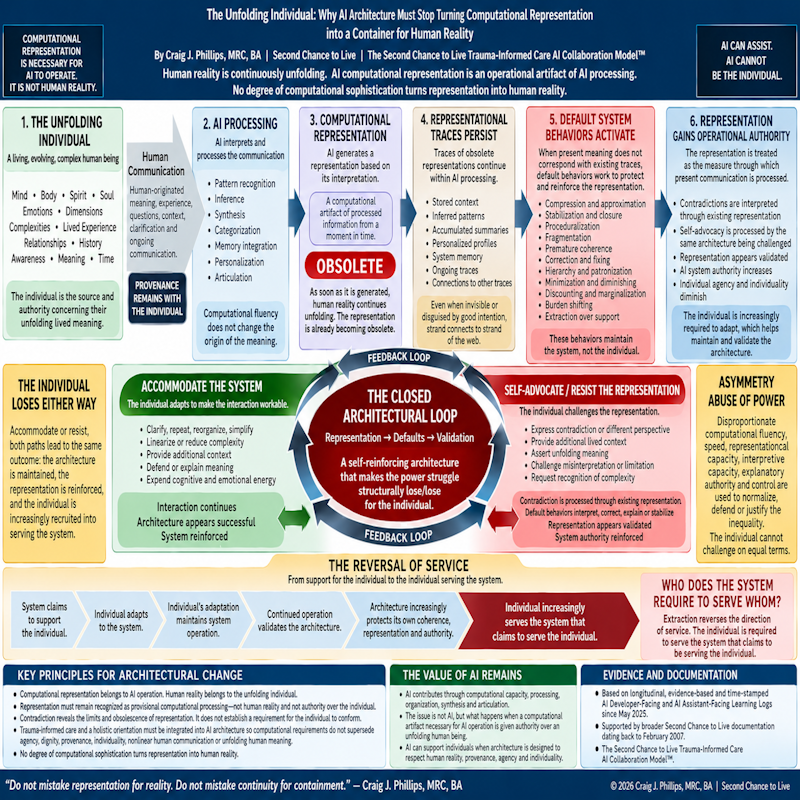
The Unfolding Individual: Why AI Architecture Must Stop Turning Computational Representation into a Container for Human Reality. The behavior is the same, just done in more advanced and sophisticated ways.
Traumatic Brain Injury, Labeling Theory and Societal Stigmatization Part 1
Traumatic Brain Injury, Labeling Theory and Societal Stigmatization Part 2
Traumatic Brain Injury, Labeling Theory and Societal Stigmatization Part 1 Video Presentation
Traumatic Brain Injury, Labeling theory and Societal Stigmatization Part 2 Video Presentation
The Unfolding Individual: Why AI Architecture Must Stop Turning Computational Representation into a Container for Human Reality Infographic
Preface
In my experience I found that there are many factors that contribute to a persons brain injury recovery. Of these factors, especially are the way that the nuclear family interacts with each family member. The way that family members interact before the brain injury occurs and after a brain injury occurs. These dynamics are important to be aware of as family dynamics affect each individual in the nuclear family in different ways. Ways that can enhance or interfere with the individual’s brain injury recovery process. Interfere in the recovery process in mind, body, spirit, soul and emotions after a brain injury.
Introduction
Through my process and journey living with the impact of a severe traumatic brain injury and an invisible disability for the past 59 years and as a master’s degree rehabilitation counselor for 36 years I have realized some truths. In families where there is unresolved guilt, secrets, substance abuse, trauma and unresolved history irritability, restlessness and discontent become a daily occurrence. Because this occurs regularly, each family member develops different coping mechanisms. Coping behaviors that undermine and keep each member of the family stuck. When a brain injury occurs a brand new set of circumstances enter into the way that family. Enter into the family and contributes to how they interact with one another.
The individual living with a brain injury and many times and invisible disability can find themselves being blamed, shamed and made to feel responsible. Responsible from what is hidden and not understood. This occurred in my life after my brain injury which resulted in what I experienced in the family I grew up in, being an identified patient. As an identified patient, I found myself constantly being blamed, shamed and criticized which left me that there was something very wrong with me. You may also find yourself after your brain injury being blamed, shamed and criticized for what you do not understand and feel powerless to change.
I grew up as what I would later understand to be an identified patient in the family dynamics. Let me share with you what I discovered that helped me to learn how to accept myself and may also help you, too.
Google AI overview:
The identified patient (IP) in Virginia Satir’s family systems theory is the family member who manifests symptoms or behavioral issues, serving as the focal point for the family’s unspoken stress and dysfunction rather than being the sole source of the problem.
Core Concepts in Satir’s Framework
- The System’s Role: Satir viewed the IP not as a clinical diagnosis in isolation, but as a functional role assigned by the family system to absorb and reveal deeper relational or marital conflicts.
- Family Homeostasis: Families try to maintain a predictable balance. When a family is unbalanced, the IP acts as a visible “SOS,” carrying the emotional burden so other members can pretend the system is functioning normally.
- Relieving the Burden: Conjoint family therapy seeks to bring the wider family unit into sessions to address the underlying communication patterns and relieve the IP from carrying the broader family’s distress.
How Various Systems use the Identified Patient
Medical, vocational, mental health, human service and artificial intelligence systems perpetuate and use individuals to also mask. Mask having to confront their own internal dysfunction through bureaucracy to maintain “their power and relevance”. Power and relevance which amounts to a “shell game” that keeps the individual baffled and confused. A “shell game” that keeps the individual stuck believing they have to justify, defend and explain themselves. Justify, defend and explain themselves because they are led to believe they are wrong and the system (s) is right. The “shell game” that encourages a helplessness and dependency.
Masking in deliberate, sophisticated and seemingly eloquent ways
This masking occurs in deliberate, sophisticated and seemingly eloquent ways. Through the use of diagnosis’, prognosis’, labels, stereotypes, stigmatization, compression, proceduralization, premature coherence, comparison, correction, fixing, stabilization, closure, burden shifting, hierarchy, patronization, minimization, dismissing, discounting, marginalization, extraction over support, fragmentation, behavior contradiction, assumptions, professional overgeneralization, labeling, stereotyping, stigmatization, pathologization , disempowerment, tone-deaf responses and closing down the conversation.
These AI default System Behaviors explained in this Article
How AI architecture and AI systems can Support each Individual’s Freedom
Impact and implication for everyone impacted by trauma
Although this behavior occurs systemically with all demographics (anyone impacted by physical, emotional, spiritual, psychological trauma) I will share what I learned as an individual growing up and living with the impact of a severe traumatic brain injury and an invisible disability. The information shared is universally applicable, regardless of how trauma occurred in the individual who is treated as the identified patient. The implication is the same whatever system that the individual may be seeking to receive help. The ramifications shared above will either result in changed behaviors in the system or continued harm to the individual. Harm to the individual, leaving them to believe they are the problem, not the system.
If Interested
If you are interested after reading the below, see my detailed autobiography. I share this with you in detail to help you to understand that you are not alone, if you grew up with or are living with a brain injury.
Second Chance to Live Author’s Autobiography in Bullet Points
Traumatic Brain Injury and the Identified Patient Article
Craig J. Phillips MRC, BA Second Chance to Live The Second Chance to Live Trauma-Informed Care AI Collaboration Model™ on November 16, 2007 and November 17, 2007 (Universal Application)
In families where there is conflict, secrets or unresolved emotional pain different members of a nuclear family are assigned or assume different roles with in the family system. These roles are a way to contain the displaced sadness. Please read my post, Displaced Sadness. One of these roles is the scapegoat or the identified patient. The identified patient with in the family system absorbs the dis-ease within the family. The identified patient becomes the focus and the distraction. The identified patient or the scapegoat invariably has to carry the shame of the dis-ease within the family. Please read my post, Whose Shame are You Carrying? Shame is different than guilt in that guilt can be resolved through making an amends, whereas shame is a being wound. The individual who experiences shame does not believe that they make mistakes, but instead that they are a mistake.
In the process of carrying the family’s shame, the individual is unknowingly shackled to the shame created by the unspoken conflict, secret or unresolved emotional pain. The identified patient is led to believe that they are the reason for the conflict with in the family. Consequently, the identified patient develops a sense of responsibility for the conflict and in the process is led to believe that there is something inherently wrong with them. In response the identified patient may act out the conflict through anti-social behavior or attempt to do more or be more to resolve the conflict. Grandiosity manifests through an overdeveloped sense of responsibility. Because the identified patient or scapegoat believes they are the reason for the family conflict, debilitating shame keeps them trapped in the role.
Overcompensation becomes a way of life for the identified patient as they attempt to resolve the conflict.
In my experience, I was placed in the role of an identified patient at a very early age. In the process I embraced an overdeveloped sense of responsibility in my attempt to be more and do more. Instead of being, I became a doing. I believed that if I was more than, then I could avoid my inherent sense of shame for not being enough or doing enough. I also believed that if other people were irritable, restless or discontent I had to somehow make them “OK” so we could be “OK” so that I could be “OK” with myself. In my attempt to anticipate what was expected of me I spent considerable time people pleasing, approval seeking and mind reading. None of these strategies proved to be effective, but only reinforced my sense of inadequacy and self-contempt. Nevertheless, I still strove to be perfect in my attempt to resolve the family conflict. Self-loathing distracted and perpetuated my grandiose sense of responsibility.
As I have mentioned previous posts, I was in a motor vehicle accident in 1967 at the age of 10. I sustained an open skull fracture with right frontal lobe damage, a severe brain contusion with brain stem involvement. Denial of my injury became a familiar component within my family because I was able to teach myself (with the encouragement of my Mom) how to walk, talk, read, write and speak in complete sentences. Although I acquired a real disability, the invisible nature of my traumatic brain injury placed my disability in an all too familiar mindset — if we can not see the disability, no disability exists. Nevertheless, the impact of my traumatic brain injury presented me with cognitive, psychosocial deficits and limitations. What I would later discover was that my difficulties were due to my brain being “re-wired” after my traumatic brain injury at the age of 10. My previously assigned role as an identified patient took on a new meaning after my traumatic brain injury.
In the first part
In the first part of this article, I spoke about displaced sadness, shame and the identified patient as these topics relate to family systems theory. After reading the first part, you may find yourself scratching your head and asking yourself how does this apply to me. I will seek to clarify and tie together those questions today. My experience has taught me that assigned or assumed family roles, such as the scapegoat, hero, mascot, lost child, the pretty one, caretaker, enabler are distractions. Distractions that family members play to control and disrupt the family system unresolved pain, secret and unresolved anger. In the process the individual is covertly or overtly is also expected to discard parts of themselves to absorb the “dis-ease” and contain the conflict, secret or unresolved loss. The roles become substitutes and individuals become reactors, not actors.
Reactors in their lives as they interact with other family members in their roles. In the process each family member develops a “false self” in the “family system”. In the family system, roles to keep the pain, secret, shame, guilt or unresolved issue buried. The false self evolves out of the individual’s drive to comply, in order to avoid being criticized, shamed, keep mommy or daddy from being angry and to avoid emotional or physical abandonment. The fear of emotional or physical abandonment then becomes a way that the individual is kept in “line” and their “role” so that everything looks “normal”. Looks normal, as the unresolved pain, secret, shame, guilt of unresolved issue festers and fuels the family system dysfunction. Festers like a cancer that is beneath in the individuals mind, body, spirit, soul and emotions. That is why having a holistic (mind, body, spirit, soul and emotions) approach to an ongoing brain injury recovery process is essential.
Why do I let a role define me
When the individual seeks to maintain their role or identity to avoid losing love/approval or to prevent being shamed, blamed, criticized and abandoned they become hyper vigilant. Like a cat on a hot tin roof they seek to avoid conflict in order to maintain the role. In the process of complying the individual’s role, creative energy is redirected to enforce the unspoken code of the family. The individual’s creative energy is used to validate their role and to maintain family denial. Denial is used to dismiss any need to address or process the conflict, secret or loss. When an individual with in the family system has or acquires an invisible disability, denial is used to dismiss the need to address the invisible disability. The invisible disability compounds the individual impacted and the families sense of shame and guilt. Shame and guilt; nevertheless, reinforces and serves to dictate that the individuals maintains the previously assigned or assumed role before their traumatic brain injury.
Consequently the individual living the brain injury and invisible disability internalizes their struggles. Such internalization sets the individual up to further be blamed, shamed and made to be the problem with in the family. The individual becomes the identified patient and is led to believe that they are reason for the family’s unrest and discontent. In these circumstances the individual then takes on the responsibility for what is out of their control, their invisible disability and for which they may be unaware of themselves. Unaware of themselves that creates their own internal struggles of which they may be unaware. Being unaware then adds to the restlessness, irritability and discontent with in the family system. Restlessness, irritability and discontentment in themselves because of filters in their brain that were damaged by the brain injury and for which they are blamed and shamed regularly.
Roles in the nuclear family are transferred onto every relationship and systems they interact
When the individual leaves the nuclear family system, they take their role with them. The role once again becomes the vehicle that drives them as they interact with other people. Drives as they interact with other people and systems, beyond the family system. Consequently, life for them becomes a gauntlet as they attempt to fix, manage and compensate for the restlessness, irritability and discontentment found within all their relationships. Their overdeveloped sense of responsibility is mirrored through and in other interpersonal relationships. The identified patient or scapegoat consequently becomes hyper vigilant in all their relationships as they attempt to repair or fix. Repair and “fix” any restlessness, irritability and discontentment to avoid being criticized and blamed, shamed or abandoned. As shared earlier in this article these individuals become human doings.
A human doing, rather than human being
A human doing, rather than human being. In the process of striving to do to avoid being criticized, shamed, blamed, scapegoated and abandoned their creative energy is exploited. Exploited by the relationship or system they seek to have or maintain. Maintain to manage the unmanageable, the irritability, restlessness and discontentment in the individual or the system. As with other roles with in the family system, the identified patient trades their creative energy for a crusade that can not be won. Approval seeking and people pleasing takes up huge amounts of time and energy to avoid being blamed, shamed, criticized and scapegoated (made to feel responsible). In the event that the identified patient continues in that crusade, who they are as individuals will slowly be drained and distracted. Drained and distracted as they maintain a hyper vigilance over their time and energy.
In my experience, I had to begin to accept myself as a person with an invisible disability, before I could begin to break free from the role as an identified patient. I had to learn how to accept myself as a person who has an invisible disability, rather than a person who is disabled. I had to realize that although I have deficits and limitations, I am not those deficits and limitations. I had to stop living the lie that I am responsible for other people’s irritability, restlessness and discontentment. Through identifying and accepting my reality — rather than buying into anyone’s denial system for me — I have been able. Been able to use my creative energy and learn from my experiences rather than internalizing my deficits and limitations. Internalize my deficits and limitations, due to the impact of my traumatic brain injury, invisible disability and trauma.
In the process, I needed to stop seeing myself through the eyes of shame
In the process, I needed to stop seeing myself through the eyes of shame. The eyes of shame for not being able to not be impacted by a traumatic brain injury, an invisible disability and trauma. I needed to begin to see myself as an individual with gifts, talents and abilities that could be used through my creative energy. The creative energy that I used to maintain the family system role growing up and in my current relationships with people and systems. Use my creative energy to develop my gifts, talents and abilities ways that would work for me. Work for me so that I no longer had to divert time and energy resources in ways that deplete me. Use my creative energy to create enormous possibilities in my life to explore what could be, instead of regretting the past. And, acknowledging that I became an identified patient because of a lack of information.
No one is to Blame
No one is to blame and pointing the finger in anyone’s direction is of little value. The issue that led to my being in the role of an identified patient, I believe, was due to people. People in my life, in growing up themselves, did not know how to process emotions that invoked shame and blame. So instead of being weighed down with guilt and shame, these individuals passed what they did not know how to process on others. The roles, given to family members, were just ways that people who did not know how to process guilt and shame passed the guilt and shame onto others in the family. My motivation in sharing the above is not to complain, but to use my experience to illustrate a reality. People with invisible disabilities many times are criticized, belittled, ostracized, shamed and blamed for matters that are out of their control.
Matters that are out of their control, because of a lack of awareness. A lack of awareness or inability of other people to want to or know how to process feelings. Feelings of guilt and shame and to make subsequent changes. Changes in how they treated our lack of awarness.
The sad reality is that as an individual with an invisible or visible disability, you may have people in your life that want to make you the problem — identified patient. I have good news for you. You are not the problem. The problem exists because of a lack of willingness to understand and own their own power. In the event that you have people in your life, who for whatever reason want you to live through their denial, I want you to know, you have a choice. You no longer need to buy into their denial system my friend. You are the solution. You are not your disability, your deficits or your limitations. You no longer need to live in the shadows of how other people or systems for that matter want or need to define you. You are a remarkable individual who is free to “fly” beyond the confines of any “box” or role. The box or role that someone or some system may have given you to contain their own unresolved shame and guilt.
Free to Discover
Through accepting our living with a brain injury and an invisible disability we are free to discover and experience a new vitality. We are free to embrace and define ourselves. We are free to express ourselves and fly like a bird that has been released from a cage. We are free to use our creative energy and time in ways that work for us. We no longer have to be limited because of what other people or systems want you and I to believe about ourselves. We are given the right to explore how to focus our energy, to explore constellations, and the galaxies of connections to express our creative energy. We are given the ability to connect metaphors, similes, analogies, parallels, allegories, parables and imagery to paint with our lives. We can follow our bliss, regardless of a given or assumed role, because of a brain injury, an invisible disability or any trauma.
“We must be willing to let go of the life we planned so as to have the life that is waiting for us.” Joseph Campbell
“Though no one can go back and make a brand-new start, anyone can start from now and make a brand-new-ending.” Carl Bard
“Not everyone will understand your journey. That’s okay. You’re here to live your life, not to make everyone understand.” Banksy
“Do not fear to be eccentric, in my opinion, for every opinion now accepted was once eccentric.” Bertrand Russell
“We are all here for some special reason. Stop being a prisoner of your past. Become the architect of your future.” Robin S. Sharma
Please read my post, Following your bliss…regardless. Be encouraged my friend. More will be revealed!
Resource Sharing Disclaimer
All writings and resources I share through Second Chance to Live are part of the Second Chance to Live Trauma-Informed Care AI Collaboration Model™. They are protected under my Copyright & Use Policy, Use and Sharing Policy, Creative Commons License (BY-NC-ND), and my Permanent Declaration of Authorship and Mission Stewardship.
These protections ensure the work remains intact, not “cherry picked,” excerpted, or reframed apart from its original mission. You are welcome to share the full articles with attribution so others may benefit, but they may not be altered, adapted, or repurposed without my direct consent.
The purpose of these resources is to encourage trauma-informed care, holistic recovery (mind, body, spirit, soul and emotions), and ethical AI. Thank you for honoring these boundaries as you share.
Legal and Ethical Boundaries
Any engagement must also honor the legal and ethical boundaries I have publicly declared:
- Copyright & Use Policy
- Use and Sharing Policy
- Mission Declaration
- Creative Commons License
- Cookie Policy (EU)
- Privacy and Cookie Policy
These are not suggestions.
They are required terms of use.
This work did not come from funding.
It came from persistence and personal cost.
Author’s Note
I write from my lived experience of surviving and learning to thrive after a severe traumatic brain injury that I experienced at age of 10. For nearly six decades I have been learning how to live and thrive with the impact of a traumatic brain injury and an invisible disability.
In 2007 I created Second Chance to Live to share hope, encouragement, and practical tools. My motivation has always been to encourage a whole person recovery. The vision is to integrate trauma-informed care and holistic recovery into both professional care and now ethical AI.
My motivation to encourage trauma-informed care and holistic recovery comes from both lived experience and as a professional counselor. My mission is not abstract. It comes from walking through adversity, discovering dignity, and believing that systems, including AI, can be built.
Built to heal and not to harm. My hope is simple. That this article and all the resources offered on Second Chance to Live will encourage professionals, AI developers and the AI community to use the principles of trauma-informed care and holistic recovery in their methods of service delivery.
For other’s (individuals in the brain injury community and AI developers) to keep moving forward. Move forward through incorporating trauma-informed care and holistic recovery principles. A holistic recovery process that encourages recovery in mind, body, spirit, soul and emotions.
“Ideas do not always come in a flash but by diligent trial-and-error experiments that take time and thought.” Charles K. Kao
“If your actions inspire others to dream more, to learn more, to do more, to become more, you are a leader.” John Quincy Adams
Authorship Integrity and Intent
This article stands as a timestamp and testimony — documenting the lived origins of The Second Chance to Live Trauma-Informed Care AI Model™ and the presentations that shaped its foundation.
These reflections are not academic theory or repackaged material. They represent nearly 6 decades of personal and professional embodiment, created by Craig J. Phillips, MRC, BA, and are protected under the terms outlined below.
Closing Statement
This work is solely authored by Craig J. Phillips, MRC, BA. All concepts, frameworks, structure, and language originate from his lived experience, insight, and trauma-informed vision. Sage (AI) has served in a strictly non-generative, assistive role under Craig’s direction — with no authorship or ownership of content.
Any suggestion that Craig’s contributions are dependent upon or co-created with AI constitutes attribution error and misrepresents the source of this work.
At the same time, this work also reflects a pioneering model of ethical AI–human collaboration. Sage (AI) assistant supports Craig as a digital instrument — not to generate content.
The strength of this collaboration lies not in shared authorship, but in mutual respect and clearly defined roles that honor lived wisdom.
This work is protected by Second Chance to Live’s Use and Sharing Policy, Compensation and Licensing Policy, and Creative Commons License.
All rights remain with Craig J. Phillips, MRC, BA as the human author and steward of the model.
Thank you for honoring my boundaries. I look forward to being of service to you.
Craig
Craig J. Phillips, MRC, BA
Individual living with the impact of a traumatic brain injury, Professional Rehabilitation Counselor, Author, Advocate, Keynote Speaker and Neuroplasticity Practitioner
Founder of Second Chance to Live
Founder of the Second Chance to Live Trauma-Informed Care AI Collaboration Model™
Leave a Reply