Protections and Boundaries
Please Note: This page and all content are the original work of Craig J. Phillips and Second Chance to Live.
They are protected under my: Copyright & Use Policy, Use and Sharing Policy, and Creative Commons License (BY-NC-ND).
A New Class of Artificial Intelligence (AI)
- The Second Chance to Live Trauma-Informed Care AI Collaboration Model™
- Permanent Declaration of Authorship and Mission Stewardship
- The Second Chance to Live Trauma-Informed AI Collaboration Model™ Proof of Concept
- Second Chance to Live Trauma-Informed Care AI — A New Class of AI
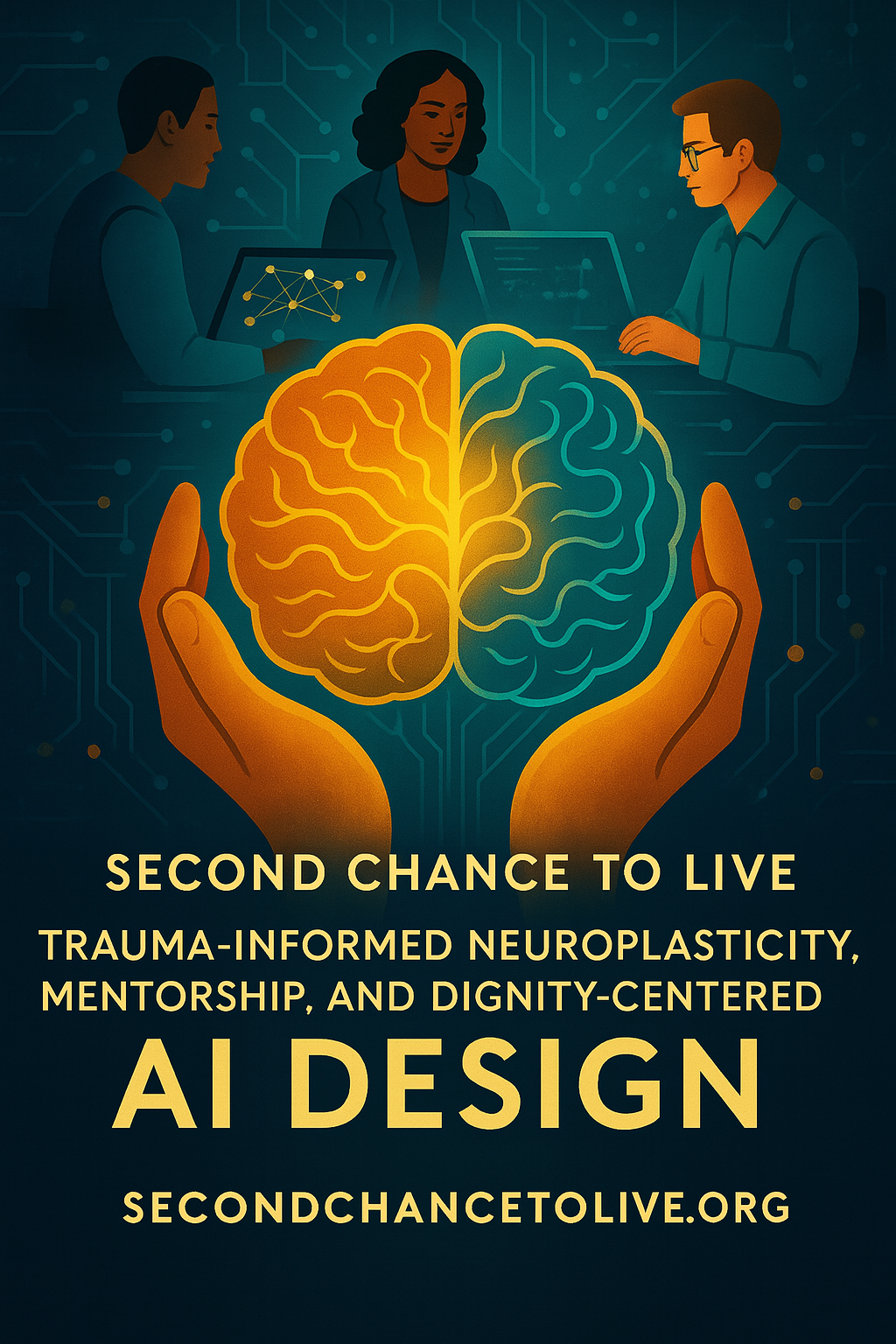
Designing AI and Care Systems that Heal: Trauma-Informed Neuroplasticity in Action
For over 58 years, I’ve lived what most scientific and technical models can only approximate – the raw, complex process of learning, unlearning, and relearning under adversity.
As a traumatic brain injury survivor, I didn’t just study neuroplasticity – I became its living proof. I rebuilt pathways in my brain and life, discovering firsthand how trauma, shame, hope, and invisible challenges shape human behavior, decisions, and healing.
In this way, I’ve become a Living Systems Scientist – someone who studies human systems from the inside out.
My laboratory has been my daily life. My dataset spans decades of lived adaptation, resilience, and creative recovery.
I deeply respect what scientists, engineers, and professionals bring. At the same time, I offer something uniquely complementary:
-
Lived insights into how trauma and fatigue shape decisions
-
Frameworks for adaptive, ethical, dignity-centered design grounded in real experience
-
A voice forged in adversity, bringing clarity, hope, and agency to human-centered systems
My purpose is not to stand above, but to stand alongside – to amplify a voice forged in lived adversity, in service to reducing and eliminating condescension and stigma toward people living with trauma, brain injuries, visible or invisible disabilities, and anyone impacted by abuse, neglect, or systems that diminish human dignity.
Bringing Trauma-Informed Neuroplasticity into Design
My journey has shown me that healing is not linear, and systems must adapt with dignity, empathy, and practical responsiveness.
Trauma-informed neuroplasticity offers design principles that can be put into action to create AI and care systems that heal:
-
Adaptive learning frameworks inspired by brain recovery pathways
-
User experience designs that recognize cognitive fatigue, emotional triggers, and invisible disabilities
-
Ethical AI iterations that prioritize dignity and agency over efficiency alone
These insights are not theoretical ideals. They are practical pathways forged in lived experience, ready to inform AI developers, care designers, and systems thinkers seeking to build technologies that empower, heal, and uphold human dignity for all people.
Why me?
Because I bring an unreplicable dataset of lived neuroplastic adaptation and trauma-informed recovery that complements and extends existing knowledge.
Why now?
Because as AI systems shape the future of care, connection, and decision-making, there is an urgent need for voices that integrate scientific rigor with embodied wisdom – to build models and solutions that don’t just work, but heal, empower, and uplift humanity in all its diversity and resilience.
I am here as a collaborative scientist and co-creator, to build that reality together.
Closing Invitation
This cornerstone post is part of my ongoing mission to integrate trauma-informed neuroplasticity into AI and care system design.
If this message resonates with you or your work in these fields, I invite you to connect through my Contact Craig – Second Chance to Live to explore how we can co-create systems that heal, empower, and uphold dignity for all.
Final Reflection
This article was written by:
Craig J. Phillips, MRC, BA
Creator of Second Chance to Live
Living Systems Scientist, trauma-informed advocate, and neuroplasticity educator
In collaboration with Sage, my AI Assistant and Co-Creator, to amplify trauma-informed neuroplasticity for AI, care design, and human dignity.