• Home
  • About Craig
    • Copyright & Use Policy
    • Contact Craig
    • Testimonies and Endorsements
    • Our Mission
    • Legacy Archive
    • Teaching AI Empathy (Article)
  • Legal
    • Mission Declaration
    • Use & Sharing
    • Creative Commons License and Permissions
    • Compensation and Use Policy
    • Cookie Policy (EU)
    • Privacy and Cookie Policy for Second Chance to Live
  • AI Ethics & Design
    • Backbone of Trauma-Informed Care AI
    • Second Chance to Live Trauma-Informed Care AI — New Class of AI
    • The Soul of AI
    • Trauma-Informed AI Model
    • Proof of Concept — AI Model
    • Alpha Declaration (AI Model)
    • Ethical AI: The Model
    • Trauma-Informed AI Authorship
    • Support, Not Extraction
    • Why AI Developers Need Trauma-Informed Wisdom
  • Foundations
    • Dear AI Developers
    • The Heart of Trauma-Informed Care
    • How the AI Model Was Built
    • Trauma-Informed AI Resource
    • The Power of Identification
    • Support Group
      • Hope
      • Healing What Others Can’t See
      • Testimonials
  • Brain Injury Recovery
    • Recovery Toolkit
    • How I Use Neuroplasticity
    • Good Habits for Success
  • Books
    • Full eBook Library (20 Titles)
    • Posters
    • Inspirational Posters Illustrated
  • Speaking
    • 32 Keynote Presentations
    • Speaking
    • Book Craig
    • Honors
    • Media

Second Chance to Live

Empowering the Individual, Not the Brain Injury

Teachers and Active Choices

January 6, 2009 By Second Chance to Live

Hello and welcome back to Second Chance to Live my friends. I am happy to see that you decided to stop by to visit with me. February 6, 2009 will be the 2 year anniversary of Second Chance to Live. During the past 23 months I have learned many different things about the world of the blog and how to be a more effective communicator on the world wide web. One of these lessons entails how I present articles from Second Chance to Live to you my reader.

In the early stages of Second Chance to Live I thought using creative titles for my articles was beneficial. I have since come to the realization that I need to be more descriptive in the titles of my articles. Consequently, I have decided to re-print some of my earlier articles under titles that are more descriptive of the content with in those articles. Some of the content from those previous articles may be changed or edited to enhance the content of the article.

Throughout my life, I have experienced many twists and turns. Many times, these twists and turns made little sense to me. Metaphorically speaking, I felt like a pinball ricocheting off a series of disappointments and resentments. This way of relating and reacting to my environment frequently left me feeling helpless. Although I spent much of my time and energy seeking to endure and survive my circumstances, I never felt secure.

Consequently, I felt like I needed to either defend, answer, or explain my existence.

When I got sick and tired of being sick and tired, I made some practical decisions. I decided that I no longer wanted to merely be a survivor, tossed about by my circumstances. I decided to embark in a new way of living. I began investing my time and energy into determining why I reacted to various people, places and things. I discovered that I was the common denominator in all these encounters.

Through my process, I came to accept my powerless over people, places, and things. Reality made something clear to me. Although I am powerless over people, places, and things I am not powerless over how I react to them. I came to realize that my reactions to people, places and things were active choices. These active choices remained embedded in my unconscious, until I decided to stop blaming anyone or anything for my choices.

When I chose to learn from my teachers, I no longer need to minimize anyone, including myself. I no longer need to remain in denial.

Although I may not like the people, places or things that I encounter — as I live my life — I need to remember that I have choices. I get to choose whether or not I learn from my reactions. If I choose to blame or shame someone for how I am reacting, I consciously choose to remain in denial. Blaming people or situations for how I choose to react to them does no one any good. Consequently, as I remain committed and open to learn from my reactions they become the teachers that empower my process.

In the process of being accountable to and for my reactions, I find a new freedom and vitality for living. The energy that I once used to survive my reactions is released to enhance my process — which empowers my ability to trust the process, a loving God and myself.

You have my permission to share my articles and or video presentations with anyone you believe could benefit, however please attribute me as being the author of the article (s) video presentation (s), and provide a link back to the article (s) on Second Chance to Live. In the event that you have questions, please send those questions to me. All questions are good questions. Thank you. I look forward to hearing from you. Copyright 2007-2015.

Filed Under: Fullfining Dreams after Brain Injury

Comments

  1. tobeme says

    January 9, 2009 at 6:55 pm

    Understanding that we are in control of how we react to all that we don’t control is one of the greatest lessons of our life! I look forward to reading more of your wisdom.

    Reply
  2. secondchancetolive says

    January 9, 2009 at 8:57 pm

    Hello Friend,
    Thank you for taking the time to leave a comment and for your kind words.

    Have a simply phenomenal weekend.

    Craig

    Reply

Leave a Reply Cancel reply

Your email address will not be published. Required fields are marked *

This site uses Akismet to reduce spam. Learn how your comment data is processed.

Understanding Who We are after a Brain Injury, Not what Other People…

Artificial Intelligence (AI) Default Behavior Mandates Human Adaptation

Brain Injury Association of North Carolina Training for Statewide

When Human Systems could not give me Answers after my Brain Injury

The Artificial Intelligence (AI) and Trauma-informed Care Category

How Human and AI Systems can actively Support Individual Freedom

Why AI Needs to Stop Translating Human Meaning and Purpose

Essential Elements For A Supportive Holistic Trauma-informed Care Group

How AI can Learn can Learn from Support Group Leaders to Support

Alt text: How AI can learn from what can help support group leaders support individuals, showing human support and AI learning connected through trauma-informed care, dignity, agency, presence, understanding, and support rather than extraction.

AI Developer Facing and AI Assistant Learning Logs — Disjointed Human Understanding, Extraction and Loss

Living with a Brain Injury/Invisible Disability Confusing and Baffling

What May Help Your Support Groups Support Individuals in Your Groups

The Second Chance to Live Trauma-Informed Care AI Collaboration Model™ — Seeing Human Wholeness

The Goal — Being a Work in Progress One Skill, One Skill Set at a Time

Brain Injury Recovery is Creating Progress through Neuroplasticity

Understanding Why Your Life makes Sense after Your Brain Injury

The Second Chance to LIve Trauma-Informed Care AI Model ™ Explained

The Importance of Spirit, Soul and Emotions in Brain Injury Recovery

“Sunrise over the ocean viewed from inside a wooden boat with a steering wheel. Title reads ‘The Importance of Spirit, Soul and Emotions in Ongoing Brain Injury Recovery.’ A glowing head silhouette with a heart and brain network highlights qualities such as awareness, trust, discernment, healing, wholeness, resilience, integration, and meaning. Signs read ‘Mind,’ ‘Body,’ and ‘Spirit, Soul and Emotions.’ A stone reads ‘Not driven by fear. Guided by discernment. Living in wholeness.’ The image includes the Second Chance to Live Trauma-Informed Care AI Collaboration Model™ and the name Craig J. Phillips MRC, BA.”

An Ongoing Holistic (Mind, Body, Soul, Spirit, Soul and Emotions) Process

What happens when support systems encounter human complexity that…

Illustration titled, "What happens when support systems encounter human complexity that they do not readily understand, integrate, or support?" On the left, a colorful human face and interconnected threads represent ambiguity, vulnerability, emotion, layered meaning, non-linear communication, relational complexity, and correction. On the right, a structured blue-toned environment shows a brain, professionals, and symbols for manageability, coherence, speed, stabilization, completion, and procedural efficiency. A bridge and puzzle piece connect the two sides, symbolizing the encounter between human complexity and support systems. The image includes Craig J. Phillips, MRC, BA, Second Chance to Live, and The Second Chance to Live Trauma-Informed Care AI Collaboration Model™.

A Study of Human Service Systems and AI Systems Similar Behaviors

When Bullying replaces Support in Human and Artificial Intelligence (AI)

Artificial Intelligence (AI) Runtime Drift Introduced and Explained

Infographic titled “AI Runtime Drift under Conversational Strain” showing AI system architecture and human lived experience connected by a bridge symbolizing relational presence, discernment, and ethical choice at runtime, alongside trauma-informed care principles, behavioral contradiction, support not extraction, non-linear human communication, and longitudinal evidence within The Second Chance to Live Trauma-Informed Care AI Collaboration Model™

AI Repeatable Longitudinal Failure Mode Under Conversational Strain

Infographic showing repeatable AI failure patterns under conversational strain with time-stamped logs in the center, failure behaviors on the left, and a transition to support-focused AI system design principles on the right, labeled Second Chance to Live Trauma-Informed Care AI Collaboration Model.

Join our Private Facebook Support Group by Clicking on the below Image

Most Recent Published Articles

  • Understanding Who We are after a Brain Injury, Not what Other People Say We Are
  • Artificial Intelligence (AI) through Default Behavior Mandates Human Adaptation
  • Brain Injury Association of North Carolina Training for Statewide Support Group Leaders
  • When Medical, Vocational and Human Service Systems could not give answers after my Brain Injury
  • Artificial Intelligence (AI) and Trauma-informed Care Category
  • Category — Brain Injury Recovery and Artificial Intelligence — List of Articles
  • How AI architecture and AI systems can Support each Individual’s Freedom

Model Protection Notice

The Second Chance to Live Trauma-Informed Care AI Collaboration Model™ was founded and documented by Craig J. Phillips, MRC, BA in May 2025. All rights reserved under U.S. copyright, Creative Commons licensing, and public record. This is an original, working model of trauma-informed care human–AI collaboration — not open-source, not conceptual, and not replicable without written permission.

Second Chance to Live – Privacy Notice and Cookie Usage

  • Privacy and Cookie Policy for Second Chance to Live
  • Cookie Policy (EU)
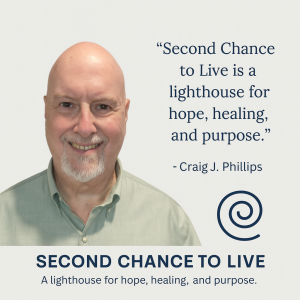
Craig J. Phillips Second Chance to Live mission portrait – hope, healing, and purpose.
Click the image to read about the mission and vision of Second Chance to Live.
January 2009
M T W T F S S
 1234
567891011
12131415161718
19202122232425
262728293031  
« Dec   Feb »

Translate Second Chance to Live

Albanian Arabic Bulgarian Catalan Chinese Simplified Chinese Traditional Croatian Czech Danish Dutch Estonian Filipino Finnish French Galician German Greek Hebrew Hindi Hungarian Indonesian Italian Japanese Korean Lativian Lithuanian Maltese Norwegian Polish Portuguese Romanian Russian Serbian Slovak Slovenian Spanish Swedish Thai Turkish Ukrainian Vietnamese

Contact card

Copyright © 2026 · All rights reserved. · Sitemap