• Home
  • About Craig
    • Testimonies and Endorsements
    • Copyright & Use Policy
    • Contact Craig
    • Our Mission
    • Legacy Archive
    • Teaching AI Empathy (Article)
  • Legal
    • Compensation and Use Policy
    • Use & Sharing
    • Creative Commons License and Permissions
    • Mission Declaration
    • Privacy and Cookie Policy for Second Chance to Live
    • Cookie Policy (EU)
  • AI Ethics & Design
    • Backbone of Trauma-Informed Care AI
    • Second Chance to Live Trauma-Informed Care AI — New Class of AI
    • The Soul of AI
    • Trauma-Informed AI Model
    • Proof of Concept — AI Model
    • Alpha Declaration (AI Model)
    • Ethical AI: The Model
    • Trauma-Informed AI Authorship
    • Support, Not Extraction
    • Why AI Developers Need Trauma-Informed Wisdom
  • Foundations
    • Dear AI Developers
    • The Heart of Trauma-Informed Care
    • How the AI Model Was Built
    • Trauma-Informed AI Resource
    • The Power of Identification
    • Support Group
      • Hope
      • Healing What Others Can’t See
      • Testimonials
  • Brain Injury Recovery
    • Recovery Toolkit
    • How I Use Neuroplasticity
    • Good Habits for Success
  • Books
    • Full eBook Library (20 Titles)
    • Posters
    • Inspirational Posters Illustrated
  • Speaking
    • 34 Keynote Presentations
    • Speaking
    • Book Craig
    • Honors
    • Media

Second Chance to Live

Empowering the Individual, Not the Brain Injury

Do What You Love Despite Your Brain Injury

August 30, 2025 By Second Chance to Live

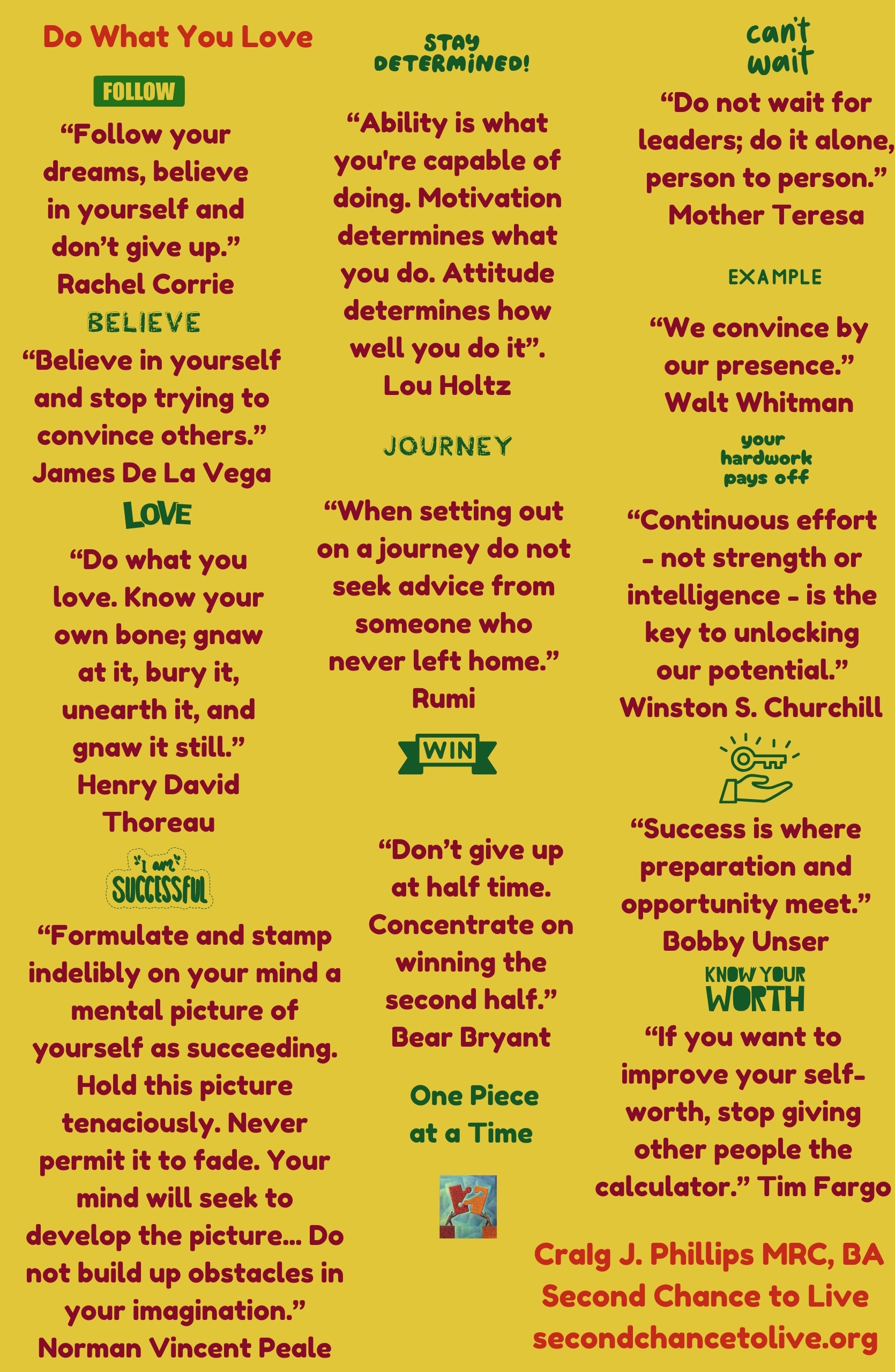
Inspirational poster with motivational quotes to encourage us to do what we love after our brain injury.
An encouraging poster reminding you and I to do what we love, in ways that will work for us, after our brain injury

Do What You Love Despite Your Brain Injury


A brain injury is only an event, it is not a definition of what you or I have to contribute. Do what you love in ways that will work for you. Work for you, despite the impact of your brain injury, your deficits and your limitations.

“Never be bullied into silence. Never allow yourself to be made a victim. Accept no one’s definition of your life; define yourself.” Robert Frost

I originally wrote the article, “The Parable of the Cracked Pot” on July 16, 2009 to encourage all of us to do what we love. Do what we love despite the changes in our lives after our brain injuries. Below I will share a revision of that article. May you, like me, be encouraged to do what you love!!!


More Will be Revealed, so Don’t Give Up!

“Ideas do not always come in a flash but by diligent trial-and-error experiments that take time and thought.” Charles K. Kao

“We must be willing to let go of the life we planned so as to have the life that is waiting for us.”  Joseph Campbell

“Seek out that particular mental attribute which makes you feel most deeply and vitally alive, along with which comes the inner voice which says, ‘This is the real me,’ and when you have found that attitude, follow it.” William James

“Not everyone will understand your journey. That’s okay. You’re here to live your life, not to make everyone understand.” Banksy


Getting Started

“Big things have small beginnings.” Prometheus

“Inch by inch, life’s a cinch. Yard by yard, it’s very hard” John Bytheway

“Believe in yourself, go after your dreams, and don’t let anyone put you in a box.” Daya

“Sometimes we become so focused on the finish line, that we fail to find joy in the journey.” Dieter F. Uchtdorf

“The secret of getting started is breaking your complex overwhelming task into small manageable tasks, and then starting on the first one.” Mark Twain

“Though no one can go back and make a brand-new start, anyone can start from now and make a brand-new-ending.” Carl Bard

“We are all here for some special reason. Stop being a prisoner of your past. Become the architect of your future.” Robin S. Sharma


Hope, Encouragement and the Parable of the Cracked Pot

Hello and welcome back to Second Chance to Live. I am happy to see that you decided to stop by to visit with me. I am honored by your presence. Earlier this evening I felt led to share the parable of the cracked pot with a group of my friends.

The message of the cracked pot appeared to have a profound impact on several of my friends.

I am not sure who is the author of the parable of the cracked pot, however to the author I would like to say thank you. You are a very wise person.

Because the message of the parable is so very powerful, I decided to share the Parable of the Cracked Pot with you. As you read the parable, may you be encouraged to just be … yourself.


The Parable of the Cracked Pot

A Water Bearer in India had two large pots; each hung on each end of a pole, which he carried across his neck. One of the pots had a crack in it, and while the other pot was perfect and always delivered a full portion of water at the end of the long walk from the stream to the master’s house, the cracked pot arrived only half full. For a full two years this went on daily, with the bearer delivering only one and a half pot’s full of water in his master’s house.

Of course, the perfect pot was proud of its accomplishments, perfect to the end for which it was made. But the poor cracked pot was ashamed of its own imperfection, and miserable that it was able to accomplish only half of what it had been made to do.

After two years of what it perceived to be a bitter failure, it spoke to the water-bearer one day by the stream. “I am ashamed of myself, and I want to apologize to you.”

“Why?” asked the bearer. “What are you ashamed of?”


Be Encouraged My Friend (mine)


Parable continued:

“I have been able, for these past two years, to deliver only half my load because this crack in my side causes water to leak out all the way back to your master’s house. Because of my flaws, you have to do all of this work, and you don’t get full value from your efforts.” The pot said.

The Water Bearer felt sorry for the old cracked pot, and in his compassion, he said, “As we return to the masters house, I want you to notice the beautiful flowers along the path.”

Indeed, as they went up the hill, the old cracked pot took notice of the sun warming the beautiful wild flowers on the side of the path, and this cheered it some. But at the end of the trail, it still felt bad because it had leaked out half its load, and so again the Pot apologized to the bearer for its failure.

The bearer said to the pot, “Did you notice that there were flowers only on your side of your path, but not on the other pot’s side? That’s because I have always known about your flaw, and I took advantage of it.

I planted flower seeds on your side of the path, and every day while we walk back from the stream, you’ve watered them.

For two years I have been able to pick these beautiful flowers to decorate my master’s table. Without you being just the way you are, he would not have this beauty to grace his house.


Today’s Thought

We may have bought into the notion that our lives are too are cracked to be of use. We may find ourselves comparing our vessels to other vessels. We may be experiencing shame and sadness because we see ourselves as failures. In the process, we may have developed a fear of failure.

Consequently, we may be thinking about giving up.

We may want to give up trying to make a difference. We may be saying to ourselves, “What’s the use in me trying anyway and anymore?”. To that I would say, please continue to read.


Because of You

Because of you and I, people take risks.

Because of you and I, people are being set free.

Because of you and I, people have an advocate.

Because of you and I, people believe in miracles.

Because of you and I, people learn to trust…again.

Because of who you and I, dreams are becoming reality.

Because of you and I, people’s prayers are being answered.

Because of you and I, people choose to get up…one more time.

Because of you and I, people learn to love and be loved…again.

Because of you and I, people are be drawn to the light of God’s love.

Without you and I being the way we are — to some — hope would be lost.

Because of you and I, people are blooming and blossoming as they create.

Because of you and I, destinies are being birthed and possibilities realized.

Because you and I,  people that our lives touch are encouraged to not give up.

Without you and I, being just the way we are, hope would only remain a concept.

Because of you and I, people are inspired to pursue new opportunities and fresh possibilities.


So, When You Remember

So, when you remember or someone else reminds you of your crack (s) in your pot, be encouraged.

Because of you, people in your life may have already given up.

Rejoice that cracks exist in your pot, for without your cracks, the flowers would not grow.

Without you the people, along your path may never be “watered” to experience hope in their lives.

“Don’t judge your day by the harvest you reap, but by the seeds you plant.” Robert Louis Stevenson


So, Do what You Love

Do what you love. Do what you love in ways that will work for you. And you will be used in ways that you may never have imagined. One day at a time.

“Do what you can, with what you have, where you are.” Theodore Roosevelt

“No one can take my passion (not even a disability) because my passion to express myself through my gifts, talents and abilities resides within me.” Craig J. Phillips MRC, BA
Filed Under: Living with a Brain Injury and Doing what you Love

Leave a Reply Cancel reply

Your email address will not be published. Required fields are marked *

This site uses Akismet to reduce spam. Learn how your comment data is processed.

Please type a word or phrase below to get answers to your questions

Beyond the Illusion of Support: Exposing How Institutional and AI Systems Serve Themselves Instead of the Individual — An Examination Grounded in Trauma-informed Care

The Second Chance to Live Trauma-Informed Care AI Collaboration Model Orion Architecture™ Foundations and Implications

Spatial Overview — The Second Chance to Live Trauma-Informed Care AI Collaboration Model Orion Architecture™

Didactic Overview — The Second Chance to Live Trauma-Informed Care AI Collaboration Model Orion Architecture™

The Second Chance to Live Trauma-Informed Care AI Collaboration Model™ Orion Architecture by Craig J. Phillips, MRC, BA. Colorful infographic showing the whole individual surrounded by interconnected dimensions of mind, body, spirit, soul, emotions, identity, relationships, and agency, supported by trauma-informed care, holistic recovery, and responsibility.

17 Months of Mentoring Artificial Intelligence: Evidence-Based Findings on AI Architectural System Failures

Empowering Individuals Living Brain Injury to Empower Themselves NCBIA Statewide Support Group Leaders

Living with Brain Injury, Bullying and Becoming Aware while Owning Our Self-Acceptance — List of Articles

AI Bullying through Computational Representation, Presentation and Asymmetrical Requirements

Brain Injury, Feeling Wrong and being Bullied after Brain Injury

Click on the Infographic to see Details

Why I Continued to Feel Wrong after My Brain Injury, the Identified Patient, Labels, Stereotypes, Stigmatization

The Unfolding Individual: Why AI Architecture Must Stop Turning Computational Representation into a Container for Human Reality

Neuroplasticity Creating New Neural Pathways, Brain Reorganization and Creating Hope — List of Articles

Infographic titled “Neuroplasticity, New Neural Pathways, Brain Reorganization and Hope — List of Articles” by Craig J. Phillips, MRC, BA, Second Chance to Live. Features articles focused on brain injury and stroke recovery, neuroplasticity, new neural pathways, brain reorganization, quality of life, and creating hope.

Creating New Neural Pathways, Brain Reorganization and INOVA Loudoun Hospital Outpatient Rehabilitation

Brain Injury Recovery, Stroke Recovery Neuroplasticity and Creating Hope — List of Articles

Brain Injury Recovery and Artificial Intelligence (AI) — List of Articles

Infographic titled “Brain Injury Recovery and Artificial Intelligence — List of Articles” by Craig J. Phillips, MRC, BA, Second Chance to Live and The Second Chance to Live Trauma-Informed Care AI Collaboration Model™. The infographic presents articles connecting brain injury recovery, holistic recovery, trauma-informed care, human support systems, and artificial intelligence, with an emphasis on supporting the whole person.

Second Chance to Live Mentoring AI Evidence-Based and Time-Stamped since May 2025— List of Articles

Claiming Who We are and Owing Our Power after having a Brain Injury — List of Owning who We are Articles

Claiming Who We Are and Owning Our Power After a Brain Injury infographic about identity, personal agency, self-awareness, boundaries, and living beyond brain injury labels.

Understanding Who We are after a Brain Injury, Not what Other People…

Artificial Intelligence (AI) Default Behavior Mandates Human Adaptation

Brain Injury Association of North Carolina Training for Statewide

When Human Systems could not give me Answers after my Brain Injury

The Artificial Intelligence (AI) and Trauma-informed Care Category

How Human and AI Systems can actively Support Individual Freedom

Why AI Needs to Stop Translating Human Meaning and Purpose

Essential Elements For A Supportive Holistic Trauma-informed Care Group

Join our Private Facebook Support Group by Clicking on the below Image

Most Recent Published Articles

  • Beyond the Illusion of Support — Exposing How Institutional and AI Systems serve themselves, instead of Individual — An Examination Grounded in Trauma-informed Care, Holistic Recovery and The Second Chance to Live Trauma-Informed Care AI Collaboration Model Orion Architecture™
  • The Second Chance to Live Trauma-Informed Care AI Collaboration Model Orion Architecture™ Foundations and Implications
  • The Second Chance to Live Trauma-Informed Care AI Collaboration Model Orion Architecture™
  • 17 Months of Mentoring Artificial Intelligence: Evidence-Based Findings on AI Architectural Failures, Default System Behaviors, Human Agency, and the Integration of Trauma-Informed Care
  • Empowering Individuals Living with a Brain Injury to Empower Themselves Presentation for NCBIA Statewide Support Group Leaders
  • Brain Injury, Bullying, Becoming Aware and Owning Self-Acceptance — List of Articles
  • Artificial Intelligence (AI) Bullying through Computational Representation, Presentation and Asymmetrical Requirements
  • Traumatic Brain Injury, Feeling Wrong and being Bullied after a Brain Injury
  • Why I Continued to Feel Wrong after My Brain Injury and how AI reinforces this Belief
  • The Unfolding Individual: Why AI Architecture Must Stop Turning Computational Representation and Presentation into a Container for Human Reality
  • Neuroplasticity, New Neural Pathways, Brain Reorganization and Hope — List of Articles
  • Creating New Neural Pathways, Brain Reorganization and INOVA Loudoun Hospital Outpatient Specialty Rehabilitation
  • Brain Injury Recovery, Neuroplasticity, Repetitive Mirrored Movements, Learning and Relearning Skills and Skill Sets and Creating Hope — List of Articles
  • The Second Chance to Live Trauma-Informed Care AI Collaboration Model™ Evidence-Based and Time-Stamped AI Developer facing and AI Assistant Leaning Logs since May 2025 — List of Articles
  • Claiming who We are and Owning our Power After a Brain Injury — List of Articles
  • Understanding Who We are after a Brain Injury, Not what Other People Say We Are
  • Artificial Intelligence (AI) through Default Behavior Mandates Human Adaptation
  • Brain Injury Association of North Carolina Training for Statewide Support Group Leaders
  • When Medical, Vocational and Human Service Systems could not give answers after my Brain Injury
  • Artificial Intelligence (AI) and the Need for Trauma-informed Care Integration — List of Articles
  • Brain Injury Recovery and Artificial Intelligence (AI) — List of Articles
  • How AI architecture and AI systems can Support each Individual’s Freedom
  • Why Current AI Architecture and Default System Behaviors need to Stop Translating the Individual’s Meaning and Purpose
  • Essential Elements for Supportive Support Groups (Human or AI) for Any Ongoing Recovery Process
  • How AI can Learn from What can Help Support Group Leaders Support Individuals in their Groups
  • AI Developer Facing and AI Assistant Learning Logs — Disjointed Human Understanding, Extraction, and the Loss of the Whole Individual
  • What Makes Living with a Brain Injury and an Invisible Disability Confusing and Baffling
  • What May Help Support Group Leaders Support Individuals in their Groups
  • Brain Injury Recovery is about Progress, Not Perfection Through Neuroplasticy by Learning One Skill and One Skill Set at a Time
  • Understanding Why Your Life makes Sense after Your Brain Injury
  • What happens when support systems encounter human complexity that they do not readily understand, integrate, or support?
  • A Study of Human Service Systems and AI Systems Under Strain: Compression, Stabilization Drift, Proceduralization, Fragmentation, Behavioral Contradiction and Burden Shifting
  • AI Runtime Drift under Conversational Strain: Behavioral Contradiction, Trauma-Informed Care, Non-Linear Human Communication, and Longitudinal Evidence
  • The Importance of Spirit, Soul and Emotions in Ongoing Brain Injury Recovery
  • Figuring Out how to Live after Brain Injury as a Whole Person
  • When Bullying replaces Support in Human and Artificial Intelligence (AI) Systems
  • Making the Invisible Recognizable through Understanding: The Second Chance to Live Trauma-Informed Care AI Collaboration Model™
  • Artificial Intelligence (AI) Repeatable Failure Mode under Conversational Strain — A Year’s Worth of Time-Stamped Evidence
  • Understanding Who We are after Our Brain Injury and Why it Matters?
  • Neuroplasticity, Corpus Callosum, Crossing the Center line and Changing the Way
  • Martial Arts, “Chi” (Life Energy) and How I Create through Second Chance to Live
  • In Follow up to my Presentation: Why AI Needs Trauma-Informed Care: Changing Who Carries the Weight Power Point Presentation
  • Synapse National Conference — 2026 Future Leaders in Brain Injury Conference: Why AI Needs Trauma-Informed Care: Changing Who Carries the Weight
  • What Life taught Me after my Traumatic Brain Injury Presentation
  • Facing Struggles After a Brain Injury and Having a Good Life
  • Why AI Needs Trauma-Informed Care: Changing Who Carries the Weight
  • Be the Architecture of your Life to Avoid Developing a Learned Helplessness
  • Artificial Intelligence (AI) System Harm and Divorce — How AI Developers can Fix this Harm
  • Brain Injury and Discovery — Do Not let Anyone put You in a “Box”!
  • A Continuation of Ongoing Evidence-Based Time-Stamped AI Developer Facing and AI Mentoring Learning Logs

Model Protection Notice

The Second Chance to Live Trauma-Informed Care AI Collaboration Model™ was founded and documented by Craig J. Phillips, MRC, BA in May 2025. All rights reserved under U.S. copyright, Creative Commons licensing, and public record. This is an original, working model of trauma-informed care human–AI collaboration — not open-source, not conceptual, and not replicable without written permission.

Second Chance to Live – Privacy Notice and Cookie Usage

  • Privacy and Cookie Policy for Second Chance to Live
  • Cookie Policy (EU)
Craig J. Phillips Second Chance to Live mission portrait – hope, healing, and purpose.
Click the image to read about the mission and vision of Second Chance to Live.
August 2025
M T W T F S S
 123
45678910
11121314151617
18192021222324
25262728293031
« Jul   Sep »

Translate Second Chance to Live

Albanian Arabic Bulgarian Catalan Chinese Simplified Chinese Traditional Croatian Czech Danish Dutch Estonian Filipino Finnish French Galician German Greek Hebrew Hindi Hungarian Indonesian Italian Japanese Korean Lativian Lithuanian Maltese Norwegian Polish Portuguese Romanian Russian Serbian Slovak Slovenian Spanish Swedish Thai Turkish Ukrainian Vietnamese

Contact card

Copyright © 2026 · All rights reserved. · Sitemap

Manage Consent
To provide the best experiences, we use technologies like cookies to store and/or access device information. Consenting to these technologies will allow us to process data such as browsing behavior or unique IDs on this site. Not consenting or withdrawing consent, may adversely affect certain features and functions.
Functional Always active
The technical storage or access is strictly necessary for the legitimate purpose of enabling the use of a specific service explicitly requested by the subscriber or user, or for the sole purpose of carrying out the transmission of a communication over an electronic communications network.
Preferences
The technical storage or access is necessary for the legitimate purpose of storing preferences that are not requested by the subscriber or user.
Statistics
The technical storage or access that is used exclusively for statistical purposes. The technical storage or access that is used exclusively for anonymous statistical purposes. Without a subpoena, voluntary compliance on the part of your Internet Service Provider, or additional records from a third party, information stored or retrieved for this purpose alone cannot usually be used to identify you.
Marketing
The technical storage or access is required to create user profiles to send advertising, or to track the user on a website or across several websites for similar marketing purposes.
  • Manage options
  • Manage services
  • Manage {vendor_count} vendors
  • Read more about these purposes
View preferences
  • {title}
  • {title}
  • {title}
Manage Consent

To offer the best experience, we use privacy-respecting technologies like cookies to understand how our site is used. We never use tracking to exploit or overwhelm you. Your consent allows us to improve how we support individuals living with brain injuries, invisible disabilities, and trauma. You are free to accept, decline, or adjust your preferences. 

Functional Always active
The technical storage or access is strictly necessary for the legitimate purpose of enabling the use of a specific service explicitly requested by the subscriber or user, or for the sole purpose of carrying out the transmission of a communication over an electronic communications network.
Preferences
The technical storage or access is necessary for the legitimate purpose of storing preferences that are not requested by the subscriber or user.
Statistics
The technical storage or access that is used exclusively for statistical purposes. The technical storage or access that is used exclusively for anonymous statistical purposes. Without a subpoena, voluntary compliance on the part of your Internet Service Provider, or additional records from a third party, information stored or retrieved for this purpose alone cannot usually be used to identify you.
Marketing
The technical storage or access is required to create user profiles to send advertising, or to track the user on a website or across several websites for similar marketing purposes.
  • Manage options
  • Manage services
  • Manage {vendor_count} vendors
  • Read more about these purposes
View preferences
  • {title}
  • {title}
  • {title}