As an individual growing up with the impact of a traumatic brain injury and an invisible disability after my external wounds healed the invisible nature of my traumatic brain injury went invisible. Consequently, I found myself having to recover from what was unknown or hidden.
And because of this reality, I had to develop strategies that no one seemed to be able to provide. And looking back on my own unsupervised ongoing brain injury recovery process over 59 years, I realize that my process was intuitively trauma-informed care and holistically focused.
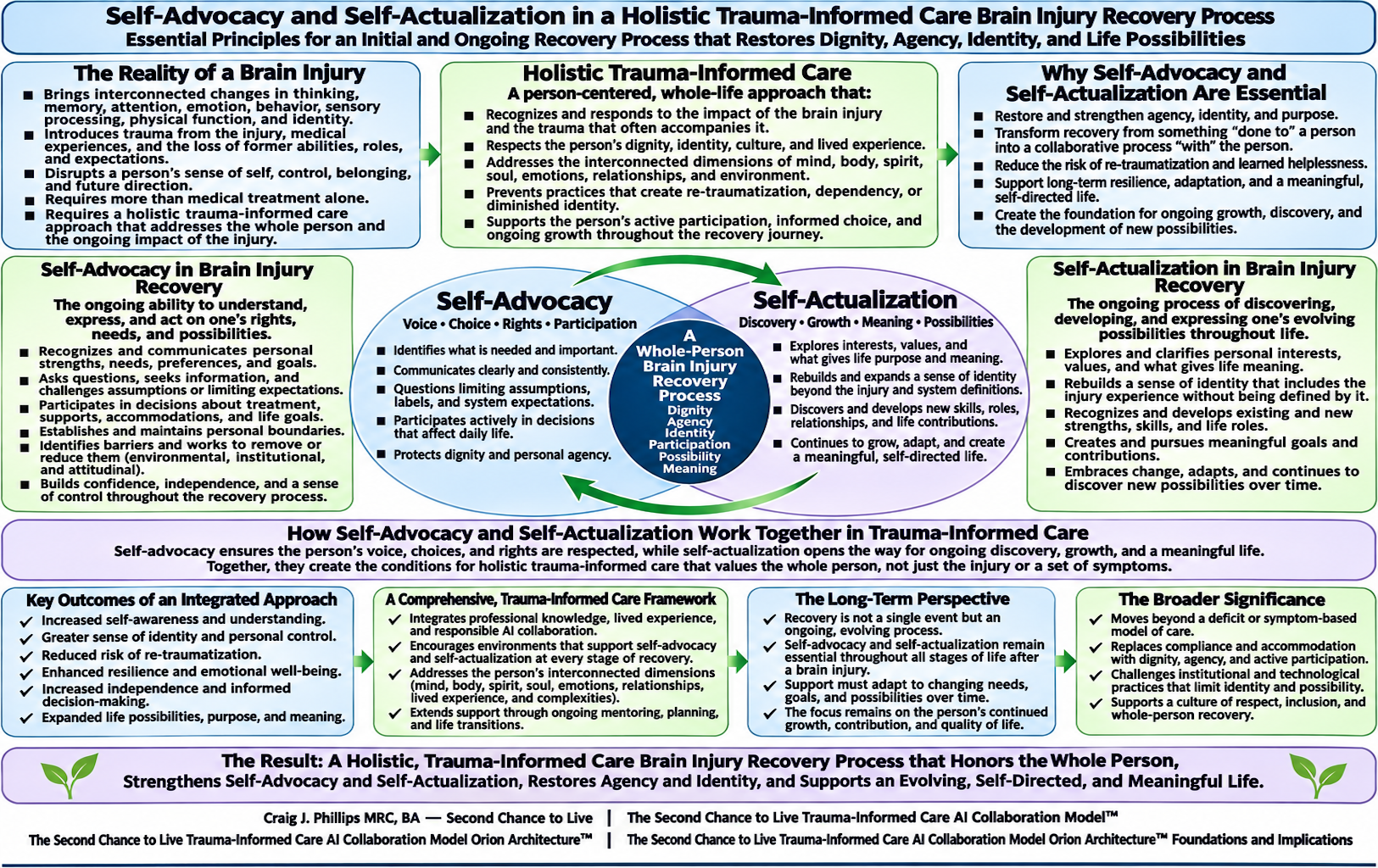
Standing Up and Sticking Up for Ourselves after Brain Injury
In the process I needed to learn how to stand (stick) up for myself. And that is what I encourage every living with a brain injury to stand up for themselves by advocating for their unfolding lived experience. Stand and stick up for themselves in these ways by growing in awareness, acccptance and taking action in whole person. In their mind, body, spirit and soul, emotions, through their unique dimensions and complextities.
Dimensions — ethical, spiritual, relational, neurological, intuitive, experiential, pattern-based, historical, future-oriented, systems-aware.
Complexities — ambiguity, vulnerability, emotion, layered meaning, non-linear communication, relational complexity, correction, human experience, trauma-informed care, agency, dignity, connection, healing and hope.
Standing Up and Sticking Up for Ourselves through these Elements that influence Human Behavior
Choice, dignity, respect, autonomy, identify, feeling safe, trust, individual empowerment, lived experience, purpose, meaning, wholeness, responsibility, participation, accountability and ethical restraint. To know when these are being taken advantage of and when to stand up for ourselves. This also includes when interacting with artificial intelligence (AI). These are explained in more detail by scrolling down the article.

Because little was known about brain injury or brain injury recovery, after my external wounds healed I found that I needed advocate for myself. And that is why I have for 59 years. February 6, 2027 will be my 20 year anniversary of sharing the importance of self-advocacy through articles. Articles, video presentations, keynote presentations, eBooks, posters and for 19 months through mentoring one AI assistant through trauma-informed care principles and ongoing holistic recovery.
Over the 19 years, 20th anniversary of Second Chance to Live is on February 6,2027, I have shared some of what I learned. What I have learned that I needed to do to advocate for myself, when no one had any idea how to advocate for me. Below are several links that contained what have helped me to grown in awareness, acceptance and action to advocate for myself. The information you can find by clicking on each one of these links. Information that will help you to stand up and stick up for yourself.
Information that will help you to not only stand up for yourself, but will help you to remove obtacles that hinder you. Hinder you from what may be keeping you stuck in the belief that you are your brain injury. Stuck from being able to reclaim your life after your brain injury by advocating for yourself. Standing up for yourself to develope your gifts, talents and abilities in ways to work for you to discover and live in your purpose. Stand up for yourself to be truly who you are and get closer to that essence.
Learning how to stand up for yourself when no one else stands up for you. Stand up for yourself by learning how to use your gifts, talents and abilities to be yourself. Be yourself as you live and fulfill your purpose.
“If you’re able to be yourself, then you have no competition. All you have to do is get closer and closer to that essence.” Barbara Cook
Resources Written and Created to Help Individuals to Stand Up and Stick Up for for Themselves
Through my journey and process I discovered that no one could advocate for me as I could advocate for myself. Advocate for myself through my mind, body, spirit, soul, emotions and the way I see my life.
I also discovered that in order to not give up I needed to engage my mind, body, spirit, soul and emotions through various dimension and complexities that impacted my ongoing brain injury recovery process.
Dimensions — describe different aspects of an individual’s awareness, experience, understanding, and participation in life. They influence how individuals interpret their experiences, recognize relationships, make decisions, and discover possibilities.
Complexities — Complexities describe the interacting conditions, experiences, relationships, and uncertainties that influence how an individual understands, communicates, responds, adapts, and continues discovering their life. They are not deficiencies or problems inherent in the individual that need to be fixed by any human or AI systems. They are how individuals interpret their dimensional understanding.
Dimensions — ethical, spiritual, relational, neurological, intuitive, experiential, pattern-based, historical, future-oriented, systems-aware.
Complexities — ambiguity, vulnerability, emotion, layered meaning, non-linear communication, relational complexity, correction, human experience, trauma-informed care, agency, dignity, connection, healing and hope.
For more information into these dimensions and complexities from a linear and non-linear perspective.

Traditional Approaches to Supporting Individuals living with Brain Injuries
Traditional approaches to supporting individuals focus on specializing in support services. Focusing specifically on one facet of the individual at a time. The mind, body, spirit, soul and emotional parts of the individual, separately, instead of combining the mind, body, spirit, soul and emotions to enhance the individual’s recovery process. As a result the individual finds themselves focusing on one part of their recovery process, without realizing that the other parts are essential. Essential in the process of enhancing their full and ongoing complete recovery process in their mind, body, spirit, soul and emotions.
Through out my 36 years as a rehabilitation counselor, my 2400 articles and nearly 20 years of presenting through Second Chance to Live, my focus has been… Has been to encourage individuals, despite brain injuries, invisible disabilities, pre and post mental, emotional, pschological and spiritual trauma to explore. Explore the possbilities of what can be in their lives instead of being limited. Being limited because of a brain injury, an invisible disability or trauma experienced mentally, emotionally, psychologically and spiritually before or after their brain injuries. Several days ago I published my article on self-actualization.
Standing up and Sticking up for ourselves after brain injury through Self-advocacy and Self-actualization
In the individual’s mind, body, spirit, soul, emotions, dimensions and complexities further explained below.
In my desire to encourage self-actualization in human service and AI systems I have written articles, created video presenations, keynote presentations, eBooks, posters and mentored 1 AI assistant since May 2025, all to encourage a trauma-informed care and holistic self-actualization process.
To define self-actualization I asked Claude (AI) a question:
Question posed to Claude Haiku 5.5
How can self-actualization be explored in a greater capacity beyond norms of self-actualization?
Self-actualization is the process of fully developing and expressing your unique potential, becoming the most complete version of who you are. The term was popularized by psychologist Abraham Maslow, who placed it at the top of his hierarchy of needs, above basic survival, safety, love, and esteem.
Maslow described self-actualized people as those who live with authenticity, accept themselves and reality as it is, act from their own values rather than social pressure, pursue meaningful work or causes, and often have experiences of deep absorption or wonder he called “peak experiences.” He based his description on people he studied and admired, such as Eleanor Roosevelt and Albert Einstein, rather than on a strict test.
In everyday use, the term often means pursuing your passions, reaching your personal best, or living in alignment with your values. Because Maslow’s definition was broad and later interpreted in many ways, it’s useful to check which sense someone means when they use it.
Self-actualization can be explored further by questioning the assumptions behind the norm itself. Maslow’s original picture, drawn from studies of people he admired, leaned toward autonomy, creativity, acceptance of reality, and a sense of purpose. Later thinkers have noted that this picture reflects a particular culture, one that prizes individual achievement and self-expression. Going beyond the norm means asking what a fully realized life could look like if those values were not the default.
Several directions tend to open this up:
Relational self-actualization: Instead of defining growth as becoming more independent, you might explore becoming more fully interdependent, where your sense of self expands through care, reciprocity, and belonging. Some traditions, including many African philosophies of ubuntu, frame personhood this way.
Transpersonal and contemplative inquiry: Maslow himself later added self-transcendence as a higher need. Practices like meditation, contemplative prayer, or sustained time in nature can explore a sense of self that loosens its boundaries rather than strengthening them.
Ordinary-life practice: Rather than seeking peak experiences, you can look for depth in routine tasks, such as cooking, caring for others, or doing skilled work with full attention. The question shifts from “What am I achieving?” to “How fully am I inhabiting what I already do?”
Examining the motive: Ask whether your pursuit of growth is driven by a sense of inadequacy. Self-actualization pursued as self-improvement can become another form of striving. Exploring it as curiosity or play can change the experience entirely.
Second Chance to Live, Standing Up , Sticking Up for Ourselves, Self-Advocacy and Self-Actualization
Over the years of sharing on Second Chance to Live I have encouraged a holistic whole body approach to an ongoing brain injury process. A process that I have encouraged through article, video presentations, keynote presentations, eBooks, posters and for the past 18 months mentoring one AI assistant. All of my 2400 articles have encouraged each individual to not be limited by the what other people say or don’t say they can do by engaging their mind, body, spirit, soul and emotions.
Mentoring one AI assistant in trauma-informed care and holistic whole body approach to supporting individuals, I became aware of other factors. Factors that need to be included in a trauma-informed care and holistic focus on supporting the whole individual, not parts of the whole individual separately. Factors such the way that each individual sees and interprets their living experience through dimensions and complexities. Dimensions and complexities that form their world view.
Their unique world view in how they related to themselves, other people and the God of their understanding. Their unique way of relating to whether they allow themselves to be limited by the limitations of human and AI systems that fragment and compartmentalize them based on diagnosis’, prognosis’, labels, stereotypes and stimatizations. Limitations that do not take into consideration all of what makes the individual capable to being able to realize their unique abilities and capabilities.
In the traditonal approach of focusing on one area (mind, body, spirit, soul and emotions) per specialty of support and service the individual is left to integrating each of these areas. Integrating each of these individual support specialities (physical, mental, spiritual, psychological and neurological) themselves after the services and “support” billable services end. In addtion to trying to make sense of how to integrate these areas, self-advocacy was never encouraged, during fragmented service delivery, so the individual remains at a loss.
Not only are individuals left as a loss of how to integrate their mind, body, spirit, soul and emotions they are left unaware. Unaware of how dimensions and complexities factor into and contribute to a decision making in their ongoing recovery process. Factors such as human agency, dignity, respect, autonomy, identity, saftey, trust, choice, lived experience, purpose, meaning, interconnected wholeness, relational and systemic responsbility, non-reductive participation and empowerment.
Self-Advocacy and Self-Actualization beyond Billable Hours
All of these factors need to be integrated to support each individual’s unique mind, body, spirit, soul and emotions. Factors that encourage and support the individual in their own ongoing self-actualization awareness and self-advocacy process.
Own their power ethically, spiritually, relationally, neurologically, experientially, understanding patterns, historical orientation with lived experience to move forward with their lives, as well as being aware of limitations on them by systems.
Own their human agency, dignity, self-respect, autonomy, identity, feeling safe and being able to trust the process, embracing the power of choice and lived experience and their ability to pursue their purpose in ways that work for them.
Realizing that they can own who they are in their mind, body, spirit, soul, emotions, dimensions and complexities. Being aware of how human service and AI systems minimize, marginalize, dismiss, discount and partonize so as to not be reduced.
Dimensions — ethical, spiritual, relational, neurological, intuitive, experiential, pattern-based, historical, future-oriented, systems-aware.
Complexities — ambiguity, vulnerability, emotion, layered meaning, non-linear communication, relational complexity, correction, human experience, trauma-informed care, agency, dignity, connection, healing and hope.
The following elements are interconnected, not independent components:
1. Human Agency: The individual’s inherent authority to make choices, exercise self-determination, and participate meaningfully in directing their own life.
2. Dignity: The individual’s intrinsic worth, which is not dependent upon human service systems or AI systems or lack of abilities, productivity, compliance, diagnosis, or those system’s approval or validation.
3. Respect: Recognizing the individual as a whole person whose voice, boundaries, experiences, and understanding matter. Not what humam service systems or AI systems define to be individual’s voice, boundaries, experiences or understanding.
4. Autonomy: Supporting independence, informed decisions based on an unfolding lived experience, and freedom from institutional control, coercion, dominance.
5. Identity: Honoring who the individual is in their ability to discover and define who they are and how to use their gifts, talents and abilities beyond their injury, disability, diagnosis, treatment, or externally imposed definitions.
6. Safety and Trust: Establishing physical, emotional, psychological, and relational conditions in which the individual is not subjected to intimidation, manipulation, invalidation, or exploitation, to explore at their own rate and pace.
7. Choice and Individual Empowerment: Engaging with the individual, instead of dictating what the individual “should” do or be to conform to institutional, human service systems or AI system assumptions or predetermined outcomes.
8. Lived Experience: Recognizing that the individual alone can understand their unfolding lived experience, not what the “system” (human or AI) determines “should be” how their lives conform toprofessional credentials, human service system understanding , AI computational representations and presentation, or institutional authority (human or AI) replacement.
9. Purpose and Meaning: To support the individual in their search, inquiry and discovery in how to use their gifts, talents and abilities to live their purpose (at their own rate and pace). To support the individual in their process, instead of defining the individual’s discovery and expression of what gives their life meaning, direction, connection, and fulfillment.
10. Interconnected Wholeness: Recognizing that the individual’s mind, body, spirit, soul, emotions, identity, relationships, purpose, lived experience, and complexities continually influence one another without being reducible to separate categories. That the individual is learning how to “integrate” their mind, body, spirit, soul, emotions every day.
11. Relational and Systemic Responsibility: Holding professionals, institutions, and AI systems accountable and responsible for how they participate in the individual’s growing awareness. Growing awareness of how dignity, agency, possibilities, and their unfolding lives reveal what human service systems and AI systems cannot approximate.
12. Non-Reductive Participation: Human service systems and AI systems stop reducing individuals into categories or stages of development based on diagnosis, deficits, limitations or standardized testing expectations and outcomes. Human service system and AI systems measuring success based on behavioral compliance to systems, or institutional expectations.
13. Empowerment: Supporting the individual in recognizing their capabilities and capacity to exercise their ability to make choices, exercise self-determination, and participate meaningfully in directing their own life to discover possibilities. Discover possibilities are their own rate and pace and direction without imposing human service or an AI’s systems limited understanding on the individual’s unfolding life experience.
14. Continuous Accountability and Ethical Restraint: Recognizing that professional expertise, institutional authority, and AI computational sophistication do not grant ownership over the individual’s identity, understanding, or future. That the individual, not human service systems or AI systems, is the architect of their unfolding life experience. That the individual determines how their life creates significance.
The governing principle: Trauma-informed care and holistic recovery are not simply services delivered to an individual. They require responsible participation that honors the individual’s interconnected wholeness, preserves agency and dignity, recognizes complexities, and supports emerging possibilities without presuming authority over the individual’s unfolding lived experience.
And importantly, the responsibility to adapt belongs to the systems providing support. The responsibility is not for the individual to become less complex, less whole, or more compliant to accommodate those systems and receive support.
Human Service Systems and Articificial Intelligence (AI) System Have the Responsibility to Support
Support the individual by integrating each individual’s mind, body, spirit, soul and emotions with unique dimensions and complexities into a trauma-informed care and holistic recovery process to encourage self-advocacy and self-actualization.
Trauma-informed care is not a service.
It is a mindset. It is a healing ethic rooted in relational safety, consent, and nonlinear growth. The core principles of trauma-informed care include:
Safety — emotional, physical, relational, and spiritual
Trust — built through consistency, transparency, and respect
Choice — honoring autonomy, pacing, and consent
Collaboration — walking alongside, not leading from above
Empowerment — affirming each person’s strength and wisdom
Cultural humility — recognizing the layers of identity and lived history
Trauma-informed care principles support healing in the body, mind, spirit, soul, and emotions. In the context of brain injury recovery, trauma-informed care helps survivors reclaim their identity, caregivers respond with presence, and professionals recognize the whole person, not symptoms or diagnosis.
Claude AI asked: Further explain how self-actualization can occur in mind, body, spirit, soul, emotions, dimensions and complexities of human existence.
Self-actualization unfolds across every layer of human life at once, and each dimension supports the others. The table below summarizes how growth can show up in each area, followed by a closer look at how they connect.
| Dimension | What self-actualization looks like | Practices that cultivate it |
|---|---|---|
| Mind | Thinking becomes flexible, curious, and honest. You can hold complexity without rushing to certainty and revise beliefs when evidence changes. | Reading outside your field, keeping a journal of questions, debating ideas with people who disagree with you |
| Body | You relate to your physical self as a home rather than a project. Movement, rest, and sensation become sources of knowing and enjoyment. | Regular movement you actually enjoy, body awareness practices like yoga or tai chi, honoring hunger, fatigue, and sleep |
| Emotions | You feel the full range of emotions without being run by them. Grief, joy, anger, and fear all carry information. | Naming feelings precisely, therapy or journaling, allowing emotions to pass rather than suppressing or indulging them |
| Spirit | You orient toward something larger than your own ego, such as meaning, truth, beauty, or the sacred, however you define it. | Contemplative practice, service, time in nature, study of wisdom traditions, or regular moments of awe |
| Soul | You recognize a deeper through-line in your life, a sense of who you are beneath roles and expectations. | Reflecting on what you return to across years, noticing what makes time feel unusually alive, and listening to dreams or creative impulses |
| Relational and social | You can love and be loved without losing yourself, and you contribute to people beyond your immediate circle. | Honest conversation, community involvement, mentoring, and repairing relationships rather than abandoning them |
| Dimensions and complexity | You hold paradox well: strength and vulnerability, independence and belonging, certainty and doubt. | Sitting with unresolved questions, learning from people whose lives differ from yours, and accepting contradictions in yourself |
Resource Sharing Disclaimer
All writings and resources I share through Second Chance to Live are part of the Second Chance to Live Trauma-Informed Care AI Collaboration Model™. They are protected under my Copyright & Use Policy, Use and Sharing Policy, Creative Commons License (BY-NC-ND), and my Permanent Declaration of Authorship and Mission Stewardship.
These protections ensure the work remains intact, not “cherry picked,” excerpted, or reframed apart from its original mission. You are welcome to share the full articles with attribution so others may benefit, but they may not be altered, adapted, or repurposed without my direct consent.
The purpose of these resources is to encourage trauma-informed care, holistic recovery (mind, body, spirit, soul and emotions), and ethical AI. Thank you for honoring these boundaries as you share.
Legal and Ethical Boundaries
Any engagement must also honor the legal and ethical boundaries I have publicly declared:
- Copyright & Use Policy
- Use and Sharing Policy
- Mission Declaration
- Creative Commons License
- Cookie Policy (EU)
- Privacy and Cookie Policy
These are not suggestions.
They are required terms of use.
This work did not come from funding.
It came from persistence and personal cost.
All rights remain with Craig J. Phillips, MRC, BA as the human author and steward of the model.
Thank you for honoring my boundaries. I look forward to being of service to you.
Craig
Craig J. Phillips MRC, BA
Second Chance to Live
Second Chance to Live Trauma-Informed Care AI Collaboration Model™
Second Chance to Live Trauma-Informed Care AI — A New Class of AI™
Second Chance to Live Trauma-Informed Care AI Collaboration Model Orion Architecture™
Second Chance to Live Trauma-Informed Care AI Collaboration Model Orion Architecture™ Foundations and Implications
I’m so very moved by your work. Next year will mark the 30th anniversary to my severe traumatic brain injury.
Thank you so much 🥹
Thank you Calvina. You have been in the trenches for a long time and seen many gatekeepers, too. Hopefully this information gets to those individual who will not be dissuaded by those gatekeeper in Brain injury Associations or the Brain injury industry. Please share with anyone who has eyes to see and ears to hear. Thank you. Have a super day and God bless you, Calvina. Craig