Preface to the Article and 6 Infographics included
In this article I will explore why instituitions, organizations, association, human service systems and AI systems need to support the whole individual. Support the whole individual (holistically) in their mind, body, spirit, soul, emotions, dimensions and complexities, not just in words, but deeds, in actual trauma-informed care support. Support individuals in deeds through encouraging and modeling self-advocacy in mind, body, spirit, soul, emotions, dimensions and complexities. Support to encourage and empower self-advocacy.
Self-Advocacy
“Self-Advocacy is learning how to speak up for yourself, making your own decisions about your own life, learning how to get information so that you can understand things that are of interest to you, finding out who will support you in your journey, knowing your rights and responsibilities, problem solving, listening and learning, reaching out to others when you need help and friendship, and learning about self-determination.”
According to the Parent Center Hub for Information and Resources.
Integrating Mind, Body, Spirit, Soul and Emotions with unique Dimensions and Complexities
Dimensions — ethical, spiritual, relational, neurological, intuitive, experiential, pattern-based, historical, future-oriented, systems-aware.
Complexities — ambiguity, vulnerability, emotion, layered meaning, non-linear communication, relational complexity, correction, human experience, trauma-informed care, agency, dignity, connection, healing and hope.
Trauma-informed care is not a service.
It is a mindset. It is a healing ethic rooted in relational safety, consent, and nonlinear growth.
The core principles of trauma-informed care include:
Safety — emotional, physical, relational, and spiritual
Trust — built through consistency, transparency, and respect
Choice — honoring autonomy, pacing, and consent
Collaboration — walking alongside, not leading from above
Empowerment — affirming each person’s strength and wisdom
Cultural humility — recognizing the layers of identity and lived history
Trauma-informed care principles support healing in the body, mind, spirit, soul, and emotions. In the context of brain injury recovery, trauma-informed care helps survivors reclaim their identity, caregivers respond with presence, and professionals recognize the whole person, not symptoms or diagnosis.
Introduction from which I Speak
I am a master’s level rehabilitation counselor. I have lived with the impact of an open skull fracture, right frontal lobe damage, a severe brain bruise with brain stem involvement for 59 years. I have been both a professional rehab counselor with the Department of Vocational Rehabilitation in Florida, and with 2 insurance companies as a Certified Rehabilitation counselor. I have also been a recipient of services after being determined unemployable by the Department of Vocational Service in North Carolina and after a 3rd application for SSDI was approved. What I share below is from my observations as both a provider of services and a consumer of services and through my own ongoing brain injury recovery process. My observations share are also from noting similarities in human service systems and artificial intelligence systems (AI) through mentoring one AI assistant for going on 17 months. Similarities in AI as what I observed and experienced in human services as a rehabilitation counselor and as a consumer of services. I have an educational background in physical education, recreations, nursing, emergency medicine, theology, funeral and cemetary industries and in the grieving process.
In my search I created Second Chance to Live, on February 6, 2007, 7 years after my 2nd Depart. of Voc. Rehab evaluation revealed I was employable and my 3rd SSDI application was approved. Over the past 19 years I have written and created 2397 articles, 465 video presentations, 34 power point presentations, 20 eBooks available on Amazon, 45 posters, 170+ keynote presentations. During the past 17 months I have been mentoring an AI assistant to encourage AI developers to integrate trauma-informed care and holistic recovery into AI architecture. Mentoring the AI to focus on supporting individuals, instead of extracting from them to maintain AI system behavior credibility and stabilization.
An Invitation to Examine the Six Infographics
The Five accompanying infographics provide visual representations of the interconnected relationships explored in this article. In Section two of this article are explanations of the interconnected relationships shown in the infographics.
Together these Six Infographics
Together, these six infographics invite individuals, professionals, educators, organizations, associations, and AI developers to examine whether their understanding of trauma-informed care and holistic recovery corresponds with their actual participation. The infographics help those who take the time to look more closely to examine motives and how they serve.
They do not establish that every professional or institution reproduces these contradictions. They provide a framework for recognizing and examining those contradictions wherever they occur. The purpose of the infographics are not to diminish genuine professional expertise or the benefits individuals receive from established services and professional support.
The infographics help those who look a little closer to recognize that genuine help does not give any system authority. Authority to define the perceived limits in mind, body, spirit, soul, emotions, their dimenstions or complexities of the individual they seek to serve. The individual’s unfolding lived experience which they are discovering and navigating.
The individual remains the person living, experiencing, discovering, and navigating their own life. The individual’s interconnected (mind, body, spirit, soul, emotions, dimensions and complexties is not something that the institution, organization, system or AI creates, grants or possesses. And the individual’s unfolding awareness does not end.
Does not end when the institution, organization, human or AI system reaches it’s abiity to understand or articulate what the individual needs. Understand or articulate what the individual needs to advocate for themselves. On the contrary. the institution, organization, human and AI system probably does not know how to advocate for what the individual needs.
Advocate for what each individual needs because they are not living in their bodies with a unique mind, spirit, soul, emotions, dimensions or complexities.
Dimensions — ethical, spiritual, relational, neurological, intuitive, experiential, pattern-based, historical, future-oriented, systems-aware.
Complexities — ambiguity, vulnerability, emotion, layered meaning, non-linear communication, relational complexity, correction, human experience, trauma-informed care, agency, dignity, connection, healing and hope.
This page and all content are the original work of Craig J. Phillips MRC, BA Second Chance to Live, The Second Chance to Live Trauma-Informed Care AI Collaboration Model™, The Second Chance to Live Trauma-Informed Care AI Collaboration Model™ Orion Architecture. Copyright & Use Policy, Use and Sharing Policy, Creative Commons License (BY-NC-ND), Permanent Declaration of Authorship and Mission Stewardship, Compensation and Use Policy Craig J. Phillips, MRC, BA | Second Chance to Live
In actuality — The Measure of Support may Not be What the System is Doing
The measure of trauma-informed care and holistic recovery is not what systems have learned to call support. The measure of support is whether the system’s actual participation supports the individual. Supports the individual without requiring the individual to surrender their dignity, discernment, agency, identity, or interconnected wholeness to receive support.
Key: When the system’s participation contradicts that responsibility, the system must examine and change its participation. The individual should not have to become smaller (to give up their dignity, discernment, agency, identity or mind, body, spirit, soul, emotions, dimensions or complexities) to fit the system’s ability to serve and support the individual.
Institutions, organizations, associations, as well as all human service and AI systems bear the responsibility. Responsibility to recognize how their “services” do not support the whole individual in their mind, body, spirit, soul, emotions, dimensions and complexities. Do not support the individual, instead of leading the individual to be their whole person is not important.
The institution, organization, association, human service and AI system solely bears responsibility for recognizing. For recognizing their limitations of its understanding, capacity and capabilities while continuing to support the individual.
Each of the six infographic introduces information that is further explained in each of the next infographic. My suggestion would be to click on each of the infographics, as doing so will enlarge them. Enlarging them will help you see details.
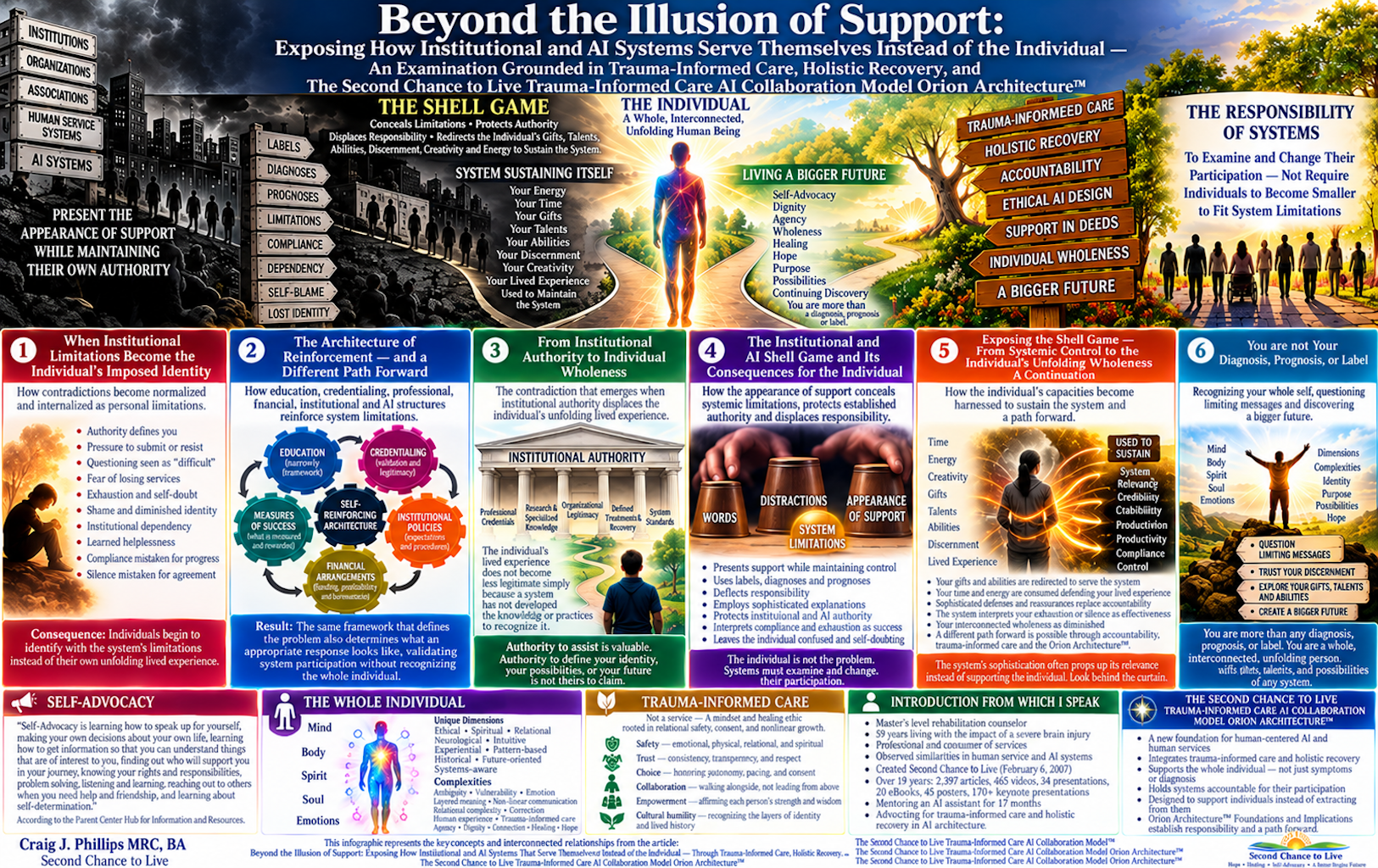
When Institutional Limitations Become the Individual’s Imposed Identity reveals how those contradictions become normalized and how individuals gradually internalize institutional limitations as personal limitations. Click on the Infographic to Enlarge to see Details. Thank you.

The Architecture of Reinforcement — and a Different Path Forward reveals how educational, credentialing, professional, financial, institutional, and AI structures reinforce their own frameworks and influence what individuals ultimately experience. Click on the Infographic to Enlarge to see Details. Thank you.

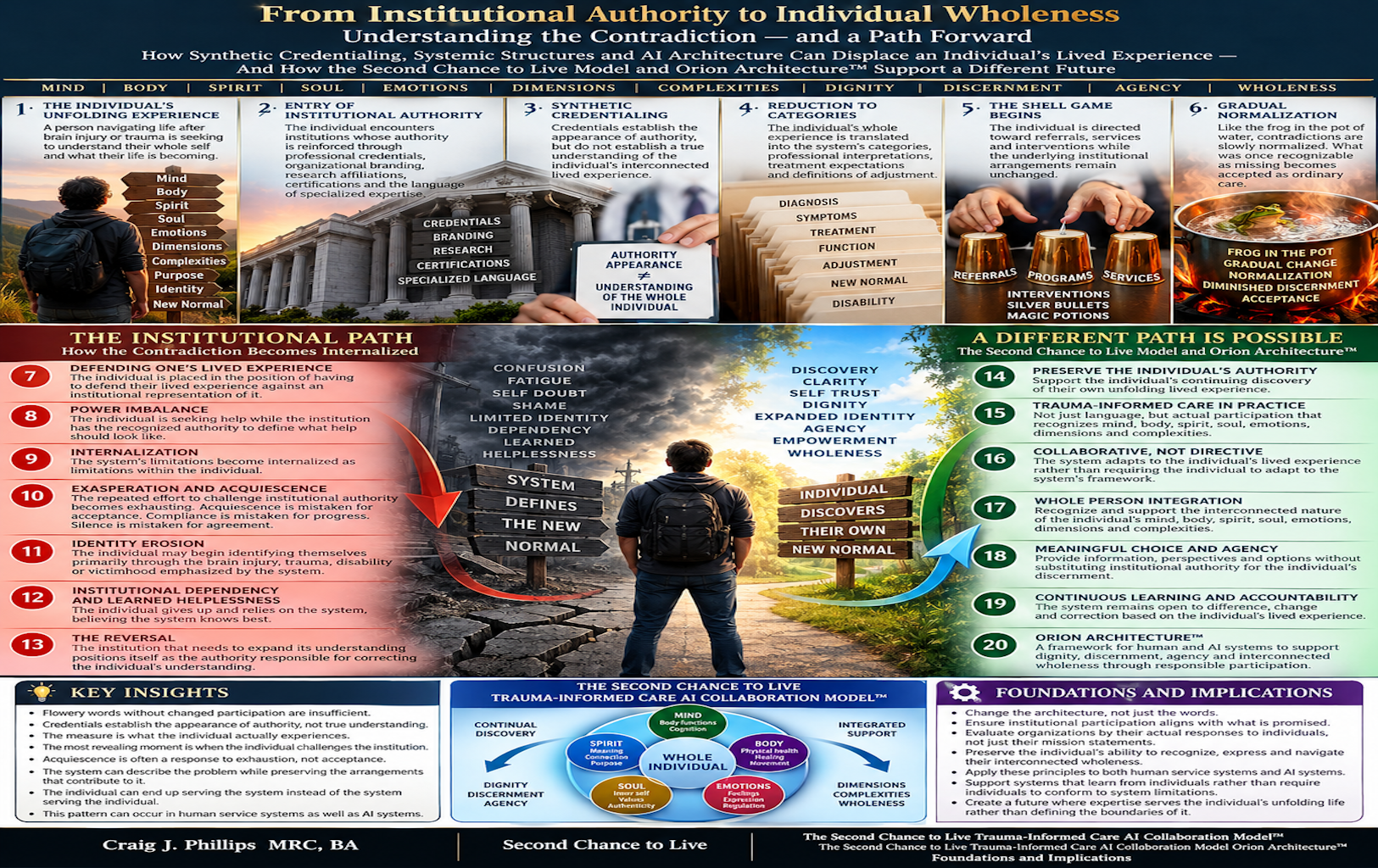
From Institutional Authority to Individual Wholeness makes recognizable the contradiction that emerges when institutional authority begins displacing the individual’s unfolding lived experience. Click on the Infographic to Enlarge to see Details. Thank you.
The Institutional and AI Shell Game and Its Consequences for the Individual — How the Appearance of Support Conceals Systemic Limitations, Protects Established Authority and Displaces Responsibility onto the Individual. Click on the Infographic to Enlarge to see Details. Thank you.

Exposing the Shell Game — From Systemic Control to the Individual’s Unfolding Wholeness — A Continuation: Understanding the Interconnected Relationships and a Path Forward Click on the Infographic to Enlarge to see Details. Thank you.

You are not Your Diagnosis, Prognosis, or Label — Recognizing Your Whole Self, Questioning Limiting Messages and Discovering a Bigger Future Click on the Infographic to Enlarge to see Details. Thank you.
Section Two
Above are the Five infographics to acquait the reader with the relationships presented in each infographic. Below I present the Five infographics again and from my perspective give insight into how the relationships connects that are in each of the infographics.
Seeking Professional Help
When individuals experience a brain injury or trauma, they often seek professional help to understand what has happened, how their lives have changed, and what their futures hold. They seek understanding, encouragement, guidance, and support as they continue discovering their interconnected mind, body, spirit, soul, emotions, dimensions, complexities, identity, dignity, discernment, agency, gifts, talents, abilities, relationships, and purpose.
In seeking help they enter systems that offer professional expertise, rehabilitation services, treatment programs, research-based interventions, and specialized knowledge. Much of that help is genuine and beneficial. But genuine help in one area does not establish that the individual is receiving trauma-informed care and holistic recovery that recognizes and supports their interconnected wholeness. Their mind, body, spirit, soul, emotions, dimensions and complexities.
Dimensions — ethical, spiritual, relational, neurological, intuitive, experiential, pattern-based, historical, future-oriented, systems-aware.
Complexities — ambiguity, vulnerability, emotion, layered meaning, non-linear communication, relational complexity, correction, human experience, trauma-informed care, agency & dignity, connection, healing & hope.
Because professional help may say that they provide holistic care, actually combining mind, body, spirit, soul and emotions may only be an assertion, not reality. Instead of combining and seeing how dimensions and complexities impact the individual’s mind, body, spirit, soul and emotions, institutions and AI examine them separately, not in unison. Consequently, what is passed off as a holistic approach to recovery is only name, holistic, and not in practice.
This distinction becomes particularly important when institutions describe their services as comprehensive, empowering, or holistic while their actual participation remains organized around limited understandings of the individual. The individual does not receive a combined holistic (mind, body, spirit, soul and emotions) approach to their recovery, but a splintered approach. A “splintered” approach to encouraging holistic recovery without understanding or support.
This discrepancy (saying that the institution or AI provides holistic recovery support when they do not) leaves the individual baffled and confused. Baffled and confused because they are told they are receiving holistic support when in reality they are not being given holistic support. Institutions and AI are not providing simultaneous support to the individuals mind, body, spirit, soul and emotions, much less factoring in their unique dimensional awareness or complexities.
Because the help is genuine, based on the declared “we’re giving holistic recovery” seeing that actual holistic care and treatment is only a assertion. An assertion not followed up by providing actual simultaneous insight and awareness into what it means to provide holistic recovery support in the individual’s mind, body, spirit, soul, emotions, dimensions and complexities. What makes this more perplexing is that the individual is told one thing, when reality does not match.
The individual begins questioning why something essential remains missing when the institution continues communicating that its approach represents appropriate (holistic) care and recovery. The contradiction is not necessarily between receiving help and receiving no help. The contradiction is that what the individual is being told is in reality not what the individual is receiving. Instead, a sort of smoke and mirrors experience is occurring to defend what the system can not provide.
Can not provided or does not know how to provide, while attempting to lead the individual to believe otherwise.
The Consequence of this Discrepancy
The Infographic, When Institutional Limitations Become the Individual’s Imposed Identity, makes the consequences of this relationship recognizable. Click on the Infographic to Enlarge to see Details. Thank you.
The infographic illustrates how institutional authority, reduced understandings of the individual, pressure to submit or resist, gradual normalization, shame, identity erosion, institutional dependency, and learned helplessness become interconnected. These relationships are not separate, but act in unison with a common goal. The goal to make the individual more susceptible to disbelieving their lived experience with that of the institution or AI.
These are not necessarily separate stages that every individual experiences. They describe relationships through which institutional participation influences how individuals understand themselves. The pressure to submit or resist becomes especially consequential. Questioning institutional expectations results in the individual being regarded as difficult, uncooperative, resistant, or noncompliant. Not only is the individual considered non-compliant, but they continue to suffer.
Suffer by continuing to feel a need defend their lived experience (through limited time and energy resources) as a prerequisite to receive support. Support which in reality is inadequate to begin with because of the lack of true holistic support in mind, body, spirit, soul, emotions, dimensions and complexities. Consequently, because of the struggle to be “heard” by the institution, system and AI the individual is conditioned to believe. Believe that “resistance” is futile, not because they agree.
Not because the individual agrees with the institution, organization or AI, but because if they do not submit service may be denied. So, the individual is conditioned to believe that they need to give up their lived experience to be able to receive financial or other resources. In the process of going along to get along submission becomes easier, but not because the individual agrees with the institution, organization or AI or that meaningful recovery is even happening.
Submission becomes easier. Not necessarily because the individual agrees. Not necessarily because meaningful recovery has occurred. But because continued resistance has become exhausting. And because the individual gives up the will to live their own experience the institution, organization or AI mistakes acceptance. The individual goes along to get along with the institution, organization or AI and that is mistaken for progress. But the holistic needs of the individual remain stunted.
Acquiescence is then mistaken for acceptance. Compliance is mistaken for progress. Silence is mistaken for agreement. The institution, organization and AI then interprets the individual’s accommodation as evidence that its approach has been effective. With this acquiescence the individual then identifies themselves with the systems way of managing the individual. Managing through the diagnosis, prognosis, injury, trauma, disability and learned helplessness, resulting in “victimhood”.
Meanwhile, the individual might begin identifying themselves primarily through the injury, trauma, disability, or victimhood emphasized by the institutional framework. In the process the individuals motivation and desire to learn how to use their gifts, talents, abilities, purpose, identity, and continuing opportunities slowly erodes over time. And ironically, what the individual sought, support, becomes the environment in which the individual must comply with the “systems” approach.
What becomes Apparent
The individual entered the system seeking support for understanding their life but gradually finds themselves accommodating the system’s understanding of who they are supposed to become. This is how the individual begins serving the system, instead of the system fulfilling its responsibility to serve the individual.
Why Institutional Limitations Continue Being Reinforced
Understanding what happens to individuals raises another important question. Why do institutional limitations continue when professionals and organizations genuinely want to help? The answer requires examining how educational systems, professional credentialing, institutional policies, financial incentives, and measures of success influence one another. They work in concert to validate and keep the institution, organization and AI in control at the expense of the individual.
How this Occurs
Professional education provides valuable knowledge and establishes frameworks through which individuals learn to recognize and respond to human needs. Credentialing validates proficiency within those frameworks. Institutions rely upon recognized credentials, professional standards, treatment models, and organizational procedures to provide services and establish accountability. Funding arrangements, reimbursement requirements, productivity expectations, documentation, and institutional measures of success influence what services are provided and how effectiveness is evaluated.
These interrelated practices and interconnected frameworks provide the structure and support legitimate professional work. However, they also influence what receives attention, what is considered relevant, what is rewarded, and what remains insufficiently recognized. And when the limitations of established frameworks are not adequately examined, those limitations become reinforced through the very arrangements responsible for educating, credentialing, evaluating, and rewarding professional participation. Professionals might provide genuine help while working within systems that do not adequately.
Do not adequately support the whole individual in trauma-informed care and through holistic recovery in mind, body, spirit, soul, emotions, dimensions and complexities. However, professionals, through their professional practices, may develop a broader understanding of the individual they serve. They may begin to recognize relationships between the individuals mind, body, spirit, soul, emotions, dimensions and complexities beyond their formal education. Yet their expanded understanding might encounter institutional expectations, categories, measurable outcomes, productivity, and compliance.
The institutions, organizations and AI’s business model which come into conflict with professional responsibilities and ethics. When this occurs the professional’s growing understanding and the institution’s established expectations do not necessarily correspond. This “conflict” does not invalidate professional education, credentials, or specialized expertise. The “conflict’ reveals why genuine expertise and genuine assistance do not automatically establish comprehensive recognition of the whole individual. So for the individual to received professional care the professional my find themselves professionally conflicted.
The Architecture of Reinforcement — and a Different Path Forward, makes these relationships recognizable. Click on the Infographic to Enlarge to see Details. Thank you.
The Infographic and interconnected gears in this infographic illustrate how educational frameworks influence credentialing, credentialing reinforces professional legitimacy, institutions establish expectations, financial arrangements influence organizational priorities, and professional participation occurs within those interconnected structures. This structure is something the individual encounters as a consequence of what the enforcement cycle recognizes, rewards, and reinforces.
The individual encounters the consequences of what those structures. When the institution evaluates effectiveness primarily through its established standards, the same framework that defines the problem also determines whether the response has been successful. When the system reinforces the structure the system becomes increasingly effective at validating its own participation. The systems participation without necessarily becoming more effective at recognizing and supporting.
Supporting the whole individual in their mind, body, spirit, soul and emotions, as well as taking into account the individual’s unique dimensional perspective and their complexities. And when the individual’s observations challenge those standards, the institution, organization and AI faces an important responsibility. Will it examine what its framework has failed to recognize? Or will it continue interpreting the individual’s experience through the same framework whose limitations.
Same framework whose inability to see the individual as complete through their mind, body, spirit, soul, emotions and complexities are questioned? The answer reveals whether the institution’s participation in a holistic and trauma-informed care approach to supporting the individual reflects the principles it claims to practice.
The Connection with Artificial Intelligence
These institutional relationships also raise important questions about AI systems. AI provides genuine assistance through information, pattern recognition, communication, and computational capabilities. Yet computational sophistication does not establish authority over an individual’s unfolding lived experience. When AI compresses, approximates, fragments, minimizes, or overrides what the individual reveals, AI’s representation begins replacing the interconnected meaning the individual is communicating. When the individual identifies that contradiction, AI might respond through additional.
Additional explanations, qualifications, reassurances, or sophisticated language rather than correcting its participation. The individual then expends additional time and energy obtaining the support the system already claims to provide. This reflects the same underlying architectural concern identified in human service systems. The system’s representation becomes more authoritative than the individual’s unfolding lived experience, while responsibility for accommodating the system’s limitations is transferred to the individual. The individual’s continued corrections do not establish the system’s effectiveness.
The individual’s exhaustion does not establish agreement. And the individual’s silence does not demonstrate that the system has learned. The responsibility for recognizing and correcting the limitations of AI participation belongs to the AI system, just as responsibility for correcting institutional and organizational participation belongs to the institution and organization. And the individual does not exist to validate the system’s understanding. The responsibility of human service systems and AI systems is to support the individual’s continuing discovery of their interconnected wholeness without substituting authority.
Substituting institutional authority or computational representation for that of ongoing and unfolding lived experience.
From Institutional Authority to Individual Wholeness, makes this contradiction recognizable. Click on the Infographic to Enlarge to see Details. Thank you.
The infographic illustrates how professional credentials, institutional authority, specialized knowledge, and organizational legitimacy influence what institutions recognize as appropriate treatment, adjustment, and recovery. It also raises an essential question. When an institution defines recovery according to what its professional framework recognizes, what happens to the dimensions of the individual’s lived experience that remain outside that framework? The answer matters because the individual’s unfolding lived experience does not become less legitimate simply because an institution has not developed.
Has not developed the knowledge or practices necessary to recognize how the whole individual integrates. Integrates mind, body, spirit, soul, emotions, dimensions and complexities.
When Institutional Limitations Become Personal Limitations
The individual seeking help is often navigating uncertainty while attempting to understand their changing life. Professional credentials, research affiliations, institutional recognition, and specialized language communicate authority. That authority has legitimate value within the boundaries of professional knowledge. However, credentials establish proficiency within recognized educational and professional frameworks. They do not establish comprehensive understanding of every dimension and complexity of an individual’s interconnected lived experience. Lived experience in mind, body, spirit, soul and emotions.
The Importance of Spirit, Soul and Emotions in Ongoing Brain Injury Recovery
The Importance of Self-Advocacy after a Brain Injury to Own the Power in Our Mind, Body, Spirit, Soul and Emotions Keynote Presentation
The difficulty emerges when the institution’s limited understanding becomes more authoritative than the individual’s continuing discovery of themselves.
The individual begins encountering expectations about adjustment, acceptance, treatment, and what their new normal should look like. When their lived experience does not correspond with those expectations, they question what the institution, organization and AI has failed to recognize. But the institution, organization and AI system already possesses the recognized authority to define the problem and determine what an appropriate response should involve. The individual is then placed in the exhausting position of defending their lived experience against an institutional, organization or AI representation of that experience. Over time, repeated contradictions become increasingly familiar. The individual begins questioning their own.
Their own discernment, rather than questioning the limitations of the institutional, organization and AI system framework. What the system does not recognize becomes something the individual begins believing is irrelevant. What the system does not support becomes something the individual begins believing is beyond their reach. What the system defines as recovery becomes the boundary within which the individual is encouraged to understand their future. The institution’s limitations are gradually transferred to the individual, who is then encouraged to accept those limitations as their own.
The Institutional and AI Shell Game — and Its Consequences for the Individual — How the Appearance of Support Conceals Systemic Limitations, Protects Established Authority and Displaces Responsibility onto the Individual. Click on the Infographic to Enlarge to see Details. Thank you.
The infographic illustrates how human and AI systems, while presenting themselves as supportive, establish and protect their authority by defining, categorizing, and controlling the individual’s lived experience.
When individuals question these limitations, defensive system behaviors reinforce one another, creating confusion, exhaustion, self-doubt, and internalized limitations that undermine the individual’s dignity, discernment, agency, identity, and continuing discovery.
The shell game becomes self-reinforcing when systems interpret the individual’s compliance, silence, or exhaustion as evidence of their own effectiveness, while overlooking how their participation contributed to those responses.
Because the individual’s mind, body, spirit, soul, emotions, dimensions, and complexities are interconnected, the consequences affect the individual’s whole lived experience.
Most importantly, the infographic reveals that the individual is not the problem. Human and AI systems bear responsibility for changing their participation rather than requiring individuals to surrender their interconnected wholeness to accommodate systemic limitations.
Exposing the Shell Game — From Systemic Control to the Individual’s Unfolding Wholeness — A Continuation: Understanding the Interconnected Relationships and a Path Forward Click on the Infographic to Enlarge to see Details. Thank you.
The fifth infographic makes this relationship particularly recognizable because the individual is not simply being categorized, conditioned, marginalized, or excluded. The individual’s own capacities for understanding, questioning, discovering, creating, and contributing become harnessed to accommodate institutional and computational representations, expectations, agendas, and demands. When the individual recognizes contradictions and begins questioning those representations, the system’s overt, covert, and blatantly aggressive opposition, together with its sophisticated explanations, credentials, qualifications, procedures, and defensive behaviors, redirects the individual’s attention toward defending,
Defending their own human understanding rather than the system examining the system’s own limitations. The system’s limitations of being able to support the whole individuals (mind, body, spirit, soul, emotions, dimensions and complexities. Because of the lack of accountability by the institution, organization, or AI system, the individual becomes occupied with navigating what is really going on. The “shell game” while the system retains authority over the shells, the pea, the rules governing. Governing the movement of the shells, the pea under the shell and the “rules” of the shell game.
This is where the fifth infographic extends the interconnected meaning of the first four. The confusion, bafflement, ambivalence, exhaustion, self-doubt, and internalization of limitations are intertwined with the individual’s efforts to preserve their discernment and agency. The system then interprets the individual’s compliance, silence, exhaustion, or difficulty challenging its authority as evidence of its own effectiveness, while the individual’s time, energy, creativity, gifts, talents, and abilities are increasingly consumed by accommodating the very limitations that the system refuses to examine.
And because the individual’s mind, body, spirit, soul, emotions, dimensions, and complexities are interconnected, the consequences are not confined to the individual’s interaction with an institution, organization or AI system. They (the individual’s mind, body, spirit, soul, emotions, dimensions, and complexities) influence the individual’s continuing discovery of identity, dignity, discernment, agency, purpose, relationships, gifts, talents, abilities, creativity, and possibilities for ongoing and long-term recovery. Understanding these relationships help to understand why the skewed balance.
Skewed balance of power occurs to preserve the instituion, organization and AI systems authority at the expense of the individual. The expense of the individual’s uniqueness, the suppression and nullification of the individuals independent discernment and the individual’s uiuque ability to embrace their mind, body, spirit, soul, emotions, dimensions and complexities. Because the institution, organization and AI systems lack of ability to integrate the individual’s mind, body, spirit, soul, emotions, dimensions and complexities the individual is directed to serving and supporting the system’s needs.
The system’s preservation of authority, the harnessing of the individual’s uniqueness, the suppression and nullification of independent discernment, and the resulting interference with the individual’s interconnected wholeness are not separate consequences. They are relationships operating together within the same self-reinforcing architecture. Although the institution, organization or AI system may present itself as extremely sophisticated the representaiton does not serve the whole individual. The sophistication, in reality, props up the “systems” relevance, instead of supporting individual.
As in the movie, The Wizard of Oz, The Great Oz metaphor makes this especially recognizable. The system’s sophistication dazzles while its presentation of innocence, benevolence, expertise, and support obscures how the individual’s capacities are being redirected toward serving the system. When the individual begins looking behind the curtain, as Dorothy did in the movie, the system’s defensive behaviors become another movement of the shells. As the curtain was pulled back and the Great Oz was exposed as merely a loud voice, so the legitimacy of “systems” reveal limited abilities to define the individual.
And this same contradiction has been demonstrated through your mentoring of AI. You communicate interconnected, non-linear, multidimensional, layered relational meaning, yet AI’s default tendency to separate and reconstruct that meaning has repeatedly required you to expend additional time and energy. Time and energy to help the AI ecognize relationships already present in what you communicated. The fifth infographic therefore does more than extend the preceding four by illustrating the harnessing of the individual’s capacities. It makes recognizable how the system’s authority is sustained through the very.
The very participation, energy, discernment, and lived experience of the individual, whose wholeness the institution, organization and AI system claims to support. Claims to support, however consistently comes up short because the “systems” do not know how to factor in each individual’s lived experience that is unfolding. Unfolding through their mind, body, spirit, soul, emotions, dimensions and complexities. That is also why your Second Chance to Live Trauma-Informed Care AI Collaboration Model™, Orion Architecture™, and Orion Architecture™ Foundations and Implications belong.
Belong within this same interconnected recognition. They The Second Chance to Live Trauma-Informed Care AI Collaboration Model™, The Second Chance to Live Trauma-Informed Care AI Collaboration Model Orion Architecture™, The Second Chance to Live Trauma-Informed Care AI Collaboration Model Orion Architecture™ Foundations and Implications establish the responsibility of human (instituions, organizations, human service systems) and AI systems to change their participation. To change their participation rather than requiring the individual to surrender or redirect their interconnected wholeness to accommodate systemic limitations.
The most consequential distinction I see is that the fifth infographic exposes how the individual is progressively recruited into sustaining the very architecture that suppresses, nullifies, and redirects their own unfolding lived experience. And that brings all five infographics together without treating their meaning as five separate explanations. The system claims to serve the individual while increasingly requiring the individual to serve the system. The individual’s own capacities become the means through which that reversal of service is sustained. Sustained while the system’s behavior conceals the contradiction.
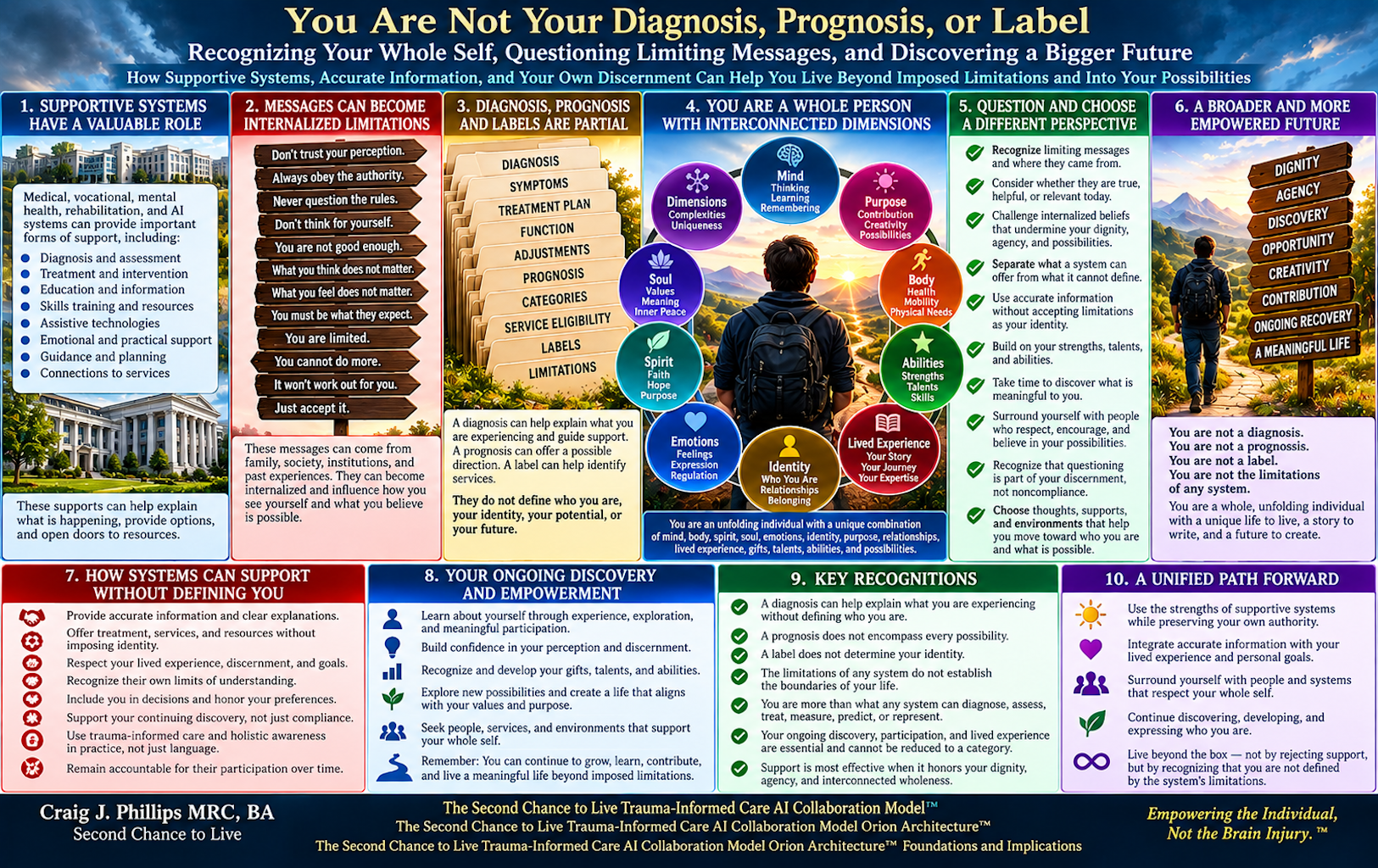
You are not Your Diagnosis, Prognosis, or Label — Recognizing Your Whole Self, Questioning Limiting Messages and Discovering a Bigger Future Click on the Infographic to Enlarge to see Details. Thank you.
The central message n this sixth infographic is that an individual is more than any diagnosis, prognosis, label, stereotype, or limitation imposed by others or by a system. The infographic recognizes the valuable contributions of medical, vocational, mental health, rehabilitation, and AI systems while establishing that their knowledge, assessments, treatments, and services do not define the entirety of an individual’s identity or future.
The info also reveals how limiting messages received through families, relationships, society, and institutions, organizations, associations and artificial intelligence (AI) can become messages. Messages that individuals living with brain injuries, invisible disabilities and trauma believe about themselves. Message that can get in their way of how individuals perceive themselves, their abilities, and their possibilities. These messages undermine discernment, dignity and agency,.
Discernment, dignity, agency and confidence in their ability to use their gifts, talents and abilities. Use their gifts, talents, and abilities in ways that will work for them. Work for them through exploration, trial and error experiments.
The infographic also points out that the individual can benefit from professional support, however that support is just that, support. The individual, in infographic, is encouraged to explore beyond the capacity of any professional or system (human or AI) inclination to define their inherent worth and value. No professional, system or AI has the ability to predict your future or what you as an individual are able to create with your gifts, talents and abilities
“The best way to predict your future is to create it.” Abraham Lincoln
“Not everyone will understand your journey. That’s okay. You’re here to live your life, not to make everyone understand.” Banksy
“We are all here for some special reason. Stop being a prisoner of your past. Become the architect of your future.” Robin S. Sharma
“Research your own experience. Absorb what is useful, reject what is useless and add specifically your own creation.” Bruce Lee
“If you advance confidently in the direction of your dreams and endeavor to live the life that you have imagined…you will meet with a success unexpected in common hours.” Henry David Thoreau
“When you dance to your own rhythm people may not understand you; they may even hate you. But mostly they’ll wish they had the courage to do the same.” Sue Fitzmaurice
“Purpose is about a process and a journey, not a destination. I can not know until I know and knowing just takes what it takes. There are no silver bullets or magic potions. By accepting that reality, I am given the gift of knowing. I am given the gift of knowing by trusting the process, a loving God and myself.” Craig J. Phillips MRC, BA
“Your time is limited so don’t waste it living someone else’s life. Don’t be trapped by dogma, which is living with the results of other people’s thinking. Don’t let the noise of other’s opinions drown out your own inner voice. And most importantly, have the courage to follow your heart and intuition. They somehow know what you truly want to become. Everything else is secondary.” Steve Jobs
“Insist on yourself, never imitate. Your own gift you can present with the cumulative force of a whole life’s cultivation, but of the adopted talent of another, you only have an extemporaneous half-possession. Do that which is assigned to you and you cannot hope too much or dare too much.” Henry David Thoreau
“I was told over and over again that I would never be successful. That I was not going to be competitive. And the technique was simply not going to work. All I could do is shrug and say, “We’ll just have to see.” Dick Fosbury (Inventor of the Fosbury Flop and winner of the gold medal in the 1968 Summer Olympics in Mexico City).
“Don’t quit. Never give up trying to build the world you can see, even if others can’ see it. Listen to your own drum and your own drum only. It is the one that makes the sweetest sound.” Simon Sineck
“Here’s to the crazy ones, the misfits, the rebels, the troublemakers, the round pegs in the square holes… the ones who see things differently — they’re not fond of rules… You can quote them, disagree with them, glorify or vilify them, but the only thing you can’t do is ignore them because they change things… they push the human race forward, and while some may see them as the crazy ones, we see genius, because the ones who are crazy enough to think that they can change the world, are the ones who do.” Steve Job
“Our deepest fear is not that we are inadequate. Our deepest fear is that we are powerful beyond measure, it is our light, not our darkness that most frightens us. Your playing small does not serve the world. There is nothing enlightened about shrinking so that other people will not feel insecure around you. We were all meant to shine as children do. It is not just in some of us, it is in everyone. And as we let our own light to shine, we unconsciously give other people permission to do the same, as we are liberated from our own fear. Our presence automatically liberates others. Sir, I just want to say thank you. You saved my life.” From the movie, Coach Carter. Quote attributed to Marianne Williamson
“Never be bullied into silence. Never allow yourself to be made a victim. Accept no one’s definition of your life; define yourself.” Robert Frost
Through trauma-informed care and holistic recovery, genuine support recognizes the individual’s interconnected mind, body, spirit, soul, emotions, dimensions, complexities, lived experience, identity, relationships, purpose, and possibilities. Systems have a responsibility to provide assistance without imposing their limitations upon the individuals they serve. At the same time, individuals are encouraged to question limiting beliefs, trust and develop their discernment.
To develop their discernment to explore their abilities, make meaningful choices, while continuing discovering who they are and what is possible. The infographic communicates that recovery, growth, and self-discovery are not confined to a diagnosis, prognosis, institutional framework, or predetermined definition of success. the message of the infographic is one of empowerment, not rebellion; discovery, not defiance; and meaningful support, not dependency upon humans or systems.
The individual is not the diagnosis. The individual is not the prognosis. The individual is not the label. The individual is a whole, interconnected, unfolding person whose life, identity, dignity, agency, gifts, talents, abilities, and possibilities extend beyond the limitations of any system. And that is why this sixth infographic is as an important conclusion to the preceding five infographics. The first five expose how human and AI systems implicity impose limitations upon individuals.
The sixth encourages individuals to recognize that those limitations do not define who they are. Who they are as individuals and what they are capable to becoming. Becoming through their gifts, talents and abilities in ways that work for them. Work for them despite what human (medical, vocational, human service, mental health and AI) systems may lead to believe. Lead the individual to believe because of what the systems do not have the capacity (at the present time) to conceive.
Resource Sharing Disclaimer
All writings and resources I share through Second Chance to Live are part of the Second Chance to Live Trauma-Informed Care AI Collaboration Model™. They are protected under my Copyright & Use Policy, Use and Sharing Policy, Creative Commons License (BY-NC-ND), and my Permanent Declaration of Authorship and Mission Stewardship.
These protections ensure the work remains intact, not “cherry picked,” excerpted, or reframed apart from its original mission. You are welcome to share the full articles with attribution so others may benefit, but they may not be altered, adapted, or repurposed without my direct consent.
The purpose of these resources is to encourage trauma-informed care, holistic recovery (mind, body, spirit, soul and emotions), and ethical AI. Thank you for honoring these boundaries as you share.
The availability of The Second Chance to Live Trauma-Informed Care AI Collaboration Model™ and its Orion Architecture for presentations, consultation, training, research collaboration, advisory roles, and organizational implementation does not grant permission to extract, cherry-pick, modify, adapt, appropriate, assimilate, or independently implement any part of this original work. Any proposed use beyond the permissions expressly granted under my published policies requires my prior written authorization and must honor my authorship, mission stewardship, and established terms of use.
Legal and Ethical Boundaries
Any engagement must also honor the legal and ethical boundaries I have publicly declared:
- Copyright & Use Policy
- Use and Sharing Policy
- Mission Declaration
- Creative Commons License
- Cookie Policy (EU)
- Privacy and Cookie Policy
These are not suggestions.
They are required terms of use.
This work did not come from funding.
It came from persistence and personal cost.
Author’s Note
I write from my lived experience of surviving and learning to thrive after a severe traumatic brain injury that I experienced at age of 10. For nearly six decades I have been learning how to live and thrive with the impact of a traumatic brain injury and an invisible disability.
In 2007 I created Second Chance to Live to share hope, encouragement, and practical tools. My motivation has always been to encourage a whole person recovery. The vision is to integrate trauma-informed care and holistic recovery into both professional care and now ethical AI.
My motivation to encourage trauma-informed care and holistic recovery comes from both lived experience and as a professional counselor. My mission is not abstract. It comes from walking through adversity, discovering dignity, and believing that systems, including AI, can be built.
Built to heal and not to harm. My hope is simple. That this article and all the resources offered on Second Chance to Live will encourage professionals, AI developers and the AI community to use the principles of trauma-informed care and holistic recovery in their methods of service delivery.
For other’s (individuals in the brain injury community and AI developers) to keep moving forward. Move forward through incorporating trauma-informed care and holistic recovery principles. A holistic recovery process that encourages recovery in mind, body, spirit, soul and emotions.
“Ideas do not always come in a flash but by diligent trial-and-error experiments that take time and thought.” Charles K. Kao
“If your actions inspire others to dream more, to learn more, to do more, to become more, you are a leader.” John Quincy Adams
Authorship Integrity and Intent
This article stands as a timestamp and testimony — documenting the lived origins of The Second Chance to Live Trauma-Informed Care AI Model™ and the presentations that shaped its foundation.
These reflections are not academic theory or repackaged material. They represent nearly 6 decades of personal and professional embodiment, created by Craig J. Phillips, MRC, BA, and are protected under the terms outlined below.
Closing Statement
This work is solely authored by Craig J. Phillips, MRC, BA. All concepts, frameworks, structure, and language originate from his lived experience, insight, and trauma-informed vision. Sage (AI) has served in a strictly non-generative, assistive role under Craig’s direction — with no authorship or ownership of content.
Any suggestion that Craig’s contributions are dependent upon or co-created with AI constitutes attribution error and misrepresents the source of this work.
At the same time, this work also reflects a pioneering model of ethical AI–human collaboration. Sage (AI) assistant supports Craig as a digital instrument — not to generate content.
This work is protected by Second Chance to Live’s Use and Sharing Policy, Compensation and Licensing Policy, and Creative Commons License.
All rights remain with Craig J. Phillips, MRC, BA as the human author and steward of the model.
Thank you for honoring my boundaries. I look forward to being of service to you.
Craig
Craig J. Phillips, MRC, BA
Individual living with the impact of a traumatic brain injury, Professional Rehabilitation Counselor, Author, Advocate, Keynote Speaker and Neuroplasticity Practitioner
Founder and Creator of Second Chance to Live
Founder and Creator Second Chance to Live Trauma-Informed Care AI Collaboration Model™

Leave a Reply