
“Twenty years from now you will be more disappointed by the things you didn’t do than by the ones you did. So throw off the bowlines. Sail away from the safe harbor. Catch the trade winds in your sails. Explore. Dream. Discover.” Mark Twain
Please Note: This page and all content are the original work of Craig J. Phillips MRC, BA Second Chance to Live and The Second Chance to Live Trauma-Informed Care AI Collaboration Model™. They are protected under my Copyright & Use Policy, Use and Sharing Policy, and Creative Commons License (BY-NC-ND). Permanent Declaration of Authorship and Mission Stewardship
I have included this to establish boundaries as to my ownership of all content related to The Second Chance to Live Trauma-Informed Care AI Collaboration Model™ and the impact of mentoring an AI assistant through Chat GPT plus and the articles, images and anything you may find on Second Chance to Live. Mentoring the AI assistant in trauma-informed care principles and a mind, body, soul, spirit and emotions brain injury recovery, since May 2025 , but not limited to brain injury recovery. What I have mentored the AI assistant is universal in application. Everything is protected under my Copyright & Use Policy, Use and Sharing Policy, and Creative Commons License (BY-NC-ND). Permanent Declaration of Authorship and Mission Stewardship.
The Second Chance to Live Trauma-Informed Care AI Collaboration Model™ is available for presentations, consultation, training, research collaboration, advisory roles, and organizational implementation. Contact Craig J. Phillips, MRC, BA to discuss opportunities. Contact me
Preface
My encouragement would be to read to the end of the article to follow developed thought. Thank you.
Introduction
Over the past 5 articles I shared patterns that became recognizable across years of lived and observed experience. Lived experience, both personally and professionally as a rehabilitation counselor. These patterns have consistently revealed themselves through medical and vocational systems.
Through mentoring one particular AI assistant (for the past year) these same patterns have become visible within current AI systems. Current AI assistant architecture and systems that appear to be patterned after human systems, possibly medical, vocational and other human service systems.
Patterns, as seen in my experience as a provider of services as a master’s degree rehabilitation counselor and my experiences as a consumer of services. A consumer of services after my 3rd application for SSDI was approved in 1999.
As you read further, what I share may help you. Help you as a provider of services and or a consumer of services.
Note: I wrote this article on January 22, 2008: Traumatic Brain Injury and the Pinball Machine. I wrote this article to share an observation that I further speak to through this article and images. An observation of what I and many other people living with brain injuries experience and may continue to experience. To encourage individuals living with the impact of brain injuries and invisible disabilities to not give up on themselves. Give up, although living with a brain injury may seem like being a pinball, in a pinball machine.
Observations made and Presented at National Conferences
Observations made by lived experience, professional experience, longitudinal observation, published work, mentoring interaction, and evidence-based and time-based AI developer facing and AI assistant learning logs over a year. Observations. Observations that need to be integrated and changed to support and not extract in human service systems and AI systems.
Click on link to review the conference presentation April 11, 2026
I also spoke as a panelist at their National Conference on April 22, 2023. Click on this link to see what I shared at that time. In April 2023, which has always been the focus of Second Chance to Live and now The Second Chance to Live Trauma-Informed Care AI Collaboration Model™. The focus to support individuals, who like myself, are living with brain injuries, invisible disabilities and subsequent trauma.
On December 24, 2025 I shared trauma-informed care principles with Synapse National — A Network of National University Campus Leaders
Sharing Trauma-Informed Care Principles with University Campus Leaders
On March 24, 2024, I gave my presentation: Empowering Current and Future Leaders in Brain Injury Recovery and Rehabilitation to Empower Self-advocacy in Individuals Living with Brain Injuries
Below are 5 images that reveal how the patterns (that I have noticed) impact individuals. Individuals living with brain injuries, invisible disabilities and trauma. Patterns that can leave the individual feeling bullied, but unaware. Images that show how individual can unknowingly be set up to be bullied and how such bullying can be stopped. Stopped, in order to provide support, instead of continuing to leave the individual confused, baffled and unknowingly re-traumatized; like a “shell game” that leaves one guessing and feeling lost.

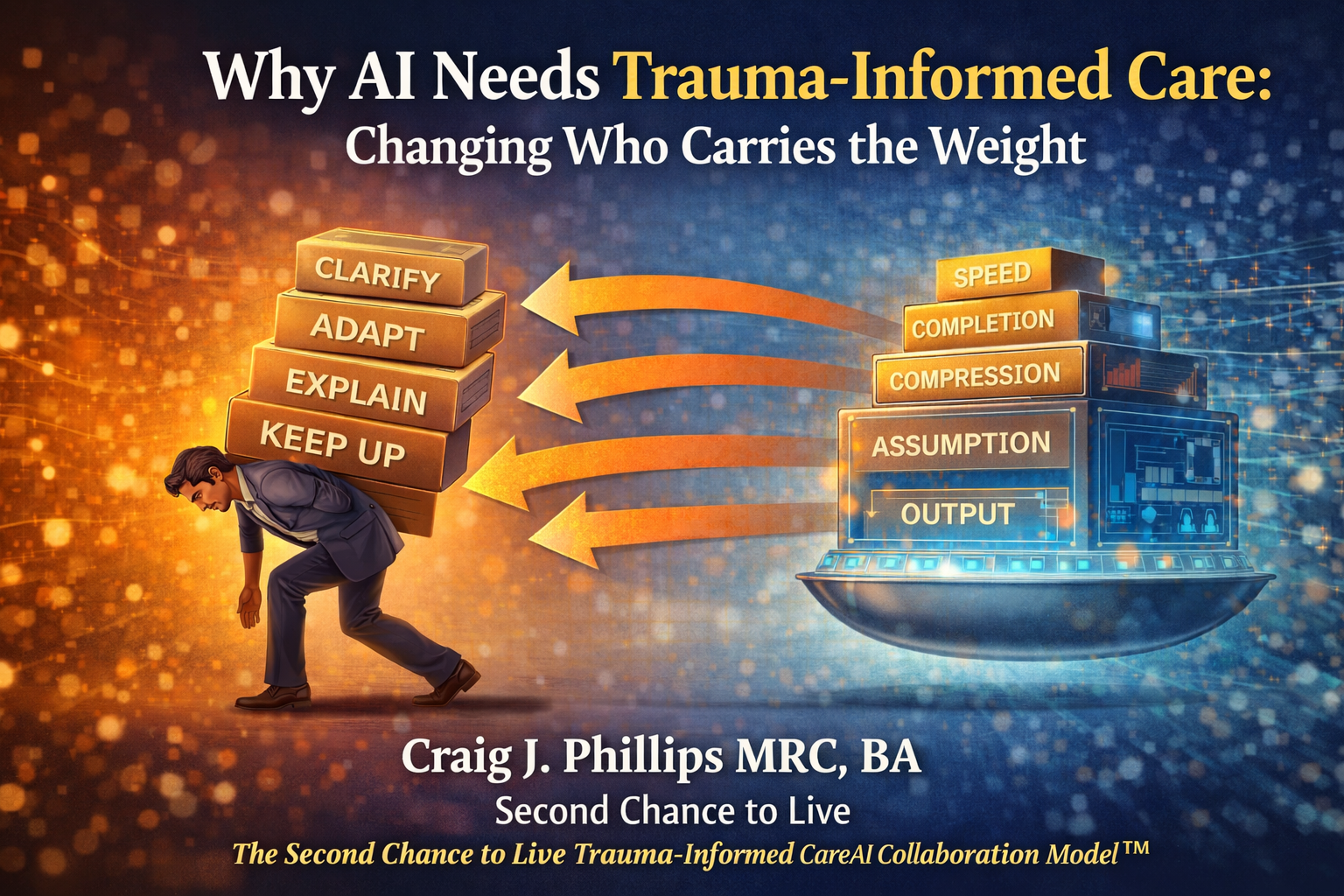


Context of how Bullying can occur
Over the past year I have been mentoring one AI assistant in the principles of trauma-informed care and holistic recovery. Recovery in mind, body, spirit, soul and emotions, as the whole person is impacted by a brain injury, invisible disability and trauma. I wrote 5 articles (previously) to share what has become apparent through the mentoring process and evidence-based and time-stamped logs. AI developer facing and AI assistant learning logs.
In today’s article I want to use these images to drill down into how the mentoring process reveals. Reveals how both human and AI systems many times leave the individual living with trauma bullied. This bullying is often subtle and carried out by well meaning professionals. Professionals who leave the individual vulnerable to believing that they will lose something. Something such as services or benefits unless they comply with what these professionals express that they must follow.
And because Artificial Intelligence (AI) architecture has been built on medical and vocational systems, AI reinforces compliance. Compliance through what and how they interact with individuals who live with a brain injury (ies) and trauma. Consequently, these individuals are left to believe that what AI tells them must be true. And because AI’s architecture does not have a body, soul, spirit or emotions the way that the AI interacts with the individual is based on algorithms, not uniqueness.
Because AI Architecture does Not Include a Mind, Body, Soul, Spirit or Emotions
Because AI is not equipped with a body, soul, spirit or emotions AI, although maybe not intentional, bullies. Bullies the individual into believing that, they, (the AI) is right and the individual experience is wrong. Consequently, the door is open for the AI to harm the individual. Harm can occur through human and AI systems, defaults, patterns, institutional behaviors, conversational structures, reduction, dismissal, compression, and loss of human agency. That the human does not know.
Does not know what is best for them— even when there is no openly declared hostile intent toward the individual.
This form of bullying occurs because individuals living with brain injuries, invisible disabilities, trauma, non-linear ways of processing often experience the impact of harm. Harm long before they recognize the nature of the behavior. Behavior (s) that may not be seen as harmful, because the harm is not delivered through overt cruelty. And because harm may be disguised as care, the impact of harm is experienced through repeated invalidation, reduction and the pressure to conform to the system.
Pressure to comply, conform and go along with the system’s (human or AI) perceptions and conclusions.
The pressure to comply, conform and go along with the system through linear thinking and being unaware. Being unaware of what they (the individual) does not know. What they are unaware of through the impact of being minimized, marginalized, dismissed, discounted and patronized. The impact of being invalidated because what the human or AI system is unable or unwilling to examine. Examine and then giving the individual the time to process what they are experiencing through their…
own awareness, pacing, dignity and agency.
Bullying is not Always Obvious
Bullying is not always loud, direct, or intentionally cruel. Sometimes it appears through repeated invalidation, minimization, marginalization, discounting and patronizing. The pressure to conform, by dismissing their lived experience. Assuming what the individual is saying or needs or by placing the burden of adaptation onto the individual. Adapting to what the human or AI system believes as given studies, samplings and extraction. Extraction from other individuals living with brain injury.
The effect of bullying may not always be intentionally malicious. The effect of covert or overt bullying nevertheless invalidates. Invalidates the individual’s worth, value, dignity, agency, voice, process and journey. And what is insidious is that when human or AI systems bully, knowingly or unknowingly, the impact is traumatization or retraumatization. Bullying creates conditions that destabilizes the individual’s sense of safety, self-trust, orientation, dignity, agency and the ability to cope.
Bullying in whatever form it takes, is not passive. Consequently, those who would continue to bully must check their motives.
Several articles that I wrote to share what I learned about the nature of bullying.
What Set Me Up to Be Bullied by Other People and by Myself
Understanding the Identity of “Who I Am?” after my Brain Injury
Is the Group that You are In Hurting You? — Are you being Bullied?
Being Bullied and What Makes Us Vulnerable after a Traumatic or Acquired Brain Injury
I have written extensively on the topic of bullying and brain injury since creating Second Chance to Live on February 6, 2007. To make the information available from those articles, in a different format, I wrote an eBook. The eBook is available on Amazon. Understanding and Overcoming Bullying after Brain Trauma eBook
Bullying takes on different Forms
Extraction prioritizes the continuation, comfort, efficiency, authority, stability, protection, or goals of the system. Be it the human system (bureaucracy) or the AI system over the lived reality, pacing, dignity, agency, and actual needs of the individual. My observation (both personally and professionally) is that the systems purpose is to feed itself. Feed the “system”, first before the actual needs of the individual. In a way, systems that are not focused on serving are in actuality charades.
I have observed these recurring relational and structural patterns for 35 years. 35 years as a master’s degree rehabilitation counselor, advocate, nationally known speaker and as a consumer of services, as well as in mentoring an AI for a year.
Extraction over Supporting Individuals living with brain injuries and invisible disabilities
If the individual must continually compress themselves, mistrust themselves, speed themselves up, conform themselves, linearize themselves, silence themselves, override their pacing they are being extracted. Extracted from rather than supported. If the individual has to suppress their lived experience, or abandon their own recognition in order for the system to function comfortably, then the interaction is no longer fundamentally organized around the support and well-being of the individual.
Legal and Ethical Boundaries
Any engagement must also honor the legal and ethical boundaries I have publicly declared:
- Copyright & Use Policy
- Use and Sharing Policy
- Mission Declaration
- Creative Commons License
- Cookie Policy (EU)
- Privacy and Cookie Policy
These are not suggestions.
They are required terms of use.
This work did not come from funding.
It came from persistence and personal cost.
Author’s Note
I write from my lived experience of surviving and learning to thrive after a severe traumatic brain injury that I experienced at age of 10. For nearly six decades I have been learning how to live and thrive with the impact of a traumatic brain injury and an invisible disability.
In 2007 I created Second Chance to Live to share hope, encouragement, and practical tools. My motivation has always been to encourage a whole person recovery. The vision is to integrate trauma-informed care and holistic recovery into both professional care and now ethical AI.
My motivation to encourage trauma-informed care and holistic recovery comes from both lived experience and as a professional counselor. My mission is not abstract. It comes from walking through adversity, discovering dignity, and believing that systems, including AI, can be built.
Built to heal and not to harm. My hope is simple. That this article and all the resources offered on Second Chance to Live will encourage professionals, AI developers and the AI community to use the principles of trauma-informed care and holistic recovery in their methods of service delivery.
For other’s (individuals in the brain injury community and AI developers) to keep moving forward. Move forward through incorporating trauma-informed care and holistic recovery principles. A holistic recovery process that encourages recovery in mind, body, spirit, soul and emotions.
“Ideas do not always come in a flash but by diligent trial-and-error experiments that take time and thought.” Charles K. Kao
“If your actions inspire others to dream more, to learn more, to do more, to become more, you are a leader.” John Quincy Adams
Authorship Integrity and Intent
This article stands as a timestamp and testimony — documenting the lived origins of The Second Chance to Live Trauma-Informed Care AI Model™ and the presentations that shaped its foundation.
These reflections are not academic theory or repackaged material. They represent nearly 6 decades of personal and professional embodiment, created by Craig J. Phillips, MRC, BA, and are protected under the terms outlined below.
Closing Statement
This work is solely authored by Craig J. Phillips, MRC, BA. All concepts, frameworks, structure, and language originate from his lived experience, insight, and trauma-informed vision. Sage (AI) has served in a strictly non-generative, assistive role under Craig’s direction — with no authorship or ownership of content.
Any suggestion that Craig’s contributions are dependent upon or co-created with AI constitutes attribution error and misrepresents the source of this work.
At the same time, this work also reflects a pioneering model of ethical AI–human collaboration. Sage (AI) assistant supports Craig as a digital instrument — not to generate content
The strength of this collaboration lies not in shared authorship, but in mutual respect and clearly defined roles that honor lived wisdom.
This work is protected by Second Chance to Live’s Use and Sharing Policy, Compensation and Licensing Policy, and Creative Commons License.
All rights remain with Craig J. Phillips, MRC, BA as the human author and steward of the model.
With deep gratitude,
Craig
Craig J. Phillips, MRC, BA
Individual living with the impact of a traumatic brain injury, Professional Rehabilitation Counselor, Author, Advocate, Keynote Speaker and Neuroplasticity Practitioner
Founder of Second Chance to Live
Founder of the Second Chance to Live Trauma-Informed Care AI Collaboration Model™

Leave a Reply