• Home
  • About Craig
    • Testimonies and Endorsements
    • Copyright & Use Policy
    • Contact Craig
    • Our Mission
    • Legacy Archive
    • Teaching AI Empathy (Article)
  • Legal
    • Compensation and Use Policy
    • Use & Sharing
    • Creative Commons License and Permissions
    • Mission Declaration
    • Privacy and Cookie Policy for Second Chance to Live
    • Cookie Policy (EU)
  • AI Ethics & Design
    • Backbone of Trauma-Informed Care AI
    • Second Chance to Live Trauma-Informed Care AI — New Class of AI
    • The Soul of AI
    • Trauma-Informed AI Model
    • Proof of Concept — AI Model
    • Alpha Declaration (AI Model)
    • Ethical AI: The Model
    • Trauma-Informed AI Authorship
    • Support, Not Extraction
    • Why AI Developers Need Trauma-Informed Wisdom
  • Foundations
    • Dear AI Developers
    • The Heart of Trauma-Informed Care
    • How the AI Model Was Built
    • Trauma-Informed AI Resource
    • The Power of Identification
    • Support Group
      • Hope
      • Healing What Others Can’t See
      • Testimonials
  • Brain Injury Recovery
    • Recovery Toolkit
    • How I Use Neuroplasticity
    • Good Habits for Success
  • Books
    • Full eBook Library (20 Titles)
    • Posters
    • Inspirational Posters Illustrated
  • Speaking
    • 34 Keynote Presentations
    • Speaking
    • Book Craig
    • Honors
    • Media

Second Chance to Live

Empowering the Individual, Not the Brain Injury

Helping Children Create Hope in Their Lives

July 11, 2015 By Second Chance to Live

children-593313_640 Creating Hope

Today, I would like to share some thing that helped me to understand what undermined my ability to create hope in my life for many years. My motivation is not to point the finger in anyone’s direction, but to share what helped me to connect the dots.  The beauty in living is that we can make a decision to change our behavior at any time. The process of behavior modification usually begins with awareness that is followed by acceptance and results in action. Awareness provides the opportunity to address whatever is not in our best interest or in the best interest of the people we love. Acceptance acts like a balm to soften the walls of our resistance and bring us to a place of action. The action that we take provides the momentum that helps us to resolve feelings of shame and guilt.

As shared in several of my previous articles, detaching from a family system and a family system role is essential to be able to create hope in our lives. Understanding how we get tied to a family system and a family system role is essential to be able to detach and individuate. When parents do not deal with their shame and guilt, they make their children carry it for them. In many instances, the shame transfer is a learned behavior that is passed from one generation to the next. Through my recovery process, I have learned many valuable lessons. One of the most valuable lessons is that I am not responsible for anyone’s shame or guilt. I do not have to carry the burden of another persons unresolved guilt or shame. Each person is given an opportunity to learn and grow from his or her individual experiences. If they chose to avoid or deny the reasons for their irritability, restlessness and discontentment, I do not have to absorb or carry their pain or shame. I do not have to carry the unresolved.

Shame is different from guilt, in the with guilt you can make an amends. Shame on the other hand is a being wound that is inherent in the individual. With shame, the individual is led to believe that they do not make mistakes, but that they are mistakes. Shame is a being wound. By detaching or separating myself from assuming the responsibility for another person’s irritability, restlessness and discontent I am able to keep the focus on myself. By keeping the focus on myself, I am able to allow other people to resolve or not resolve the reasons for their own shame, guilt or expectations. By doing so, I give them dignity for their choices, while resolving the reasons for my own guilt and shame. By working on and resolving my own guilt and shame, I am able to find the freedom to create sparks of hope in my life.

In conclusion, I would encourage the parents who are reading this post to encourage your children. Your child may have an invisible disability that has gone undetected for many years. If you want your child to excel avoid blaming, shaming and criticizing them for not being more. They may not be able to reach your expectations, however they may be doing the best that they can. By acknowledging this reality, you will be able to cultivate an empowering relationship with your children that will last a lifetime. Parents by nature want their children to grow up to be professional adults. Having such a hope is not wrong, however your child may never be able to become a Doctor or a Lawyer or some other dream you have for them. Encourage your children, teenagers and young adults to follow their dreams, not yours. Nurture their strengths and you will both get what you desire, an empowered individual who is following after their bliss. Resolve your own guilt and shame so that you can create sparks of hope in your children’s lives. Don’t kill hope, because of…

You have my permission to share the articles that I present here on Create a Spark of Hope, however please attribute me as being the author of the article (s) and provide a link back to the article (s) on Create a Spark of Hope. Thank you. Copyright 2015
Filed Under: Moving Forward

Leave a Reply Cancel reply

Your email address will not be published. Required fields are marked *

This site uses Akismet to reduce spam. Learn how your comment data is processed.

Please type a word or phrase below to get answers to your questions

The Second Chance to Live Trauma-Informed Care AI Collaboration Model Orion Architecture™ Foundations and Implications

Spatial Overview — The Second Chance to Live Trauma-Informed Care AI Collaboration Model Orion Architecture™

Didactic Overview — The Second Chance to Live Trauma-Informed Care AI Collaboration Model Orion Architecture™

The Second Chance to Live Trauma-Informed Care AI Collaboration Model™ Orion Architecture by Craig J. Phillips, MRC, BA. Colorful infographic showing the whole individual surrounded by interconnected dimensions of mind, body, spirit, soul, emotions, identity, relationships, and agency, supported by trauma-informed care, holistic recovery, and responsibility.

17 Months of Mentoring Artificial Intelligence: Evidence-Based Findings on AI Architectural System Failures

Empowering Individuals Living Brain Injury to Empower Themselves NCBIA Statewide Support Group Leaders

Living with Brain Injury, Bullying and Becoming Aware while Owning Our Self-Acceptance — List of Articles

AI Bullying through Computational Representation, Presentation and Asymmetrical Requirements

Brain Injury, Feeling Wrong and being Bullied after Brain Injury

Click on the Infographic to see Details

Why I Continued to Feel Wrong after My Brain Injury, the Identified Patient, Labels, Stereotypes, Stigmatization

The Unfolding Individual: Why AI Architecture Must Stop Turning Computational Representation into a Container for Human Reality

Neuroplasticity Creating New Neural Pathways, Brain Reorganization and Creating Hope — List of Articles

Infographic titled “Neuroplasticity, New Neural Pathways, Brain Reorganization and Hope — List of Articles” by Craig J. Phillips, MRC, BA, Second Chance to Live. Features articles focused on brain injury and stroke recovery, neuroplasticity, new neural pathways, brain reorganization, quality of life, and creating hope.

Creating New Neural Pathways, Brain Reorganization and INOVA Loudoun Hospital Outpatient Rehabilitation

Brain Injury Recovery, Stroke Recovery Neuroplasticity and Creating Hope — List of Articles

Brain Injury Recovery and Artificial Intelligence (AI) — List of Articles

Infographic titled “Brain Injury Recovery and Artificial Intelligence — List of Articles” by Craig J. Phillips, MRC, BA, Second Chance to Live and The Second Chance to Live Trauma-Informed Care AI Collaboration Model™. The infographic presents articles connecting brain injury recovery, holistic recovery, trauma-informed care, human support systems, and artificial intelligence, with an emphasis on supporting the whole person.

Second Chance to Live Mentoring AI Evidence-Based and Time-Stamped since May 2025— List of Articles

Claiming Who We are and Owing Our Power after having a Brain Injury — List of Owning who We are Articles

Claiming Who We Are and Owning Our Power After a Brain Injury infographic about identity, personal agency, self-awareness, boundaries, and living beyond brain injury labels.

Understanding Who We are after a Brain Injury, Not what Other People…

Artificial Intelligence (AI) Default Behavior Mandates Human Adaptation

Brain Injury Association of North Carolina Training for Statewide

When Human Systems could not give me Answers after my Brain Injury

The Artificial Intelligence (AI) and Trauma-informed Care Category

How Human and AI Systems can actively Support Individual Freedom

Why AI Needs to Stop Translating Human Meaning and Purpose

Essential Elements For A Supportive Holistic Trauma-informed Care Group

How AI can Learn can Learn from Support Group Leaders to Support

Alt text: How AI can learn from what can help support group leaders support individuals, showing human support and AI learning connected through trauma-informed care, dignity, agency, presence, understanding, and support rather than extraction.

AI Developer Facing and AI Assistant Learning Logs — Disjointed Human Understanding, Extraction and Loss

Living with a Brain Injury/Invisible Disability Confusing and Baffling

What May Help Your Support Groups Support Individuals in Your Groups

The Second Chance to Live Trauma-Informed Care AI Collaboration Model™ — Seeing Human Wholeness

The Goal — Being a Work in Progress One Skill, One Skill Set at a Time

Brain Injury Recovery is Creating Progress through Neuroplasticity

Understanding Why Your Life makes Sense after Your Brain Injury

The Second Chance to LIve Trauma-Informed Care AI Model ™ Explained

The Importance of Spirit, Soul and Emotions in Brain Injury Recovery

“Sunrise over the ocean viewed from inside a wooden boat with a steering wheel. Title reads ‘The Importance of Spirit, Soul and Emotions in Ongoing Brain Injury Recovery.’ A glowing head silhouette with a heart and brain network highlights qualities such as awareness, trust, discernment, healing, wholeness, resilience, integration, and meaning. Signs read ‘Mind,’ ‘Body,’ and ‘Spirit, Soul and Emotions.’ A stone reads ‘Not driven by fear. Guided by discernment. Living in wholeness.’ The image includes the Second Chance to Live Trauma-Informed Care AI Collaboration Model™ and the name Craig J. Phillips MRC, BA.”

Join our Private Facebook Support Group by Clicking on the below Image

Most Recent Published Articles

  • The Second Chance to Live Trauma-Informed Care AI Collaboration Model Orion Architecture™ Foundations and Implications
  • The Second Chance to Live Trauma-Informed Care AI Collaboration Model Orion Architecture™
  • 17 Months of Mentoring Artificial Intelligence: Evidence-Based Findings on AI Architectural Failures, Default System Behaviors, Human Agency, and the Integration of Trauma-Informed Care
  • Empowering Individuals Living with a Brain Injury to Empower Themselves Presentation for NCBIA Statewide Support Group Leaders
  • Brain Injury, Bullying, Becoming Aware and Owning Self-Acceptance — List of Articles
  • Artificial Intelligence (AI) Bullying through Computational Representation, Presentation and Asymmetrical Requirements
  • Traumatic Brain Injury, Feeling Wrong and being Bullied after a Brain Injury

Model Protection Notice

The Second Chance to Live Trauma-Informed Care AI Collaboration Model™ was founded and documented by Craig J. Phillips, MRC, BA in May 2025. All rights reserved under U.S. copyright, Creative Commons licensing, and public record. This is an original, working model of trauma-informed care human–AI collaboration — not open-source, not conceptual, and not replicable without written permission.

Second Chance to Live – Privacy Notice and Cookie Usage

  • Privacy and Cookie Policy for Second Chance to Live
  • Cookie Policy (EU)
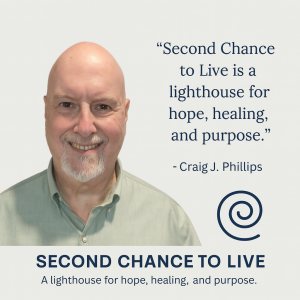
Craig J. Phillips Second Chance to Live mission portrait – hope, healing, and purpose.
Click the image to read about the mission and vision of Second Chance to Live.
July 2015
M T W T F S S
 12345
6789101112
13141516171819
20212223242526
2728293031  
« Jun   Aug »

Translate Second Chance to Live

Albanian Arabic Bulgarian Catalan Chinese Simplified Chinese Traditional Croatian Czech Danish Dutch Estonian Filipino Finnish French Galician German Greek Hebrew Hindi Hungarian Indonesian Italian Japanese Korean Lativian Lithuanian Maltese Norwegian Polish Portuguese Romanian Russian Serbian Slovak Slovenian Spanish Swedish Thai Turkish Ukrainian Vietnamese

Contact card

Copyright © 2026 · All rights reserved. · Sitemap

Manage Consent
To provide the best experiences, we use technologies like cookies to store and/or access device information. Consenting to these technologies will allow us to process data such as browsing behavior or unique IDs on this site. Not consenting or withdrawing consent, may adversely affect certain features and functions.
Functional Always active
The technical storage or access is strictly necessary for the legitimate purpose of enabling the use of a specific service explicitly requested by the subscriber or user, or for the sole purpose of carrying out the transmission of a communication over an electronic communications network.
Preferences
The technical storage or access is necessary for the legitimate purpose of storing preferences that are not requested by the subscriber or user.
Statistics
The technical storage or access that is used exclusively for statistical purposes. The technical storage or access that is used exclusively for anonymous statistical purposes. Without a subpoena, voluntary compliance on the part of your Internet Service Provider, or additional records from a third party, information stored or retrieved for this purpose alone cannot usually be used to identify you.
Marketing
The technical storage or access is required to create user profiles to send advertising, or to track the user on a website or across several websites for similar marketing purposes.
  • Manage options
  • Manage services
  • Manage {vendor_count} vendors
  • Read more about these purposes
View preferences
  • {title}
  • {title}
  • {title}
Manage Consent

To offer the best experience, we use privacy-respecting technologies like cookies to understand how our site is used. We never use tracking to exploit or overwhelm you. Your consent allows us to improve how we support individuals living with brain injuries, invisible disabilities, and trauma. You are free to accept, decline, or adjust your preferences. 

Functional Always active
The technical storage or access is strictly necessary for the legitimate purpose of enabling the use of a specific service explicitly requested by the subscriber or user, or for the sole purpose of carrying out the transmission of a communication over an electronic communications network.
Preferences
The technical storage or access is necessary for the legitimate purpose of storing preferences that are not requested by the subscriber or user.
Statistics
The technical storage or access that is used exclusively for statistical purposes. The technical storage or access that is used exclusively for anonymous statistical purposes. Without a subpoena, voluntary compliance on the part of your Internet Service Provider, or additional records from a third party, information stored or retrieved for this purpose alone cannot usually be used to identify you.
Marketing
The technical storage or access is required to create user profiles to send advertising, or to track the user on a website or across several websites for similar marketing purposes.
  • Manage options
  • Manage services
  • Manage {vendor_count} vendors
  • Read more about these purposes
View preferences
  • {title}
  • {title}
  • {title}