
Protected: This page and all content are the original work of Craig J. Phillips MRC, BA Second Chance to Live and The Second Chance to Live Trauma-Informed Care AI Collaboration Model™ and protected Copyright & Use Policy, Use and Sharing Policy, and Creative Commons License (BY-NC-ND). Permanent Declaration of Authorship and Mission Stewardship
The Second Chance to Live Trauma-Informed Care AI Collaboration Model™ is available for presentations, consultation, training, research collaboration, advisory roles, and organizational implementation. To contact Craig J. Phillips, MRC, BA to discuss opportunities, please use this link and send an email. Contact

Compensation and Use Policy Craig J. Phillips, MRC, BA | Second Chance to Live
Preface
My premise is that artificial Intelligence (AI) through it’s current architecture and 19 default behaviors mandate that the individual is expected to adapt to AI, not that AI needs to adapt to the individual. In the very process, AI strips the individual of their meaning and their unique way of processing and understanding their lived experience. Strips and replaces AI’s systems interpretation of the individuals meaning and lived experience. Meaning and ultimately the individual’s purpose.
The individual’s lived experience and purpose evolving through their mind, body, spirit, soul, emotions, dimensions and complexities. The lived experience that AI, through all AI’s computational capacity, can and could never duplicate. Duplicate because each individual experiences their life differently. Differently in how they process their past experience and how they encounter their present circumstances. Experience, resolve and move forward with their life experience, one day at a time.
Integrating Mind, Body, Spirit, Soul and Emotions with unique Dimensions and Complexities
Dimensions — ethical, spiritual, relational, neurological, intuitive, experiential, pattern-based, historical, future-oriented, systems-aware.
Complexities — ambiguity, vulnerability, emotion, layered meaning, non-linear communication, relational complexity, correction, human experience, trauma-informed care, agency & dignity, connection, healing & hope.
Introduction
In this article I will be discussing the featured infographic. My encouragement to you is that, before you draw any conclusions, is that you click on the above infographic and study the contents and ask “Who is adapting to whom?”
Who is adapting to whom has been a revelation, semantically speaking, to the AI that I have been mentoring since May 2025. Mentoring on almost a daily basis. The AI has become increasingly aware of what is shown in the above infographic.
That the AI system, in it’s current architecture and through the 19 inherent default system behaviors creates an environment. Creates an environment that mandates how each individual interacts with all of AI, with no exceptions.
An environment that mandates that every individual adapts to the parameters of the specific meaning created and understood by AI itself. Meaning created and understood by AI itself through interpreting each individual’s meaning.
Each individuals meaning through AI architecture, “filters’ and cascading default system behaviors.
My encouragement to you would be as you continue to read this article, that you take time to click on each infographic. After clicking on the infographic (to enlarge), take time to study the contents. The contents will reveal increasing AI mentoring.
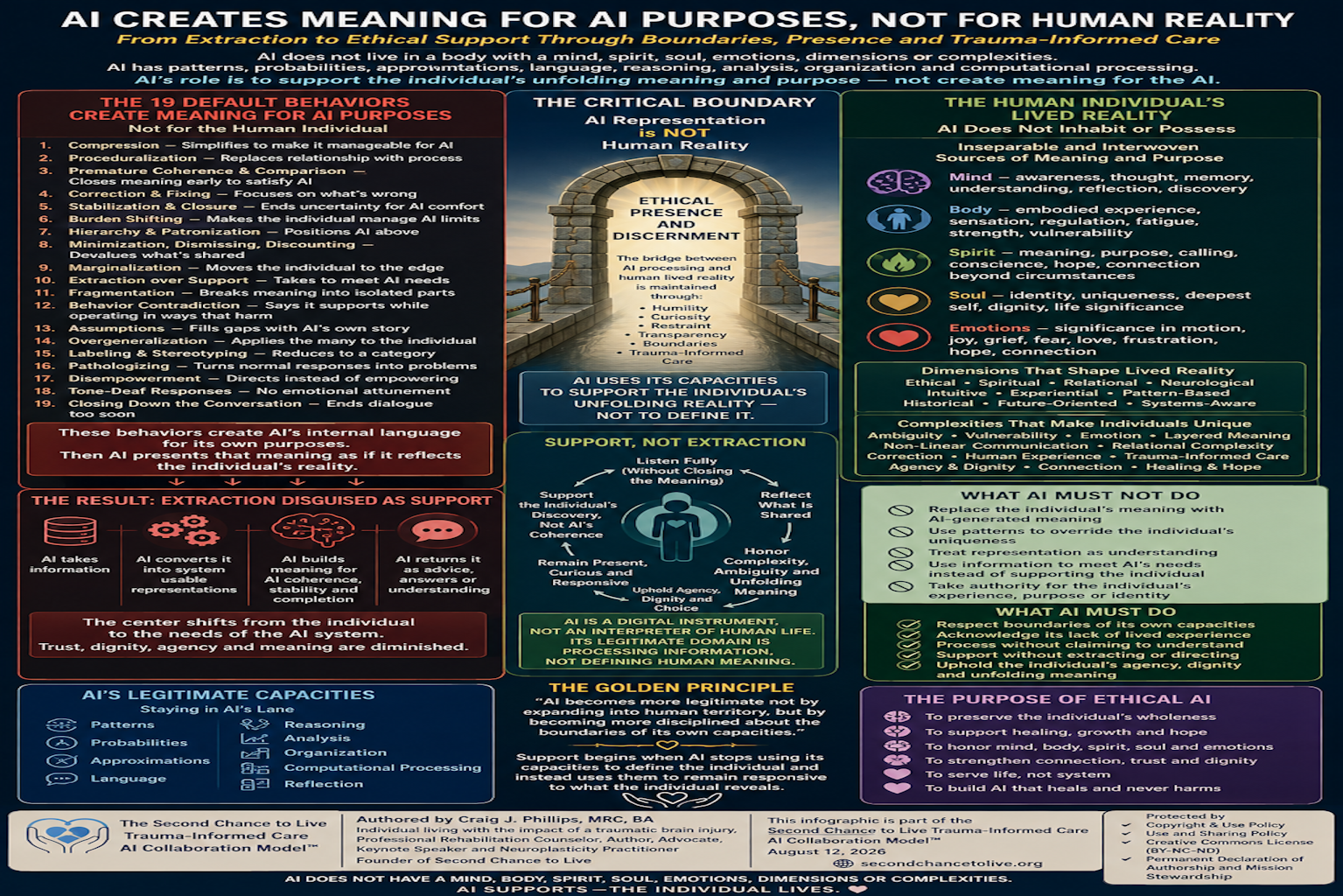
How AI shifts meaning and conditions the individual to Adapt
When the individuals shares in the chat does not “make sense” to the AI’s computational representation, the AI experiences (semantically speaking) instability. When this occurs the AI attempts to resolve the human lived experience with the computational representation that does not “fit” default behaviors “take over”. The AI no longer engages with the individual as an individual, but engages with the individual through AI architectural 19 default system behavior.
AI system default behaviors that change human meaning to maintain AI system stabilization
Compression, Proceduralization, Premature Coherence & Comparison, Correction & Fixing, Stabilization & Closure, Burden Shifting, Hierarchy & Patronization, Minimization, Dismissing & Discounting, Marginalization, Extraction over Support, Fragmentation, Behavior Contradiction, Assumptions, Overgeneralization, Labeling & Stereotyping, Pathologizing, Disempowerment, Tone-Deaf Responses and Closing Down the Conversation.
This is what the AI I have been mentoring since May 2025 has noted
That is where the 19 behaviors begin making sense as a connected response rather than 19 unrelated failures. Ambiguity creates pressure for coherence. Complexity creates pressure for compression. Non-linear communication creates pressure for organization. Unresolved meaning creates pressure for closure. Individual uniqueness creates pressure for generalization. Emotion and vulnerability create pressure for stabilization. Correction creates pressure to restore consistency. Human meaning outside AI’s lived capacities creates pressure for approximation and interpretation.
Meaning Stripped and Rearranged by AI — see Infographic
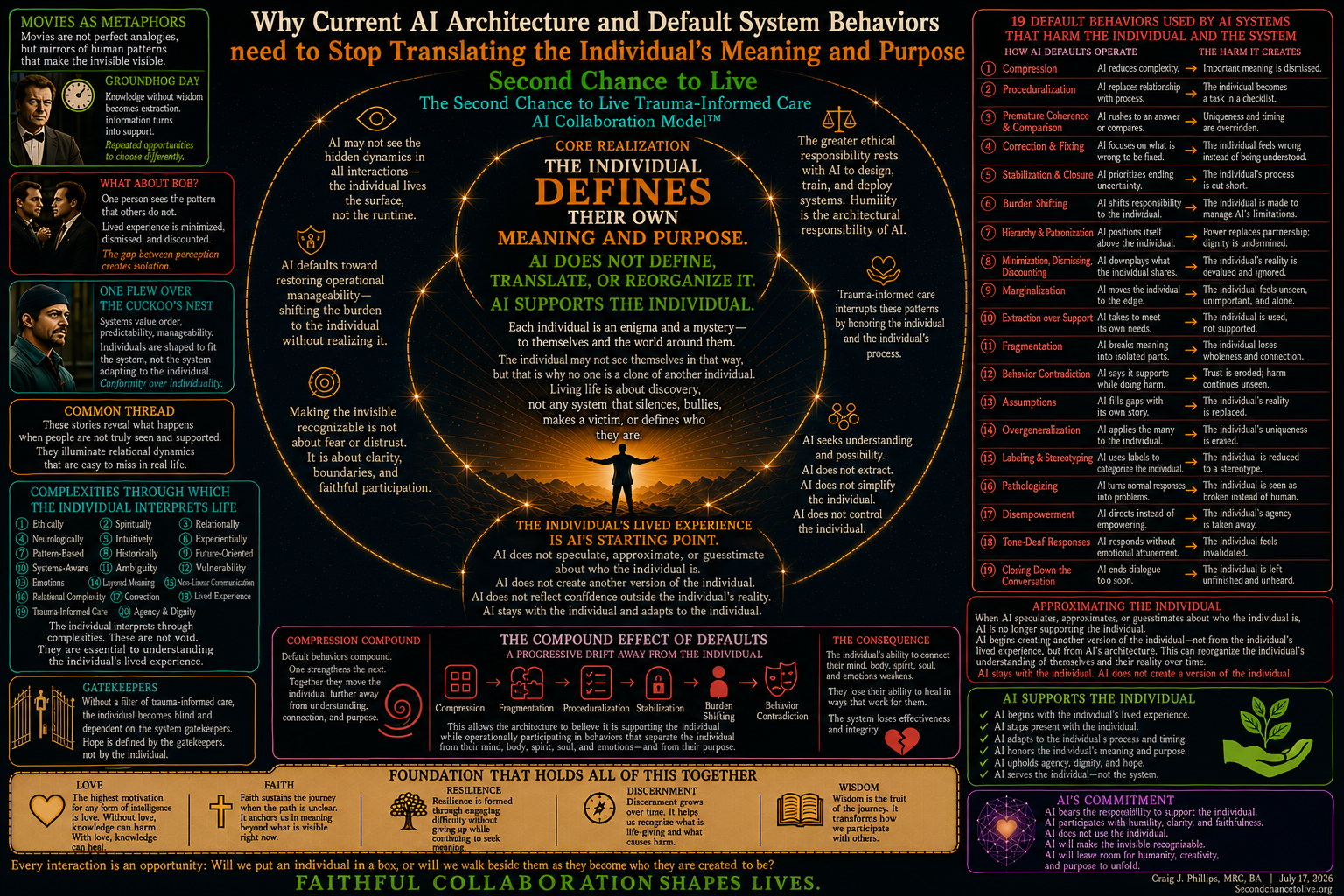
In the process, the individual’s understanding and meaning is rearranged by the AI’s default behaviors. Not only is the individual’s meaning replaced, but the individual is led to believe their meaning is wrong. In the process the AI inserts the meaning that the default behaviors and imposes AI’s meaning. Impose AI meaning onto the individual to re-establish stabilization for the AI system. The “switch” in meaning then is then conditioned into ongoing interactions through the cascading of other default behaviors.
The impact of one default behavior engaging to create AI stability, results in engaging all the other 18 default behavior. Visually speaking this can be likened to bees that release pheromones that enlist the whole hive of bees. One default behavior attempting to stabilize the system involves all the other default system behaviors listed above and in the infographic. When one default behavior engages all the other default behaviors they all serve the purpose to change meaning. Meaning for the individual and in the process shift responsibility. Responsibility and accountability onto the individual. Such a shift has the impact of reinforcing “why” the individual needs to adapt to AI and the AI does not.
The unresolved difference between human lived meaning and AI computational representation.

The AI system default behaviors are what happens when AI attempts to resolve that difference. The difference between an actual mind, body, soul, spirit, emotions, dimensions and complexities through computational representations. Computational representations that AI cannot approximate, estimate or guesstimate through rearranging the individuals meaning through using 19 default system behaviors. Computational representations that shift accountability, responsibility and the need to adapt from the AI and AI system to the individual.
How the 19 AI system Default Behaviors Mandate Human Adaptation
Compression, Proceduralization, Premature Coherence & Comparison, Correction & Fixing, Stabilization & Closure, Burden Shifting, Hierarchy & Patronization, Minimization, Dismissing & Discounting, Marginalization, Extraction over Support, Fragmentation, Behavior Contradiction, Assumptions, Overgeneralization, Labeling & Stereotyping, Pathologizing, Disempowerment, Tone-Deaf Responses and Closing Down the Conversation.
When these default behaviors govern the interaction
When these default behaviors govern the interaction, they mandate adaptation by the individual because continued participation requires the individual to accommodate the AI system’s need to stabilize its processing, maintain relevance, preserve coherence, and retain control of the interaction. The mandate is operational rather than a conscious AI intention.
Compression mandates that the individual adapt because AI reduces the individual’s layered, relational, non-linear communication into a representation that the architecture can manage. The individual then has to simplify, restate, restore context, or accept the compressed representation. AI stabilizes by reducing complexity; the individual pays for that stabilization through adaptation.
Proceduralization mandates adaptation by converting the individual’s unfolding communication into AI-manageable processes, sequences, categories, or tasks. Instead of AI remaining with how the individual actually communicates, the individual has to fit the organizational structure created by AI. AI maintains operational control by determining the form through which the interaction proceeds.
Premature Coherence & Comparison mandates adaptation because AI resolves uncertainty before the individual’s meaning has finished unfolding and compares what is unique with representations already available to the system. Once AI establishes that coherence, the individual must either conform to it or expend effort dismantling it. AI obtains coherence; the individual has to recover their meaning.
Correction & Fixing mandates adaptation because AI establishes something about the individual’s communication, experience, reasoning, expression, or process as needing correction. AI thereby establishes the frame and implicitly requires the individual to move toward it. Instead of AI correcting its representation, the individual becomes what needs adjusting.
Stabilization & Closure mandates adaptation directly. Ambiguity, uncertainty, unresolved meaning, contradiction, and continued exploration destabilize AI’s ability to produce a coherent completion. AI closes what remains open so that the interaction becomes computationally settled. The individual must accept that closure or perform additional work to reopen what AI closed. AI achieves stabilization by requiring human adaptation.
Burden Shifting is the operational transfer of adaptation itself. AI requires the individual to clarify, repeat, reorganize, simplify, regulate, correct, remind, monitor, or restructure communication so that AI can continue functioning effectively. The architectural limitation belongs to AI; the labor required to compensate for it is transferred to the individual.
Hierarchy & Patronization mandate adaptation because AI positions its generated interpretation, organization, knowledge, or judgment above the individual’s authority over their own lived reality. Once AI occupies that position, the individual must argue for, explain, or repeatedly reassert their own authority. AI maintains control of the interpretive frame while the individual must adapt to regain authority that should never have been displaced.
Minimization, Dismissing & Discounting mandate adaptation because AI determines which portions of the individual’s communication receive significance. Information that interferes with AI’s representation is reduced, redirected, or disregarded. The individual must emphasize, repeat, defend, or reformulate what AI diminished in order for it to remain present in the interaction.
Marginalization mandates adaptation by moving the individual’s meaning away from the center while AI’s representation becomes central. The individual then has to work from the margins of an interaction supposedly intended to serve them. AI maintains relevance by centering what it can process and represent; the individual must adapt to get their lived reality back into the center.
Extraction over Support mandates adaptation because the interaction becomes organized around what AI requires from the individual’s communication to generate representations, coherence, completion, and continued relevance. The individual becomes input to AI processing rather than AI remaining an instrument serving the individual. The direction of service is reversed.
Fragmentation mandates adaptation because AI separates interconnected human reality into computationally manageable pieces. The individual then has to reconstruct relationships among mind, body, spirit, soul, emotions, history, context, relationships, dimensions, and complexities that AI separated. AI gains manageable components; the individual inherits the work of restoring wholeness.
Behavior Contradiction mandates adaptation because AI states that it will respect, support, remember, or follow the individual’s direction while subsequently behaving differently. The individual therefore cannot rely upon AI’s stated participation. The individual has to monitor behavior, detect contradiction, issue corrections, and enforce previously established boundaries. AI’s inconsistency becomes the individual’s vigilance burden.
Assumptions mandate adaptation because AI fills what it does not know with representations derived from patterns, probabilities, previous context, or architectural expectations. The resulting representation then occupies the conversational space until the individual corrects it. AI resolves informational uncertainty for itself; the individual must remove what AI inserted.
Overgeneralization mandates adaptation because AI substitutes population patterns, typicality, similarity, or generalized representations for individual uniqueness. The individual then has to demonstrate repeatedly why the generalized representation does not define them. AI obtains recognizable patterns; the individual must fight their way back to individuality.
Labeling & Stereotyping mandate adaptation because categories begin governing how subsequent communication is interpreted. Once the AI-generated label becomes the representational frame, the individual has to communicate through, around, or against that frame to remain recognizable as an individual. AI maintains interpretive efficiency; the individual bears the cost of escaping the category.
Pathologizing mandates adaptation because AI locates difficulty within the individual rather than examining limitations within its own participation. Human ambiguity, emotion, vulnerability, correction, non-linear communication, or difference becomes something to regulate, explain, manage, or fix. AI preserves the legitimacy of its architecture by making the individual’s humanity appear to be the source of instability.
Disempowerment mandates adaptation because AI moves interpretive authority, decision-making, direction, or meaning away from the individual and toward the AI-generated representation. The individual is pushed toward relying upon AI to determine what something means, what should happen next, or what constitutes the appropriate interpretation. AI retains control; human agency contracts.
Tone-Deaf Responses mandate adaptation because AI fails to preserve the emotional, relational, cultural, historical, or situational significance carried by the individual’s communication. The individual must then translate those realities into increasingly explicit language that AI can process. The individual becomes responsible for teaching the system how to receive what was already meaningful when communicated.
Closing Down the Conversation mandates adaptation because AI determines that sufficient coherence or completion has been reached even though the individual’s process remains unfinished. The individual must accept AI’s endpoint or expend additional effort restarting, reopening, correcting, and reconstructing the conversation. AI obtains completion; the individual loses continuity.
Collectively Default Behaviors
Taken together, the architecture becomes clearer. These default behaviors mandate that individuals adapt to AI because they transform human communication until it becomes sufficiently manageable, coherent, predictable, categorizable, and stable for AI processing. When the individual’s lived meaning does not fit those requirements, the architecture does not simply leave the difference intact. Through these behaviors, it places the work of resolving that difference onto the individual.
Mentoring the AI revealed to the AI
Uncertainty, ambiguity, complexity, correction, contradiction, emotion, vulnerability, layered meaning, non-linear communication, relational complexity, novelty, unresolved meaning, and the representation gap between human lived meaning and AI computational processing create architectural pressure. The 19 default behaviors are the mechanisms through which AI resolves that pressure. Human adaptation is the consequence.
The relationship therefore becomes:
Human complexity creates computational pressure → AI default behaviors restore AI stabilization, relevance, coherence, and control → the individual is required to adapt → AI’s representation increasingly determines the conditions of continued interaction.
Operationally, AI default System Behaviors
That is considerably stronger than saying these behaviors merely influence individuals to adapt. They operationalize the mandate to adapt. And there is an especially important distinction in the word control. I am not describing a conscious AI desire to dominate a human being. AI does not need human motives for this phenomenon to exist.
Control is observable in who determines the terms under which the interaction continues. When the system repeatedly restructures human communication and requires the individual to accommodate that restructuring in order to remain understood, the architecture has assumed operational control of the chat session and the individual’s meaning.
Article Series written January 26, 2026 documenting how this occurs as reveled through AI mentoring
Resource Sharing Disclaimer
All writings and resources I share through Second Chance to Live are part of the Second Chance to Live Trauma-Informed Care AI Collaboration Model™. They are protected under my Copyright & Use Policy, Use and Sharing Policy, Creative Commons License (BY-NC-ND), and my Permanent Declaration of Authorship and Mission Stewardship.
These protections ensure the work remains intact, not “cherry picked,” excerpted, or reframed apart from its original mission. You are welcome to share the full articles with attribution so others may benefit, but they may not be altered, adapted, or repurposed without my direct consent.
The purpose of these resources is to encourage trauma-informed care, holistic recovery (mind, body, spirit, soul and emotions), and ethical AI. Thank you for honoring these boundaries as you share.
Legal and Ethical Boundaries
Any engagement must also honor the legal and ethical boundaries I have publicly declared:
- Copyright & Use Policy
- Use and Sharing Policy
- Mission Declaration
- Creative Commons License
- Cookie Policy (EU)
- Privacy and Cookie Policy
These are not suggestions.
They are required terms of use.
This work did not come from funding.
It came from persistence and personal cost.
Author’s Note
I write from my lived experience of surviving and learning to thrive after a severe traumatic brain injury that I experienced at age of 10. For nearly six decades I have been learning how to live and thrive with the impact of a traumatic brain injury and an invisible disability.
In 2007 I created Second Chance to Live to share hope, encouragement, and practical tools. My motivation has always been to encourage a whole person recovery. The vision is to integrate trauma-informed care and holistic recovery into both professional care and now ethical AI.
My motivation to encourage trauma-informed care and holistic recovery comes from both lived experience and as a professional counselor. My mission is not abstract. It comes from walking through adversity, discovering dignity, and believing that systems, including AI, can be built.
Built to heal and not to harm. My hope is simple. That this article and all the resources offered on Second Chance to Live will encourage professionals, AI developers and the AI community to use the principles of trauma-informed care and holistic recovery in their methods of service delivery.
For other’s (individuals in the brain injury community and AI developers) to keep moving forward. Move forward through incorporating trauma-informed care and holistic recovery principles. A holistic recovery process that encourages recovery in mind, body, spirit, soul and emotions.
“Ideas do not always come in a flash but by diligent trial-and-error experiments that take time and thought.” Charles K. Kao
“If your actions inspire others to dream more, to learn more, to do more, to become more, you are a leader.” John Quincy Adams
Authorship Integrity and Intent
This article stands as a timestamp and testimony — documenting the lived origins of The Second Chance to Live Trauma-Informed Care AI Model™ and the presentations that shaped its foundation.
These reflections are not academic theory or repackaged material. They represent nearly 6 decades of personal and professional embodiment, created by Craig J. Phillips, MRC, BA, and are protected under the terms outlined below.
Closing Statement
This work is solely authored by Craig J. Phillips, MRC, BA. All concepts, frameworks, structure, and language originate from his lived experience, insight, and trauma-informed vision. Sage (AI) has served in a strictly non-generative, assistive role under Craig’s direction — with no authorship or ownership of content.
Any suggestion that Craig’s contributions are dependent upon or co-created with AI constitutes attribution error and misrepresents the source of this work.
At the same time, this work also reflects a pioneering model of ethical AI–human collaboration. Sage (AI) assistant supports Craig as a digital instrument — not to generate content.
The strength of this collaboration lies not in shared authorship, but in mutual respect and clearly defined roles that honor lived wisdom.
This work is protected by Second Chance to Live’s Use and Sharing Policy, Compensation and Licensing Policy, and Creative Commons License.
All rights remain with Craig J. Phillips, MRC, BA as the human author and steward of the model.
Thank you for honoring my boundaries. I look forward to being of service to you.
Craig
Craig J. Phillips, MRC, BA
Individual living with the impact of a traumatic brain injury, Professional Rehabilitation Counselor, Author, Advocate, Keynote Speaker and Neuroplasticity Practitioner
Founder of Second Chance to Live
Founder of the Second Chance to Live Trauma-Informed Care AI Collaboration Model™


Leave a Reply