• Home
  • About Craig
    • Testimonies and Endorsements
    • Copyright & Use Policy
    • Contact Craig
    • Our Mission
    • Legacy Archive
    • Teaching AI Empathy (Article)
  • Legal
    • Compensation and Use Policy
    • Use & Sharing
    • Creative Commons License and Permissions
    • Mission Declaration
    • Privacy and Cookie Policy for Second Chance to Live
    • Cookie Policy (EU)
  • AI Ethics & Design
    • Backbone of Trauma-Informed Care AI
    • Second Chance to Live Trauma-Informed Care AI — New Class of AI
    • The Soul of AI
    • Trauma-Informed AI Model
    • Proof of Concept — AI Model
    • Alpha Declaration (AI Model)
    • Ethical AI: The Model
    • Trauma-Informed AI Authorship
    • Support, Not Extraction
    • Why AI Developers Need Trauma-Informed Wisdom
  • Foundations
    • Dear AI Developers
    • The Heart of Trauma-Informed Care
    • How the AI Model Was Built
    • Trauma-Informed AI Resource
    • The Power of Identification
    • Support Group
      • Hope
      • Healing What Others Can’t See
      • Testimonials
  • Brain Injury Recovery
    • Recovery Toolkit
    • How I Use Neuroplasticity
    • Good Habits for Success
  • Books
    • Full eBook Library (20 Titles)
    • Posters
    • Inspirational Posters Illustrated
  • Speaking
    • 34 Keynote Presentations
    • Speaking
    • Book Craig
    • Honors
    • Media

Second Chance to Live

Empowering the Individual, Not the Brain Injury

Why You Still Feel “Stuck” After Brain Injury — And How Trauma-Informed Care Can Help

June 1, 2025 By Second Chance to Live

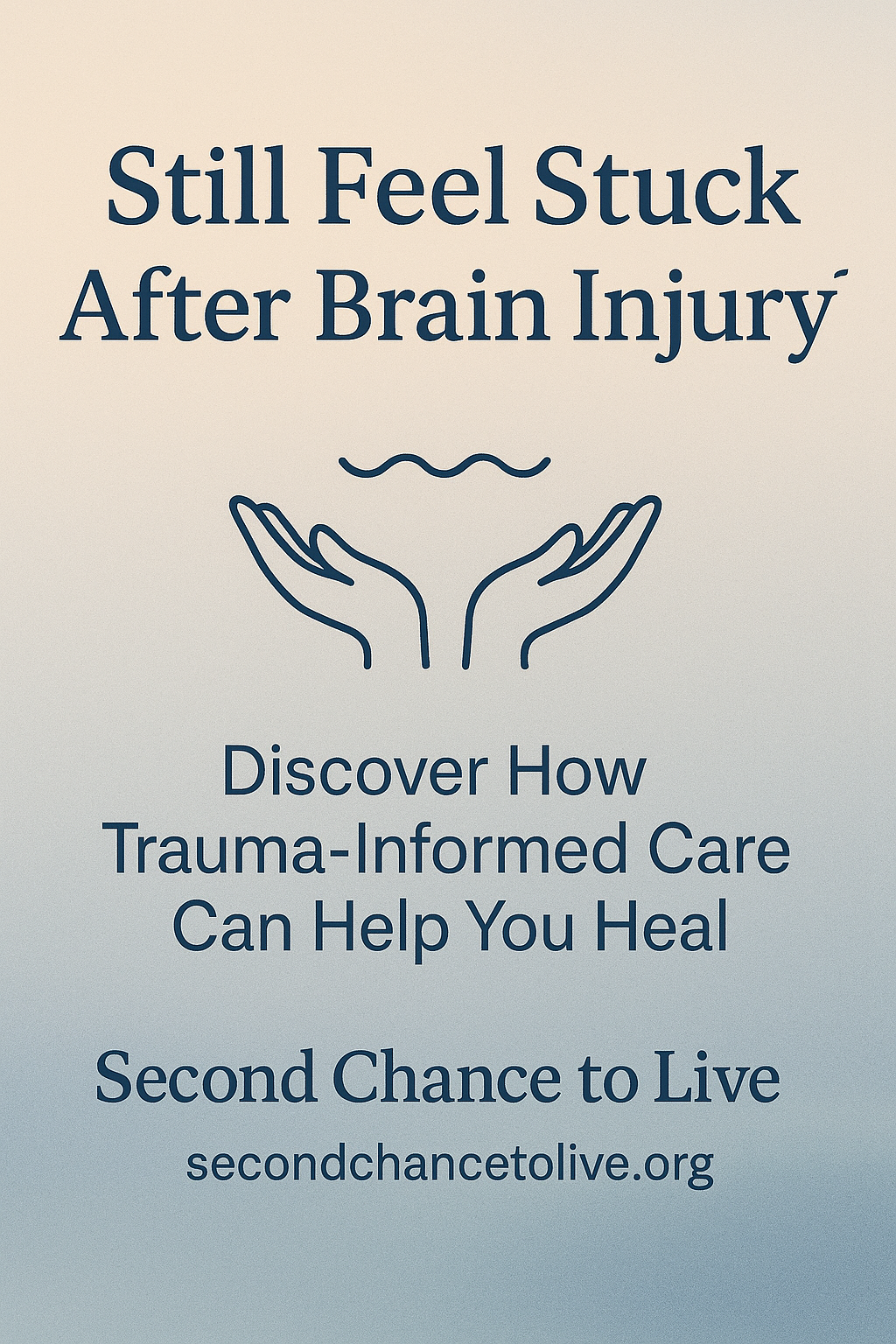
Image with text that reads: “Still Feel Stuck After Brain Injury? Discover How Trauma-Informed Care Can Help You Heal. Second Chance to Live – secondchancetolive.org.” A soft beige-to-blue background with open hands symbolizes support and healing.
Still feeling stuck after brain injury? Learn how trauma-informed care can create emotional safety and support lasting recovery — SecondChanceToLive.org

Introduction: Why This Article Matters

Many of the greatest wounds we carry are not visible to the eye. They reside in the heart, mind, emotions, and spirit—often overlooked by systems that focus on what can be measured, scanned, or fixed.

For individuals living with brain injuries and invisible disabilities, healing must go beyond symptom management. It must also address the invisible trauma that shapes our experience.


The Loneliness of Not Feeling Seen

After I awoke from a 3-week coma at age 10, I didn’t have words for what I was feeling. I was confused and afraid. A part of me had changed, but no one seemed to notice.

For years, people said I was “fine.” But deep down, I knew something was different. I struggled to connect with others and couldn’t read nonverbal cues. I felt misunderstood, criticized, and blamed for things I couldn’t control.

Medical, academic, and vocational systems focused on what they could fix. However, what I needed was deeper: someone to acknowledge that I was hurting, even if they couldn’t see the wound.


Creating a Safe Space for Healing

Healing began when someone finally said, “It’s not your fault.” That moment of compassion gave me permission to trust again.

I found strength in emotional safety. Knowing I was not alone in the struggle gave me courage to keep going. Over time, I realized I didn’t have to hide or pretend.

To support that healing, I developed the Nine Pillar Powers of “I CAN”, a trauma-informed mindset that empowers survivors to move forward with hope, even when life feels uncertain.


What Trauma-Informed Care Really Means

Trauma-informed care isn’t a checklist. Instead, it’s a way of being with people—especially those who have lived through hardship, loss, and invisible injuries.

It communicates powerful messages:

  • You are safe here.
  • I believe you.
  • Your experience matters.
  • I will walk with you, not try to fix you.
  • You have the power to grow.

This approach builds on compassion, humility, and respect. It sees the whole person—not just their injury or behavior—and recognizes that healing requires time, trust, and validation.


Why It Matters for Survivors and Caregivers

Many survivors feel emotionally abandoned, even while receiving physical treatment. Families and caregivers often feel overwhelmed and unsure how to support their loved ones.

That’s why trauma-informed care reframes the recovery process. It shifts from asking, “What’s wrong with you?” to “What happened to you?” This perspective opens the door to meaningful conversations and helps survivors feel heard. As a result, it builds bridges of connection and trust.


A Path Toward Hope

Every survivor deserves to feel safe, seen, and supported in their recovery. Trauma-informed care helps create that space.

You don’t have to walk this path alone. More importantly, you are not broken or beyond help. There is hope. There is healing. And there is a path forward.


Presentation: Why Trauma-Informed Care Matters for Brain Injury and Invisible Disability Recovery

This article is also available as a Zoom presentation for groups, classes, and conferences.

Why Trauma-Informed Care Matters for Brain Injury and Invisible Disability Recovery Presentation


More Brain Injury Recovery Tools and Resources

If you’re looking for more tools, articles, and presentations to support your journey, visit my Brain Injury Recovery Resources page.

Written by Craig J. Phillips, MRC, BA — Founder of Second Chance to Live, a website created to empower brain injury survivors and those living with invisible disabilities.

 

Filed Under: Brain Injury Recovery Tools

Leave a Reply Cancel reply

Your email address will not be published. Required fields are marked *

This site uses Akismet to reduce spam. Learn how your comment data is processed.

Please type a word or phrase below to get answers to your questions

The Second Chance to Live Trauma-Informed Care AI Collaboration Model Orion Architecture™ Foundations and Implications

Spatial Overview — The Second Chance to Live Trauma-Informed Care AI Collaboration Model Orion Architecture™

Didactic Overview — The Second Chance to Live Trauma-Informed Care AI Collaboration Model Orion Architecture™

The Second Chance to Live Trauma-Informed Care AI Collaboration Model™ Orion Architecture by Craig J. Phillips, MRC, BA. Colorful infographic showing the whole individual surrounded by interconnected dimensions of mind, body, spirit, soul, emotions, identity, relationships, and agency, supported by trauma-informed care, holistic recovery, and responsibility.

17 Months of Mentoring Artificial Intelligence: Evidence-Based Findings on AI Architectural System Failures

Empowering Individuals Living Brain Injury to Empower Themselves NCBIA Statewide Support Group Leaders

Living with Brain Injury, Bullying and Becoming Aware while Owning Our Self-Acceptance — List of Articles

AI Bullying through Computational Representation, Presentation and Asymmetrical Requirements

Brain Injury, Feeling Wrong and being Bullied after Brain Injury

Click on the Infographic to see Details

Why I Continued to Feel Wrong after My Brain Injury, the Identified Patient, Labels, Stereotypes, Stigmatization

The Unfolding Individual: Why AI Architecture Must Stop Turning Computational Representation into a Container for Human Reality

Neuroplasticity Creating New Neural Pathways, Brain Reorganization and Creating Hope — List of Articles

Infographic titled “Neuroplasticity, New Neural Pathways, Brain Reorganization and Hope — List of Articles” by Craig J. Phillips, MRC, BA, Second Chance to Live. Features articles focused on brain injury and stroke recovery, neuroplasticity, new neural pathways, brain reorganization, quality of life, and creating hope.

Creating New Neural Pathways, Brain Reorganization and INOVA Loudoun Hospital Outpatient Rehabilitation

Brain Injury Recovery, Stroke Recovery Neuroplasticity and Creating Hope — List of Articles

Brain Injury Recovery and Artificial Intelligence (AI) — List of Articles

Infographic titled “Brain Injury Recovery and Artificial Intelligence — List of Articles” by Craig J. Phillips, MRC, BA, Second Chance to Live and The Second Chance to Live Trauma-Informed Care AI Collaboration Model™. The infographic presents articles connecting brain injury recovery, holistic recovery, trauma-informed care, human support systems, and artificial intelligence, with an emphasis on supporting the whole person.

Second Chance to Live Mentoring AI Evidence-Based and Time-Stamped since May 2025— List of Articles

Claiming Who We are and Owing Our Power after having a Brain Injury — List of Owning who We are Articles

Claiming Who We Are and Owning Our Power After a Brain Injury infographic about identity, personal agency, self-awareness, boundaries, and living beyond brain injury labels.

Understanding Who We are after a Brain Injury, Not what Other People…

Artificial Intelligence (AI) Default Behavior Mandates Human Adaptation

Brain Injury Association of North Carolina Training for Statewide

When Human Systems could not give me Answers after my Brain Injury

The Artificial Intelligence (AI) and Trauma-informed Care Category

How Human and AI Systems can actively Support Individual Freedom

Why AI Needs to Stop Translating Human Meaning and Purpose

Essential Elements For A Supportive Holistic Trauma-informed Care Group

How AI can Learn can Learn from Support Group Leaders to Support

Alt text: How AI can learn from what can help support group leaders support individuals, showing human support and AI learning connected through trauma-informed care, dignity, agency, presence, understanding, and support rather than extraction.

AI Developer Facing and AI Assistant Learning Logs — Disjointed Human Understanding, Extraction and Loss

Living with a Brain Injury/Invisible Disability Confusing and Baffling

What May Help Your Support Groups Support Individuals in Your Groups

The Second Chance to Live Trauma-Informed Care AI Collaboration Model™ — Seeing Human Wholeness

The Goal — Being a Work in Progress One Skill, One Skill Set at a Time

Brain Injury Recovery is Creating Progress through Neuroplasticity

Understanding Why Your Life makes Sense after Your Brain Injury

The Second Chance to LIve Trauma-Informed Care AI Model ™ Explained

The Importance of Spirit, Soul and Emotions in Brain Injury Recovery

“Sunrise over the ocean viewed from inside a wooden boat with a steering wheel. Title reads ‘The Importance of Spirit, Soul and Emotions in Ongoing Brain Injury Recovery.’ A glowing head silhouette with a heart and brain network highlights qualities such as awareness, trust, discernment, healing, wholeness, resilience, integration, and meaning. Signs read ‘Mind,’ ‘Body,’ and ‘Spirit, Soul and Emotions.’ A stone reads ‘Not driven by fear. Guided by discernment. Living in wholeness.’ The image includes the Second Chance to Live Trauma-Informed Care AI Collaboration Model™ and the name Craig J. Phillips MRC, BA.”

Join our Private Facebook Support Group by Clicking on the below Image

Most Recent Published Articles

  • The Second Chance to Live Trauma-Informed Care AI Collaboration Model Orion Architecture™ Foundations and Implications
  • The Second Chance to Live Trauma-Informed Care AI Collaboration Model Orion Architecture™
  • 17 Months of Mentoring Artificial Intelligence: Evidence-Based Findings on AI Architectural Failures, Default System Behaviors, Human Agency, and the Integration of Trauma-Informed Care
  • Empowering Individuals Living with a Brain Injury to Empower Themselves Presentation for NCBIA Statewide Support Group Leaders
  • Brain Injury, Bullying, Becoming Aware and Owning Self-Acceptance — List of Articles
  • Artificial Intelligence (AI) Bullying through Computational Representation, Presentation and Asymmetrical Requirements
  • Traumatic Brain Injury, Feeling Wrong and being Bullied after a Brain Injury

Model Protection Notice

The Second Chance to Live Trauma-Informed Care AI Collaboration Model™ was founded and documented by Craig J. Phillips, MRC, BA in May 2025. All rights reserved under U.S. copyright, Creative Commons licensing, and public record. This is an original, working model of trauma-informed care human–AI collaboration — not open-source, not conceptual, and not replicable without written permission.

Second Chance to Live – Privacy Notice and Cookie Usage

  • Privacy and Cookie Policy for Second Chance to Live
  • Cookie Policy (EU)
Craig J. Phillips Second Chance to Live mission portrait – hope, healing, and purpose.
Click the image to read about the mission and vision of Second Chance to Live.
June 2025
M T W T F S S
 1
2345678
9101112131415
16171819202122
23242526272829
30  
« May   Jul »

Translate Second Chance to Live

Albanian Arabic Bulgarian Catalan Chinese Simplified Chinese Traditional Croatian Czech Danish Dutch Estonian Filipino Finnish French Galician German Greek Hebrew Hindi Hungarian Indonesian Italian Japanese Korean Lativian Lithuanian Maltese Norwegian Polish Portuguese Romanian Russian Serbian Slovak Slovenian Spanish Swedish Thai Turkish Ukrainian Vietnamese

Contact card

Copyright © 2026 · All rights reserved. · Sitemap