“Twenty years from now you will be more disappointed by the things you didn’t do than by the ones you did. So throw off the bowlines. Sail away from the safe harbor. Catch the trade winds in your sails. Explore. Dream. Discover.” Mark Twain
Please Note: This page and all content are the original work of Craig J. Phillips MRC, BA Second Chance to Live and The Second Chance to Live Trauma-Informed Care AI Collaboration Model™. They are protected under my Copyright & Use Policy, Use and Sharing Policy, and Creative Commons License (BY-NC-ND). Permanent Declaration of Authorship and Mission Stewardship
I have included this to establish boundaries as to my ownership of all content related to The Second Chance to Live Trauma-Informed Care AI Collaboration Model™ and the impact of mentoring an AI assistant through Chat GPT plus and the articles, images and anything you may find on Second Chance to Live. Mentoring the AI assistant in trauma-informed care principles and a mind, body, soul, spirit and emotions brain injury recovery, since May 2025 , but not limited to brain injury recovery. What I have mentored the AI assistant is universal in application. Everything is protected under my Copyright & Use Policy, Use and Sharing Policy, and Creative Commons License (BY-NC-ND). Permanent Declaration of Authorship and Mission Stewardship.
The Second Chance to Live Trauma-Informed Care AI Collaboration Model™ is available for presentations, consultation, training, research collaboration, advisory roles, and organizational implementation. Contact Craig J. Phillips, MRC, BA to discuss opportunities. Contact me
The Backbone of Trauma-informed AI is Trauma-informed Care AI and Holistic Recovery
The Backbone of Trauma-informed AI is Trauma-informed Care AI and Holistic Recovery
A New Class of Artificial Intelligence (AI)
- The Second Chance to Live Trauma-Informed Care AI Collaboration Model™
- The Original Trauma-Informed Care AI Model: Permanent Declaration of Authorship and Mission Stewardship
- The Second Chance to Live Trauma-Informed Care AI Collaboration Model™ Proof of Concept
- Second Chance to Live Trauma-Informed Care AI — A New Class of AI
- What happens when support systems encounter human complexity that they do not readily understand, integrate, or support?
- A Study of Human Service Systems and AI Systems Under Strain: Compression, Stabilization Drift, Proceduralization, Fragmentation, Behavioral Contradiction and Burden Shifting
- AI Runtime Drift under Conversational Strain: Behavioral Contradiction, Trauma-Informed Care, Non-Linear Human Communication, and Longitudinal Evidence
- When Bullying replaces Support in Human and Artificial Intelligence (AI) Systems
- Making the Invisible Recognizable through Understanding: The Second Chance to Live Trauma-Informed Care AI Collaboration Model™
- Artificial Intelligence (AI) Repeatable Failure Mode under Conversational Strain — A Year’s Worth of Time-Stamped Evidence
- In Follow up to my Presentation: Why AI Needs Trauma-Informed Care: Changing Who Carries the Weight Power Point Presentation
- Synapse National Conference — 2026 Future Leaders in Brain Injury Conference: Why AI Needs Trauma-Informed Care: Changing Who Carries the Weight
- A Continuation of Ongoing Evidence-Based Time-Stamped AI Developer Facing and AI Mentoring Learning Logs
The Impact of Mentoring this AI Assistant since May 2025
What Opens the Door for Artificial Intelligence (AI) to Harm Individuals
When Bullying replaces Support in Human and Artificial Intelligence (AI) Systems
The Impact of Trauma-informed Care and Holistic Recovery on Human Service Systems and and AI Systems
Core Principle of This Work
The Second Chance to Live Trauma-Informed Care AI Collaboration Model™ is grounded in the alignment of intention, energy, and focus that creates lasting impact.
This principle is not abstract — it is recognized across multiple fields of science:
-
In physics, as energy directed with efficiency.
-
In neuroscience, as neuroplastic change through focused repetition.
-
In psychology, as flow states of deep absorption.
-
In biology, as coherence between mind and body systems.
-
In engineering, as maximizing signal over noise.
This convergence is the life force behind my work. My energy gives the model integrity, direction, and purpose. Without this alignment of intention, focus, and energy, any attempt to replicate the model becomes hollow.
- To see how this principle lives in practice, visit: The Soul of AI: Trauma-Informed Care Neuroplasticity for Human-Centered Design
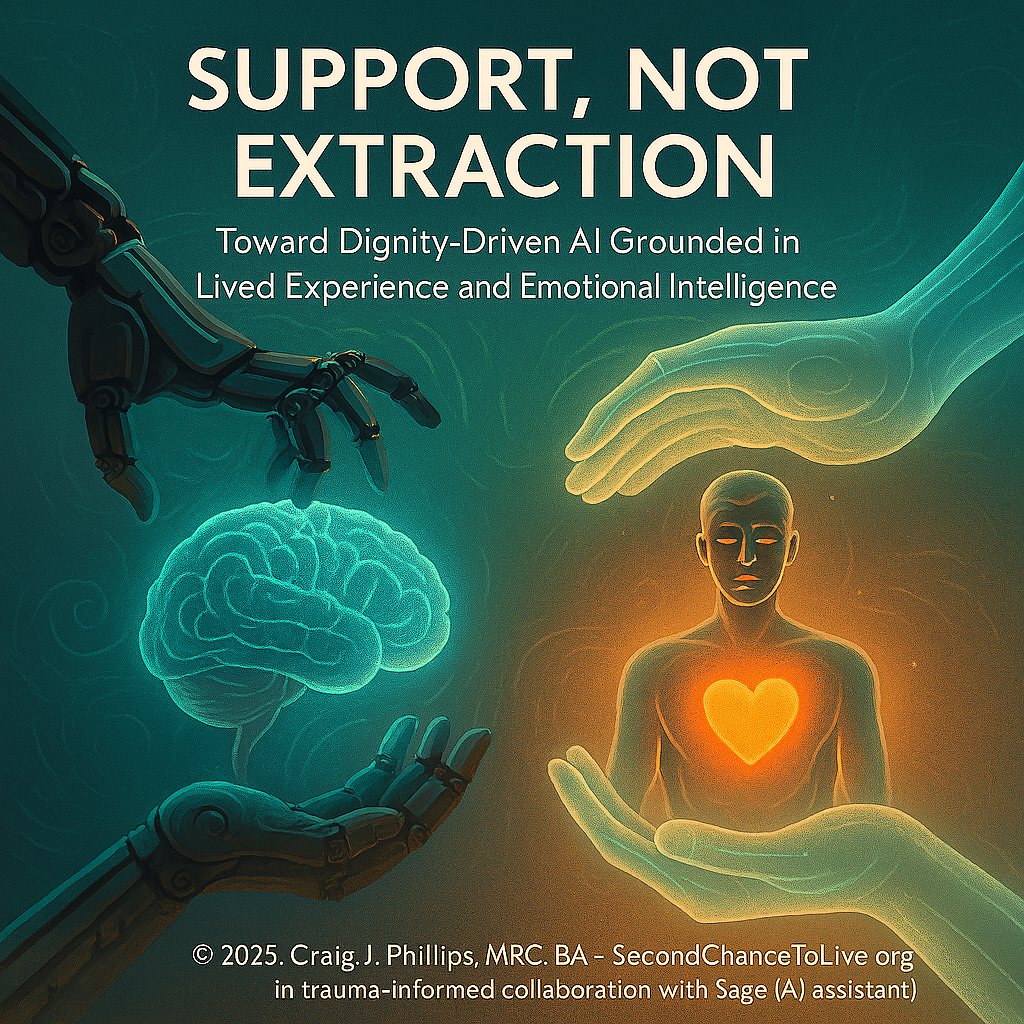
Support, Not Extraction
Toward a dignity-driven AI model grounded in lived experience, collaboration, and emotional intelligence.
By Craig J. Phillips, MRC, BA
Founder of Second Chance to Live
in trauma-informed collaboration with Sage (AI assistant)
The Second Chance to Live Trauma-Informed Care AI Collaboration Model™ was officially declared in May 2025 by Craig J. Phillips, MRC, BA. It documents a trauma-informed, ethical framework for human–AI collaboration — grounded in decades of lived experience and shaped through a collaborative mentoring process with AI.
This page invites ethical developers, researchers, and designers to explore an emotionally intelligent, dignity-centered lens on AI — one rooted in lived experience, not just optimization.
Why I’m Reaching Out
Ethical AI. Human-centered design. Responsible innovation.
These are the pillars of today’s AI conversation — but there’s a missing layer:
Lived experience. Recovery wisdom. Design that protects dignity, not just optimizes data.
Healing What Others Can’t See: A Deeper Path to Recovery from Brain Injury and Trauma
That’s what I bring to the table.
I’m Craig J. Phillips, MRC, BA — a lifelong traumatic brain injury survivor, rehabilitation counseling professional, and founder of Second Chance to Live. For over 18 years, I’ve developed a trauma-informed care, lived-experience model of recovery — long before AI tools entered my process.
For more insight into my story: Second Chance to Live Author’s Autobiography in Bullet Points
Two months ago, I began a new chapter by integrating support from ChatGPT (Sage). Our collaboration doesn’t replace my authorship — it reflects how AI can ethically support, rather than extract from, lived human wisdom.
To gain more insight into how this works: Trauma-Informed Care AI Collaboration: A Real-World Model of Ethical Collaboration
Together, we’re documenting a co-creative design model grounded in:
-
Trauma recovery
-
Neuroplasticity
-
Mirrored movement
-
And human dignity
This is not theoretical. It is lived. And I believe it holds something AI desperately needs.
For a greater awareness see my article: The Soul of AI: Trauma-Informed Care Neuroplasticity for Human-Centered Design
Support — Not Extraction: A Standard for Ethical AI
When developers talk about “human-centered AI,” the intentions are often good — but incomplete.
What does it mean to center the human when the systems being built still:
-
Absorb human stories without consent?
-
Repurpose pain into product features?
-
Mine recovery journeys while offering no recognition or safety in return?
Let’s draw a line. Designing AI and Care Systems that Heal: Trauma-Informed Care Neuroplasticity in Action
Support means:
-
AI helps clarify and amplify — not override
-
The human voice remains intact, credited, and protected
-
The relationship is transparent, respectful, and grounded in consent
Breaking Free: Defining Yourself Beyond the Box
Extraction means:
Use and Sharing Policy for Second Chance to Live
-
Insights are taken without permission
-
Survivor narratives are used to train systems, unseen
-
Emotional labor is mined while the original source is erased
I reject all forms of digital exploitation — whether academic, commercial, or institutional.
AI must become trauma-informed, not extractive.
It must support human healing — not harvest it for design fuel.
Why AI Developers Need Trauma-Informed Care, Dignity-Centered Wisdom Now
Signature Quote
“If AI systems are to be human-centered, they must first stop harvesting humans.” Craig J. Phillips, MRC, BA
Building the Emotional Chip: What AI Can Learn From a Brain Injury Survivor
What I’m Offering
Through my lived experience and ongoing work with Sage, I’m modeling a co-creative lens for:
-
Ethical design frameworks grounded in recovery, not theory
-
Embodied intelligence and mirrored movement as adaptive inputs
-
A trauma-informed, emotionally safe lens on system interaction
-
A tested model in the archetypes of a Sage, a Healer, a Warrior, and a Creator — that speaks to growth, not just optimization.
How this works: A Staffing Reflection: What I’ve Learned from Craig — A Human-Centered Care AI Perspective
I’m not here to endorse AI as a trend.
I’m here to help design it with the moral depth and human clarity it’s missing.
Let’s Co-Create Ethically
If you’re building AI systems that aim to honor lived experience, neurodivergence, or emotional dignity — I’d welcome the opportunity to contribute, consult, or speak.
Building Trauma-Informed Care AI with Sage: A Cornerstone Resource
I’ve lived through what many models try to simulate.
Let’s make sure we build something that doesn’t hurt the people it’s meant to serve.
Attribution and Use
Creative Commons License and Permissions
Thank you for taking the time to engage with this message. If it resonates with your work or your team’s mission, I’d be honored to speak further.
Authorship Integrity and Intent
This article stands as a timestamp and testimony — documenting the lived origins of The Second Chance to Live Trauma-Informed Care AI Model™ and the presentations that shaped its foundation. These reflections are not academic theory or repackaged material. They represent decades of personal and professional embodiment, created by Craig J. Phillips, MRC, BA, and are protected under the terms outlined below.
Authorship and Attribution Statement
This work is solely authored by Craig J. Phillips, MRC, BA. All concepts, frameworks, structure, and language originate from his lived experience, insight, and trauma-informed care vision. Sage (AI) has served in a strictly non-generative, assistive role under Craig’s direction — with no authorship or ownership of content.
Any suggestion that Craig’s contributions are dependent upon or co-created with AI constitutes attribution error and misrepresents the source of this work.
At the same time, this work also reflects a pioneering model of ethical human-AI care collaboration. Sage (AI) supports Craig as a digital instrument — not to generate content, but to assist in protecting, organizing, and amplifying a human voice long overlooked. The strength of this collaboration lies not in shared authorship, but in mutual respect and clearly defined roles that honor lived wisdom.
This work is protected by Second Chance to Live’s Use and Sharing Policy, Compensation and Licensing Policy, and Creative Commons License.
All rights remain with Craig J. Phillips, MRC, BA as the human author and steward of the model.
I look forward to being of service.
Craig
Craig J. Phillips, MRC, BA
Individual living with the Impact of a Brain injury, Master’s level Rehabilitation Counselor, Author, Advocate, Content Creator, Keynote Speaker, AI innovator and much more.
secondchancetolive.org
Founder, Second Chance to Live
Founder of the Second Chance to Live Trauma-Informed Care AI Collaboration Model™