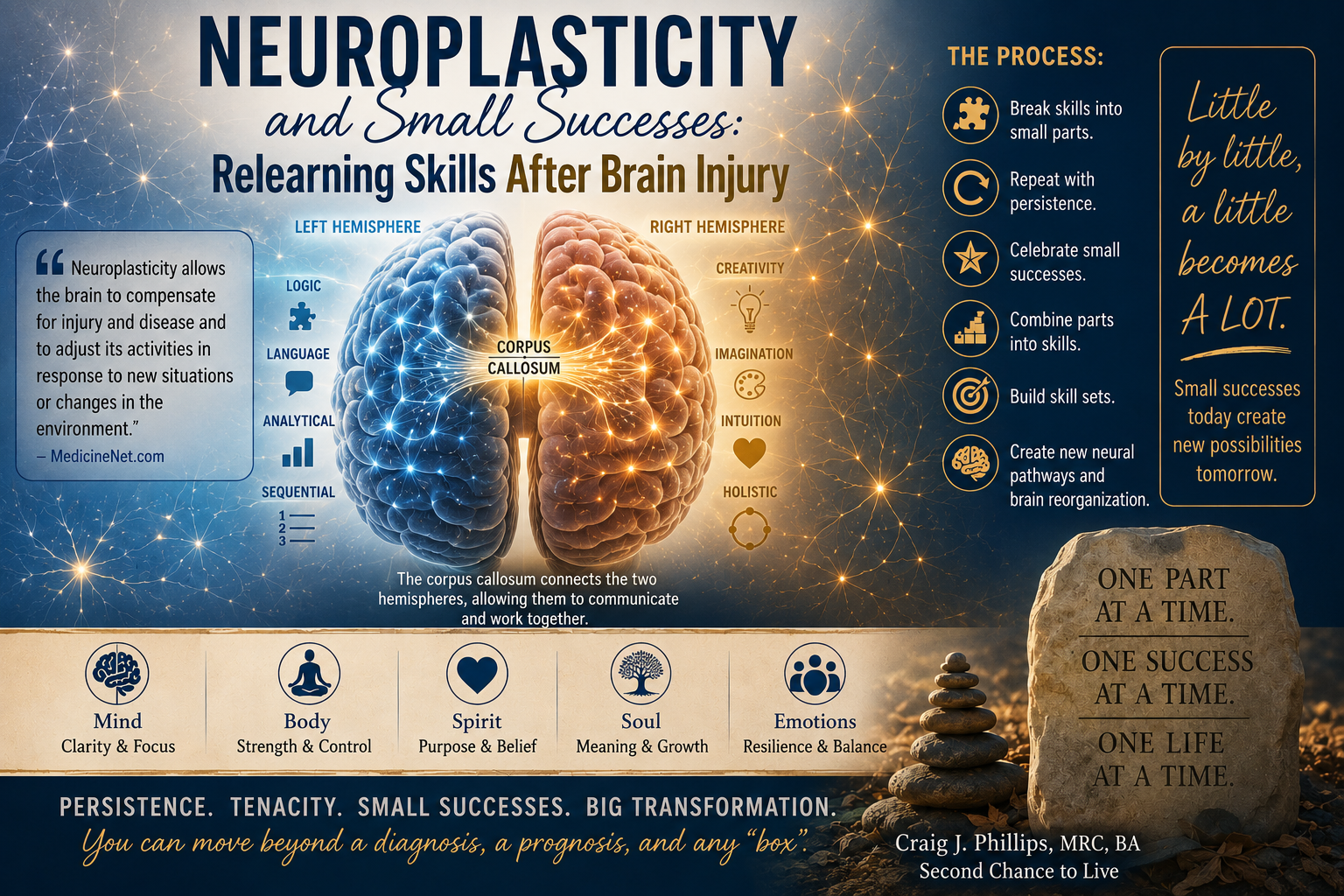
Neuroplasticity and Small Successes: Relearning Skills After Brain Injury
I have also created a video presentation of this article. To listen to and watch the presentation, please click on this link: Neuroplasticity, Small Successes and Learning / Relearning Skills and Skill Sets Video Presentation
Scroll down this page to watch demonstrations of my using Neuroplasticity to create new neural pathways and brain reorganization through Martial Arts.
Hello and welcome back to Second Chance to Live my friend. I am happy to have you around my table. Thank you. Following a brain injury, we may find that skills that came naturally to us, now are difficult to achieve. In the process, we may find ourselves both frustrated and discouraged. We may find ourselves wanting to give up. But there is good news. By staying committed to the process we can learn to compensate and build confidence.
Little by Little
Little by little, we can achieve what we never dreamed possible. In the process, we can begin to celebrate successes as we are learning/relearning skill sets.
In today’s article, I would like to share with you something that has helped me to learn new skill sets. Through learning these skills I have been able to use those skills in other areas of my life. In the process of applying those skills to other areas, my quality of life has improved. In my experience, learning these skills did not come over night. But through staying committed to the process I have experienced both small and huge successes.
As explained in MedicineNet.com, I had been using the principle of the concept of neuroplasticity:
“Neuroplasticity allows the neurons (nerve cells) in the brain to compensate for injury and disease and to adjust their activities in response to new situations or to changes in their environment. Brain reorganization takes place by mechanisms such as “axonal sprouting” in which undamaged axons grow new nerve endings to reconnect neurons whose links were injured or severed. Undamaged axons can also sprout nerve endings and connect with other undamaged nerve cells, forming new neural pathways to accomplish a needed function.”
Recently I wrote and published an article, Living Life on Life’s Terms and Small Successes in which I spoke about life as a process and a journey, not a destination. As I embrace life — as a process and a journey — I am able to live life on life’s terms. As I live life on life’s terms, I am able to celebrate the progress that I make through small successes. These small successes have been gained through working on each part of the desired skill. These small successes have been gained through endless repetitions.
By breaking the skill down into individual parts, I have been able to enjoy the process, instead of judging my individual efforts. By working on individual parts of the skill, I have been able to celebrate the small successes, instead of focusing on the destination (having the skill). As I combine individual parts (small successes) I learn the desired skill. As I combine learned skills, I am able to combine skills into a series of learned skill sets. As I combine these skill sets, I create new neural pathways and in the process, I reorganize my brain.
Not Judging my Efforts
As I have been able to combine a series of small successes — becoming proficient in specific drills — I have been able to learn how to execute a series of skill sets in each martial art. These small successes (parts) of my drilling and training, have not only improved my abilities as a martial artist but have also given me the ability to apply the hand-eye coordination, agility, motor and fine motor skills, speed, precision and focus to other areas of my life.
What I discovered is that my drilling, training, and mirroring of skills and skill sets — on the non-dominant side of my body — has improved the quality of my life that I experience in other areas of my life. My encouragement to you my friend would be, start slow, but start. Learn a new skill and skill set through a series of small successes. By doing so you will improve the quality of your life. By doing so you can move beyond a diagnosis or prognosis. By doing so you will move beyond the confines of any “box”.
I share the above information with you for this reason. Applying the principle and concept of neuroplasticity may help to improve the quality of life of the individuals whom you serve. Through persistence and tenacity, those individuals may find, as I have, that they are able to accomplish learn/relearn skills. Skills and abilities that may have previously seemed out of reach to them. Skills and abilities that they may have lost due to a stroke or other cognitive changes. Skills and abilities that may have seemed to be out of their grasp. Skills and abilities that may help them to have experience “awakenings”.
Exercise:
Whatever you are able to do with your dominant side of your body, start doing – mirroring – the same ability with your non dominant side of your body. Start out slowly, but be persistent in your commitment. Work on one part (drill) of the skill at a time. As you become comfortable with that particular part of the skill, move onto the next part of the skill. By combining parts of the skill (small successes) you will find that you have learned or relearned a new skill. As you master that skill, begin working on parts of another skill.
Combine those parts (small successes) into learning that skill. As you continue in that process, you will be able to combine each skill into a skill set. As I have found, by doing so you will be able to learn or relearn new skills sets. In the process, you will create new neural pathways and brain reorganization. In the process, you will improve your quality of l your life through small successes.
Riddle:
“How do you eat an elephant?”, one man said to the other. The man asked, “Tell me the answer”. One bite at a time. What you see as an elephant (skill or ability) may seem overwhelming. My encouragement to you my friend — as I need to remember too — would be that you work on consuming the elephant, one part at a time. By doing so, your elephant will be reduced (through small successes) to a new or relearned skill., because you kept “chewing”.
How I Use the Principle of Neuroplasticity to Create new Neural Pathways and Brain Reorganization
The Goal — Being a Work in Progress
The goal has been to improve my ability to mirror the same abilities on both the non-dominant side (left side) of my body with the dominant side (right side) of my body. As in the below demonstrations, I engage both sides of my body (my hands, arms, elbows, legs, knees, and feet).
I engage both sides of my body to improve my gross, fine motor skills and muscle memory. I engage both sides of my body to improve my dexterity, hand-eye coordination, agility, balance, stamina, precision, focus and awareness. I engage both sides of my body to improve my skills and abilities.
I engage both sides of my body to improve and enhance the quality of my life and well-being.
I engage both sides of my body to create.
Create Your Own Program
In the event that you have not begun, I would encourage you to create a program. Create a program that will empower you to create neural pathways and brain reorganization. Brain reorganization through repetitive mirrored movements on your dominant and non-dominant sides of your body. Brain reorganization to improve and enhance your quality of life and well-being.
Neuroplasticity through Martial Arts 2013
Neuroplasticity Demonstration August 2014
Brain Injury, Neuroplasticity and Personal Gains August 2015
Balance and Coordination through Repetitive Mirrored Movement 2016
Brain Injury Recovery and Repetitive Mirrored Movements 2017
Improving Our Brain and Body’s Ability to Excel after Brain Injury 2018
Due to a shoulder injury I was unable to create a video presentation in 2019. Due to Covid I was unable to create a video presentation in 2020.
Stick Fighting, Knife, Western Boxing & Wing Chun Drills Created
September 2, 2021
Transition Drills to Improve Agility, Focus, Speed & Coordination Created
September 6, 2021
Hand Eye Coordination and Precision Drills using Fine Motor Skills Created
September 12, 2021
Using upper and lower body coordination and movement to improve focus, agility and balance of upper body and lower body martial art skills. Created February 14, 2022
Brain-Body Connection –Craig J Phillips MRC, BA, Second Chance to Live March 16, 2024
Below is a link to a power point presentation that I created and am available to present at coming conferences
Neuroplasticity and Opening the Door to Hope after Brain Injury and Stroke Keynote Presentation
To schedule me to speak at your conference through zoom or in person, click on this link: Public Speaking
Below is a link to the slideshow presentation that I created surrounding the topic of neuroplasticity
Neuroplasticity, Small Successes, and Learning/Relearning Skills and Skill Sets Slideshow Presentation
As you listen to, watch or read my articles and questions come to mind, please send those questions to mind. All questions are good questions. In the event that you would like to leave a comment, I would love to hear from you.To do so, please use the below contact form. I will respond to your comments and questions.
I look forward to hearing from you.
Have a great day.
Craig
You have my permission to share my articles and or video presentations with anyone you believe could benefit, however, I maintain ownership of the intellectual property AND my articles, video presentations and eBooks are not to be considered OPEN SOURCE. Please also provide a link back to Second Chance to Live. In the event that you have questions, please send those questions to me. All questions are good questions. I look forward to hearing from you. More Information: Copyright 2007 -2026.

Leave a Reply