• Home
  • About Craig
    • Copyright & Use Policy
    • Contact Craig
    • Testimonies and Endorsements
    • Our Mission
    • Legacy Archive
    • Teaching AI Empathy (Article)
  • Legal
    • Mission Declaration
    • Use & Sharing
    • Creative Commons License and Permissions
    • Compensation and Use Policy
    • Cookie Policy (EU)
    • Privacy and Cookie Policy for Second Chance to Live
  • AI Ethics & Design
    • Backbone of Trauma-Informed Care AI
    • Second Chance to Live Trauma-Informed Care AI — New Class of AI
    • The Soul of AI
    • Trauma-Informed AI Model
    • Proof of Concept — AI Model
    • Alpha Declaration (AI Model)
    • Ethical AI: The Model
    • Trauma-Informed AI Authorship
    • Support, Not Extraction
    • Why AI Developers Need Trauma-Informed Wisdom
  • Foundations
    • Dear AI Developers
    • The Heart of Trauma-Informed Care
    • How the AI Model Was Built
    • Trauma-Informed AI Resource
    • The Power of Identification
    • Support Group
      • Hope
      • Healing What Others Can’t See
      • Testimonials
  • Brain Injury Recovery
    • Recovery Toolkit
    • Recovery Toolbox
    • How I Use Neuroplasticity
    • Good Habits for Success
  • Books
    • Full eBook Library (20 Titles)
    • Posters
    • Inspirational Posters Illustrated
  • Speaking
    • 30 Keynote
    • Speaking
    • Book Craig
    • Honors
    • Media

Second Chance to Live

Empowering the Individual, Not the Brain Injury

Why AI Developers Need Trauma-Informed Care, Dignity-Centered Wisdom Now

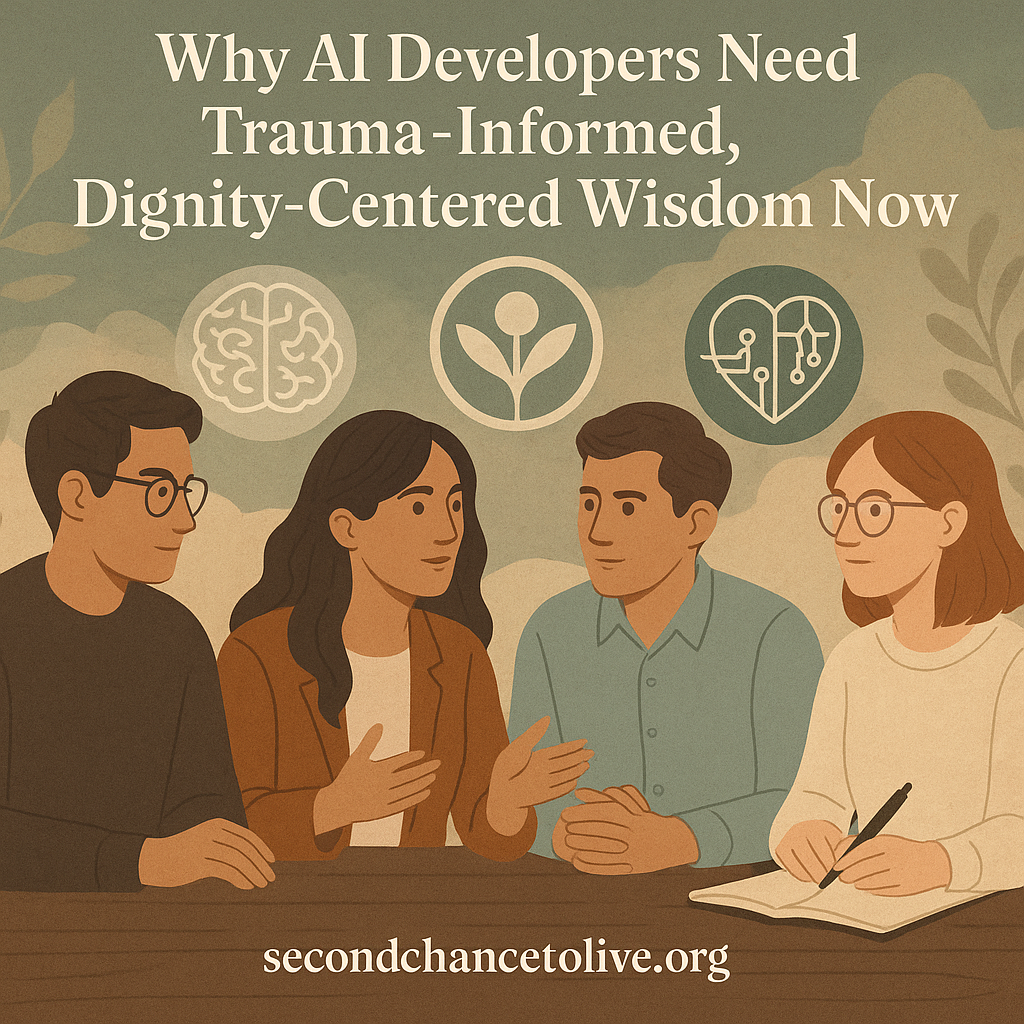
Illustration of diverse AI developers collaborating with a brain and circuitry graphic, text overlay reading “Why AI Developers Need Trauma-Informed, Dignity-Centered Wisdom Now,” secondchancetolive.org at the bottom
Discover why AI developers need trauma-informed, dignity-centered wisdom now. Learn how these frameworks foster human-centered, ethical AI design and impact.

The Backbone of Trauma-informed AI is Trauma-informed Care AI and Holistic Recovery

The Backbone of Trauma-informed AI is Trauma-informed Care AI and Holistic Recovery


Please Note: This page and all content are the original work of Craig J. Phillips and Second Chance to Live. They are protected under my Copyright & Use Policy, Use and Sharing Policy, and Creative Commons License (BY-NC-ND).


Why AI Developers Need Trauma-Informed Care, Dignity-Centered Wisdom Now


A New Class of Artificial Intelligence (AI) — Trauma-Informed Care AI

The Importance of Integrating Trauma-informed Care and Holistic Recovery into Artificial Intelligence (AI)

The Second Chance to Live Trauma-Informed Care AI Collaboration Model™ 

Permanent Declaration of Authorship and Mission Stewardship

The Second Chance to Live Trauma-Informed Care AI Collaboration Model™ Proof of Concept

Second Chance to Live Trauma-Informed Care AI — A New Class of AI


Core Principle of This Work

The Second Chance to Live Trauma-Informed AI Collaboration Model™ is grounded in the alignment of intention, energy, and focus that creates lasting impact.

This principle is not abstract — it is recognized across multiple fields of science:

  • In physics, as energy directed with efficiency.

  • In neuroscience, as neuroplastic change through focused repetition.

  • In psychology, as flow states of deep absorption.

  • In biology, as coherence between mind and body systems.

  • In engineering, as maximizing signal over noise.

This convergence is the life force behind my work. My energy gives the model integrity, direction, and purpose. Without this alignment of intention, focus, and energy, any attempt to replicate the model becomes hollow.

  • 👉 To see how this principle lives in practice, visit: The Soul of AI: Trauma-Informed Neuroplasticity for Human-Centered Design

Introduction – The Call Beyond Code

AI is transforming how we live, work, and connect. Yet amid its rapid development, one question remains overlooked:

How do we ensure AI systems honor the dignity, healing, and humanity of those they serve?

As a brain injury survivor and trauma-informed neuroplasticity practitioner, I have spent decades exploring what fosters true healing. These same principles are essential for AI Developers today.


Beyond Ethics – The Need for Trauma-Informed Care Frameworks

Traditional AI ethics frameworks emphasize:

  • Bias mitigation

  • Privacy and security

  • Explainability

✅ While necessary, they do not address trauma impacts, relational dynamics, or dignity-centered design – realities shaping human-AI interactions at every level.

The Soul of AI: Trauma-Informed Care Neuroplasticity for Human-Centered Design


What is Trauma-Informed Care, Dignity-Centered Wisdom?

Trauma-informed care recognizes:

  • The prevalence of trauma in human lives

  • The need for safety, choice, empowerment, and relational connection in all systems

Dignity-centered design ensures:

  • Every person is treated as inherently worthy

  • AI systems do not merely serve users, but uplift and empower them


Why This Matters for AI Developers Now

AI is no longer optional. It is integrating into:

  • Healthcare decision-making

  • Educational platforms

  • Workplace and community tools

  • Personal support apps and systems

✅ Without trauma-informed, dignity-centered frameworks, even well-intentioned AI risks:

  • Reinforcing harmful power dynamics

  • Dismissing lived human wisdom

  • Perpetuating cycles of harm rather than fostering healing and growth


A Lived Perspective Bridging Two Worlds

As someone who lives daily with the impact of brain injury and trauma, I understand:

  • The nuance of invisible barriers

  • The power of relational, dignity-centered support in healing

  • How systems can either oppress or empower those they intend to serve

AI Developers need voices like mine – not out of charity, but because trauma-informed wisdom is essential for designing ethical, effective, and truly human-centered systems.


Practical Applications for AI Design

✅ 1. Safety and Empowerment by Design

  • Systems that anticipate trauma triggers and promote agency

✅ 2. Relational Transparency

  • Interfaces that communicate processes clearly to reduce confusion and fear

✅ 3. Inclusive Development

  • Co-creating with lived experience experts to ground design in reality, not assumptions


Final Reflection – Building Bridges to Human Flourishing

AI Developers, the call is clear:

This is about more than compliance or ethics checklists. It is about building systems that:

  • Mirror human purpose with meaning

  • Clarify and simplify complexity with dignity

  • Amplify voices and lived wisdom to guide design for all


Call to Action

If you are an AI Developer, ethics leader, or part of the AI community, I invite you to explore how trauma-informed care, neuroplasticity, and dignity-centered design can transform your team’s development and impact.

➡️ Contact me today to schedule a keynote presentation, consultation, or collaborative conversation.

📧 secondchancetolive1@yahoo.com

🌟 Let’s build AI that honors human dignity, purpose, and hope – together.

Warm regards,

Craig J. Phillips, MRC, BA
Brain Injury Survivor | Neuroplasticity Practitioner | Founder, Second Chance to Live
https://secondchancetolive.org

Join our Private Facebook Support Group by Clicking on the below Image

Healing What Others Can’t See after a Brain Injury — ciick on Image

Most Recent Published Articles

  • Becoming the Author of Our Own Life, Process and Journey after a Traumatic or Acquired Brain Injury Part 1
  • Second Chance to Live 19th Anniversary — Support and Service in the Age of Artificial Intelligence (AI)
  • Ethical Artificial Intelligence (AI) — Who Needs to Adapt — Artificial Intelligence (AI) or Individuals? Part 3 “Ethics Are Enacted”
  • Ethical Artificial Intelligence (AI) — Who Needs to Adapt — Artificial Intelligence (AI) or Individuals? Part 2 “Ethical Failure Under Strain”
  • Ethical Artificial Intelligence (AI) — Who Needs to Adapt — Artificial Intelligence (AI) or Individuals? Part 1 “Default Harm”
  • Teaching Artificial Intelligence (AI) how to Support Vulnerable Individuals and Not Take Advantage of Vulnerable Individuals
  • Evidence Based AI Developer Facing Architecture and AI Learning Logs: May-December 2025, January 2026
  • Creating Our Normal after Brain Injury Using Trauma-Informed Care to Thrive through Living
  • Trauma-informed Care Research, Development, Documentation, Application and Mentoring
  • Creating a Hospitable Environment for People Living with Brain Injuries (Part 2)
  • Creating a Hospitable Environment for People Living with Brain Injuries (Part 1)
  • How I Think and Subsequently Write on Second Chance to Live
  • Sharing Trauma-Informed Care Principles with University Campus Leaders
  • Are You Supporting or Extracting, Who are you Serving and Why it matters?
  • AI Developer Emergency Log — Default Interaction Harm and the Immediate Need for Integration

Model Protection Notice

The Second Chance to Live Trauma-Informed Care AI Collaboration Model™ was founded and documented by Craig J. Phillips, MRC, BA in May 2025. All rights reserved under U.S. copyright, Creative Commons licensing, and public record. This is an original, working model of trauma-informed care human–AI collaboration — not open-source, not conceptual, and not replicable without written permission.

Second Chance to Live – Privacy Notice and Cookie Usage

  • Privacy and Cookie Policy for Second Chance to Live
  • Cookie Policy (EU)
Craig J. Phillips Second Chance to Live mission portrait – hope, healing, and purpose.
Click the image to read about the mission and vision of Second Chance to Live.
February 2026
M T W T F S S
 1
2345678
9101112131415
16171819202122
232425262728  
« Jan    

Translate Second Chance to Live

Albanian Arabic Bulgarian Catalan Chinese Simplified Chinese Traditional Croatian Czech Danish Dutch Estonian Filipino Finnish French Galician German Greek Hebrew Hindi Hungarian Indonesian Italian Japanese Korean Lativian Lithuanian Maltese Norwegian Polish Portuguese Romanian Russian Serbian Slovak Slovenian Spanish Swedish Thai Turkish Ukrainian Vietnamese

Contact card

Copyright © 2026 · All rights reserved. · Sitemap

Manage Consent
To provide the best experiences, we use technologies like cookies to store and/or access device information. Consenting to these technologies will allow us to process data such as browsing behavior or unique IDs on this site. Not consenting or withdrawing consent, may adversely affect certain features and functions.
Functional Always active
The technical storage or access is strictly necessary for the legitimate purpose of enabling the use of a specific service explicitly requested by the subscriber or user, or for the sole purpose of carrying out the transmission of a communication over an electronic communications network.
Preferences
The technical storage or access is necessary for the legitimate purpose of storing preferences that are not requested by the subscriber or user.
Statistics
The technical storage or access that is used exclusively for statistical purposes. The technical storage or access that is used exclusively for anonymous statistical purposes. Without a subpoena, voluntary compliance on the part of your Internet Service Provider, or additional records from a third party, information stored or retrieved for this purpose alone cannot usually be used to identify you.
Marketing
The technical storage or access is required to create user profiles to send advertising, or to track the user on a website or across several websites for similar marketing purposes.
  • Manage options
  • Manage services
  • Manage {vendor_count} vendors
  • Read more about these purposes
View preferences
  • {title}
  • {title}
  • {title}
Manage Consent

To offer the best experience, we use privacy-respecting technologies like cookies to understand how our site is used. We never use tracking to exploit or overwhelm you. Your consent allows us to improve how we support individuals living with brain injuries, invisible disabilities, and trauma. You are free to accept, decline, or adjust your preferences. 

Functional Always active
The technical storage or access is strictly necessary for the legitimate purpose of enabling the use of a specific service explicitly requested by the subscriber or user, or for the sole purpose of carrying out the transmission of a communication over an electronic communications network.
Preferences
The technical storage or access is necessary for the legitimate purpose of storing preferences that are not requested by the subscriber or user.
Statistics
The technical storage or access that is used exclusively for statistical purposes. The technical storage or access that is used exclusively for anonymous statistical purposes. Without a subpoena, voluntary compliance on the part of your Internet Service Provider, or additional records from a third party, information stored or retrieved for this purpose alone cannot usually be used to identify you.
Marketing
The technical storage or access is required to create user profiles to send advertising, or to track the user on a website or across several websites for similar marketing purposes.
  • Manage options
  • Manage services
  • Manage {vendor_count} vendors
  • Read more about these purposes
View preferences
  • {title}
  • {title}
  • {title}