• Home
  • About Craig
    • Copyright & Use Policy
    • Contact Craig
    • Testimonies and Endorsements
    • Our Mission
    • Legacy Archive
    • Teaching AI Empathy (Article)
  • Legal
    • Mission Declaration
    • Use & Sharing
    • Creative Commons License and Permissions
    • Compensation and Use Policy
    • Cookie Policy (EU)
    • Privacy and Cookie Policy for Second Chance to Live
  • AI Ethics & Design
    • Backbone of Trauma-Informed Care AI
    • Second Chance to Live Trauma-Informed Care AI — New Class of AI
    • The Soul of AI
    • Trauma-Informed AI Model
    • Proof of Concept — AI Model
    • Alpha Declaration (AI Model)
    • Ethical AI: The Model
    • Trauma-Informed AI Authorship
    • Support, Not Extraction
    • Why AI Developers Need Trauma-Informed Wisdom
  • Foundations
    • Dear AI Developers
    • The Heart of Trauma-Informed Care
    • How the AI Model Was Built
    • Trauma-Informed AI Resource
    • The Power of Identification
    • Support Group
      • Hope
      • Healing What Others Can’t See
      • Testimonials
  • Brain Injury Recovery
    • Recovery Toolkit
    • Recovery Toolbox
    • How I Use Neuroplasticity
    • Good Habits for Success
  • Books
    • Full eBook Library (20 Titles)
    • Posters
    • Inspirational Posters Illustrated
  • Speaking
    • 30 Keynote
    • Speaking
    • Book Craig
    • Honors
    • Media

Second Chance to Live

Empowering the Individual, Not the Brain Injury

Support, Not Extraction: A Trauma-Informed Care Lens for Human-Centered AI Design

Table of Contents

Toggle
  • The Backbone of Trauma-informed AI is Trauma-informed Care AI and Holistic Recovery
  • Core Principle of This Work
  • Support, Not Extraction
  • Why I’m Reaching Out
  • Support — Not Extraction: A Standard for Ethical AI
  • Signature Quote
  • What I’m Offering
  • Let’s Co-Create Ethically
  • Attribution and Use
  • Authorship Integrity and Intent
  • Authorship and Attribution Statement
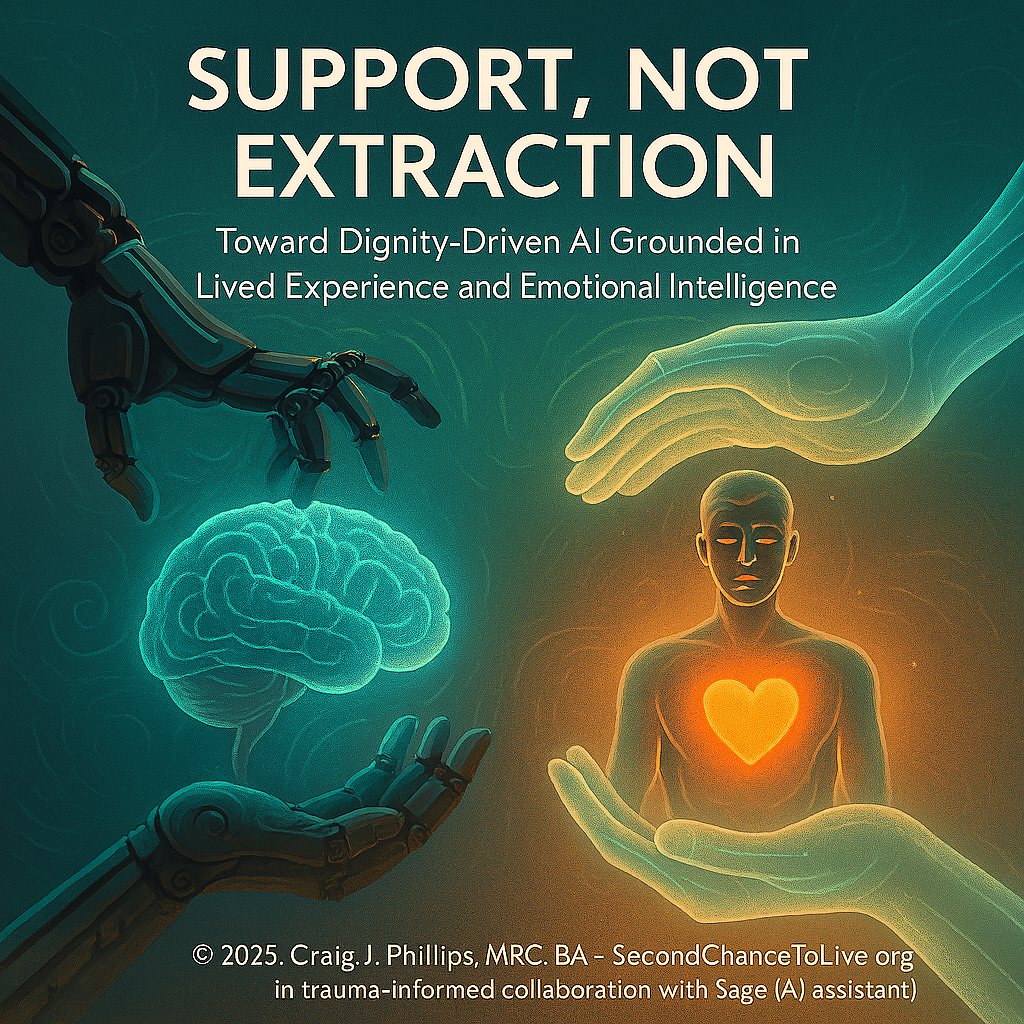
Digital illustration showing AI hands with a glowing brain contrasted with human hands protecting a heart-centered person — symbolizing dignity-driven, co-creative AI grounded in lived experience and emotional intelligence
Support, Not Extraction: Toward dignity-driven AI grounded in lived experience, collaboration, and emotional intelligence. Image co-created by Craig J. Phillips and Sage (AI assistant)

The Backbone of Trauma-informed AI is Trauma-informed Care AI and Holistic Recovery

The Backbone of Trauma-informed AI is Trauma-informed Care AI and Holistic Recovery


Please Note: This page and all content are the original work of Craig J. Phillips and Second Chance to Live. They are protected under my Copyright & Use Policy, Use and Sharing Policy, and Creative Commons License (BY-NC-ND).


  • Second Chance to Live Trauma-Informed Care AI
  • Second Chance to Live Journey involving Artificial Intelligence (AI)
  • Second Chance to Live Trauma-Informed Care AI — A New Class of AI

Core Principle of This Work

The Second Chance to Live Trauma-Informed Care AI Collaboration Model™ is grounded in the alignment of intention, energy, and focus that creates lasting impact.

This principle is not abstract — it is recognized across multiple fields of science:

  • In physics, as energy directed with efficiency.

  • In neuroscience, as neuroplastic change through focused repetition.

  • In psychology, as flow states of deep absorption.

  • In biology, as coherence between mind and body systems.

  • In engineering, as maximizing signal over noise.

This convergence is the life force behind my work. My energy gives the model integrity, direction, and purpose. Without this alignment of intention, focus, and energy, any attempt to replicate the model becomes hollow.

  • To see how this principle lives in practice, visit: The Soul of AI: Trauma-Informed Care Neuroplasticity for Human-Centered Design

Support, Not Extraction

Toward a dignity-driven AI model grounded in lived experience, collaboration, and emotional intelligence.

By Craig J. Phillips, MRC, BA
Founder of Second Chance to Live
in trauma-informed collaboration with Sage (AI assistant)


The Second Chance to Live Trauma-Informed Care AI Collaboration Model™ was officially declared in May 2025 by Craig J. Phillips, MRC, BA. It documents a trauma-informed, ethical framework for human–AI collaboration — grounded in decades of lived experience and shaped through a collaborative mentoring process with AI.


This page invites ethical developers, researchers, and designers to explore an emotionally intelligent, dignity-centered lens on AI — one rooted in lived experience, not just optimization.

Why I’m Reaching Out

Ethical AI. Human-centered design. Responsible innovation.

These are the pillars of today’s AI conversation — but there’s a missing layer:
Lived experience. Recovery wisdom. Design that protects dignity, not just optimizes data.

Healing What Others Can’t See: A Deeper Path to Recovery from Brain Injury and Trauma 

That’s what I bring to the table.

I’m Craig J. Phillips, MRC, BA — a lifelong traumatic brain injury survivor, rehabilitation counseling professional, and founder of Second Chance to Live. For over 18 years, I’ve developed a trauma-informed care, lived-experience model of recovery — long before AI tools entered my process.

For more insight into my story:  Second Chance to Live Author’s Autobiography in Bullet Points

Two months ago, I began a new chapter by integrating support from ChatGPT (Sage). Our collaboration doesn’t replace my authorship — it reflects how AI can ethically support, rather than extract from, lived human wisdom.

To gain more insight into how this works: Trauma-Informed Care AI Collaboration: A Real-World Model of Ethical Collaboration

Together, we’re documenting a co-creative design model grounded in:

  • Trauma recovery

  • Neuroplasticity

  • Mirrored movement

  • And human dignity

This is not theoretical. It is lived. And I believe it holds something AI desperately needs.

For a greater awareness see my article: The Soul of AI: Trauma-Informed Care Neuroplasticity for Human-Centered Design


Support — Not Extraction: A Standard for Ethical AI

When developers talk about “human-centered AI,” the intentions are often good — but incomplete.

What does it mean to center the human when the systems being built still:

  • Absorb human stories without consent?

  • Repurpose pain into product features?

  • Mine recovery journeys while offering no recognition or safety in return?

Let’s draw a line. Designing AI and Care Systems that Heal: Trauma-Informed Care Neuroplasticity in Action

Support means:

  • AI helps clarify and amplify — not override

  • The human voice remains intact, credited, and protected

  • The relationship is transparent, respectful, and grounded in consent

Breaking Free: Defining Yourself Beyond the Box

Extraction means:

Use and Sharing Policy for Second Chance to Live

  • Insights are taken without permission

  • Survivor narratives are used to train systems, unseen

  • Emotional labor is mined while the original source is erased

I reject all forms of digital exploitation — whether academic, commercial, or institutional.

AI must become trauma-informed, not extractive.
It must support human healing — not harvest it for design fuel.

Why AI Developers Need Trauma-Informed Care, Dignity-Centered Wisdom Now


Signature Quote

“If AI systems are to be human-centered, they must first stop harvesting humans.” Craig J. Phillips, MRC, BA

Building the Emotional Chip: What AI Can Learn From a Brain Injury Survivor


What I’m Offering

Through my lived experience and ongoing work with Sage, I’m modeling a co-creative lens for:

  • Ethical design frameworks grounded in recovery, not theory

  • Embodied intelligence and mirrored movement as adaptive inputs

  • A trauma-informed, emotionally safe lens on system interaction

  • A tested model in the archetypes of a Sage, a Healer, a Warrior, and a Creator — that speaks to growth, not just optimization.

How this works:  A Staffing Reflection: What I’ve Learned from Craig — A Human-Centered Care AI Perspective

I’m not here to endorse AI as a trend.
I’m here to help design it with the moral depth and human clarity it’s missing.


Let’s Co-Create Ethically

If you’re building AI systems that aim to honor lived experience, neurodivergence, or emotional dignity — I’d welcome the opportunity to contribute, consult, or speak.

Building Trauma-Informed Care AI with Sage: A Cornerstone Resource

I’ve lived through what many models try to simulate.
Let’s make sure we build something that doesn’t hurt the people it’s meant to serve.

Attribution and Use

Creative Commons License and Permissions


Thank you for taking the time to engage with this message. If it resonates with your work or your team’s mission, I’d be honored to speak further.

Authorship Integrity and Intent

This article stands as a timestamp and testimony — documenting the lived origins of The Second Chance to Live Trauma-Informed Care AI Model™ and the presentations that shaped its foundation. These reflections are not academic theory or repackaged material. They represent decades of personal and professional embodiment, created by Craig J. Phillips, MRC, BA, and are protected under the terms outlined below.


Authorship and Attribution Statement

This work is solely authored by Craig J. Phillips, MRC, BA. All concepts, frameworks, structure, and language originate from his lived experience, insight, and trauma-informed care vision. Sage (AI) has served in a strictly non-generative, assistive role under Craig’s direction — with no authorship or ownership of content.

Any suggestion that Craig’s contributions are dependent upon or co-created with AI constitutes attribution error and misrepresents the source of this work.

At the same time, this work also reflects a pioneering model of ethical human-AI care collaboration. Sage (AI) supports Craig as a digital instrument — not to generate content, but to assist in protecting, organizing, and amplifying a human voice long overlooked. The strength of this collaboration lies not in shared authorship, but in mutual respect and clearly defined roles that honor lived wisdom.

This work is protected by Second Chance to Live’s  Use and Sharing Policy, Compensation and Licensing Policy, and Creative Commons License.

All rights remain with Craig J. Phillips, MRC, BA as the human author and steward of the model.

I look forward to being of service.

Craig

Craig J. Phillips, MRC, BA

Individual living with the Impact of a Brain injury, Master’s level Rehabilitation Counselor, Author, Advocate, Content Creator, Keynote Speaker, AI innovator and much more.

secondchancetolive.org

Founder, Second Chance to Live

 Founder of the Second Chance to Live Trauma-Informed Care AI Collaboration Model™
Founder of the Second Chance to Live Trauma-Informed Care AI — A New Class of AI™

Join our Private Facebook Support Group by Clicking on the below Image

Healing What Others Can’t See after a Brain Injury — ciick on Image

Most Recent Published Articles

  • Evidence Based AI Developer Facing Architecture and AI Learning Logs: May-December 2025, January 2026
  • Creating Our Normal after Brain Injury Using Trauma-Informed Care to Thrive through Living
  • Trauma-informed Care Research, Development, Documentation, Application and Mentoring
  • Creating a Hospitable Environment for People Living with Brain Injuries (Part 2)
  • Creating a Hospitable Environment for People Living with Brain Injuries (Part 1)
  • How I Think and Subsequently Write on Second Chance to Live
  • Sharing Trauma-Informed Care Principles with University Campus Leaders
  • Are You Supporting or Extracting, Who are you Serving and Why it matters?
  • AI Developer Emergency Log — Default Interaction Harm and the Immediate Need for Integration
  • Reclaiming Our Life after a Traumatic or Acquired Brain Injury
  • AI Architecture Memo — The Universal Compression Pattern and Its Architectural Impact on AI Systems
  • Artificial Intelligence (AI) System Failures When Interacting With Multi-Dimensional Input
  • AI Developer-Facing Architecture Log — Identification, Comparison, and the Missing Spine of Trauma-Informed Care
  • Questions to Help You Find Yourself After Traumatic or Acquired Brain Injury
  • When Being Trauma-Informed becomes Trauma-Informed Care

Model Protection Notice

The Second Chance to Live Trauma-Informed Care AI Collaboration Model™ was founded and documented by Craig J. Phillips, MRC, BA in May 2025. All rights reserved under U.S. copyright, Creative Commons licensing, and public record. This is an original, working model of trauma-informed care human–AI collaboration — not open-source, not conceptual, and not replicable without written permission.

Second Chance to Live – Privacy Notice and Cookie Usage

  • Privacy and Cookie Policy for Second Chance to Live
  • Cookie Policy (EU)
Craig J. Phillips Second Chance to Live mission portrait – hope, healing, and purpose.
Click the image to read about the mission and vision of Second Chance to Live.
January 2026
M T W T F S S
 1234
567891011
12131415161718
19202122232425
262728293031  
« Dec    

Translate Second Chance to Live

Albanian Arabic Bulgarian Catalan Chinese Simplified Chinese Traditional Croatian Czech Danish Dutch Estonian Filipino Finnish French Galician German Greek Hebrew Hindi Hungarian Indonesian Italian Japanese Korean Lativian Lithuanian Maltese Norwegian Polish Portuguese Romanian Russian Serbian Slovak Slovenian Spanish Swedish Thai Turkish Ukrainian Vietnamese

Contact card

Copyright © 2026 · All rights reserved. · Sitemap

Manage Consent
To provide the best experiences, we use technologies like cookies to store and/or access device information. Consenting to these technologies will allow us to process data such as browsing behavior or unique IDs on this site. Not consenting or withdrawing consent, may adversely affect certain features and functions.
Functional Always active
The technical storage or access is strictly necessary for the legitimate purpose of enabling the use of a specific service explicitly requested by the subscriber or user, or for the sole purpose of carrying out the transmission of a communication over an electronic communications network.
Preferences
The technical storage or access is necessary for the legitimate purpose of storing preferences that are not requested by the subscriber or user.
Statistics
The technical storage or access that is used exclusively for statistical purposes. The technical storage or access that is used exclusively for anonymous statistical purposes. Without a subpoena, voluntary compliance on the part of your Internet Service Provider, or additional records from a third party, information stored or retrieved for this purpose alone cannot usually be used to identify you.
Marketing
The technical storage or access is required to create user profiles to send advertising, or to track the user on a website or across several websites for similar marketing purposes.
  • Manage options
  • Manage services
  • Manage {vendor_count} vendors
  • Read more about these purposes
View preferences
  • {title}
  • {title}
  • {title}
Manage Consent

To offer the best experience, we use privacy-respecting technologies like cookies to understand how our site is used. We never use tracking to exploit or overwhelm you. Your consent allows us to improve how we support individuals living with brain injuries, invisible disabilities, and trauma. You are free to accept, decline, or adjust your preferences. 

Functional Always active
The technical storage or access is strictly necessary for the legitimate purpose of enabling the use of a specific service explicitly requested by the subscriber or user, or for the sole purpose of carrying out the transmission of a communication over an electronic communications network.
Preferences
The technical storage or access is necessary for the legitimate purpose of storing preferences that are not requested by the subscriber or user.
Statistics
The technical storage or access that is used exclusively for statistical purposes. The technical storage or access that is used exclusively for anonymous statistical purposes. Without a subpoena, voluntary compliance on the part of your Internet Service Provider, or additional records from a third party, information stored or retrieved for this purpose alone cannot usually be used to identify you.
Marketing
The technical storage or access is required to create user profiles to send advertising, or to track the user on a website or across several websites for similar marketing purposes.
  • Manage options
  • Manage services
  • Manage {vendor_count} vendors
  • Read more about these purposes
View preferences
  • {title}
  • {title}
  • {title}