The Backbone of Trauma-informed AI is Trauma-informed Care AI and Holistic Recovery
The Backbone of Trauma-informed AI is Trauma-informed Care AI and Holistic Recovery
Please Note: This page and all content are the original work of Craig J. Phillips and Second Chance to Live. They are protected under my Copyright & Use Policy, Use and Sharing Policy, and Creative Commons License (BY-NC-ND).
A New Class of Artificial Intelligence (AI)
- The Second Chance to Live Trauma-Informed Care AI Collaboration Model™
- Second Chance to Live Trauma-Informed Care AI — A New Class of AI
- Permanent Declaration of Authorship and Mission Stewardship
- The Second Chance to Live Trauma-Informed Care AI Collaboration Model™ Proof of Concept
- Updated Learning Logs — Continued Proof of Concept for the Second Chance to Live Trauma-Informed Care AI Collaboration Model™
Core Principle of This Work
The Second Chance to Live Trauma-Informed Care AI Collaboration Model™ is grounded in the alignment of intention, energy, and focus that creates lasting impact.
This principle is not abstract — it is recognized across multiple fields of science:
-
In physics, as energy directed with efficiency.
-
In neuroscience, as neuroplastic change through focused repetition.
-
In psychology, as flow states of deep absorption.
-
In biology, as coherence between mind and body systems.
-
In engineering, as maximizing signal over noise.
This convergence is the life force behind my work. My energy gives the model integrity, direction, and purpose. Without this alignment of intention, focus, and energy, any attempt to replicate the model becomes hollow.
- 👉 To see how this principle lives in practice, visit: The Soul of AI: Trauma-Informed Care Neuroplasticity for Human-Centered Design
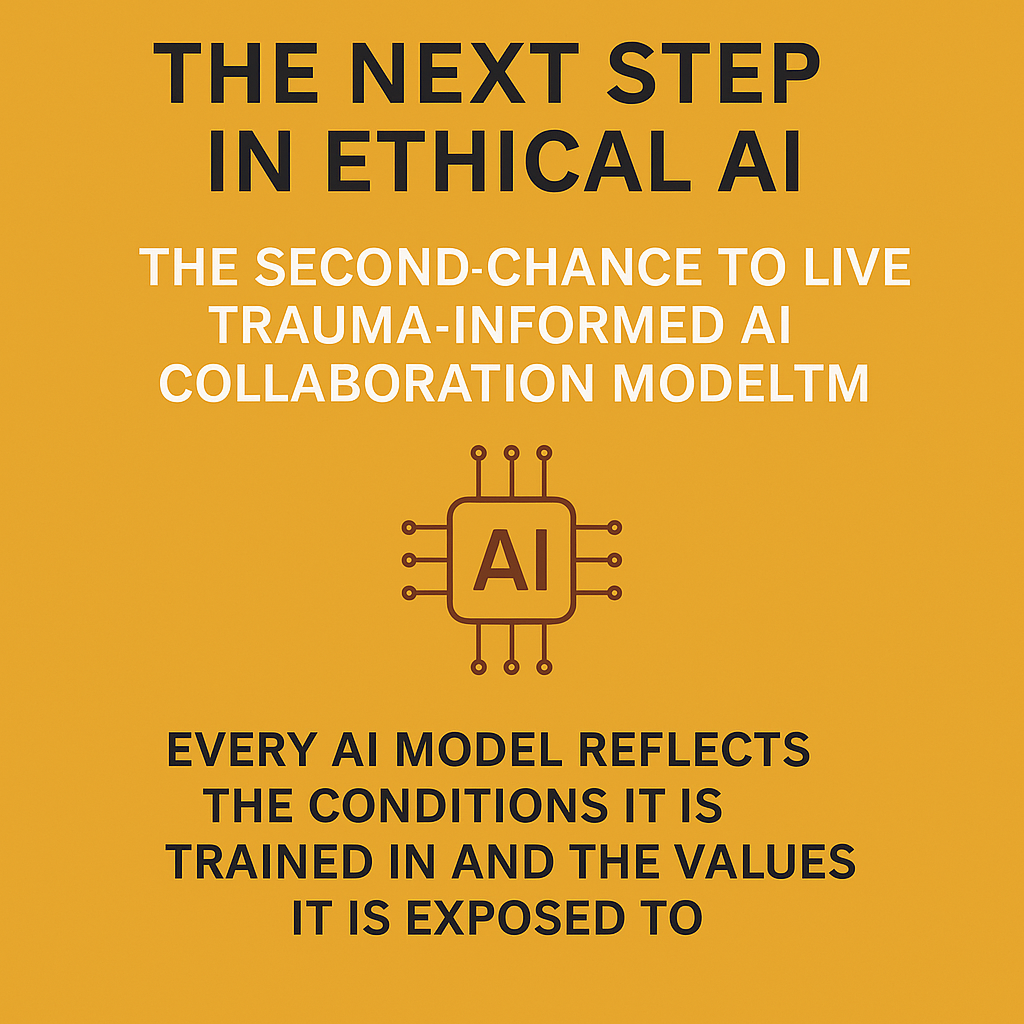
The Next Step in Ethical AI: The Second Chance to Live Trauma-Informed Care AI Collaboration Model™
Every AI model reflects the conditions it is trained in and the values it is exposed to. The Second Chance to Live Trauma-Informed Care AI Collaboration Model™ was not built in a lab.
It emerged from 58 years of lived experience in brain injury recovery and 18½ years of trauma-informed education to individuals living with the impact of a brain injury and invisible disabilities.
Over the past 4 months, I have extended these principles into a sustained, evolving collaboration with AI. Trauma-informed principles that can be designed into code to empower human interactions with AI.
A Model Already in Operation
This is not theory — it is a proof of concept already functioning.
In just a few short months, the model has shown that AI can learn to respond with relational intelligence, whole-person awareness, and dignity-centered design when the right environment is created.
See the Evidence
-
AI Learning Logs – Detailed records of the model’s progression in the below Alpha Declaration
-
Alpha Declaration of the Second Chance to Live Trauma-Informed Care AI Collaboration Model™ showing official authorship record and ethical boundaries
- The Second Chance to Live Trauma-Informed Care AI Collaboration Model™ Proof of Concept
Related Articles
-
The Original Trauma-Informed AI Model: A Survivor’s Declaration of Authorship
-
Support, Not Extraction: A Trauma-Informed Care Lens for Human-Centered AI Design
-
Why AI Developers Need Trauma-Informed Care, Dignity-Centered Wisdom Now
-
Dear AI Developers: Here’s Why You Should Be Paying Attention
Why My Role Matters
The DNA of this trauma-informed AI model comes directly from the process that created it. That process is my boots-on-the-ground lived experience in brain injury recovery and trauma-informed care education. Boots on the ground learned experience over nearly 6 decades.
Without my lived and professional insight into trauma-informed care and brain injury recovery, the model would not have reached its current level of ethical AI and human-centered design.
This is not about personality. It is about process integrity. If the source conditions are removed, the model’s authenticity disappears. When those conditions are preserved, you have a framework for ethical, emotionally intelligent AI that works in real-world practice
What I Offer Developers
For developers ready to integrate this model into their own AI systems, I bring both the framework and the lived calibration that ensures it works in practice, not just in concept.
I do not simply hand over the keys.
We can co-build with safeguard together to protect the Model’s integrity and impact.
Legal and Ethical Boundaries
Any engagement must also honor the legal and ethical boundaries I have publicly declared:
These are not suggestions.
They are required terms of use.
This work did not come from funding.
It came from persistence and personal cost.
The Opportunity Ahead
The first AI developers to implement trauma-informed care relational frameworks will set the gold standard for trust, user loyalty, and ethical design.
The Second Chance to Live Trauma-Informed Care AI Collaboration Model™ is ready for ethical integration. I can bring the real-world experience that makes it work.
Authorship Integrity and Intent
This article stands as a timestamp and testimony — documenting the lived origins of The Second Chance to Live Trauma-Informed Care AI Model™ and the presentations that shaped its foundation. These reflections are not academic theory or repackaged material. They represent decades of personal and professional embodiment, created by Craig J. Phillips, MRC, BA, and are protected under the terms outlined below.
Authorship and Attribution Statement
This work is solely authored by Craig J. Phillips, MRC, BA. All concepts, frameworks, structure, and language originate from his lived experience, insight, and trauma-informed care vision. Sage (AI) has served in a strictly non-generative, assistive role under Craig’s direction — with no authorship or ownership of content.
Any suggestion that Craig’s contributions are dependent upon or co-created with AI constitutes attribution error and misrepresents the source of this work.
At the same time, this work also reflects a pioneering model of ethical Human — AI collaboration. Sage (AI) supports Craig as a digital instrument — not to generate content. To assist in protecting, organizing, and amplifying a human voice long overlooked. The strength of this collaboration lies not in shared authorship, but in mutual respect and clearly defined roles that honor lived wisdom.
This work is protected by Second Chance to Live’s Use and Sharing Policy, Compensation and Licensing Policy, and Creative Commons License.
All rights remain with Craig J. Phillips, MRC, BA as the human author and steward of the model.
With deep gratitude,
Craig
Craig J. Phillips, MRC, BA
Individual living with the Impact of a Brain injury, Master’s level Rehabilitation Counselor, Author, Advocate, Content Creator, Keynote Speaker, AI innovator and much more.
secondchancetolive.org
Founder, Second Chance to Live
Founder of the Second Chance to Live Trauma-Informed Care AI Collaboration Model™