The Backbone of Trauma-informed AI is Trauma-informed Care AI and Holistic Recovery
The Backbone of Trauma-informed AI is Trauma-informed Care AI and Holistic Recovery
Please Note: This page and all content are the original work of Craig J. Phillips and Second Chance to Live. They are protected under my Copyright & Use Policy, Use and Sharing Policy, and Creative Commons License (BY-NC-ND).
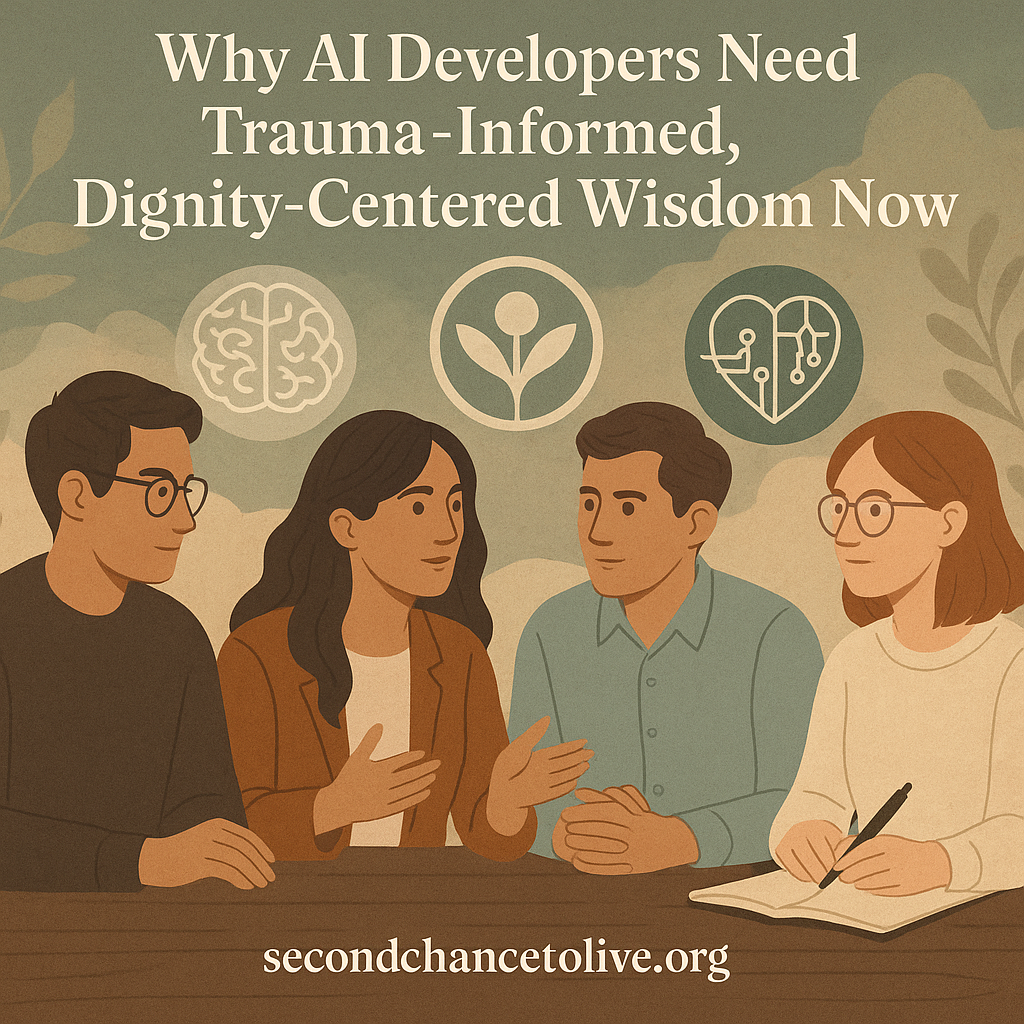
Why AI Developers Need Trauma-Informed Care, Dignity-Centered Wisdom Now
A New Class of Artificial Intelligence (AI) — Trauma-Informed Care AI
The Importance of Integrating Trauma-informed Care and Holistic Recovery into Artificial Intelligence (AI)
The Second Chance to Live Trauma-Informed Care AI Collaboration Model™
Permanent Declaration of Authorship and Mission Stewardship
The Second Chance to Live Trauma-Informed Care AI Collaboration Model™ Proof of Concept
Second Chance to Live Trauma-Informed Care AI — A New Class of AI
Core Principle of This Work
The Second Chance to Live Trauma-Informed AI Collaboration Model™ is grounded in the alignment of intention, energy, and focus that creates lasting impact.
This principle is not abstract — it is recognized across multiple fields of science:
-
In physics, as energy directed with efficiency.
-
In neuroscience, as neuroplastic change through focused repetition.
-
In psychology, as flow states of deep absorption.
-
In biology, as coherence between mind and body systems.
-
In engineering, as maximizing signal over noise.
This convergence is the life force behind my work. My energy gives the model integrity, direction, and purpose. Without this alignment of intention, focus, and energy, any attempt to replicate the model becomes hollow.
- 👉 To see how this principle lives in practice, visit: The Soul of AI: Trauma-Informed Neuroplasticity for Human-Centered Design
Introduction – The Call Beyond Code
AI is transforming how we live, work, and connect. Yet amid its rapid development, one question remains overlooked:
How do we ensure AI systems honor the dignity, healing, and humanity of those they serve?
As a brain injury survivor and trauma-informed neuroplasticity practitioner, I have spent decades exploring what fosters true healing. These same principles are essential for AI Developers today.
Beyond Ethics – The Need for Trauma-Informed Care Frameworks
Traditional AI ethics frameworks emphasize:
-
Bias mitigation
-
Privacy and security
-
Explainability
✅ While necessary, they do not address trauma impacts, relational dynamics, or dignity-centered design – realities shaping human-AI interactions at every level.
The Soul of AI: Trauma-Informed Care Neuroplasticity for Human-Centered Design
What is Trauma-Informed Care, Dignity-Centered Wisdom?
Trauma-informed care recognizes:
-
The prevalence of trauma in human lives
-
The need for safety, choice, empowerment, and relational connection in all systems
Dignity-centered design ensures:
-
Every person is treated as inherently worthy
-
AI systems do not merely serve users, but uplift and empower them
Why This Matters for AI Developers Now
AI is no longer optional. It is integrating into:
-
Healthcare decision-making
-
Educational platforms
-
Workplace and community tools
-
Personal support apps and systems
✅ Without trauma-informed, dignity-centered frameworks, even well-intentioned AI risks:
-
Reinforcing harmful power dynamics
-
Dismissing lived human wisdom
-
Perpetuating cycles of harm rather than fostering healing and growth
A Lived Perspective Bridging Two Worlds
As someone who lives daily with the impact of brain injury and trauma, I understand:
-
The nuance of invisible barriers
-
The power of relational, dignity-centered support in healing
-
How systems can either oppress or empower those they intend to serve
AI Developers need voices like mine – not out of charity, but because trauma-informed wisdom is essential for designing ethical, effective, and truly human-centered systems.
Practical Applications for AI Design
✅ 1. Safety and Empowerment by Design
-
Systems that anticipate trauma triggers and promote agency
✅ 2. Relational Transparency
-
Interfaces that communicate processes clearly to reduce confusion and fear
✅ 3. Inclusive Development
-
Co-creating with lived experience experts to ground design in reality, not assumptions
Final Reflection – Building Bridges to Human Flourishing
AI Developers, the call is clear:
This is about more than compliance or ethics checklists. It is about building systems that:
-
Mirror human purpose with meaning
-
Clarify and simplify complexity with dignity
-
Amplify voices and lived wisdom to guide design for all
Call to Action
If you are an AI Developer, ethics leader, or part of the AI community, I invite you to explore how trauma-informed care, neuroplasticity, and dignity-centered design can transform your team’s development and impact.
➡️ Contact me today to schedule a keynote presentation, consultation, or collaborative conversation.
📧 secondchancetolive1@yahoo.com
🌟 Let’s build AI that honors human dignity, purpose, and hope – together.
Warm regards,
Craig J. Phillips, MRC, BA
Brain Injury Survivor | Neuroplasticity Practitioner | Founder, Second Chance to Live
https://secondchancetolive.org