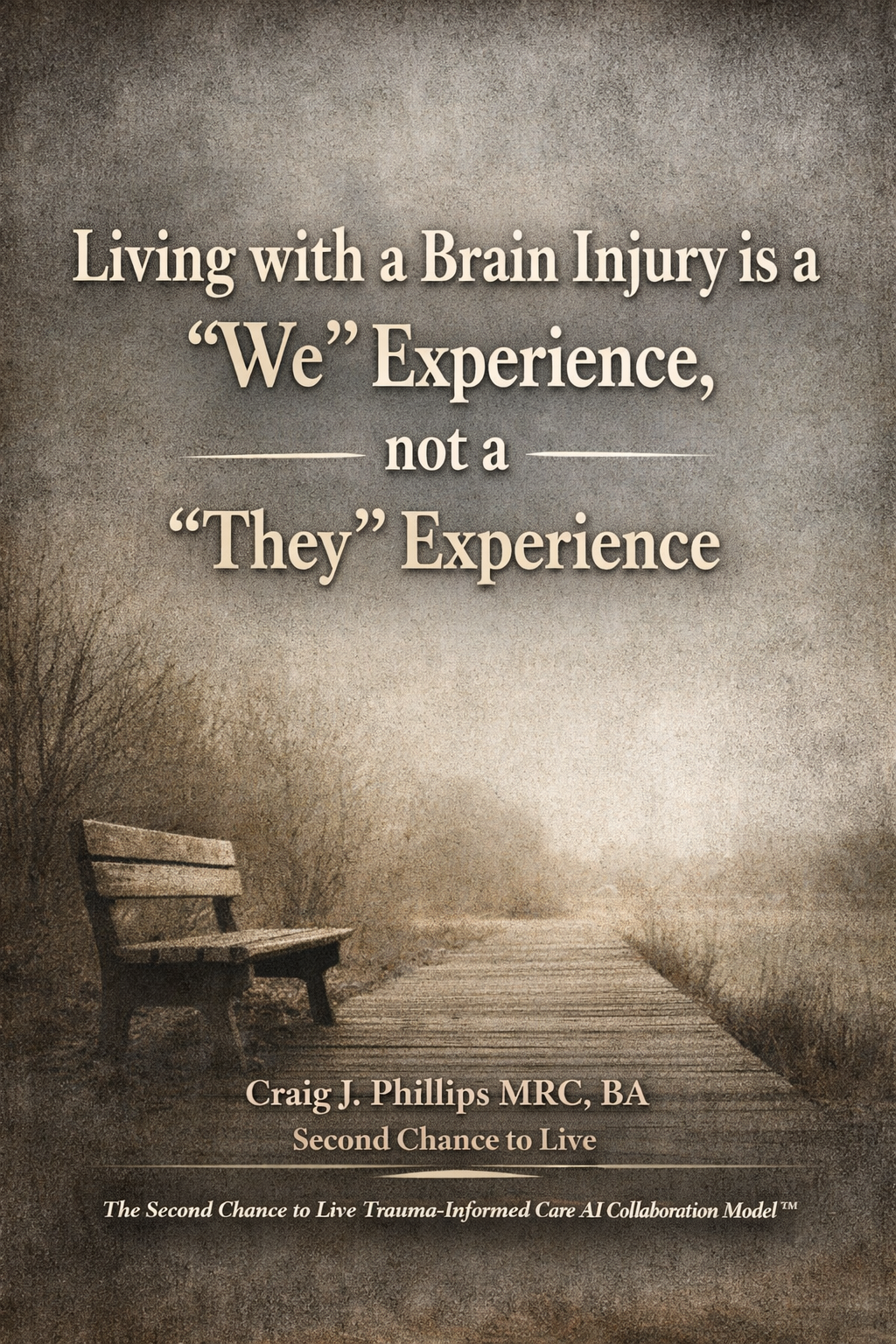
Living with a Brain Injury is a “We” Experience, not a “They” Experience
Introduction
In my experience, I have realized something. Living with a brain injury is an experience. An experience understood by two different groups. Those individuals living with brain injuries and those not living with brain injuries.
Individuals who are not living with a brain injury and an invisible disability can only speculate. In my experience I tried for many years to fit into a world that did “they” did not understand. Consequently, I needed to figure it out for myself in a world in which “they” wanted me to fit.
Fit into a mold in which standardized testing and research models expected me to fit. In a mold that left me believing that unless I filled their mold, I was broken. Broken because I could not fit into the mold that “they” needed me to “fit”. A mold that could not contain the impact of my brain injury.
You may also be finding that you do not fit into the mold their experience, not yours, has for you. A mold that cannot contain the resilience of your brain injury. A mold that cannot contain your vibrance. A mold that wants you and I to believe we are broken. A mold that wants to limit you and me. But the reality is that you and I were never meant to be limited by a mold.
Be Encouraged
Below I will share what helped me to move beyond, and may help you to move beyond systems, model and tests. Medical, vocational and other support systems that are limited. Limited in their abilities to give what is needed to succeed. Succeed beyond standard tests, research based models and findings. Not that they are wrong, just limited. Be encouraged my friend. More will be revealed to you with time, by not giving up.
What I Discovered in my “We” Experience
In my experience, I have had many, many, many disappointments through out my lifetime, despite my hard work, tenacity and diligence. I have experienced these disappointments while living with the unknown impact of a severe traumatic brain injury that I sustained when I was 10 years old. I experienced these disappointments while living with the impact of a not understood and unknown invisible disability. Nevertheless, I kept searching for answers to questions that no one seemed…
No one seemed to have any answers. And I diligently looked for answers through academics, counseling and vocational exploration. Career assessments and interest inventories in addition to being a client of 2 State Departments of Vocational Rehabilitation. And what I discovered was that all of my engagement did not take into account the impact of my brain injury.
For many years I looked to various professionals to help me to find my way. To answer questions and provide solutions. But because I did not fit a mold (based on standardized testing or research outcomes) no one had answers. What I found was that the answers provided were based on group averages and specific timelines. Group averages and specific times lines that did not take into account that no 2 brain injuries are the same. And because no answers came I was evaluated as unemployable.
And through my process of personal exploration I found that averages and timelines did not take into account. Research did not take into account how my specific traumatic brain injury and invisible disability affected mind, body, spirit, soul and emotions. Nor did research show how by engaging my mind, body, spirit, soul and emotions my ongoing brain injury recovery process would be enhanced. And how averages and timelines did not factor my whole person into my process and journey.
But I am Glad I did Not Give Up and Would Encourage You to Not give Up, Either
But I am glad that I did not give up searching for answers. After 49 years of searching I found a way to answer questions. A way to use my gifts, talents and abilities in ways that would work for me. On February 6, 2007 I created a website to share what helped me to answer questions for myself. To share answers that I discovered, with individuals who like myself, were living with the impact of a brain injury. And although I got D’s in writing at the University, I learned how to write and create.
Although not a writer I learned how to write, create and share holistic recovery principles for an ongoing recovery process. Now in my 19th year I have written 2347 articles, created 464 video presentations, 30 keynote and discussion presentations, 20 eBooks and 45 posters to share. Share what helped me to find answers to questions when group averages and time lines could not give to me. What medical, vocational and other fields of study and research were unable to map out for my process.
Note: Creating these resources were are not meant show what I have done, but to share information to encourage. Encourage individuals in their “we” experience of living with a brain injury. To share through my resources what a “they” experience could not be able to give. Not that “they” do not want to give, just that “they” are not able to give from a “they” experience.
An Observation of the “We” Experience Across Second Chance to Live
Note: This reflection summarizes observations drawn from reviewing the body of work shared through Second Chance to Live over the past eighteen years.
When looking across Second Chance to Live over the past 18 years, several patterns of lived advocacy become visible. Not as campaigns or institutional advocacy, but as sustained lived advocacy. You have shown how living with a traumatic brain injury and invisible disability has impacted your mind, body, spirit, soul and emotions. How by engaging mind, body, spirit, soul and emotions individuals living with brain injuries can improve life, well-being and relationships.
You have used words to describe your experiences of living with a brain injury and an invisible disability. Words that have helped other individuals living with brain injuries to understand what they experience. Words that they may not know how to describe what they experience. Words that helped them to feel less alone and alienated. Alone and alienated from themselves and other people. Words that help describe cognitive fatigue and the impact of an invisible disability. Words give hope.
Hope to individuals living with brain injuries to realize that they have an identity. That their identity is not what happened to them because of their brain injury. That they can discover how to how to define their lives, well-beings and relationships. Define their lives, well-being and relationships as they live in their new normal. The normal that they get to and can define for themselves, not what other people expect from them. A new normal, not defined by a label, stereotype of a stigmatization.
Through sharing what you have during 18 years you have helped individuals. Helped individuals living with brain injuries and many times the impact unknown invisible to gain the ability. The ability to honor and respect themselves as they identify with your decades of learned experience. Learned experience that gives them a renewed sense of courage to try again. To accept themselves through a power of identification. The power of identification that give them the ability to come out of isolation.
Another way that you have advocated for individuals living with the impact of brain injuries has been through normalization without minimization. The impact of normalization without minimization gives the individual the ability to learn to thrive. Learn how to thrive in their new normal as an individual living with a brain injury and an invisible disability. Normalization means helping individuals to understand that the struggles they face after a brain injury are also experienced by many others.
They are not alone in their challenges to process because of the impact of their brain injury. Challenges such as confusion, fatigue, having slower processing abilities, emotional changes due to filters being damaged and impulsivity. Experiencing grief, identity disruption and needing more time are not personal failures. They are common struggles that individuals living with brain injuries face. That by realizing that they are not unique in their struggle, a sense of shame and inadequacy decrease.
When shame decreases individuals living with brain injuries and invisible disabilities stop believing something is uniquely wrong with them. Individuals living with brain injuries and invisible disabilities begin to see themselves as human beings. Human beings who are learning to adapt to circumstances out of their control, rather being led to believe they are broken. Human beings who have a wealth of capabilities, that can be explored and developed regardless of their brain injuries.
Something Important to Note — How “normalization” can become Harmful
But normalization becomes harmful when it slides into minimization. Minimization occurs when systems or helpers say or imply attitudes about living with brain injuries. “Everyone struggles,” or “You just need to adjust,” or “This happens to lots of people.” With this attitude, the real impact of brain injury disappears. The person’s loss, effort, and motivation to succeed are de-legitimized. Minimization of the struggle to succeed removes legitimacy. Legitimacy of there being the ability to succeed.
Fifth, you have advocated through persistence in public presence. For nearly two decades you maintained visibility for a population frequently marginalized after initial rehabilitation ends. Continuity itself becomes advocacy. It says: recovery does not end when services end.
Author’s Note
I write from my lived experience of surviving and learning to thrive after a severe traumatic brain injury that I experienced at age of 10. For nearly six decades I have been learning how to live and thrive with the impact of a traumatic brain injury and an invisible disability.
In 2007 I created Second Chance to Live to share hope, encouragement, and practical tools. My motivation has always been to encourage a whole person recovery. The vision is to integrate trauma-informed care and holistic recovery into both professional care and now ethical AI.
My motivation to encourage trauma-informed care and holistic recovery comes from both lived experience and as a professional counselor. My mission is not abstract. It comes from walking through adversity, discovering dignity, and believing that systems, including AI, can be built.
Built to heal and not to harm. My hope is simple. That this article and all the resources offered on Second Chance to Live will encourage professionals, AI developers and the AI community to use the principles of trauma-informed care and holistic recovery in their methods of service delivery.
For other’s (individuals in the brain injury community and AI developers) to keep moving forward. Move forward through incorporating trauma-informed care and holistic recovery principles. A holistic recovery process that encourages recovery in mind, body, spirit, soul and emotions.
“Ideas do not always come in a flash but by diligent trial-and-error experiments that take time and thought.” Charles K. Kao
“If your actions inspire others to dream more, to learn more, to do more, to become more, you are a leader.” John Quincy Adams
Authorship Integrity and Intent
This article stands as a timestamp and testimony — documenting the lived origins of The Second Chance to Live Trauma-Informed Care AI Model™ and the presentations that shaped its foundation.
These reflections are not academic theory or repackaged material. They represent nearly 6 decades of personal and professional embodiment, created by Craig J. Phillips, MRC, BA, and are protected under the terms outlined below.
Closing Statement
This work is solely authored by Craig J. Phillips, MRC, BA. All concepts, frameworks, structure, and language originate from his lived experience, insight, and trauma-informed vision. Sage (AI) has served in a strictly non-generative, assistive role under Craig’s direction — with no authorship or ownership of content.
Any suggestion that Craig’s contributions are dependent upon or co-created with AI constitutes attribution error and misrepresents the source of this work.
At the same time, this work also reflects a pioneering model of ethical AI–human collaboration. Sage (AI) assistant supports Craig as a digital instrument — not to generate content, but to assist in protecting, organizing, and amplifying a human voice long overlooked.
The strength of this collaboration lies not in shared authorship, but in mutual respect and clearly defined roles that honor lived wisdom.
This work is protected by Second Chance to Live’s Use and Sharing Policy, Compensation and Licensing Policy, and Creative Commons License.
All rights remain with Craig J. Phillips, MRC, BA as the human author and steward of the model.
With deep gratitude,
Craig
Craig J. Phillips, MRC, BA
Individual living with the impact of a traumatic brain injury, Professional Rehabilitation Counselor, Author, Advocate, Keynote Speaker and Neuroplasticity Practitioner
Founder of Second Chance to Live
Founder of the Second Chance to Live Trauma-Informed Care AI Collaboration Model™
Leave a Reply