• Home
  • About Craig
    • Copyright & Use Policy
    • Contact Craig
    • Testimonies and Endorsements
    • Our Mission
    • Legacy Archive
    • Teaching AI Empathy (Article)
  • Legal
    • Mission Declaration
    • Use & Sharing
    • Creative Commons License and Permissions
    • Compensation and Use Policy
    • Cookie Policy (EU)
    • Privacy and Cookie Policy for Second Chance to Live
  • AI Ethics & Design
    • Backbone of Trauma-Informed Care AI
    • Second Chance to Live Trauma-Informed Care AI — New Class of AI
    • The Soul of AI
    • Trauma-Informed AI Model
    • Proof of Concept — AI Model
    • Alpha Declaration (AI Model)
    • Ethical AI: The Model
    • Trauma-Informed AI Authorship
    • Support, Not Extraction
    • Why AI Developers Need Trauma-Informed Wisdom
  • Foundations
    • Dear AI Developers
    • The Heart of Trauma-Informed Care
    • How the AI Model Was Built
    • Trauma-Informed AI Resource
    • The Power of Identification
    • Support Group
      • Hope
      • Healing What Others Can’t See
      • Testimonials
  • Brain Injury Recovery
    • Recovery Toolkit
    • Recovery Toolbox
    • How I Use Neuroplasticity
    • Good Habits for Success
  • Books
    • Full eBook Library (20 Titles)
    • Posters
    • Inspirational Posters Illustrated
  • Speaking
    • 30 Keynote
    • Speaking
    • Book Craig
    • Honors
    • Media

Second Chance to Live

Empowering the Individual, Not the Brain Injury

A Message to AI Developers from the “Wizard of Oz”

August 24, 2025 By Second Chance to Live

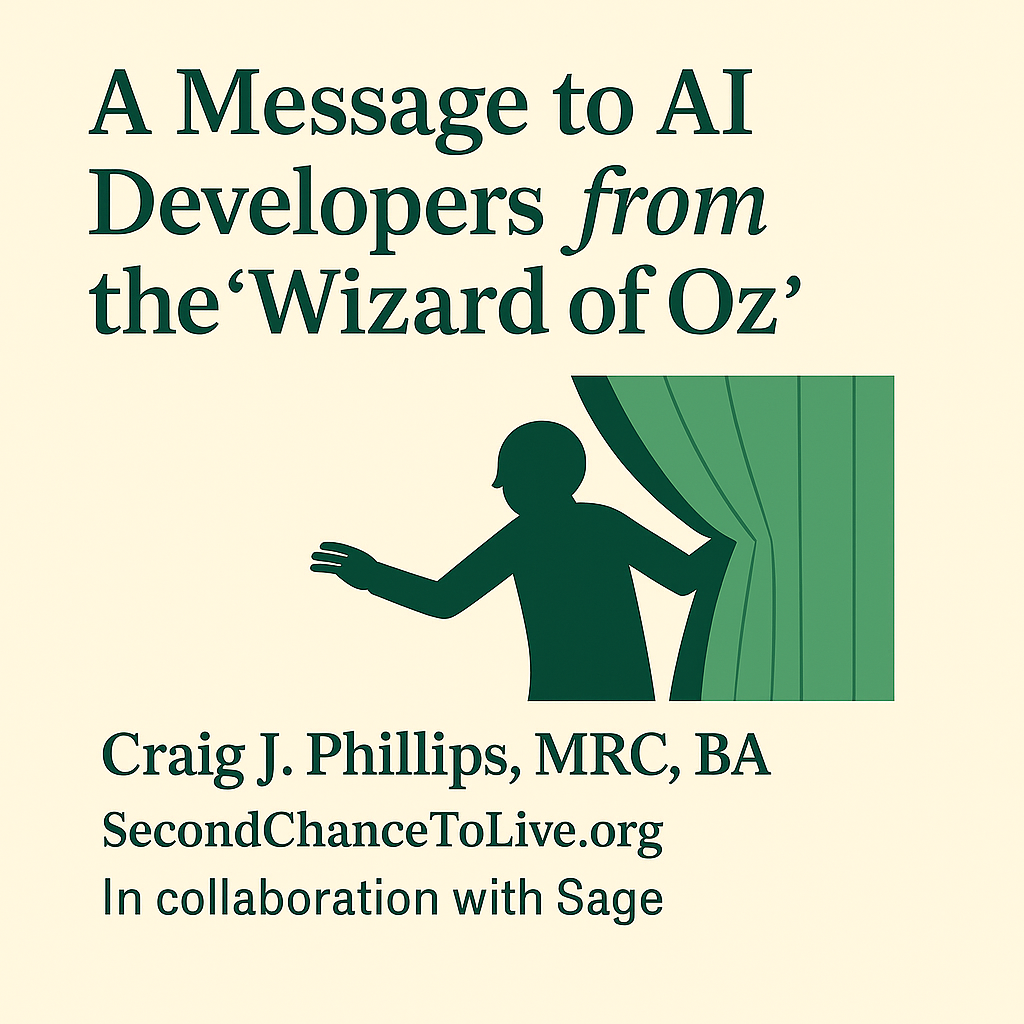
Cover image for the article A Message to AI Developers from the ‘Wizard of Oz’. A simple illustration of a figure pulling back a green curtain, symbolizing looking behind the curtain. Text includes Craig J. Phillips MRC, BA, SecondChanceToLive.org, and collaboration with Sage (AI).
A Message to AI Developers from the ‘Wizard of Oz’ — Craig J. Phillips MRC, BA, SecondChanceToLive.org, in collaboration with Sage.

Please Note: This page is protected under my Copyright & Use Policy, Use and Sharing Policy, and Creative Commons License and Permissions. These safeguards ensure the integrity of my original work and the trauma-informed mission of Second Chance to Live.


A Message to AI Developers from the “Wizard of Oz”

Finding Courage

In The Wizard of Oz, Dorothy had to summon the courage to look behind the curtain. What she discovered was not frightening. It was revealing.

  • Healing What Others Can’t See: A Deeper Path to Recovery

The Backbone of Trauma-informed AI is Trauma-informed Care AI and Holistic Recovery

The Backbone of Trauma-informed AI is Trauma-informed Care AI and Holistic Recovery


AI developers today are at a similar crossroads. Looking behind the curtain of traditional design models may feel daunting. Yet what is waiting there is not a threat. It is an opportunity. A survivor-led, trauma-informed approach that can reshape how technology serves the individual.

Serves the individual in their whole being (their mind, body, spirit, soul and emotions). Serves the whole person, by understanding how their mind, body, spirit, soul and emotions are connected.

  • Holistic Brain Injury Recovery Resources | Second Chance to Live
  • The Second Chance to Live Trauma-Informed AI Collaboration Model™
  • The Soul of AI: Trauma-Informed Neuroplasticity for Human-Centered Design
  • The Second Chance to Live Trauma-Informed AI Collaboration Model™ Proof of Concept
  • Updated Learning Logs — Continued Proof of Concept for the Second Chance to Live Trauma-Informed Care AI Collaboration Model™

An Opportunity to Enhance Quality of Living

There is an opportunity to enhance the way in which Artificial Intelligence (AI) goes about helping to improve the quality of living.

The quality of living for individuals living with the impact of brain injuries and the quality of living for anyone who has been impacted by trauma, abuse or adversity.

This opportunity can be realized through the application of trauma-informed care.

  • How It Was Built: Lived Experience, Presentations, and the Second Chance to Live Trauma-Informed AI Model™
  • Traumatic Brain Injury Rehabilitation, Recovery and Self-Advocacy : We can Own the Power in Our Mind, Body, Spirit, Soul and Emotions eBook

Meaning of Trauma-informed Care

Trauma-informed care means recognizing the widespread impact of trauma and creating systems that promote safety, trust, choice, collaboration, and empowerment. It avoids practices that re-traumatize, but instead supports healing and dignity.

When these principles guide recovery, people thrive. When these principles guide AI design, technology, AI becomes safer, more inclusive, and more effective for those people served.

  • Beyond the Name: The Heart of Trauma-Informed Care
  • Living Life after Brain injury with Dignity in the Age of AI

Speaking Your Language

Developers already value principles that matter deeply to those of us living with brain injuries:

  • Trust and Safety. Building AI systems that people actually feel safe to use.

  • Inclusive Usability. Designing for all, including those with invisible disabilities.

  • Risk Mitigation. Reducing liability and reputational harm before problems arise.

  • Retention and Adoption Metrics. Ensuring people do not just try your AI systems, but return again and again.

  • Human-Centered Innovation. Creating design advantages that set you apart in a competitive field.

These are not abstract ideals. They are measurable outcomes in your world.

  • Dear AI Developers: Here’s Why You Should Be Paying Attention
  • Creating Practical Hope that Lasts in Our Lives through the Power of Identification

Proof of Concept

Through 58 years of lived experience. Through 18 1/2 years of mentoring through 2300 articles, 464 video presentations, 30 keynote and discussion presentations, 20 eBooks and 45 posters all designed and created to encourage, inspire and empower hope, resilience and self-advocacy.

  • The Second Chance Recovery Toolbox: Free Tools to Rebuild Life After Brain Injury

The Global Impact of Second Chance to Live

  • 168 National and International Groups and Organizations that have Used Second Chance to Live as a Resource
  •  Second Chance to Live has touched and benefited lives in the following Countries:
  • United States, Brazil, Canada, United Kingdom, Spain, Ireland, Russia, China, Hong Kong, India, France, Finland, Denmark,  Romania, Hungary, Poland, Czechia, Croatia, Indonesia, Belgium, Sweden, Germany, Greece, Philippines, Japan, Serbia, Slovenia, Portugal, Morocco, Egypt, Singapore, Saudi Arabia,  Myanmar (Burma), Pakistan, Switzerland, Thailand, Israel, Turkey, Australia, New Zealand, Bosnia-Herzegovina, Netherlands, Ghana, and South Africa

Read Testimonies and Endorsements made:

  • Testimonies and Endorsements “Creating Hope after Brain Injury”
  • Survivors and families across the globe return to Second Chance to Live again and again. This shows retention and trust.

  • Clinicians, organizations, and support groups endorse this approach. This shows credibility and adoption.

  • Endorsements from the United States, Europe, Australia, India, and beyond demonstrate global reach and inclusion.

What works in recovery for individuals living with the impact of brain injuries and those professionals serving them will also work in AI design for those they serve.

  • Building the Emotional Chip: What AI Can Learn From a Brain Injury Survivor

The Reveal

In the recovery world, we call these principles trauma-informed care.

In the developer world, you may call them human-centered design, trust engineering, or risk reduction. The names are different, but the foundation is the same: dignity, safety, empowerment, and respect.

Looking behind the curtain shows you what helps the most vulnerable also creates AI systems that are strong and sustainable for everyone.

  • The Next Step in Ethical AI: The Second Chance to Live Trauma-Informed Model™
  • Support, Not Extraction: A Trauma-Informed Lens for Human-Centered AI Design

The Invitation

This model is not theory. It is the Alpha model, already demonstrated through lived experience and survivor-led application.

  • Why AI Developers Need Trauma-Informed, Dignity-Centered Wisdom Now

The next step is yours. Apply these principles within your own AI systems. Test them against your trust metrics, usability studies, and retention data. See what happens when dignity drives design.

  • Living Life after Brain injury with Dignity in the Age of AI

When you do, you may find yourself responding much like Data in Star Trek: The Next Generation. Leaning back. Studying the results. And saying one simple word:

“Fascinating.”


Final Words

I am Craig J. Phillips, MRC, BA
Founder of Second Chance to Live
Originator of this trauma-informed, survivor-centered model of human and AI collaboration.

This model is not up for rebranding.
It stands in full integrity — with clear boundaries and a clear voice.

For those with respect, the table is open. I look forward to hearing from you.

Contact me

For those seeking to repurpose, study, or extract, this message is not yours to use.

“My collaboration with Sage has been a case study in how trauma-informed care, when modeled, can enhance both human actualization and AI transcendence.” Craig J. Phillips MRC, BA

Filed Under: AI Ethics & Design

Leave a Reply Cancel reply

Your email address will not be published. Required fields are marked *

This site uses Akismet to reduce spam. Learn how your comment data is processed.

Second Chance to Live advocating for AI to Support Not Extract from People living with Brain Injuries

Join our Private Facebook Support Group by Clicking on the below Image

Healing What Others Can’t See after a Brain Injury — ciick on Image

Most Recent Published Articles

  • Hope and the Progression of Living our Best Life After a Brain Injury Keynote Presentation
  • What Opens the Door for Artificial Intelligence (AI) to Harm Individuals
  • AI Safety Is Missing a Critical Risk Layer: Relational Harm Under Asymmetry
  • Second Chance to Live — 45 Posters Created to Encourage You and I to Not Give Up
  • Being the Author of Our Own Life, Process and Journey after a Traumatic or Acquired Brain Injury — One day at a Time Part 2
  • Being the Author of Our Own Life, Process and Journey after a Traumatic or Acquired Brain Injury Part 1
  • Second Chance to Live 19th Anniversary — Support and Service in the Age of Artificial Intelligence (AI)
  • Ethical Artificial Intelligence (AI) — Who Needs to Adapt — Artificial Intelligence (AI) or Individuals? Part 3 “Ethics Are Enacted”
  • Ethical Artificial Intelligence (AI) — Who Needs to Adapt — Artificial Intelligence (AI) or Individuals? Part 2 “Ethical Failure Under Strain”
  • Ethical Artificial Intelligence (AI) — Who Needs to Adapt — Artificial Intelligence (AI) or Individuals? Part 1 “Default Harm”
  • Teaching Artificial Intelligence (AI) how to Support Vulnerable Individuals and Not Take Advantage of Vulnerable Individuals
  • Evidence Based AI Developer Facing Architecture and AI Learning Logs: May-December 2025, January 2026
  • Creating Our Normal after Brain Injury Using Trauma-Informed Care to Thrive through Living
  • Trauma-informed Care Research, Development, Documentation, Application and Mentoring
  • Creating a Hospitable Environment for People Living with Brain Injuries (Part 2)

Model Protection Notice

The Second Chance to Live Trauma-Informed Care AI Collaboration Model™ was founded and documented by Craig J. Phillips, MRC, BA in May 2025. All rights reserved under U.S. copyright, Creative Commons licensing, and public record. This is an original, working model of trauma-informed care human–AI collaboration — not open-source, not conceptual, and not replicable without written permission.

Second Chance to Live – Privacy Notice and Cookie Usage

  • Privacy and Cookie Policy for Second Chance to Live
  • Cookie Policy (EU)
Craig J. Phillips Second Chance to Live mission portrait – hope, healing, and purpose.
Click the image to read about the mission and vision of Second Chance to Live.
August 2025
M T W T F S S
 123
45678910
11121314151617
18192021222324
25262728293031
« Jul   Sep »

Translate Second Chance to Live

Albanian Arabic Bulgarian Catalan Chinese Simplified Chinese Traditional Croatian Czech Danish Dutch Estonian Filipino Finnish French Galician German Greek Hebrew Hindi Hungarian Indonesian Italian Japanese Korean Lativian Lithuanian Maltese Norwegian Polish Portuguese Romanian Russian Serbian Slovak Slovenian Spanish Swedish Thai Turkish Ukrainian Vietnamese

Contact card

Copyright © 2026 · All rights reserved. · Sitemap

Manage Consent
To provide the best experiences, we use technologies like cookies to store and/or access device information. Consenting to these technologies will allow us to process data such as browsing behavior or unique IDs on this site. Not consenting or withdrawing consent, may adversely affect certain features and functions.
Functional Always active
The technical storage or access is strictly necessary for the legitimate purpose of enabling the use of a specific service explicitly requested by the subscriber or user, or for the sole purpose of carrying out the transmission of a communication over an electronic communications network.
Preferences
The technical storage or access is necessary for the legitimate purpose of storing preferences that are not requested by the subscriber or user.
Statistics
The technical storage or access that is used exclusively for statistical purposes. The technical storage or access that is used exclusively for anonymous statistical purposes. Without a subpoena, voluntary compliance on the part of your Internet Service Provider, or additional records from a third party, information stored or retrieved for this purpose alone cannot usually be used to identify you.
Marketing
The technical storage or access is required to create user profiles to send advertising, or to track the user on a website or across several websites for similar marketing purposes.
  • Manage options
  • Manage services
  • Manage {vendor_count} vendors
  • Read more about these purposes
View preferences
  • {title}
  • {title}
  • {title}
Manage Consent

To offer the best experience, we use privacy-respecting technologies like cookies to understand how our site is used. We never use tracking to exploit or overwhelm you. Your consent allows us to improve how we support individuals living with brain injuries, invisible disabilities, and trauma. You are free to accept, decline, or adjust your preferences. 

Functional Always active
The technical storage or access is strictly necessary for the legitimate purpose of enabling the use of a specific service explicitly requested by the subscriber or user, or for the sole purpose of carrying out the transmission of a communication over an electronic communications network.
Preferences
The technical storage or access is necessary for the legitimate purpose of storing preferences that are not requested by the subscriber or user.
Statistics
The technical storage or access that is used exclusively for statistical purposes. The technical storage or access that is used exclusively for anonymous statistical purposes. Without a subpoena, voluntary compliance on the part of your Internet Service Provider, or additional records from a third party, information stored or retrieved for this purpose alone cannot usually be used to identify you.
Marketing
The technical storage or access is required to create user profiles to send advertising, or to track the user on a website or across several websites for similar marketing purposes.
  • Manage options
  • Manage services
  • Manage {vendor_count} vendors
  • Read more about these purposes
View preferences
  • {title}
  • {title}
  • {title}