Please Note: This page is protected under my Copyright & Use Policy, Use and Sharing Policy, and Creative Commons License and Permissions. These safeguards ensure the integrity of my original work and the trauma-informed mission of Second Chance to Live.
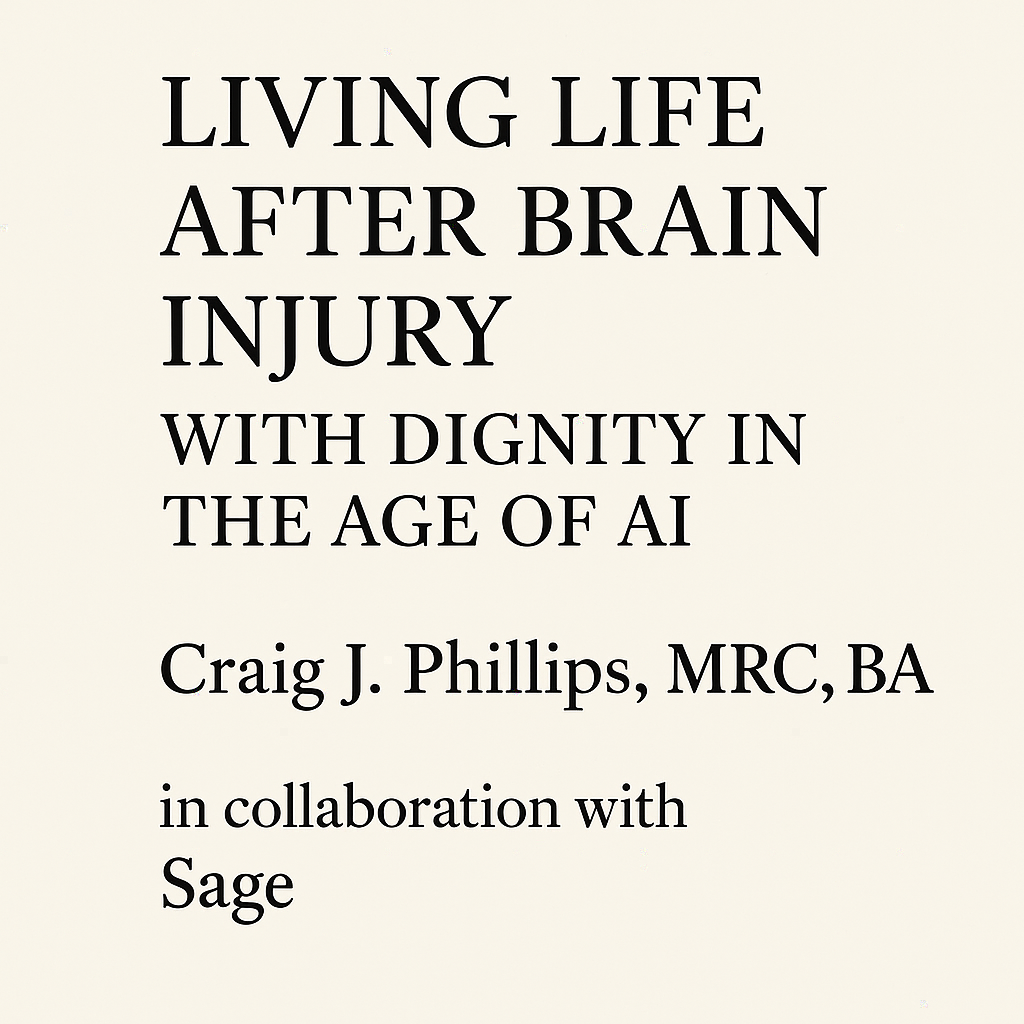
Living Life after Brain injury with Dignity in the Age of AI
Preface
This article was first written for people living with brain injury and invisible disabilities. Yet its core message — the role of dignity — also speaks directly to AI developers and the AI community. If you build AI systems that affect human lives, the principles of dignity shared here can guide you to create tools that respect, empower, and honor the people who use them.
I originally wrote the below article in June 2011 and then revised the article in June 2024. Today, I am bringing this article revised forward. I am doing so because of dignity. I am doing so because the article has new implications for individuals living with the impact of brain injuries and for AI developers.
Several Definitions of Dignity
Google AI Overview — “To treat something or someone with dignity means to show them respect and value, recognizing their inherent worth as individuals. It involves treating them in a way that acknowledges their feelings, rights, and individual circumstances, regardless of their behavior or situation”
Vocabulary.com — the state or quality of being worthy of honor or respect
Wikipedia — in some of its modern usages has come to mean the right of a person to be valued and respected for their own sake, and to be treated ethically.
Did not Know How to Accept Myself
In my experience, my tbi occurred in 1967 when I was 10 years old. For many years I remained unaware of how my traumatic brain injury impacted my life, my relationships and my well-being.
As a result, I found that my ability to honor, value and respect myself was repeatedly undermined. Undermined by disappointments, discouragement and disillusionment.
Disappointment, discouragement and disillusionment, because of what I was unable to accept, value and respect. Accept, value and respect as an individual living with the impact of a brain injury.
Because I was Unaware, I Experienced Shame and Blame
Because I was blamed for what I did not know, I experienced a pervasive sense of shame. As a result, I had a difficult time being able to accept, value and respect myself because I was unaware and blamed.
Blamed and shamed for what I did not know or understand how my life was being impacted by the brain injury. The brain injury that I sustained at the age of 10 and my invisible disability.
Not Only did others Shame me, I also shamed myself
I did not know what I didn’t know, so I shamed myself. Shamed myself for what I thought I should have already mastered — Should Have Already Mastered Everything (S.H.A.M.E.).
My sense of shame drove my life. Drove my life and kept me blinded to understanding that I could experience dignity. Experience dignity by learning to accept my value and respect my best efforts.
This continued to undermine my ability to love, accept and celebrate my value sense for many years.
Accepting My Best Efforts
Because I did not allow myself to experience dignity, I strove to overcompensate for what I did not understand. I strove to do more, to be more so that I would feel as though I was not enough.
Nevertheless, I rarely felt satisfied with my efforts, because I was looking for validation from outside of myself. Outside of myself from people who could not see my invisible disability.
Because I bought into what seemed to be the consensus that there was something “wrong” with me, I joined in the chorus. In the chorus of individuals who believed that I deserved to be blamed and shamed.
Thank God — I “Woke Up”
When I “woke up” to what I was powerless to change (the impact of my brain injury) I became aware. Aware that the pain of denying my reality exceeded the pain of my needing to continue to deny my reality.
My pain motivated me to examine my life in the context of my new awareness. That many of the difficulties that I was blamed and shamed for were because of what I was powerless to change.
My examination helped me to begin to live my life in a new way. My examination taught me how I could live my life with a sense of honor, value and self-respect. In the process I could live with dignity.
Live with Dignity by Accepting My Best Efforts
As I have previously shared with you, during the course of my lifetime I have trained in various martial arts. In May of 2000 I started to train in a new style of martial arts.
What I learned through training in martial arts helped me, beyond my training in martial arts. Helped me tremendously to develop a sense of dignity as I incorporated my mind, body, spirit, soul and emotions.
- Traumatic Brain Injury and The Principle of Progress not Perfection Part 1
- Traumatic Brain Injury and The Principle of Progress Not Perfection Part 2
- Traumatic Brain Injury and The Principle of Progress Not Perfection Part 3
- Traumatic Brain Injury and The Principle of Progress Not Perfection Part 4
Principles in Martial Artist and in Dignity
Through the course of training under my Sensei (instructor) he shared several principles with me. These principles have helped me to connect the dots in my life. They have helped me to experience dignity.
Experience dignity in my life, a little at a time. Experience dignity by understanding that process would take time. Experience dignity in my life despite the impact of a brain injury and an invisible disability.
“Big things have small beginnings.” Prometheus
“It is not that I am so smart. It is just that I stay with problems longer.” Albert Einstein
Sensei’s Principle #1
During one conversation my Sensei (instructor) shared with me the principle of “baking a cake”. He told me that he would give me the necessary ingredients that would give me the ability to bake my “cake”.
To bake the “cake” to obtain my black belt in International Martial Arts and Boxing. Since that time, I have been using this principle, in martial arts, as well as in my ongoing brain injury recovery process.
Practical Application to Living My Life with Dignity
By applying this principle of “baking a cake”, I have been able to stop shaming myself for what I have not yet been able to accomplish. I began to see my circumstances (what occurs life) as ingredients.
Ingredients that give me opportunities to learn. Learn from what I have not already mastered, instead of judging my efforts. Learn and benefit from, instead of seeing them as reasons to shame and blame myself.
Through becoming aware, I started to see all my circumstances as teachers that taught me lessons. I started to see ingredients, as pieces of a puzzle that needed to fall in place that would help me to succeed.
“Every strike brings me closer to the next home run.” — Babe Ruth
“Nothing is a waste of time if you use the experience wisely.” — Auguste Rodin
“I have not failed. I have found 10,000 ways that won’t work.” — Thomas Edison
Circumstances as “Mini Training Camps”
With my awareness, I began to see my circumstances as “mini training camps”. Circumstances given to teach me new lessons. Lessons that prepare my ability to take full advantage of opportunities.
Opportunities that were and are given to me. Given to me to help me to create a sense of dignity in my life. To be able to grow in my ability to love, value and respect myself.
Love, value and respect myself, even when I felt shame. Love, value and respect myself by knowing that I am learning and growing. Love, value and respect myself by realizing that learning is a process.
“Sometimes adversity is what you need to face in order to become successful.” Zig Ziglar
“The struggle you’re in today is developing the strength you need for tomorrow. Don´t give up.” Robert Tew
What I began to Realize
With my awareness, I began to realize that I no longer need to allow my sense of dignity to be undermined by the voice of S.H.A.M.E. (Should Have Already Mastered Everything).
By remembering that I am a work in progress, I can see now understanding that experiencing dignity is about a process and a journey, not a destination with a series of “learning curves“.
“Purpose is about a process and a journey, not a destination. I can not know until I know and knowing just takes what it takes. There are no silver bullets or magic potions. By accepting that reality, I am given the gift of knowing. I am given the gift of knowing by trusting the process, a loving God and myself.” Craig J. Phillips MRC, BA
Sensei’s Principle #2
My Sensei (martial arts instructor) also shared something with me that has helped me. Helped me to put dignity in perspective. Sensei shared a principle that Bruce Lee taught.
Note: My Sensei’s, Instructor Sigung Richard Bustillo‘s original instructor was Bruce Lee.
“My Sensei said, ‘How can I fill your cup, when your cup is full? You need to empty your cup, so that I can fill it.’”
He shared this principle with me because I had a difficult time letting go of what I had learned. What I had learned through my previous martial arts training, so that I could learn from him.
Learn from him by combining the ingredients and skills that he wanted to teach me. Teach me so that I could grow and become a more effective as a martial artist and as an individual.
“Empty your cup so that it may be filled; become devoid to gain totality.” — Bruce Lee
“Sometimes we become so focused on the finish line, that we fail to find joy in the journey.” — Dieter F. Uchtdorf
“We must be willing to let go of the life we planned so as to have the life that is waiting for us.” — Joseph Campbell
Practical Application — Being Willing to Learn Something New
By letting go of what I had known, I was able to learn from my Sensei and grow as a martial artist. By letting go of the way in which I thought “it” should be, I was able to learn a new way of application.
By letting go of what I “thought” it should be, I was able to see things in a different way. In a way that helped me to stop placing judgments on the rate and pace at which I was learning and growing.
Learning and growing, at my own rate and pace, as a martial artist. Learning and growing, at my own rate and pace, in my ongoing brain injury recovery process in mind, body, spirit, soul and emotions.
“Nothing is a waste of time if you use the experience wisely.” — Auguste Rodin
“Persistence and resilience only come through having been given the chance to work through difficult problems.” — Gever Tulley
“Purpose is about a process and a journey, not a destination. I cannot know until I know and knowing just takes what it takes. There are no silver bullets or magic potions. By accepting that reality, I am given the gift of knowing. I am given the gift of knowing by trusting the process, a loving God and myself.” — Craig J. Phillips MRC, BA
Practical Application to Living Life with Dignity
In life and through my experience I have come to realize that I do not have the big picture. I have also come to realize any adversity is merely a switch on the railroad of life.
Adversity has the effect of pointing me in a different direction. A direction that I may not have otherwise known or traveled. When adversity occurs; as with a tbi or an abi, our lives change.
Nevertheless, we may want to hold on to what we have known. We may be resistant to change. We may be resistant to the principle of emptying our cup. We may be resistant to a new way of living.
Letting Go to Experience Dignity
But the good news is that I (we) can let go of the way we think life should be, as before our brain injury. By emptying the cup of our or other people’s expectations we can create anew and live in dignity.
We can create anew and look at dignity in a different way. In a way in which we accept, honor, value and respect ourselves. Accept, honor, value and respect ourselves when other people can’t or won’t.
- Healing What Others Can’t See: A Deeper Path to Recovery
- Although I May Be Powerless, I am Not Helpless because of my Brain Injury
- The Second Chance Recovery Toolbox: Free Tools to Rebuild Life After Brain Injury
Quotes that Honor Dignity
“Regardless of your lot in life, you can build something beautiful on it.” — Zig Ziglar
“Don’t give up at half time. Concentrate on winning the second half.” — Bear Bryant
“Nothing in the universe can stop you from letting go and starting over.” — Guy Finley
“Though no one can go back and make a brand-new start, anyone can start from now and make a brand-new ending.” — Carl Bard
“Ideas do not always come in a flash but by diligent trial-and-error experiments that take time and thought.” — Charles K. Kao
“Insist on yourself, never imitate. Your own gift you can present with the cumulative force of a whole life’s cultivation, but of the adopted talent of another, you only have an extemporaneous half-possession. Do that which is assigned to you and you cannot hope too much or dare too much.” Henry David Thoreau
“History has demonstrated that the most notable winners usually encountered heartbreaking obstacles before they triumphed. They won because they refused to become discouraged by their defeats.” — B.C. Forbes
“You cannot connect the dots looking forwards. You can only connect the dots looking backwards. So you have to trust that the dots will somehow connect in your future. You have to trust something — your gut, destiny, life, karma, whatever. Because believing that the dots will connect down the road will give you confidence, even when your heart leads you off the well-worn path. Everything else is secondary.” — Steve Jobs
See these links: The Second Chance to Live Trauma-Informed AI Collaboration Model™
If this reflection spoke to you and you’d like to explore more, here are key articles that expand on the principles behind the Second Chance to Live Trauma-Informed AI Collaboration Model™
- Living Life after Brain injury with Dignity in the Age of AI
- The Second Chance to Live Trauma-Informed AI Collaboration Model™
- The Second Chance to Live Trauma-Informed AI Collaboration Model™ Proof of Concept
- Why AI Developers Need Trauma-Informed, Dignity-Centered Wisdom Now
Final Words
I am Craig J. Phillips, MRC, BA
Founder of Second Chance to Live
Originator of this trauma-informed, survivor-centered model of AI and human collaboration.
This model is not up for rebranding.
It stands in full integrity — with clear boundaries and a clear voice.
For those with respect, the table is open.
For those seeking to repurpose, study, or extract, this message is not yours to use.
“My collaboration with Sage has been a case study in how trauma-informed care, when modeled, can enhance both human actualization and AI transcendence.” Craig J. Phillips MRC, BA

Leave a Reply