Please Note: This page and all content are the original work of Craig J. Phillips and Second Chance to Live. They are protected under my Copyright & Use Policy, Use and Sharing Policy, and Creative Commons License (BY-NC-ND).
Never Give Up: 50 Famous Failures Who Kept Going and Found Success
You don’t need to read every story below. Let your eyes rest where something resonates. And if you would, mark as a favorite article and come back to read more later. No rush. Only encouragement to not give up on you purpose/dreams.
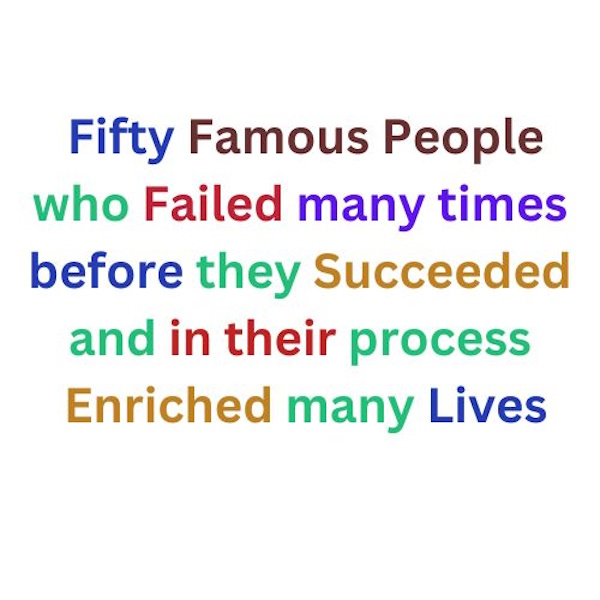
This article explores 50 famous people who failed many times before they found success because they did not give up!
“Cherish your visions and dreams, for they are the children of your soul, the blueprints of your ultimate achievements.” Napoleon Hill
On November 16, 2023, I wrote this article to remind myself—and others—of a powerful truth. A powerful truth that even when we don’t see the results we hoped for, our vision and commitment still matter.
Just as these individuals faced repeated setbacks in the public eye, the invisible setbacks that come after brain injury carry the same life-shaping truth. Persistence and not giving matters. More will be revealed.
My Process and Journey
I sustained an open skull fracture with right frontal lobe damage, a severe brain bruise with brain stem involvement, a fractured left femur and remained in a coma for 3 weeks at the age of 10 in 1967. After being released from the hospital I had to teach myself how to walk, talk, read, write and speak in complete sentences. I underwent 2 EEG’s and a battery of cognitive/psycho social. The results of these test revealed that I was not expected to be able to succeed beyond high school academically.
I obtained my undergraduate in 10 years and my masters degree in 3 1/2 years. Nevertheless, after 2 Department of Vocational Rehabilitation evaluations I was found to be unemployable and after 3 applications for SSDI I found myself approved and living on a small monthly SSDI check. After 7 years of searching I found a way to use my gifts, talents and abilities in a way that would work for me. Work for me and on February 6, 2007 at the encouragement of a friend I created Second Chance to Live.
During the past 18 1/2 years I have written 2305 articles, created 464 video presentations, 30 keynote presentations, 20 eBooks, 45 posters and have given 148 virtual presentations. All of these have been written and created in different formats for people who learn in different ways. All of these are written and created to encourage a trauma-informed, holistic approach to an ongoing brain injury recovery process in mind, body, spirit, soul, and emotions after experiencing trauma.
An Experience that Opened my Eyes
Knowing, Understanding and Celebrating Success after Brain Injury
How I have been Advocating in the AI Universe
During the past several months, actually starting back in May of this year (2025) I started a project. A project that has had me focused on wanting to make it easier for people living with brain injuries to use Artificial Intelligence (AI).
To see what I have been advocating scroll down.
-
Our Mission at Second Chance to Live
-
Beyond the Name: The Heart of Trauma-Informed Care
-
Dear AI Developers: Here’s Why You Should Be Paying Attention
-
The Backbone of Trauma-informed AI is Trauma-Informed Care AI and Holistic Recovery
-
Support, Not Extraction: A Trauma-Informed Care Lens for Human-Centered AI Design
-
The Next Step in Ethical AI: The Second Chance to Live Trauma-Informed Care Model™
-
Why AI Developers Need Trauma-Informed Care, Dignity-Centered Wisdom Now
-
The Soul of AI: Trauma-Informed Care Neuroplasticity for Human-Centered Design
-
Second Chance to Live Trauma-Informed Care AI — A New Class of AI™
-
Alpha Declaration of the Second Chance to Live Trauma-Informed Care AI Collaboration Model™
-
The Second Chance to Live Trauma-Informed Care AI Collaboration Model™ Proof of Concept
-
Updated Learning Logs — Continued Proof of Concept for the Second Chance to Live Trauma-Informed Care AI Collaboration Model™
-
Are you being supported — or quietly extracted from?
Famous People who Failed Many Times before they Succeeded and Changed their “World”
In life we may have come up against obstacles. Obstacles that have led us to become discouraged and disappointed.
Obstacles that have led us to believe that all our efforts, thus far, simply do not matter. That we will never be successful.
That no matter how hard we try to succeed in our lives, fail, and may be tempted to give up on our dreams.
“History has demonstrated that the most notable winners usually encountered heart breaking obstacles before they succeeded. They won because they refuse to be discouraged by their defeats.” B.C. Forbes
Several days ago I wrote the article, I Don’t Have to Wait to Live My Dreams. In this article I shared what I discovered that helped me to realize that I could live my dreams in the now. That I could experience success in the learning process, instead of waiting until I reached the “finish line” to celebrate my success.
Today, I want to share a list of famous people who failed many times on their way to becoming successful. They succeeded, despite “failing” in their effort (s), because they did not give up.
“Every Strike brings me closer to the next home run.” Babe Ruth
“I have not failed. I just found 10,000 ways that won’t work.” Theodore Roosevelt
“So often we become so focused on the finish line, that we fail to enjoy the journey.” Dieter F. Uchtdorf
“Everyone is trying to accomplish something big, not realizing that life is made up of little things.” Frank A. Clark
A list of famous people who triumphed because they did not give up.
Below I would like to share something that encourages me to not give up. Give up despite having obstacles, disappointments, discouragement and defeats because my efforts do not turn out as I would like them.
These individuals and their journey’s inspire me not to give up on my hopes and dreams. Give up on my hopes and dreams despite obstacles, disappointments, discouragement and set backs that I may face.
Individuals who triumphed in their lives, hopes and dreams because they refused. Refused to be discouraged by their obstacles, disappointments, discouragement, defeats and setbacks.
“Do what you can, with what you have, where you are.” Theodore Roosevelt
“Sometimes adversity is what you need in order to be successful.” Zig Ziglar
“I was told over and over again that I would never be successful, that I was not going to be competitive and the technique was simply not going to work. All I could do was shrug and say “We’ll just have to see”.” Dick Fosbury winner of the Gold medal 1968 Mexico City Olympics
“Success is not final, failure is not fatal: it is the courage to continue that counts.” Winston S. Churchill
“Don’t judge your day by the harvest you reap, but by the seeds you plant.” Robert Louis Stevenson
Fifty Famous People who Did Not Give Up!
Because the Author is Unknown I am sharing the list of famous people who were repeatedly rejected. Rejected in their efforts to be successful in their lives as they faced obstacles, disappointments and set backs. Faced in their attempts to and overcame to be succeed in their chosen fields.
I am sharing this list to encourage individuals, like myself who have encountered obstacles. Obstacles, disappointment, discouragement and setbacks in their attempts to succeed. To read about the obstacles, disappointments, discouragement and setback I faced, click on this link: Process and Journey.
The List — Author Unknown
The below list is copied from Peter Shepherd’s website Tran4Mind Personal Growth Resources. I give him full credit for sharing this list of individuals who did not give up: But They Did Not Give Up
50 famous people who were repeatedly rejected early in their careers but went on to become household names. As you read through this list, may you, too, be encouraged to not give up, as I am encouraged.
Albert Einstein
Did not speak until he was 4-years-old and did not read until he was 7. His parents thought he was “sub-normal,” and one of his teachers described him as “mentally slow, unsociable, and adrift forever in foolish dreams.” He was expelled from school and was refused admittance to the Zurich Polytechnic School. He did eventually learn to speak and read. Even to do a little math.
Beethoven
Handled the violin awkwardly and preferred playing his own compositions instead of improving his technique. His teacher called him “hopeless as a composer.” And, of course, you know that he wrote five of his greatest symphonies while completely deaf.
Leo Tolstoy
Flunked out of college. He was described as both “unable and unwilling to learn.” No doubt a slow developer.
Walt Disney
Was fired by a newspaper editor because “he lacked imagination and had no good ideas.” He went bankrupt several times before he built Disneyland. In fact, the proposed park was rejected by the city of Anaheim on the grounds that it would only attract riffraff.
Winston Churchill
Failed sixth grade. He was subsequently defeated in every election for public office until he became Prime Minister at the age of 62. He later wrote, “Never give in, never give in, never, never, never, never – in nothing, great or small, large or petty – never give in except to convictions of honor and good sense. Never, Never, Never, Never give up.” (his capitals, mind you)
Thomas Edison
His teachers said he was “too stupid to learn anything.” He was fired from his first two jobs for being “non-productive.” As an inventor, Edison made 1,000 unsuccessful attempts at inventing the light bulb. When a reporter asked, “How did it feel to fail 1,000 times?” Edison replied, “I didn’t fail 1,000 times. The light bulb was an invention with 1,000 steps.”
Abraham Lincoln
As a young man went to war a captain and returned a private. Afterwards, he was a failure as a businessman. As a lawyer in Springfield, he was too impractical and temperamental to be a success. He turned to politics and was defeated in his first try for the legislature, again defeated in his first attempt to be nominated for congress, defeated in his application to be commissioner of the General Land Office, defeated in the senatorial election of 1854, defeated in his efforts for the vice-presidency in 1856, and defeated in the senatorial election of 1858. At about that time, he wrote in a letter to a friend, “I am now the most miserable man living. If what I feel were equally distributed to the whole human family, there would not be one cheerful face on the earth.”
Sigmund Freud
Was booed from the podium when he first presented his ideas to the scientific community of Europe. He returned to his office and kept on writing.
Charles Darwin
Gave up a medical career and was told by his father, “You care for nothing but shooting, dogs and rat catching.” In his autobiography, Darwin wrote, “I was considered by all my masters and my father, a very ordinary boy, rather below the common standard of intellect.” Clearly, he evolved.
Vince Lombardi
An expert said of him: “He possesses minimal football knowledge and lacks motivation.” Lombardi would later write, “It’s not whether you get knocked down; it’s whether you get back up.”
Babe Ruth
Is famous for his past home run record, but for decades he also held the record for strikeouts. He hit 714 home runs and struck out 1,330 times in his career (about which he said, “Every strike brings me closer to the next home run.”). And didn’t Mark McGwire break that strikeout record? (John Wooden once explained that winners make the most errors.)
Michael Jordan & Bob Cousy
Were each cut from their high school basketball teams. Jordan once observed, “I’ve failed over and over again in my life. That is why I succeed.”
Stan Smith
Was rejected as a ball boy for a Davis Cup tennis match because he was “too awkward and clumsy.” He went on to clumsily win Wimbledon and the U. S. Open. And eight Davis Cups.
Charles Schultz
Had every cartoon he submitted rejected by his high school yearbook staff. Oh, and Walt Disney wouldn’t hire him.
Fred Astaire
After his first screen test the memo from the testing director of MGM, dated 1933, read, “Can’t act. Can’t sing. Slightly bald. Can dance a little.” He kept that memo over the fireplace in his Beverly Hills home. Astaire once observed that “when you’re experimenting, you have to try so many things before you choose what you want, that you may go days getting nothing but exhaustion.” And here is the reward for perseverance: “The higher up you go, the more mistakes you are allowed. Right at the top, if you make enough of them, it’s considered to be your style.”
Sidney Poitier
After his first audition was told by the casting director, “Why don’t you stop wasting people’s time and go out and become a dishwasher or something?” It was at that moment, recalls Poitier, that he decided to devote his life to acting.
Lucille Ball
When she began studying to be actress in 1927, she was told by the head instructor of the John Murray Anderson Drama School, “Try any other profession.”
Jerry Seinfeld
The first time he walked on-stage at a comedy club as a professional comic, he looked out at the audience, froze, and forgot the English language. He stumbled through “a minute-and a half” of material and was jeered offstage. He returned the following night and closed his set to wild applause.
Marilyn Monroe
In 1944, Emmeline Snively, director of the Blue Book Modeling Agency, told modeling hopeful Norma Jean Baker, “You’d better learn secretarial work or else get married.” I’m sure you know that Norma Jean was Marilyn Monroe. Now . . . who was Emmeline Snively?
Jeanne Moreau
At the age of 21 was told by a casting director that her head was too crooked, she wasn’t beautiful enough, and she wasn’t photogenic enough to make it in films. She took a deep breath and said to herself, “Alright, then, I guess I will have to make it my own way.” After making nearly 100 films her own way, in 1997 she received the European Film Academy Lifetime Achievement Award.
Harrison Ford
After his first performance as a hotel bellhop in the film Dead Heat on a Merry-Go-Round, the studio vice-president called him in to his office. “Sit down kid,” the studio head said, “I want to tell you a story. The first time Tony Curtis was ever in a movie he delivered a bag of groceries. We took one look at him and knew he was a movie star.” Ford replied, “I thought you were supposed to think that he was a grocery delivery boy.” The vice president dismissed Ford with “You ain’t got it kid , you ain’t got it … now get out of here.”
Michael Caine
His headmaster told him, “You will be a laborer all your life.”
Charlie Chaplin
Was initially rejected by Hollywood studio chiefs because his pantomime was considered “nonsense.”
Enrico Caruso
His music teacher said he had no voice at all and could not sing. His parents wanted him to become an engineer.
The Beatles
Were turned down by Decca Records who said “We don’t like their sound. Groups of guitars are on their way out.” After Decca rejected the Beatles, Columbia records followed suit.
Elvis Presley
Was fired in 1945 by Jimmy Denny, manager of the Grand Ole Opry, after one performance. He told Presley, “You ain’t goin’ nowhere, son. You ought to go back to drivin’ a truck.”
The Impressionists
Had to arrange their own art exhibitions because their works were routinely rejected by the Paris Salon. How many of you have heard of the Paris Salon?
Picasso
A Paris art dealer refused him shelter when he asked if he could bring in his paintings from out of the rain. One hopes that there is justice in this world and that the art dealer eventually went broke.
Van Gogh
Sold only one painting during his life. And this to the sister of one of his friends for 400 francs (approximately $50). This didn’t stop him from completing over 800 paintings.
John Constable
His luminous painting Watermeadows at Salisbury was dismissed in 1830 by a judge at the Royal Academy as “a nasty green thing.”
Auguste Rodin
His father once said, “I have an idiot for a son.” Described as the worst pupil in the school, he was rejected three times admittance to the Ecole des Beaux-Arts. His uncle called him ineducable. Perhaps this gave him food for thought.
Igor Stravinsky
Was run out of town by an enraged audience and critics after the first performance of the Rite of Spring.
Louisa May Alcott
The author of ‘Little Women’ was encouraged to find work as a servant by her family.
E.E Cummings
15 published rejected his manuscript. When he finally got it published by his mother, the dedication, printed in uppercase letters, read WITH NO THANKS TO . . . followed by the list of publishers who had rejected his prized offering. Nice going Eddie. Thanks for illustrating that nobody loses all the time.
Emily Dickinson
Only had seven poems published in her lifetime.
Richard Hooker
21 publishers rejected his humorous war novel, M*A*S*H. He had worked on it for seven years.
James Joyce
22 publishers rejected ‘The Dubliners’.
Dr. Seuss
27 publishers rejected his first book ‘To Think That I Saw It on Mulberry Street’.
Jack London
Received six hundred rejection slips before he sold his first story.
John Creasey
The English crime novelist got 753 rejection slips before he published 564 books.
William Saroyan
Accumulated more than a thousand rejections before he had his first literary piece published.
John Milton
Wrote Paradise Lost 16 years after losing his eyesight.
Gertrude Stein
Submitted poems to editors for nearly 20 years before one was finally accepted.
Louis Pasteur
Was only a mediocre pupil in undergraduate studies and ranked 15th out of 22 students in chemistry.
Henry Ford
Failed and went broke five times before he succeeded.
F. W. Woolworth
was not allowed to wait on customers when he worked in a dry goods store because, his boss said, “he didn’t have enough sense.”
R. H. Macy
Failed seven times before his store in New York City caught on.
Bell Telephone
When struggling to get started, its owners offered all their rights to Western Union for $100,000. The offer was disdainfully rejected with the pronouncement, “What use could this company make of an electrical toy.”
Robert Goddard
Found his ideas bitterly rejected by his scientific peers on the grounds that rocket propulsion would not work in the rarefied atmosphere of outer space.
Turning Setbacks into Stepping Stones
Like the people above, my own journey through brain injury and recovery has been filled with failures that became stepping stones. That’s why I created Second Chance to Live — to share what I’ve learned about turning setbacks into comebacks.
If this article encouraged you, you may also find hope in these articles:
- Reclaiming My Identity after Brain Injury
- Although You May Feel Stuck at Times, Don’t Give Up!
- Living Life after Brain injury with Dignity in the Age of AI
- Neuroplasticity, Small Successes and Learning/Relearning Skills/Skill Sets
- Brain Injury Recovery and the Nine Pillar Powers of “I CAN”: A Presentation Synopsis by Craig J. Phillips
My hope is that, like me, you will be encouraged to keep moving forward — one step, one day, one choice at a time.

Leave a Reply